NC State Board of Education: COVID-19 Legislative Update
North Carolina Public Schools sent this bulletin at 03/18/2020 07:13 PM EDT
Wednesday, March 18th, 2020
NC State Board of Education COVID-19 Legislative Update

- Good Evening, from the Legislative Team of the NC State Board of Education. Bringing you all wishes of safety and security as we navigate the changing tides of the COVID-19 outbreak and its impact. First, a HUGE THANK YOU to EACH and EVERY one of you who are working to bring a sense of clarity to the murky uncertainty that has pervaded our daily lives. Know that there is a great many individuals that are dedicating themselves to the continued promotion of NC Public Education and the service to our approximately 1.5 million students and their families, schools, and communities.
- We hope this update provides you information on "Legislative Priorities" with an understanding that this might change. Below you will find the link to an excellent resource that will stay updated as we learn more and respond:
COVID-19: NC DPI/ NC SBE Response and Resources
-
Thank you, once again, please reach out using the information listed at the bottom of this update, and "may the road rise to meet you, until we meet again."
- Freebird McKinney, NC SBE Director of Legislative and Community Affairs
- Anne Murtha, NC SBE Legislative Specialist

- 9:00am- Wednesday, March 18th, 2020, NC State Board of Education Meeting

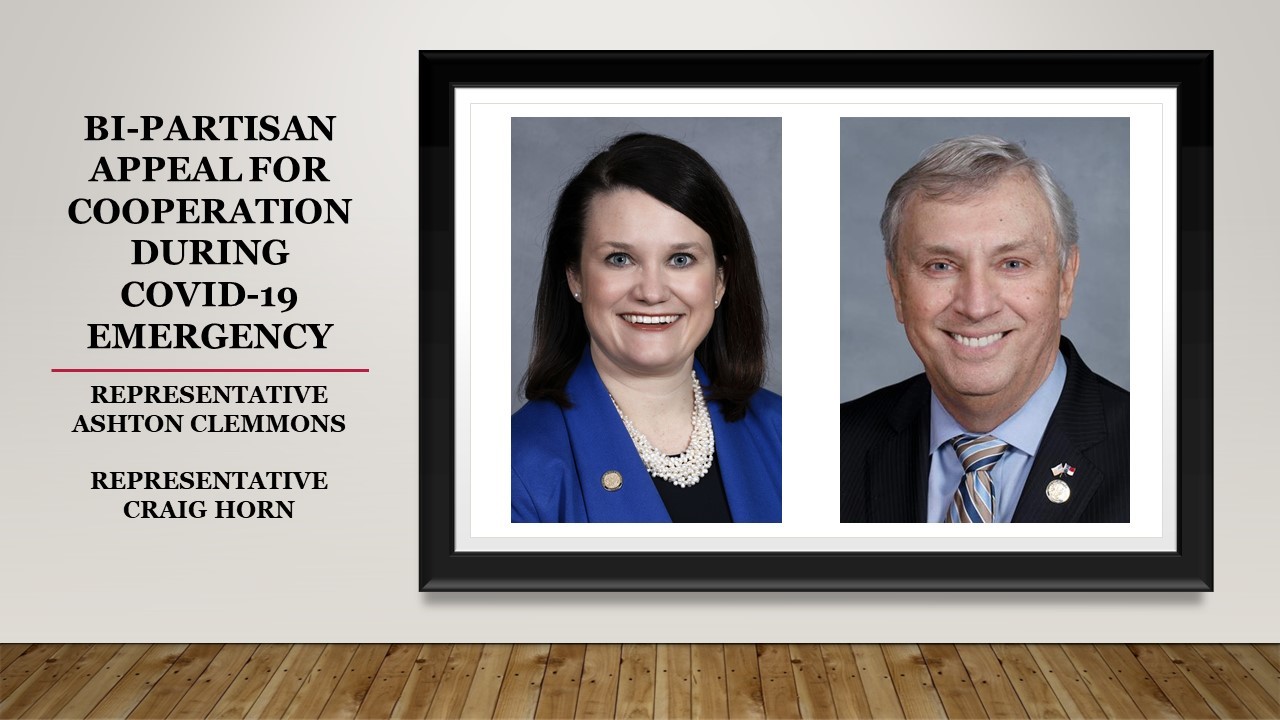
Bi-Partisan Appeal for Cooperation During COViD-19 Emergency
We know this is an incredibly stressful time for our educators, parents, and our children. On Saturday, March 14, Governor Cooper issued Executive Order No. 117 directing the closure of all. North Carolina K-12 Public Schools to limit the spread of COViD-19 known as Coronavirus. We support this decision and are committed to working with our non-partisan staff and Governor Cooper’s task forces to address the many issues resulting from this order.
The President of the United States and the Governor of North Carolina have previously declared that a State of Emergency exists due to the rapid spread of COViD-19. Although available data indicates that school-age children are at a low-risk of infection, there are a large number of teachers, support personnel and volunteers in schools across our state on a daily basis. Although children are seldom infected with this virus, they can be carriers. Public health officials believe closing schools can help flatten the curve of the current pandemic and lead to better community outcomes. Consequently, and in consideration of other precautions already in place, we believe it important that our state have a consistent policy for all Local Education Areas (LEAs) with regard to school closure.
It is during this time of uncertainty that we must work together in the best interests of our children and educators. We encourage all Members of the North Carolina General Assembly to put partisan differences aside and work together with the Department of Public Instruction, the State Board of Education, the Department of Health and Human Services, all Local Superintendents and Boards of Education and the Governor’s office to find solutions to the many challenges ahead. Our children need our shared leadership now and in the coming months.
Ashton Clemmons (D-Guilford) D. Craig Horn (R-Union)
Representative, District 57 Representative, District 68
March 14, 2020
- New Introduced Federal Legislation –
- H.R. 6201: Families First Coronavirus Response Act- This bill would guarantee free coronavirus testing, establishes paid leave, enhances unemployment insurance, expands food security initiatives, and increases federal Medicaid funding. UPDATE- PASSED US SENATE: 90-8 (3/18/2020)
- H.R. 6275: Supporting Students in Response to Coronavirus Act- To support children and students in responding to safety and health risks presented by qualifying emergencies, and for other purposes.
- This bill is to provide about $3 billion in emergency funding for early childhood education programs, k-12 schools and higher education institutions in response to the sever disruptions caused by the COVID-19 pandemic.
- The funding in the Supporting Students in Response to Coronavirus Act will allow schools to reopen more quickly by covering costs of sanitation and emergency staffing needs, and will ensure schools can provide students critical services, such as nutritious meals, access to technology, and mental health services. The bill also establishes increased flexibility for students with student loan obligations and eases the financial burden on students and institutions in response to the coronavirus crisis.
- A companion bill was introduced in the Senate by Senator Patty Murray (D-WA). To read the fact sheet for Supporting Students in Response to Coronavirus Act, click here.
-
US Department of Education:
- The Department of Education continues to update www.ed.gov/coronavirus with information for students, parents, educators and local leaders, For additional resources from the Centers for Disease Control and Prevention, please visit: https://www.cdc.gov/coronavirus/2019-ncov/index.html
- Questions and Answers on Providing Services to Children with Disabilities During the Coronavirus Disease 2019 Outbreak
- Fact Sheet: Addressing the Risk of COVID-19 in Schools While Protecting the Civil Rights of Students
- Impact of COVID-19 on Assessments and Accountability under the Elementary and Secondary Education Act
-
Preliminary Legislative Considerations:
- Statewide Testing Waiver Request
- NC DPI has a call with USDOE to discuss a testing waiver.
- Currently, we will be in session as the Executive Order is now only 2 weeks – others state’s executive orders who now have testing waived extend the end of the school year.
- As currently structured, we would need to test for this school year.
- ESEA and ESSA Considerations
- Child Nutrition
- Snapshot of Nutrition Waiver Requests
- North Carolina requests a waiver for the meal pattern requirements of the Child and Adult Care Food Program (7 C.F.R. 226.20), Summer Food Service Program (7 C.F.R. 225.16(d)), and the Seamless Summer Option (USDA policy memo SP-39-2014). Based on information provided by School Food Authorities and Summer Food Service sponsors about actual and potential food shortages, this waiver authority is necessary to allow institutions to provide what they can of the meal pattern requirements (may be missing two or more food components) as necessary to supply a sufficient amount of nourishment to participants.
- North Carolina also requests the authority to offer meals to all students in economically disadvantaged and vulnerable communities. The Seamless Summer Option (SSO) requires schools with less than 50% of students eligible for free or reduced-price meal benefits to directly target meals to eligible children. This requirement limits the ability of schools to provide meals to students who may live in economically distressed conditions but whose household income and size does not qualify them for meal benefits. The waiver will enable schools to provide meals to any student or to the parent, on behalf of a student who requests meals at a school site that is operating during the period of school closure.
- Snapshot of Nutrition Waiver Requests
- Employee Compensation (Certified and Non-Certified)
- Calendar Flexibility
- School Accountability linked to Statewide Testing
- Annual Evaluation for Teachers (3 Observations)
- Student Attendance Waivers
- Teacher Work Days
- Senior Graduation Requirements (CPR Certification, etc.)
- Additional Funding for:
- Child Nutrition Needs
- Digital Learning Expansion
- Sanitation/ Cleaning Supplies
- Statewide Testing Waiver Request
- Questions Regarding Unemployment Benefits and Employee Health Insurance (From Eileen Townsend)
- I have been facilitating questions from LEAs regarding unemployment benefits during school closures as a direct result from COVID-19.
- Unemployment benefits (approximately $264 per week) will be awarded to employees who are unemployed through “no fault of their own.” Consequently, employees of LEAs will be eligible for unemployment benefits: (1) if they apply to Department of Employment Security www.des.nc.gov (2) and as a direct result of no work available during school closures of COVID-19.
- LEAs are now questioning whether or not they pay an employee’s health insurance premium and I am asking for some clarification in order to correctly advise LEAs.
- LEAs have the option to “dismiss” employees due to no work available. If they dismiss an employee, I anticipate an employee is removed from the LEAs payroll. Termination/dismissal generally requires the LEA to offer an employee COBRA to continue and pay for their own health insurance benefits.
- LEAs have the option to “separate” due to no work available. I am not sure if the LEA is required to pay health insurance benefits for a period of time or if they offer COBRA at time of separation.
- LEAs have the option to allow employee status of “still employed, no work available.” With this option, I anticipate an employee would remain on the LEAs payroll and LEA would be required to pay the health insurance.
Freebird McKinney 自由鸟
Director of Legislative and Community Affairs
Public Schools of North Carolina
North Carolina State Board of Education
Department of Public Instruction
301 N. Wilmington Street
Raleigh, NC 27601-2825
Office: 2nd Floor- 213
Office Phone: 919-807-3406
Cell Phone: 336-686-3323
E-Mail: Freebird.McKinney@dpi.nc.gov
|
Stay Connected with North Carolina Public Schools: |
|||||||
 |
 |
 |
 |
 |
|||
|
|
|||||||