Board Affirms Focus on
“Whole Child” in Resolution
Recognizing that some public
school students in North Carolina face significant barriers to learning and
academic success, the State Board of Education unanimously approved a
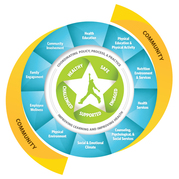
resolution supporting a “whole school, whole community, whole child framework.”
The resolution lists concerns about poverty, poor health, unsafe environments,
lack of access to services and supporting infrastructure to support health and
safety, and references research that links these factors to academic success.
This resolution directs the Department of Public Instruction to rename its
Interagency Committee to become the NC SBE Whole Child NC Committee and to use
the whole child model as a framework for creating collaborative
school-community relationships that can help support students more effectively.
|
School Mental Health
Initiative Highlighted
Out of concern for the
continued and increasing mental health challenges facing North Carolina children
and youth, a group of stakeholders representing diverse backgrounds and
experiences related to mental health services came together to consider options
for providing support to students experiencing mental health concerns. This
group presented its findings and recommendations to the State Board of
Education in November.
Mental and behavioral wellness is directly linked to
overall positive student achievement, school climate, high school graduation
rates and the prevention of risky behaviors, disciplinary incidents and
substance abuse. Nearly one in five North Carolina students has a mental health
and/or substance use disorder in any given year, but only one-fourth of these
young people will receive treatment. In addition, suicide was the second leading
cause of death among 10- to 24-year-olds in 2014. In alignment with the Whole
School, Whole Community, Whole Child Model, consistently funded and implemented
school-based mental health services could help more students receive services
they need.
The School Mental Health Initiative made three large recommendations
to the Board:
• create a continuum of supports and services;
• make the continuum sustainable; and
• engage stakeholders.
Next steps for the group
include work to implement policy and legislative changes; identifying,
researching and replicating sustainable practices; developing tools to
facilitate implementation strategies; and continuing to build partnerships
across government agencies and community providers.
 NC School-Based Administrator Pay Lags
Teacher salaries have been
in the spotlight for a number of years in North Carolina and nationally, but
pay for school principals and assistant principals also has been a concern as
described in a report to the Board by NCDPI’s School Business division.
Approximately 5 percent of state public school salary and benefit costs support
these school-based administrators.
The salary schedule for administrators used
to be aligned to the teacher salary schedule, but those linkages were severed
and other adjustments made over time. The end result is that the
principals/assistant principal pay is no longer as competitive when compared
with master teachers’ pay, and pay can be a disincentive to entering the
assistant principal or principal roles.
Today, it takes 10 years of experience
to move off of the assistant principal bottom step and 36 years to move to the
top of the scale. For principals, it takes between 13 and 23 years to move off the
beginning salary step and 1,000 of 2,400 principals are on the beginning step
of their classification. The average state base pay for principals has
decreased by $6,835 since 2008-09 and is now at $62,633. For assistant
principals, the average base pay is $50,528, a slight increase since 2010
because of a special provision that guaranteed no loss of pay for assistant
principals who move into that role from the teacher corps.
|
State of the Teaching
Profession Report Overhauled to Reflect Attrition, Mobility
About
9 percent of North Carolina teachers were counted as leaving employment in the
state’s public schools during the 2015-16 school year, according to a report (pdf, 1mb) presented to the
State Board of Education. The 2015-16 State of the Teaching Profession in North
Carolina report provides a more detailed analysis of shifts in the state’s
teaching force than the annual teacher turnover report that it replaces.
Instead of a single “turnover” percentage combining attrition from North
Carolina classrooms with departures from one school district to another in the state,
the new report separates attrition from teaching jobs in the state from
“mobility,” a measure the report defines as the loss of teachers from one
district to another or to a charter school.
Among
the key findings in the report:
•
Most teachers who left employment in North Carolina’s public schools
(53.3 percent) cited “personal reasons” for their decision. Within that
category, retirement with full benefits and family relocation were the largest
individual reasons (19.8 percent and 12.6 percent, respectively).
•
The attrition rate for beginning teachers (less than three years), is
substantially higher than the attrition rate for those not counted as beginning
teachers – 12.78 percent vs. 8.19 percent.
•
Based on reporting from 100 of North Carolina’s 115 school districts,
the five hardest-to-fill license areas are math (middle and high school),
exceptional children’s education – general curriculum, and science (middle and
high school).
•
Total attrition from the state’s 115 school districts (attrition plus
mobility) ranged from 35.02 percent in Halifax County to 5.26 percent in Avery
County.
The board will vote in its December meeting on the report.
|