Getting Started/Strengthening MTSS in your District:
-
What is your mission/vision statement? Discuss with your team how Multi-Tiered Systems of Support might support those core beliefs and goals.
-
Do you need a team? Discuss this with your administrator and put together a team, representative of your school, who want to create a multi-tiered system of supports. It is vital to have your administration on board for essential support and leadership.
-
Use your school data as the basis for discussing why your school needs MTSS. This may include academics, social/behavioral, attendance, climate, and staff, student, and parent surveys.
- Access the MTSS Overview Video for your staff.
-
Or you could put together a District MTSS Training Plan or a School MTSS Training Plan that includes:
- expanding your District and/or Building Teams' knowledge of Multi-Tiered System of Supports and the purpose of the MTSS systems framework
- the importance of data-driven decision making
- how to identify school-wide, grade level and individual student needs
- setting up evidence-based interventions
- an ongoing monitoring/review process to view outcomes
- a comprehensive problem-solving approach that addresses academic, behavior, attendance, and social-emotional needs -- improving learning outcomes for EVERY student!
 Implementation Science for Educational Leaders: From Initiative to Implementation
This course provides an overview of implementation science that will help you and your building-level teams improve student outcomes by using interventions effectively and with fidelity. The content has been developed by a team at the University of Montana’s Center for Children, Families and Workforce Development, in partnership with the National Implementation Research Network and the Montana Office of Public Instruction. No matter where you’re starting from, you’ll leave with deeper knowledge, fresh insights and practical tools to support educators in Montana.
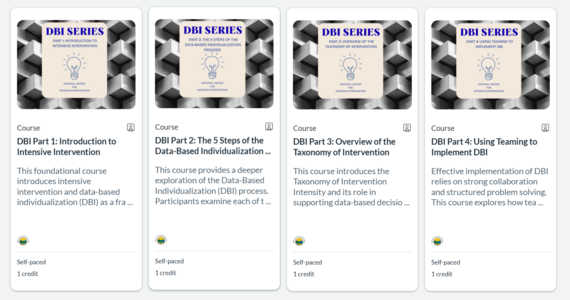 OPI Teacher Learning Hub is proud to host a series of courses on Data-Based Individualization developed by the National Center for Intensive Intervention (NCII).
Key Pillars Covered in This Series
- Systemic Alignment: Connecting DBI seamlessly with MTSS and Special Education.
- The 5-Step Process: Mastering the cyclical workflow of data-driven individualization.
- The Taxonomy of Intensity: Evaluating and adapting interventions with scientific precision.
- Collaborative Teaming: Structuring and facilitating highly effective intervention meetings.
DBI is Goal 2 of the MT State Personnel Development Grant funded by the Department of Education. To learn more about DBI implementation grants and training opportunities, contact Tammy Lysons.
Need help with MTSS?
Contact Jessica Wilhelm, 406-410-1140, GT/MTSS Program Specialist
The OPI is committed to providing reasonable accommodations to people with disabilities. If you need a reasonable accommodation, require an alternate format, or have questions concerning accessibility, contact the OPI ADA Coordinator, 406-444-3161, opiada@mt.gov, Relay Service: 711.
|