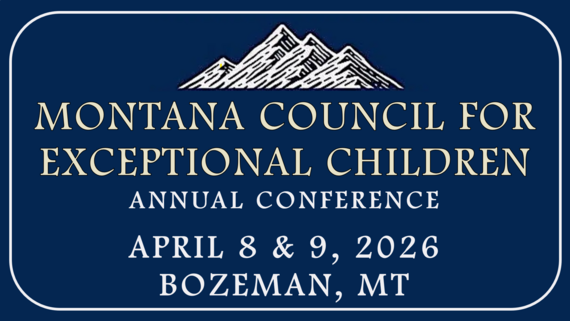
2026 Montana Council for Exceptional Children (MCEC) Conference | Bozeman, MT | April 8-9, 2026
MCEC 2026 Early Bird Registration is OPEN! This is the time to sign up your teams at the discounted prices and also book your rooms at the state rate in our room block at the AC Marriott. They are already 50% filled after just two weeks of registration opening. Early bird registration closes on February 14, 2026! The schedule for MCEC is posted online at www.montanacec.org.
Attendee Registration is at: 2026 Montana Council for Exceptional Children's Conference Tickets, Wed, Apr 8, 2026 at 8:30 AM | Eventbrite
Reserve your rooms at: Reservation-Link (Keynotes do start on the mornings of April 8th and 9th at 8:30 a.m. so the room block prices are extended to accommodate attendees coming in on the 7th.)
-
MCEC Award Nominations- please remember to nominate those amazing colleagues, teacher stars, and students making huge progress! Check out the categories and nominations at 2026 Nominations Forms. These are due by February 23, 2026!
-
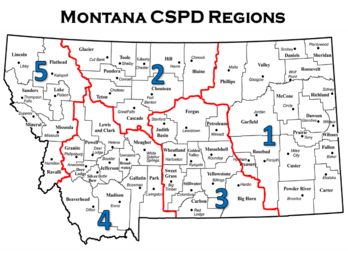
CSPD Award Nominations - MCEC will once again be the time to present CSPD region awards for the Teri Fisk Paraeducator of the Year and Para/Teacher Team of the Year Award. Don't forget to check out these nomination opportunities as well! You can connect with your CSPD region lead by going to Comprehensive System of Personnel Development (CSPD).
-
Bozeman SEPTA - The Bozeman Special Education Parent Teacher Association is planning an event on the evening of April 7th. They will be firming up details soon, but do hope to see you there! Stay tuned!

The Ukeru Train the Trainer Workshop is happening at the Willson School on April 7th and April 10th. These dates are to allow workshop attendees not to miss out on also attending MCEC. The deadline to submit interest is February 28th. Please complete the first step of registration by filling out the Google Form. Interest Form for Ukeru.
|
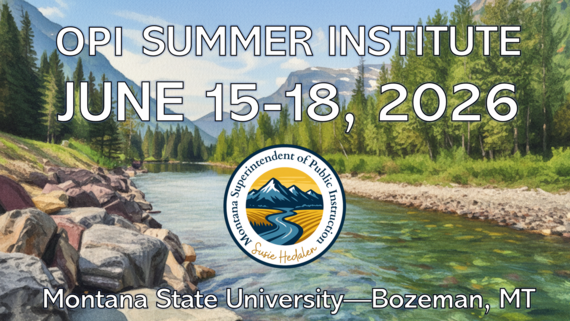
OPI Summer Institute June 15-18, 2026
MSU Campus - Bozeman, MT
 |
|
Montana Autism Education Project
The OPI Montana Autism Education Project offers free autism trainings, technical assistance, and student consultations to Montana public schools.
Statewide Coordinator of the MAEP: Katie Mattingley
|
Upcoming MAEP Professional Development on Transition:
Online | Feb.11 @ 11:30 AM - 1:00 PM
Plan and adapt student goals through school transitions with strategies that build functional skills and independence.
Treatment goals that are set for the individuals we work with often vary depending on, their age, 'ability' and who creates their goals. As learners develop, their skill sets expand and evolve creating the need to reassess these goals. This talk looks at the challenges transitioning presents from one age to the next and discusses planning for teaching functional skills. We will also look at how behavior analysts can use the principles of our applied science to define, apply, and facilitate success across variable settings encountered in adolescence.
Learner Objectives
- Define the population, and challenges for achieving independence
- Identify role of the behavior analyst within the adolescent population in transition
- Evaluate social significance of skills and provide examples of functional lessons
 |
Presented by Dr. Keith Radley
Two upcoming opportunities and locations for this one day training:
This session is designed to equip school personnel with the knowledge and practical tools necessary to support students with disabilities, particularly those with developmental disabilities (e.g., autism, intellectual disability) in their transition from school to successful employment. We will move beyond traditional academic preparation to focus on hard (e.g., technical) and soft (e.g., social) skills that are critical for obtaining and maintaining meaningful work. Participants will explore the unique strengths and challenges these individuals may experience in the workplace and learn how to effectively identify, assess, and foster the skills that lead to employment success and satisfaction. The session will emphasize a strengths-based approach to transition planning, providing actionable strategies that can be immediately implemented in the classroom and other educational settings.
|
Presented by Cari Ebert
Thursday, February 19, 2026 | 5:00 - 7:00 PM | VIRTUAL
This course provides an overview of the external and internal sensory systems along with observable characteristics of sensory dysregulation. Understanding that sensory input drives motor and behavioral output provide the foundation for this course. The way young children take in, process, and respond to sensory information significantly affects the way they learn, develop, and behave. While occupational therapists are the professionals who specialize in sensory integration therapy, this course is designed for all therapists, educators, mental health providers, and administrators to better understand how to support children with sensory differences.

Presented by Katie Novak
Monday, February 23, 2026 | 5:00 - 8:00 PM | VIRTUAL
Universal Design for Learning (UDL) offers a proactive alternative to retrofitting instruction by anticipating and removing barriers to learning before they arise. This session introduces UDL’s three core beliefs and models practical strategies and routines to help educators design for learner variability and promote student success.
|
Presented by Stacy York Nation
Friday, March 6, 2026 | 8:30 AM - 3:30 PM
Richland County Extension Office, Sidney, Montana
We’ll begin the day with a viewing of the award-winning documentary Paper Tigers, which follows the journey of Lincoln Alternative High School in Walla Walla, Washington. The film chronicles a powerful transformation in how the school approaches discipline and student relationships through a trauma-informed lens.
Through the stories of six remarkable students—and the educators who stand beside them—the documentary illuminates how understanding and compassion can break generational cycles of poverty, violence, and despair. Paper Tigers vividly demonstrates the profound impact of trauma on the developing brain, the power of connection, and the difference that caring adults can make when they choose to treat rather than judge.
|
Presented by Dr. Keith Radley
Monday, March 23, 2026 | 9:00 AM - 4:00 PM
Room 122 of the College of Education at Montana State University Billings
A thorough presentation of positive behavioral supports and interventions in a variety of school environments will be presented to conference attendees. Discussion will center around types of behaviors; task avoidance, escape motivated, attention seeking, behaviors that produce sensory consequences, and the role motivation plays in behavioral success in many settings. Screen addiction consequences and behaviors. The audience will be able to apply the information presented through videos, activities, and examples of how to set up positive plans for the students in a variety of environmental settings immediately in their respective situations. The training will also contain discussions about setting limits that work and the application of positive interventions in the regular education setting. We will examine the common pitfalls that sabotage behavioral intervention plans and what to avoid when wanting to make significant behavioral changes. Discussions of how to implement 504 accommodations in a regular education setting will be discussed.
|
 Special Education Professional Development
OPI has contracted with LRP Publications for Montana’s use of their LRP Direct Step online professional learning modules for Montana districts. Access to these modules is available to all Montana public school employees for FREE!
Create an account and start accessing the LRP Modules today.
Licensed educators can receive OPI Professional Learning Units for modules designed for teachers and administrators, to receive PLUs, please complete this form.
Special Education Paraprofessionals:
The OPI Special Education Team and Dawson Community College are excited to celebrate the growing success of the Para Pathways Project!
LEVEL 1: If you are currently working in a special education role for all or part of your day and interested in professional growth, you qualify for the incentive pay ($20/module) for the Special Education Technician set of modules. Completion of the identified 40 modules is also one of the pre-requisites to entering Dawson Community College’s (DCC) Special Education Technician Level 2 courses.
LEVEL 2: Take and pass 4 courses (13 credits) at Dawson Community College. Qualified paras are eligible for tuition payment via OPI, provided they meet the qualifications and have worked for at least 1,000 hours in a Montana public school with students with disabilities for a portion of their day.
Find more information the Para Pathways Project on our website. For any questions regarding the Special Education Technician program, please contact DCCParaPathways@dawson.edu or Anne.Carpenter2@mt.gov.
"EMPOWER HOUR" Spring Webinar Series
REGISTER HERE: Eventbrite link
-
Wednesday, February 18- 12:00pm Navigating SSI for Transition Aged Teens- Tiffany Costa, MSUB Work Incentives and Assistance Program
The nuts and bolts of Supplemental Security Income (SSI) for youth with disabilities for the transition to adulthood (over age 16).
-
Wednesday, March 18- 12:00pm The Road Ahead: High School Transition to Adulthood - Montana Empowerment Center
Participants will explore IEP Transition requirements, adult service options, and strategies to support self-advocacy, independence and successful outcomes after high school.
-
Wednesday, April 15- 12:00pm Executive Function and Behaviors - Carla Miller, PhD, South Dakota Parent Connection
How executive function skills affect children's behavior and daily challenges. You will learn simple, practical strategies to support regulation, organization and positive behavior.
-
Wednesday, May 13- 12:00pm Financial Trusts and MATL Loans - Melissa Hoffman, RDI Financial
Learn about financial trusts and low interest loans for assistive equipment.
|
Training and Assessment Systems for K-12 Educational Interpreters (TASK12)
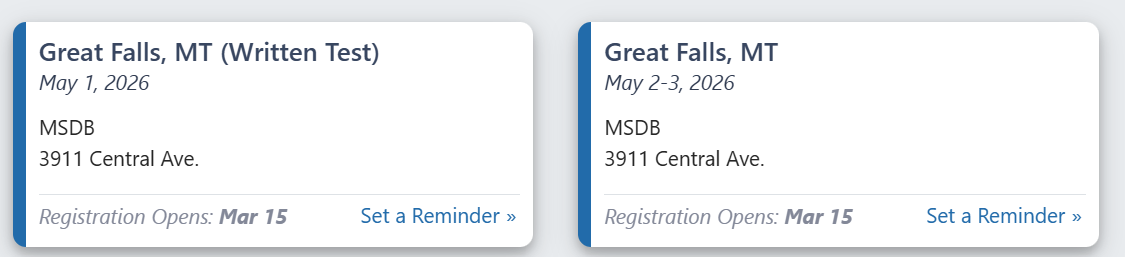
Training and Assessment Systems for K-12 Educational Interpreters (TASK12) is a multi-state assessment program designed to support sign language interpreters in educational settings. In partnership with OPI and the center for Technical Assistance for Excellence in Special Education (TAESE), we endeavor to provide educational interpreters an opportunity to evaluate and improve their skills. Registration opens March 15th. Please contact Lucy Beltz to see if you are eligible for reimbursement for EIPA assessment fees.
Dates set for 2026 EIPA Assessment:
Great Falls, MT (Written Test)
MSDB | May 1, 2026
Great Falls, MT
MSDB | May 2-3, 2026
Financial Assistance from Children's Special Health Services
Children’s Special Health Services (CSHS) can provide up to $2,000 per year in financial assistance for treatment, enabling services, and/or items for qualified Children and Youth with Special Healthcare Needs (CYSHCN), aged birth to 21. If your child is uninsured or underinsured, you might qualify for assistance. Please review the eligibility information below and contact us if you have questions. Applicants may receive partial or complete funding on a case-by-case basis as determined by the Financial Assistance Review Committee.
To be eligible for CSHS Financial Assistance, a child or youth:
- Age birth through 21 (up to 22nd birthday)
- Has or is at increased risk for a chronic physical, developmental, behavioral, or emotional condition, and also,
- Requires health and related services of a type or amount beyond that required by children generally
- Is a resident of the state of Montana and either a U.S. citizen or a qualified alien as defined under federal statute
- Must be enrolled in Healthy Montana Kids (MT Medicaid or CHIP), if eligible
- Must be at or below 300% Federal Poverty Level, check below to determine if your family is eligible
Application link for CSHS Financial Assistance
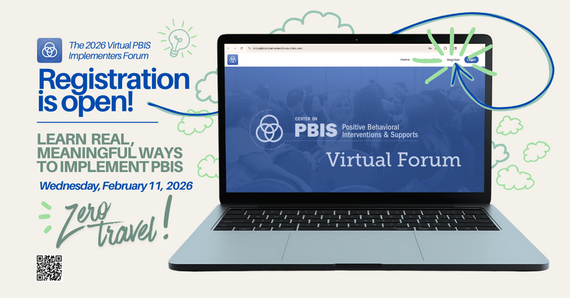
February 11, 2026 | Virtual
The Center on PBIS is excited to announce its inaugural National PBIS Virtual Implementers Forum designed to complement the in-person National PBIS Leadership Forum held last fall in Chicago. This newly organized event will support all implementers in developing specific skills related to key features of PBIS implementation.
Registration: $80 ($40 for those who participated in the October 2025 PBIS Forum)
- The day will begin with a keynote from our Center Co-Directors, followed by a series of breakout sessions throughout the day. Participants can join the sessions that best fit their individual schedules.
- Those joining the session(s) live will have the opportunity to participate in a discussion portion with the lead presenters for each topic.
- All participants will also receive access to on-demand recordings of every session.
Who is this for? In addition to our usual participants of the in-person event, this event is particularly valuable for school-level staff who directly support and contribute to their school's PBIS implementation efforts.
Learn more about the PBIS Implementers Forum online.
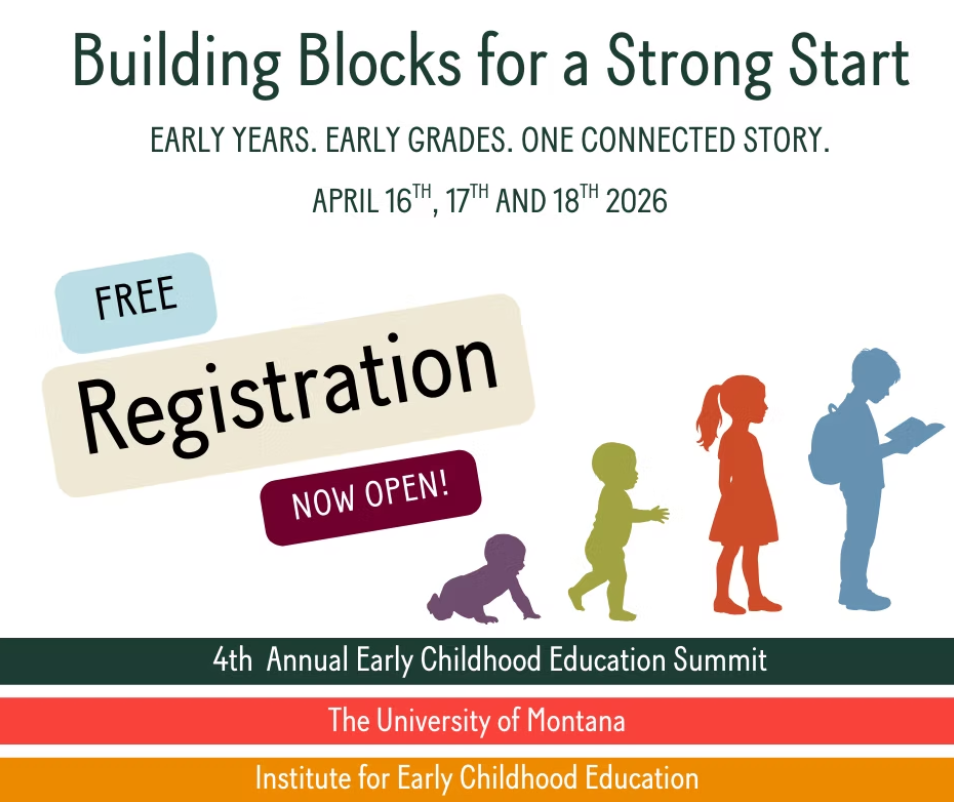
FREE REGISTRATION | APRIL 16, 17, & 18, 2026 | Missoula, MT
The University of Montana’s Institute for Early Childhood Education Annual Summit convenes a diverse array of voices and stories, uniting professionals who work with or on behalf of young children and families across Montana and the broader region. This three-day event is designed to be responsive to the unique needs of Montana's communities and features a dynamic agenda, including a keynote address, awards celebration, expert panels, and professional development opportunities. With a strong emphasis on research, demonstration, and community outreach, the summit serves as a vital platform for collaboration, innovation, and sharing best practices to improve outcomes for young children and their families.
The OPI is committed to providing reasonable accommodations to people with disabilities. If you need a reasonable accommodation, require an alternate format, or have questions concerning accessibility, contact the OPI ADA Coordinator, 406-444-3161, opiada@mt.gov, Relay Service: 711.
|