
Autism Spectrum Disorder (ASD) Recognition, Response & Risk Management: High Risk Contacts with Autistic Individuals is designed for law enforcement, first responders, and school administrators. This training is sponsored by the Montana Office of Public Instruction Montana Autism Education Project and is free of charge to attendees.
A lesson plan and session handout will be provided in digital format.
LOCATIONS
-
Monday 9/29/25 @ Flathead High School | Flex Room, 644 4th Ave W. Kalispell
-
Tuesday 9/30/25 @ Missoula Schools | Admin Building B - Professional Learning Lab, 909 South Ave W., Missoula
-
Wednesday 10/1/25 @ Helena Schools | Lincoln Center, 1325 Poplar St., Helena
-
Thursday 10/2/25 @ Belgrade Schools | Learning Center, 106 North Broadway St., Belgrade
-
Friday 10/3/25 @ Billings Schools | Lincoln Center, 415 N. 30th St., Billings
This 4-hour training (8:30am - 12:30pm) will focus on identification of individuals at varied independence levels.
- recognition & disclosure of autism spectrum disorder (ASD);
- communication tips;
- sensory and scene management tips;
- search and rescue of missing & vulnerable children and adults;
- development of vulnerable/voluntary informational data bases;
- suspicious persons contacts;
- persons in crisis emergencies with aggression;
- use of force/custody;
- interview of an autistic victim, witness, or suspect;
- threat assessment;
- partnership opportunities with autism support organizations & related training policies.
 |
|
Montana Autism Education Project
The OPI Montana Autism Education Project offers free autism trainings, technical assistance, and student consultations to Montana public schools.
Statewide Coordinator of the MAEP: Katie Mattingley
|
Special Education Director's Calls occur on the second Wednesday of each month for October-May. Our next director's call, led by John Gorton, will be on October 8, 2025 at 9:00-10:00 AM. Please email John.Gorton@mt.gov if you need the link!
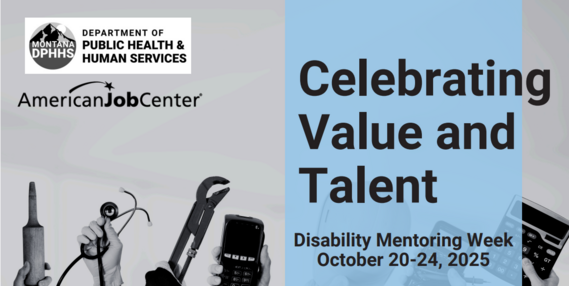 Disability Mentoring Week Oct. 20-24
October marks the 80th year of National Disability Employment Awareness Month, and this year’s theme, “Celebrating Value and Talent,” is all about recognizing how people with disabilities strengthen our communities. Vocational Rehabilitation and Blind Services are hosting Montana’s 2nd Annual Disability Mentoring Week October 20–24, and they would love your support! Schools and students across the state are invited to take part. Feel free to share the flyer with anyone who is interested. Use the QR code on the flyer for all the event and registration info.
Infinite Campus Forms Updated
Additional information on three of the IC Form changes:
- “Annual Notice to a Parentally Placed Child with Disabilities in a Private School” formerly known as the “Offer of FAPE”.
Some of the language has been edited while the parental signature is no longer required.
- “Referral for a Comprehensive Evaluation”
Changes include: More narrative in scope; Referrer Information; Additional Information; and Next Steps for the LEA.
Changes include: Paragraph noting the Montana Empowerment Center and its contact information.
Additionally, the following forms have been updated in Infinite Campus:
- Annual Medicaid Billing Notice
- Consent To Bill Medicaid
- Consent to Invite Outside Agency
- IEP Excusal
- Manifestation Determination
- Notice Of Evaluation Plan
- Notice Of Team Meeting
- Prior Written Notice - Combined
- Prior Written Notice - Eval
- Prior Written Notice - IEP
- Transfer Student Documentation
- Transfer Student Rights - Parent
- Transfer Student Rights - Student
The following form will be removed from Infinite Campus:
For more information, contact Kristie Sears.
Presented by Tanya Peshovich, Dyslexia Specialist
2-Part Series, 4 PDUs available
- Monday, October 27th from 4:00 - 6:00 PM
- Monday, November 3rd from 4:00 - 6:00 PM
This interactive two-part training with Side-by-Side consultant and dyslexia specialist Tanya Peshovich introduces educators to dyslexia, its impact on learning, and the instructional approaches that ensure reading success for all students, including those most at risk. Participants will learn how dyslexia is defined, explore its common characteristics, and understand how
phonological processing difficulties affect reading and writing development. A structured literacy approach will be clearly
defined, with examples of explicit, systematic, evidence-based practices that support students with dyslexia while
strengthening Tier 1 instruction for all learners. The training will also review the Montana Dyslexia Law and its implications for schools and educators.
There will be a reminder email the day before and the day of the event that will contain handouts, the ZOOM link, and any information needed for the event. A follow-up email will come the next day containing the recording, if applicable, and other relative information.
These sessions are live and it is requested you leave your camera on and actively participate. Please sign in to the Chat Box with your first and last name and your job title.
Presented by Tanya Peshovich and Carrie Cole, Side-by-Side Consulting
9-Part Series, Wednesdays from 4-6 PM
- October 22, 2025: Science of Reading: Understanding the Basics
- November 12, 2025: Phonemic Awareness: A Core Foundation
- November 19, 2025: Beginning Phonics: Sound-Symbol Correspondences and Beginning Decoding
- December 3, 2025: Advanced Phonics: Syllables and Decoding Multisyllabic Words
- January 7, 2026: Why and When of Decodable Texts and Teaching High-Frequency Words
- January 21, 2026: Sticky Spelling: Strategies That Work
- February 4, 2026: Building Fluency for Confident Reading
- February 18, 2026: Morphology: Unlocking Word Structure
- March 4, 2026: Using Assessment to Guide Instruction for Interventions
Teaching Essential Reading Foundations at Any Age This training explores key concepts related to how the brain learns to read and how to build strong readers through explicit, systematic instruction in foundational reading skills — at any age. Core reading frameworks such as Scarborough’s Rope, the Simple View of Reading, the Four-Part Processing System, and Ehri’s Phases of Reading Development will be examined. The training emphasizes evidence-based literacy practices aligned with the IES Practice Guides, covering both content and instructional strategies for teaching phonemic awareness, beginning and advanced phonics, multisyllabic word reading, morphology, spelling, fluency, and the use of literacy assessments to diagnose student needs for intervention. This is essential knowledge not only for classroom teachers, but also for special educators and interventionists, equipping all educators with the tools to provide high-quality Tier 1 instruction while also addressing the needs of students who require additional supports.

Presented by Jessica Minahan
October 16, 2025 @ 9:00 AM - 3:30 PM
Big Sky, Montana
With up to one in three children struggling with anxiety in this country, overwhelmed adults require a new approach as well as a practical and easy-to-implement toolkit of strategies that work. Anxiety has become ever-present in students of all ages. Several strategies will be shared and time will be spent developing FAIR plans.
Join us in beautiful Big Sky for this FREE workshop.
|
Presented by Dori Phillips
Friday, October 24, 2025 @ 8:30 AM - 3:30 PM
Richland County Extension Office, 1499 N Central Ave., Sidney, MT
Audience: Appropriate for Pre-K through High School staff (all teachers, paraprofessionals, specialists and administrators)
Learning Targets:
- Learn how all behavior, even big, baffling behaviors, make sense
- Learn how connections help students learn, and why being in protection mode inhibits learning
- Learn how fight, flight, and freeze play a vital role in understanding big, baffling behaviors
- Learn strategies to keep kids learning and how to get them back to their "learning" brains when they are not there
- Understand why strategies may not always work perfectly and what to do when they don’t work
If you work in education, you have seen big, baffling behaviors in students. Are you feeling lost and frustrated when you work with these students? Based on work from Robyn Gobbel, Dr. Bruce Perry, Dr. Dan Siegel, and many more, we will discuss how trauma impacts students’ brains, how this changes the development of their brains, and how this can result in big, baffling behaviors. All behavior makes sense when we learn to look at it through a new lens; a lens that believes regulated, connected kids who feel safe, behave well.
We all need connection; relationships are vital to our growth and safety. But what happens when students do not have strong connections? Maybe some big, baffling behaviors! These behaviors are a result of brains switching into protection mode. We will learn how to tell which mode our students are in and what to do to help them.
Often we have parents who want help with their child. They try hard, they communicate with the school well, and they want to play an important role in helping change these behaviors. Join us as we learn some new techniques to try and how we can use this information to support our families at home!
The OPI Special Education Team and Dawson Community College are excited to celebrate the growing success of the Para Pathways Project and access to the online learning modules! The agency has contracted with LRP Publications for Montana’s use of their LRPDirectStep online professional learning modules. Access to these modules is available to all Montana public school district employees for FREE!
Licensed educators can receive OPI Professional Learning Units for modules designed for teachers and administrators, to receive PLUs, please complete this form.
Special Education Paraprofessionals:
LEVEL 1: If you are currently working in a special education role for all or part of your day and interested in professional growth, you qualify for the incentive pay ($20/module) for the Special Education Technician set of modules. Completion of the identified 40 modules is also one of the pre-requisites to entering Dawson Community College’s (DCC) Special Education Technician Level 2 courses.
LEVEL 2: Take and pass 4 courses (13 credits) at Dawson Community College. Qualified paras are eligible for tuition payment via OPI, provided they meet the qualifications and have worked for at least 1,000 hours in a Montana public school with students with disabilities for a portion of their day.
Find more information on our website. For any questions regarding the Special Education Technician program, please contact DCCParaPathways@dawson.edu or Anne.Carpenter2@mt.gov.
Training and Assessment Systems for K-12 Educational Interpreters (TASK12)
Training and Assessment Systems for K-12 Educational Interpreters (TASK12) is a multi-state assessment program designed to support sign language interpreters in educational settings. In partnership with OPI and the center for Technical Assistance for Excellence in Special Education (TAESE), we endeavor to provide educational interpreters an opportunity to evaluate and improve their skills.
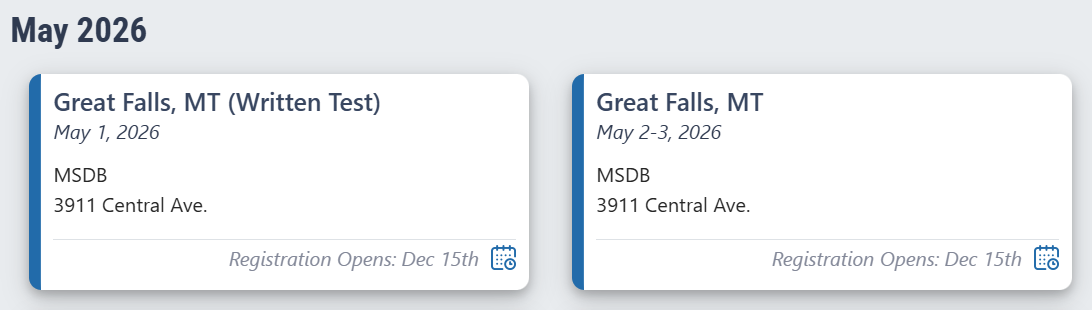
Dates set for 2026 EIPA Assessment:
Great Falls, MT (Written Test)
MSDB | May 1, 2026
Great Falls, MT
MSDB | May 2-3, 2026
 |

Dr. John Ravenscroft, CVI Scotland
When: Thursday, October 16th. 9:30-4:30 with a lunch break - food trucks will be on site.
Where: Butte Civic Center, Butte Montana
Cost: This event is free for a three state region: Montana, Wyoming, Idaho
Registration: Please register using the link Please know there are only 600 seats and this event will fill quickly. Register as soon as possible to save your seats.
This day course will:
1. Examine the intricate relationship between visual impairment and cerebral visual impairment (CVI) and delve into the visual challenges that children with CVI.
2. Explore the co-occurring disabilities that many children with CVI experience.
3. Highlight the problem of definitions, assessment, collaborative working with other professionals and will cover intervention strategies that are used.
4. We will look at the importance of understanding brain structures, so that we can focus on higher and lower processing of vision.
Attendees:
- Part C - FSS, Admin
- Part B - Gen ED, SPED, OT, PT, SLP, Para-Educators, Administrators
- Medical - Ophthalmologists, Optometrists, Pediatricians, Family Practice
- Families - Guardians and family members
|
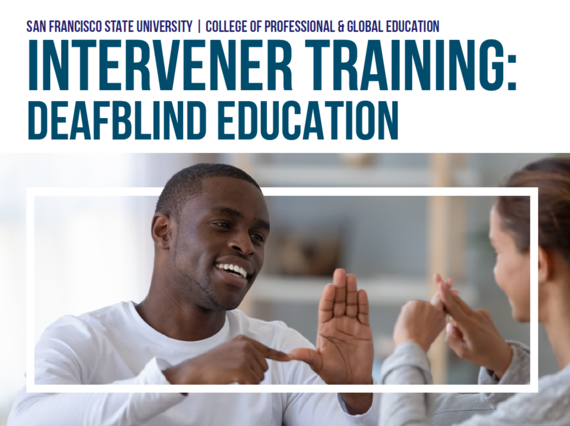
San Francisco State University and California Deafblind Services (CDBS) collaborate to offer this online, university-based training program to prepare paraeducators to effectively serve learners who are deafblind (i.e., a child who is both deaf/hard of hearing and blind/visually impaired). Interveners are paraeducators with specialized knowledge and skills in deafblindness. Trained interveners allow school districts and agencies to effectively meet the unique individualized support needs of students who benefit from intervention services.
This online program uses content from the deafblind training modules developed by the National Center on Deafblindness and CDBS staff members serve as the online instructors of the course.
Students completing the training program receive a Certificate of Completion of Intervener Training from SFSU College of Professional and Global Education which demonstrates the candidate has completed formal intervener training.
The cost for two courses over two semesters (Fall 2025 and Spring 2026) will be $480 ($240 per course). Click hear to learn more about SFSU's Intervener Training Program.

Grants of up to $3,000 are available to special needs educators, therapists, medical professionals, and caregivers in the United States. These competitive grants can be used for a wide range of projects and materials designed to improve the lives of individuals with special needs.
The Hambrick Foundation (THF) is dedicated to supporting professionals and organizations that serve individuals with disabilities. Through grants, scholarships, and resources, we empower educators, therapists, medical professionals, and caregivers by funding specialized programs, adaptive equipment, and other meaningful initiatives. Click here to learn more about these grants.
|
The OPI is committed to providing reasonable accommodations to people with disabilities. If you need a reasonable accommodation, require an alternate format, or have questions concerning accessibility, contact the OPI ADA Coordinator, 406-444-3161, opiada@mt.gov, Relay Service: 711.
|