Tribal Student Achievement and Relations
School Climate: Supporting Student Learning Through the Creation of a Safe and Supportive Learning Environment
School climate refers to the quality of school life and impacts all those who interact with schools: students, educators, administrators, parents/caregivers, and community members. Sometimes, individuals refer to school climate as the teaching and learning environment. There are many benefits associated with a positive school climate, including:
- Increase in student academic performance & graduation
- Increase in student & educator emotional wellbeing
- Increase in student ability to overcome challenges
- Safer schools with fewer discipline referrals
Newly adopted legislation now requires all Montana school districts to begin measuring the climate of their schools (please see Administrative Rules of Montana (ARM) 10.55.801 which further outlines the requirements of schools specific to school climate). Conducting a school climate survey provides community members with an opportunity to share their experiences with attending school and participating in school events and enables school leadership to better understand what school is like for students, school staff, and members of the community. Survey data can help schools make informed decisions and better provide a safe and supportive learning environment, especially if members of the community are engaged during the decision-making process.
The Office of Public Instruction recently released a resource for districts to utilize for reviewing school climate data and prioritizing school improvement strategies. The School Climate Data Interpretation Guidance: Making Data-Driven Decisions to Foster Safe and Supportive Learning Environments document encourages collaborative partnerships between schools and community members and provides step-by-step guidance to analyze school climate data and make data-informed decisions to strengthen the climate of a school. The Office of Public Instruction also provides school climate guidance and resources on the Positive School Climate Development webpage, which includes access to an additional resource specific to improving the climate of schools serving American Indian students: Creating a Safe and Connected School Climate for American Indian Students. First created in 2022, the guidance featured in this resource was developed in partnership with a group of Montana Indian high school students and is continuously updated with new resources as they become available.
For more information, please visit the OPI’s School Accreditation website, or reach out to any of the Tribal Student Achievement and Relations staff.
Director's Updates
As we close out the "moon of wolves running together" (Northern Cheyenne) it has been a time of planning for the second half of the academic school year. We have been busy planning our spring site visits and will be continuing our collaboration with OPI's School Improvement Unit. This opportunity has allowed the Tribal Student Achievement and Relations Unit to align and dovetail our student achievement supports and strategies for Indigenous students along with the work and visits with CSI.
It has also been a month of working hard to align our new strategic plan to our action plan for the second half of the year and with our weekly work plans. This was done with thoughtfulness and intention to drive and guide our work for comprehensiveness, cohesion, inclusion, and efficiencies that maximize our efforts. We are very excited about our programs and projects in the coming year.
Please take some moments in this dark time of winter to reflect, tell stories, and seek restorative practices until the light begins its return. This is the season when we turn inward - a metaphorical "hibernation". We would like to wish you a happy holiday season filled with blessings.
Nea'ese.
Dr. Brooke Gondara, TSAR Director
(Northern Cheyenne)
 |
|
Culture and Language
Amba daya!
Seasons greetings and happy holidays! In Nakoda, January is Wicogandu, Center Moon, because October to April is allotted to the Winter Season. It is also called, Witehi (Hard Moon, Hard Time Moon).
The tribes across the state have similar names for their calendars as well as unique stories regarding how the seasons came to be and what to look for with the passing of each moon cycle. We hope this winter season brings opportunities to learn and share more about traditional stories from each Indigenous nation in the state.
Additionally, we are hoping to help spread cultural understandings regarding the concept of the New Year, as the indigenous people of the land had differing ideas regarding when the cycle of the year begins and ends, in addition to the recorded Morning Greetings that are being shared. If you have not already, please look for the Blackfeet and Crow Star Stories on the OPI IEFA webpage and reach out with questions or follow-ups
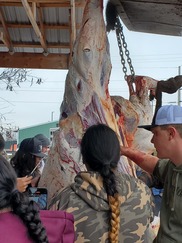
We recently had the opportunity to share the experience of a bison harvest in Missoula with students and knowledge keepers at the MCPS Ag Center. Thank you to MCPS staff and representatives from out of town who shared traditional knowledge and experiences. The students were very excited and eager to attend this event! Our team would be happy to help with schools looking to facilitate similar events with guidance from tribal representatives!
We are looking forward to our annual RISE conference (location TBA), IEFA Best Practices, and other in-person meeting opportunities on the horizon. Please reach out if you would like our Tribal Student Achievement and Relations Unit to visit your staff and or students and we’d be happy to connect with RISE, Professional Development, Restorative Circle Training, and more!
Pinamaya,
Matt Bell
Photo Credit: Missoula Bison Harvest, Matt Bell
|
The OPI is committed to providing reasonable accommodations to people with disabilities. If you need a reasonable accommodation, require an alternate format, or have questions concerning accessibility, contact the OPI ADA Coordinator, 406-444-3161, opiada@mt.gov, Relay Service: 711.
|