Responding to Tragic Events: Supporting Students, Families and School Staff
It is important that students, families, and school staff feel safe in their schools and communities. Following a tragic event, it may be difficult for a school to maintain and foster feelings of safety. To assist schools during these challenging times we have developed the guidance document, Resources for Supporting Students, Families, and School Staff After a Tragic Event. This guide features best-practice recommendations and resources schools may consider using.
Recommendations for supporting students, families, and school staff
The American School Counselor Association and National Association of School Psychologists have provided the following recommendations:
- Try and keep routines as normal as possible. Children (and adults) gain security from the predictability of routine, including attending school.
- Reassure children that they are safe and that schools are safe places.
- Limit exposure to television and the news.
- Families and adults need to first deal with and assess their own responses to crisis and stress.
- Rebuild and reaffirm attachments and relationships.
- Help children identify at least one adult at school to whom they should go if they feel threatened or at risk.
- Observe children’s emotional state. Some children may not express their concerns verbally.
- Make time to talk and listen to children’s’ fears and concerns. Keep explanations age-appropriate:
- Early elementary school: Provide brief, simple information balanced with reassurances that their school and homes are safe and that adults are there to protect them.
- Upper elementary and early middle school: Children this age may have more questions and need more reassurances about what is being done at their school.
- Upper middle school and high school students: Emphasize the role that students play in maintaining safe schools by following school safety guidelines (such as reporting threats to school safety) and communicating any personal safety concerns to school administrators.
Please visit the Talking to Children About Violence website for additional information and resources or visit the OPI’s Emergency Planning and Safety website or Safe and Supportive Schools website. You may also contact Michele Henson, School Safety Program Manager (michele.henson@mt.gov 406-595-1058) with questions.
Jeremy Bullock Safe Schools Summit
The Jeremy Bullock Safe Schools Summit will be held August 9-10 in Butte, Montana. This two-day conference serves to provide an opportunity for Montana schools and school safety stakeholders to join experts from around the state and nation to discuss best practices for student and educator safety and creating safe school environments. The Safe Schools Summit is designed for school safety teams, educators, school health personnel, mental health professionals, law enforcement, and emergency and disaster preparedness coordinators. Continuing education units are available! Please visit the Safe Schools Summit page for more details.
Order Your Free "Tobacco Free" Pencils for Red Ribbon Week
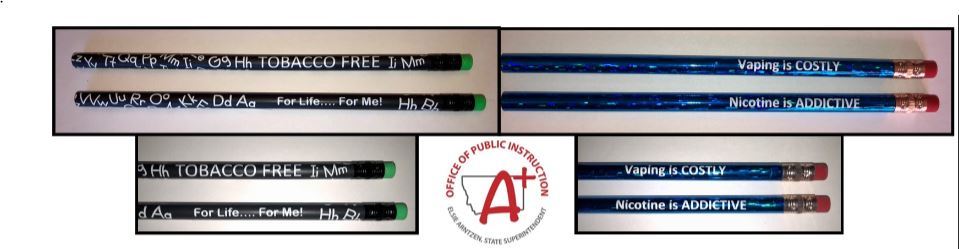
Montana teachers can use this link to request free pencils for their classrooms just in time for Red Ribbon Week. (Oct 23-31, 2022) Choose between heat-activated “Tobacco-Free….For Life” pencils enjoyed by elementary students or shiny blue pencils for MS/HS students with a reminder that nicotine is addictive. Supplies are limited, orders will be filled on a first come first served basis. Administrators may also submit bulk orders for your school.
For more information about tobacco use prevention resources for your school, contact Kris Minard at kminard@mt.gov or phone 406.444.0785.
Montana Students Speak Out! Student Voice Submission Opportunity
The Office of Public Instruction is inviting students to join the conversation about supporting student wellness in Montana. We want to hear from students to better understand their experiences and hear their recommendations to improve in-school supports for student mental health and wellness. We are currently seeking written student submission to elevate Montana student voices. To participate you must be a Montana youth between the ages of 13 and 19 years old. Students have the option of submitting written responses anonymously.
Please visit our School Safety Student Voice website for more information. You may also contact Michele Henson, School Safety Program Manager (michele.henson@mt.gov 406-595-1058) with questions.
Suicide Prevention and Response Training: Montana Crisis Action Toolkit for Schools (CAST-S)
The Montana Safe Schools Center (MSSC), in collaboration with the Montana School Counselor Association (MSCA), School Administrators of Montana (SAM), and the Montana Small Schools Alliance will be holding a virtual training on using the Montana Crisis Action Toolkit for Schools (CAST-S) to prevent youth suicide. This training will allow participants to learn from suicide experts and Montana CAST-S collaborators: Karl Rosston, DPHHS Suicide Prevention Resource Coordinator; Matt Kuntz with the Montana chapter of NAMI; and Dr. Scott Poland, Director of the Suicide and Violence Prevention Office at Nova Southeastern University and national expert on schools and suicide prevention.
This training will occur on August 2, 2022, from 9:00 am to 4:00 pm with a one-hour lunch break. The training is intended to offer school administrators, school counselors, school nurses, and other school stakeholders the tools and knowledge in suicide prevention, intervention, and postvention efforts in PK-12 settings. Attendees can participate as a representative or as a school team (preferred). Attendees will earn 6 OPI renewal credits from the Montana Safe Schools Center. There is no cost for this training. Please visit the registration website to register or contact Dr. Emily Sallee at the Montana Safe Schools Center for more information (Emily.sallee@umontana.edu).
If you are unable to attend the training on August 2nd an on-demand, shorter version of the CAST-S training is available online. Find more information about this training and additional resources on the Montana Suicide Awareness & Prevention School Resources website.
Nita M. Lowey 21st Century Community Learning Centers (21st CCLC): Watch for Upcoming Competitive Grant Application
The Office of Public Instructions's 21st CCLC afterschool program will be opening a Request for Application (RFA) toward the end of the 2022 calendar year. Please watch for more information on this competitive grant funding opportunity in coming months. For more information contact Michelle Cusey michelle.cusey@mt.gov or Amanda Domino adomino@mt.gov.
The OPI is committed to providing reasonable accommodations to people with disabilities. If you need a reasonable accommodation, require an alternate format, or have questions concerning accessibility, contact the OPI ADA Coordinator, 406-444-3161, opiada@mt.gov, Relay Service: 711.
|