1. Tobacco Use Prevention Education
2. Montana School Immunization Survey
3. Grant Resources
4. STOP School Violence Program
5. Traffic Education and Montana DRIVE
6. Montana Team Nutrition
7. Department of Homeland Security
8. MT Kids with Diabetes
9. 2020 MedStart Summer Camp Application
Federal Legal Age to Purchase Tobacco Products Officially Raised to 21
From the U.S. Food and Drug Administration's (FDA) website: “On December 20, 2019, the President signed into legislation to amend the Federal Food, Drug and Cosmetic Act, and raise the federal minimum age of sale of tobacco products from 18 to 21 years. It is now illegal for a retailer to sell any tobacco products – including cigarettes, cigars and e-cigarettes – to anyone under 21. FDA will provide additional details on this issue as they become available.”
Nineteen states had previously raised the age to 21. Montana has not yet established how the state will comply with and enforce this law.
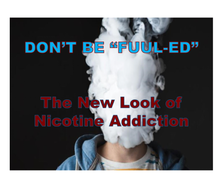
Youth Vaping and Montana Schools
Youth vaping prevention and education has been the primary focus of our program this quarter. It’s unfortunate that something designed to help adult smokers quit smoking has become the tobacco product of choice for our youth. Youth smoking rates have declined by 80% over the last twenty years; suggesting that kids who have become vapers would likely never have started as smokers.
Presentations for Students
The OPI Tobacco Use Prevention Education Program has provided student presentations for quite a few schools districts in the last year. Our middle and high school vaping prevention presentations focus on 3 key points:
- Nicotine is addictive, especially for the teen brain.
- It’s not a harmless water vapor.
- Safer doesn’t mean safe.
County tobacco prevention specialists are also available to share their expertise with schools; we can help coordinate presentations from local specialists as well as from the OPI. Contact our office if you’d like to schedule a presentation for your middle or high school students.
Prevention Strategies
Principals tell us students who vape during the school day most often do so in school restrooms. Some districts have implemented a sign-in/sign-out system for each classroom to help identify and reduce excessive student class departures. At least one district has installed vape detectors in restrooms, which is a big investment, but will likely help curb student vaping during school hours. We are very interested to know how you are addressing vaping in your school and what kind of success you’re having reducing student use. Please contact Kris Minard with any helpful insights.
Vaping is becoming harder and harder to detect in schools. Most teachers have heard about Juul, that popular electronic device that looks like a thumb drive, but what about asthma inhalers, wristwatches, car keys and hoodie sweatshirts? Check out this news story about stealth vaping and don’t forget the OPI Teacher Learning Hub offers a one-hour course called Current Tobacco Trends and Impacts on Montana Youth.
Vaping-Related Lung Illness
Undoubtedly, you’ve heard about the national E-cigarette or Vaping product use Associated with Lung Injury (EVALI). Sadly, the current number of deaths in our country related to vaping has reached 54, and one of those deaths was a Montana teen. There have been over 2,500 cases of vaping associated lung injury in the U.S. to-date. Deaths and hospitalizations continue to climb each week. Here’s an informative EVALI news story from PBS NewsHour.
 Helping Students Quit
The Montana Tobacco Use Prevention Program has invested in a website called My Life, My Quit that is designed just for teens who want to quit using tobacco. My Life, My Quit is 100% confidential and provides Montana students free access to coaches who specialize in supporting teens wanting to overcome an addiction to nicotine.
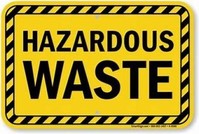
Requirements for nicotine-containing wastes from E-cigarettes
As school officials, you are probably all too aware of the many issues surrounding e-cigarettes and vaping products. Concern about the disposal of related wastes is just one more dimension to the problem. Did you know that if a school accumulates over 2.2 pounds in any month of nicotine-containing liquids from E-cigarettes, the school becomes a generator of hazardous waste? Requirements for hazardous waste generators include obtaining an EPA ID number from the Montana Department of Environmental Quality, proper storage, and of course, proper disposal. Nicotine-containing wastes must be sent off site for disposal as a hazardous waste within 90 days of original accumulation.
Lithium-Ion batteries are a component of the nicotine delivery system for E-cigarettes. Montana DEQ recommends these batteries be managed as universal waste, a sub-category of hazardous waste. Universal wastes may be accumulated for up to one year before disposal. And, as with hazardous waste, there are requirements for storage and proper disposal.
Montana DEQ is currently developing a fact sheet on best practices for the management and disposal of vaping liquids, E-cigarettes, and nicotine wastes.
Please contact the Montana DEQ Hazardous Waste Program at 406-444-5300 for more information.

Letter to Montana Principals from DPHHS
The Montana Department of Public Health and Human Services (DPHHS) began enforcing the emergency rules to temporarily restrict the sale of flavored electronic cigarette products, including flavored nicotine, THC, and CBD e-cigarette products, in-store and online. The ban on flavored e-cigarettes, which are widely marketed to and used by young people, will seek to curb youth e-cigarette use while authorities investigate additional agent(s) associated with E-cigarette or Vaping product use Associated Lung Injury (EVALI). To further combat the epidemic of youth e-cigarette use, school districts need to continue implementing and enforcing comprehensive tobacco-free school policies as required by state law MCA 20-1-220. Encouraging completion of cessation programs to those that wish to quit tobacco products, including e-cigarette products can be beneficial. For additional information and updates related to the emergency rules please visit: https://dphhs.mt.gov/publichealth/mtupp/vapingpulmonarydisease.
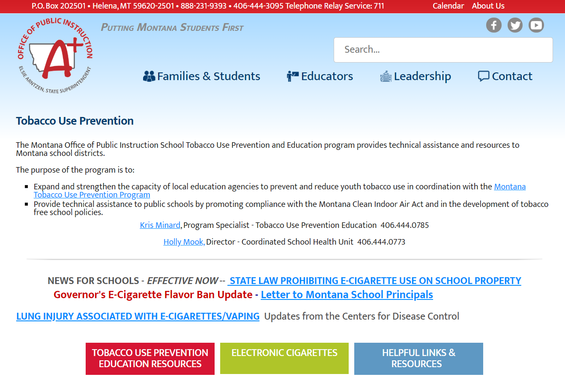
We do our best to keep youth tobacco use prevention resources for all Montana schools updated on the OPI Tobacco Use Prevention website. The Montana Tobacco Use Prevention Program has additional resources for schools as well.
Don’t hesitate to contact Kris Minard at 406.444.0785 or kminard@mt.gov with questions or comments about tobacco use prevention education in your schools.
Every year the Montana Immunization Program conducts a survey of schools to determine the immunization status of their students. Schools are asked to submit data to an online survey tool, the School Immunization Reporting System (SIRS). While reporting is mandated by state administrative rules, it is also a positive way to ensure children are appropriately immunized in compliance with state law. Reports submitted are reviewed by local and state public health authorities who can work with schools to address any issues identified. Immunizations are effective in keeping children safe and the communities they live in free from preventable diseases.
The 2018-2019 SIRS report provided a comprehensive picture of the immunization rates for school-aged children in Montana. An impressive 98.3% schools submitted the survey, which is an increase from 97% the previous year. Medical exemptions remained at or below 0.5% for the two previous reporting years. Religious exemptions experienced a slight increase to 3.1% for 2018-2019, as compared to 3.0% in 2017-2018. Please see the 2018-2019 Immunization Assessment Summary for additional details. Reports for prior years and additional resources can be found at: https://dphhs.mt.gov/publichealth/immunization. Our desire is to increase reporting for the 2019-2020 year and staff are actively working towards that goal.
The 2019-2020 report was required to be submitted by December 1, 2019, and currently approximately 80% of schools have submitted their report. If your school has not submitted a survey, or you are uncertain, you may contact the program at the number below. If staff experiences any difficulty in accessing the reporting site, please email hhsiz@mt.gov, fax your report to 406-444-2920, or contact the Montana Immunization Program at 406-444-5580.
The Montana Immunization Program appreciates all the work done by school staff to ensure the SIRS report is completed and submitted on time. Thank you!
Center for Children, Families, and Workforce Development
Robin Nielson-Cerquone, Project Coordinator for the Center for Children, Families and Workforce Development within the University of Montana, has created a Grant Resource Website as a resource for districts, schools, organizations and agencies to search for grants, develop grant-writing skills, and apply for grants. We hope that you find this as a great tool to add to your toolkit.
The Office of Public Instruction was awarded a Department of Justice STOP School Violence Program grant. One objective of this funding is to provide Second Step SEL and Second Step Bully Prevention curriculum to elementary schools as well as Second Step SEL curriculum to middle schools...free of charge!
Second Step is a research-based, universal prevention program for Early Learning through Grade 8 students. It is designed to promote school success, school connectedness, and a safe, respectful school climate and to prevent problem behaviors. It does this by teaching self-regulation and social-emotional skills and by addressing bullying and unsafe behaviors. It is developmental and sequential, with skills being reviewed and expanded on each year and gradually becoming more complex as students get older. The program provides clear school-wide norms for prosocial behavior.
One of the core components of Second Step is that staff model all program skills, remind students to use them, and notice and reinforce skill use in students with specific verbal feedback. All staff are encouraged to do this, whether teaching the actual lessons or not.
Interactive take-home activities focus on the skills taught at each grade level. These encourage dialogue and engagement between adult family members and students, inform adults about the skills taught in the program, and give students and adults frequent opportunities to practice the skills at home.
Free Curriculum Available: This is now the start of the second year of this grant. As part of Year 2 funding, OPI still has available free curriculum to (4) elementary schools and (3) middle schools to use for the remainder of the 2019-2020 school year and for the following 2 years.
There is an MOU that would require an administrative signature. In exchange for free Second Step curriculum, each receiving school must be willing and able to:
- Support the Second Step program implementation and give a brief explanation of your implementation plan
- Attend fidelity training and other trainings as needed
- Submit evaluation data including but not limited to:
- Name and brief description of the session
- Number of individuals receiving the session by type (elementary, middle school, etc.)
- Method of delivery (in-person, online, etc.)
- Implement at least one model program in at least one full grade (all classes), per year.
- Communicate with the OPI Program Manager as needed.
If you are interested in this opportunity, please send an application request to Christine Steele, STOP Grant Program Manager, Christine.Steele@mt.gov, or call 406-444-4706.
OPI Welcomes New Director of Traffic Education Programs
In October, Tara Ferriter-Smith joined the Traffic Education Program as its new Director. She was a classroom teacher in the Helena area for ten years, and has been with the Office of Public Instruction for thirteen years working on various educational initiatives including the Response to Intervention/Multi-tiered Systems of Support (MTSS) pilot project, Reading First, Striving Readers, Early Reading First, and the Montana Preschool Development Grant.
Tara is excited to take the helm of this dynamic program that encompasses state-approved driver education provided at school districts throughout Montana and the Montana DRIVE summer driving workshops in Lewistown. She says, “I have accepted this position with the utmost respect for those that have come before me and will continue to learn from colleagues and partners, so that I can carry on the torch to guide, lead, and advocate for traffic education and safe driving in our state.”
Contact Tara at tferriter@mt.gov or (406) 444-4396.
New Driver Education Resource: MDT Launches Transportation Awareness Program (TAP)
The Transportation Awareness Program (TAP) is a new public outreach program operated by the Montana Department of Transportation with staff volunteers across the state who are available to visit driver education classes.
This new educational resource will add value to and enrich our high-quality traffic education programs. The content of the one-hour TAP presentation covers general vehicle and driving safety, snow plow and winter driving safety, and work-zone safety in a comprehensive and engaging PowerPoint presentation.
The program goal is to augment the driver education curriculum with MDT’s Vision Zero objectives to increase roadway safety for all roadway users as well as MDT’s construction and maintenance crews. MDT employees are excited to give the TAP presentation to driver education students and their teachers.
To schedule a MDT TAP volunteer for a visit to your driver education class, write to the TAP Coordinator at mttapteam@mt.gov or call (406) 444-6200.
Anyone can take a Montana DRIVE one-day summer workshop to improve their driving skills, including teachers, school bus drivers and teens with at least six months of driving experience! Registration for the 2020 Montana DRIVE Summer Workshops opens February 3, 2020! This popular one-day workshop starts June 1 and runs until August 6, with no workshops offered during the 4th of July week. Teen Week is July 20 through July 24 and registration for the teen workshops will open in March.
Visit Montana DRIVE to learn more and to sign up for email updates.
|
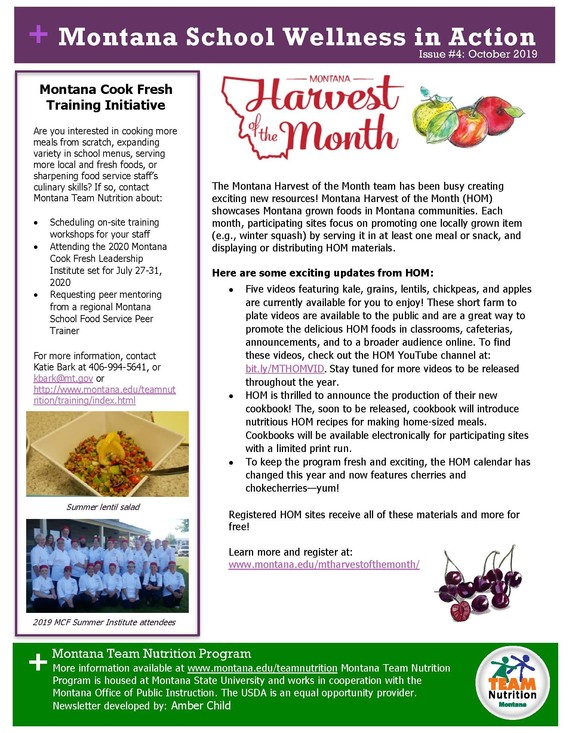
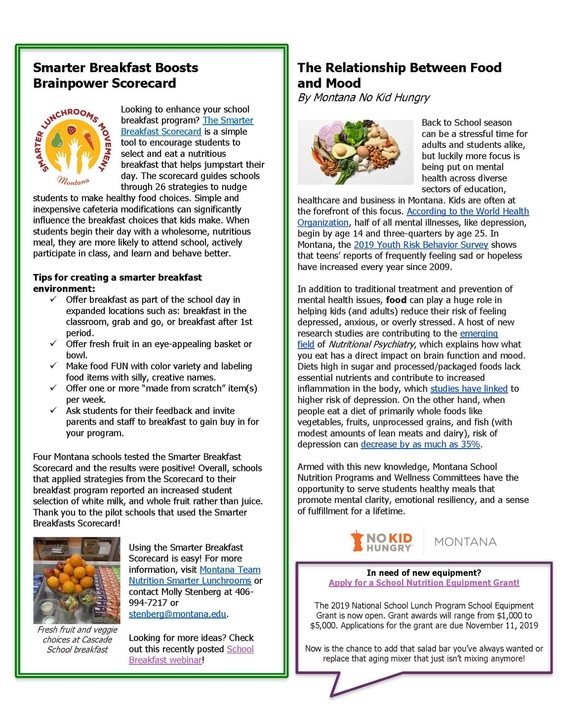
Montana Team Nutrition is thrilled to share with you the Fall 2019 School Wellness in Action Newsletter.
The newsletter highlights:
- Educational Videos from the Harvest of the Month Program
- Professional development opportunities for serving from scratch meals in Montana schools
- The relationship between food and mood contributed by Montana No Kid Hungry
- How to create a Smarter Breakfast Program
On behalf of Montana Team Nutrition, we are ecstatic to collaborate with you to improve learning environments and the health of Montana children. We thank you for your commitment to school wellness initiatives.
Katie Bark, RDN, LN, SNS, Project Director
Montana Team Nutrition, Department of Health and Human Development
(406) 994-5641 kbark@montana.edu
Security Cameras Tips & Myths
While conducting Site Assist Visits at schools across Montana, one of the common statements I frequently hear is, “We are going to purchase some cameras, but don’t know where to put them.” There is nothing wrong with installing some cameras on school grounds as long as you have a plan and are purchasing the right system to suit your needs. Along with being Montana’s Department of Homeland Security Protective Security Advisor, I am also a Certified Protection Professional (CPP) with the American Society of Industrial Security (ASIS). Somewhere along my certification path to obtain my CPP, CCTV (camera systems) has become one of my pet peeves. CCTV at your school can either help you or break you $$$. Here are some things I have learned about CCTV that hopefully will help you not get broke $$$.
- Do your homework and research the different types of systems out there
- Establish objectives on what you want the camera system to do for your situation
- Make sure there is enough lighting at the camera location during the hours you want the camera to operate
- Remember, a CCTV system is not the answer to your security; it is one of many tools
…..and finally “The Myths”
- Fake cameras put up to act as a deterrent can also give people a false sense of security
- ‘Nothing is going to happen at my school so I don’t need to record my camera video’
- If you are going to spend the money to install the system why not make sure you record it?
- ‘We’ve had coax and Cat 5 wiring all over the school for years, we’ll just tie it to that’
- Your old wiring may not support the new technology cameras; do the research.
Randy Middlebrook, CPP, Protective Security Advisor, Department of Homeland Security
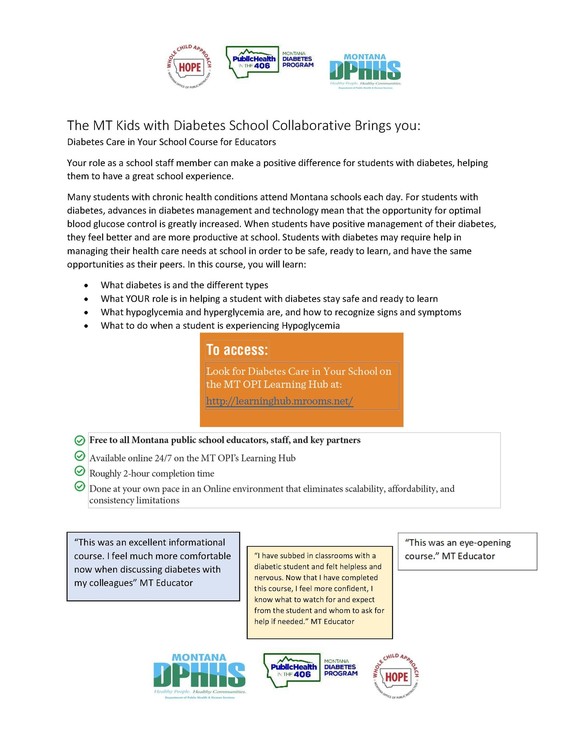
Diabetes Care in Your School for Educators on the Teachers Learning Hub!
MedStart Summer Camp is a 5-day summer camp program sponsored by the Montana AHEC (Area Health Education Center) system. The aim of MedStart is to provide students a chance to further explore healthcare careers, learn about college life, and realize it is possible to pursue higher education.
APPLY BY MARCH 6, 2020 -- ONLINE MedStart APPLICATION
WHO: Current sophomores or juniors from a Montana high school. Homeschooled or GED students are eligible as well. Students may be no older than 18. Students may apply for a second year of MedStart, but may not attend camp at the same campus two years in a row.
WHERE: 5 Camp Locations Available:
- Missoula; University of Montana (June 7-11)
- Great Falls; Providence and Great Falls College (June 14-18)
- Miles City; Miles City Community College (July 12-16)
- Butte/Helena; Montana Tech & Carroll College (July 19-24)
- Billings; Montana State University Billings (July 26-30)
COST: Cost to attend MedStart is $500/student. MedStart tuition fees cover room & board, meals, transportation to events, all included activities, scrubs, and student materials.
SCHOLARSHIPS: Multiple scholarships are available based on need and/or merit; see page 5. Scholarship priority will be given to first year MedStart applicants.
COLLEGE CREDIT: Students completing the MedStart Camp at any of the five camps are eligible for one college credit through Montana Tech, and is transferable to all schools in the Montana University System. More information will be available upon acceptance.
IMMUNIZATION NOTE: Students accepted into the MedStart Camps are required to provide proof of health insurance and up-to-date vaccinations as well as a tuberculosis test in order to be allowed to participate in the activities at healthcare facilities. Montana AHEC is not an affiliate of the Montana Office of Public Instruction, and therefore, does not recognize Montana Immunization Exemption Form 20-5-401. In order for your child to participate in activities at MedStart, current immunization records and negative results of a TB test (within the last year) are required.
DUE DATE: Applications must be submitted by March 6 to be considered.
ACCEPTANCE & PAYMENT: Notification of camp acceptance will be announced April 3, 2020. Students will receive a packet to complete and submit with payment in full by May 15, 2020.
Applications must be postmarked by March 6, 2020 to be considered.
Notification of camp acceptance and scholarship awards will be announced April 3, 2019. Students will receive a packet to complete and submit with payment in full by May 15, 2019. Please direct questions to and mail application to:
2020 MedStart Camp – Attn: Grace Ulven
2625 Winne Ave.
Helena, MT 59601
(406) 457-8024
|
Health Enhancement & Safety Division
Health Enhancement & Safety: Leona Wetherall, 406-444-0751
School Nutrition: Clay Hickman, 406-444-2501
Traffic Education: Patti Borneman, 406-444-4432
The OPI is committed to providing reasonable accommodations to people with disabilities. If you need a reasonable accommodation, require an alternate format, or have questions concerning accessibility, contact the OPI ADA Coordinator, 406-444-3161, opiada@mt.gov, TTY 406-444-0235.
|