Real Life Experience with the Lingo and Stelo Continuous Glucose Monitors
The two non-prescription continuous glucose monitors (CGMs), Abbott’s Lingo and Dexcom’s Stelo, have been available since late summer. They are sold online on the Stelo or Lingo websites via credit or debit card payments and may qualify for Health Savings Accounts (HSA) or Flexible Spending Accounts (FSA).
Lingo offers two pricing options: a two-week plan for $49 or a four-week plan for $89, while Stelo is available for $99 per month. Both companies may offer discounts based on subscription choices. These systems measure glucose in real-time, 24 hours a day, with sensor lifespans of 14 days for Lingo and 15 days for Stelo.
Lingo is designed for adults without diabetes who aim to enhance their metabolic health, whereas Stelo targets adults with or without diabetes who do not use insulin. Each system has its own app and includes numerous educational resources on various lifestyle topics.
|
Unique Characteristics of Each System
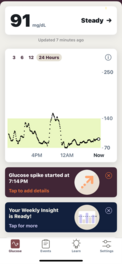
The Stelo employs the same sensor technology as the Dexcom G7. Glucose data is recorded every 5 minutes and transmitted to a compatible mobile device every 15 minutes. Its sensor lasts up to 15 days, with a 12-hour grace period for replacement. The system provides arrows indicating glucose trends and predictive rises or falls. Users also receive notifications for glucose spikes, including the precise time of the spike’s onset. Stelo focuses on blood sugar variability and highlights glucose spikes outside the normal range of 70–140 mg/dL (adjustable). The messaging is tailored for individuals with diabetes or prediabetes.
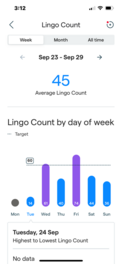
The Lingo is based on Libre system technology but features a larger sensor size. It transmits readings every minute to the user’s smartphone, offering a detailed view of glucose fluctuations. The Lingo sensor lasts 14 days and includes a unique "Lingo Number," assigned at app setup, which evolves into a daily "Lingo Count." The system emphasizes glucose spikes, assigning specific numbers to spikes based on their amplitude and duration. Users are encouraged to maintain their daily Lingo Numbers below an assigned maximum threshold. The messaging language seems geared toward healthy individuals, including athletes, who perceive glucose spikes, even within the normal 70–140 mg/dL range, as potentially detrimental to their performance or health.
Real Life Experience
I tested both systems, wearing the Lingo for 14 days and the Stelo for 30 days. Using both the Lingo and Stelo was straightforward and comfortable. Applying the sensors caused only a slight, almost unnoticeable sting, and I took care to place them on the back of my upper arm (rather than further to the outside) to avoid pressure on the sensor and accidental removal. Determined to explore the full potential of these devices, I experimented with food and exercise. I logged every meal and snack in detail, including the estimated carbohydrate content.
While wearing the Lingo, I completed two 12-mile trail runs. With the Stelo, I participated in a 25K (17-mile) trail race. These activities allowed me to assess how each device performed under varying conditions and provided insights into how different foods and physical exertion impacted glucose levels.
I paid close attention to my go-to meal recipes, such as blueberry/milk/protein smoothies for breakfast, salmon and rice bowls for dinner, and snacks like popcorn, chips, or almonds. Based on the data I gathered, I’ve made some changes, including eliminating or reducing the portion sizes of problematic meals and adjusting my protein intake and timing. I also discovered that incorporating even small amounts of exercise immediately after meals can help blunt the glucose spikes that would otherwise occur.
|

Conclusions
As a Certified Diabetes Care and Education Specialist (formerly known as CDE) for nearly 30 years, I can honestly say that wearing a CGM, even as someone without diabetes, has been one of the most valuable experiences I’ve had for understanding the impact of food and exercise on glucose levels. Both devices are engaging to use and provide meaningful insights into how your body processes food and responds to physical activity. I recommend trying a CGM for at least two weeks, though a month offers even more opportunities to experiment in a variety of scenarios.
|
The 3-Minute Extra Mile
James Bennett BsPharm, BCGP, CDCES
MT DPH Cardiovascular and Diabetes Programs consultant
Bozeman MT
|