 Upcoming EHFS Webinars - Please register in advance using the link below. EHFS webinars are for state and local health officials, sanitarians maintaining CEs, and partner organizations only.
Food Safety in Schools – January 2025, Date and Time TBD: The School Nutrition Program at OPI and Jenna Fisher will talk about the requirements for food safety in schools and the differences between our programs. After the presentations, there will be guided discussion about our programs, potential for collaboration, and time for questions.
Lead Poisoning Prevention in Montana - February 13, 2025 at 10AM: Emma Whitehead with the Montana DPHHS Toxicology and Environmental Public Health Section will be discussing the basics of lead and lead poisoning prevention programs in Montana.
Training Opportunities From Other Organizations
National Environmental Health Association (NEHA) Body Art Facility Inspector Training: The Body Art Facility Inspector Training is available virtually and taught live by experienced body art facility inspectors and industry professionals. The 2-half day introductory training focuses on the fundamentals of conducting a risk-based body art facility inspection. Space is limited to 25 participants. Course topics and registration information are available on the NEHA Website.
If you have questions related to upcoming trainings or would like to be added to the Training Announcement Email List, please contact Karenna at Karenna.Doctor@mt.gov.
-Karenna
 EHFS does not take payment over the phone.
When we receive an email or phone call notice that an establishment is no longer in business, we will email you the information. If we receive a hard copy renewal with changes, we will forward those on to the county.
Please continue to collect 2024 and 2025 new license fees.
-Gail
 If you would like a foodborne illness sample kit, please email Staci. You can request up to two kits. These kits contain coolers, ice packs, gloves, sample containers, and instructions for collecting food samples.
-Staci
 We continue to see a lot of interest and confusion surrounding portable cold plunge tubs. These tubs are regulated as a public swimming pool when offered for use in a public setting such as a day spa or health club. Many companies like PLUNGE, ColdTub, or ReGen, are producing a commercial model and marketing that to businesses in Montana. The term commercial is not defined and has no specific meaning within state or national safety standards for public swimming pools. They may be more expensive and possibly better built, but unfortunately, many of the required circulation components are not listed to NSF-50, and most models are not able to show compliance with suction entrapment standards such as the Virginia Graeme Baker Pool and Spa Safety Act. We are aware that these companies are working towards finding a solution for these issues. Some models are very close to meeting safety standards, and we may be able to consider approving specific models with a variance, consistent with what some other states are currently doing. We have not yet approved any specific model with a variance for use in Montana.
Another ongoing issue concerns the proper construction and plumbing of submerged suction outlet sumps and the installation of appropriate drain covers.
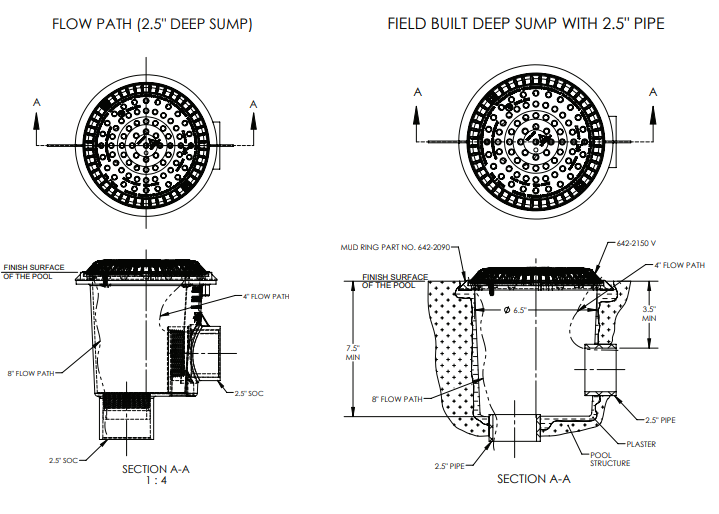
Most fully submerged suction outlets are required to be installed over a properly constructed sump to be safely used in a public swimming pool. A sump is most simply just the space underneath the drain cover. Some sumps are premanufactured plastic. Other sumps are field built directly into the pool floor and finished with plaster. The important part is that each drain cover must be properly installed over a sump that has the correct dimensions and is consistent with the drain manufacturers instructions.
The diagrams below are examples taken from the instruction manual for a common Waterway Plastics drain cover, the 8” Anti-Vortex Model 640-2310. You can see the premanufactured sump on the left, and the field built on the right. The 8” Anti-Vortex is a blockable drain cover that is rated for a maximum flow of 100 GPM for either 2” or 2.5” diameter suction pipe. The necessary depth of this specific sump is determined by the diameter of suction pipe. The sump must be a minimum of 7.5” deep when plumbed with a 2.5” diameter suction pipe. The sump must only be a minimum of 5” deep to accommodate a 2” diameter suction pipe. All of this is described in the manufacturers instruction manual.
 Another popular drain is the 32” Aquastar channel drain. The channel drains can get quite confusing, because there are many different models and plumbing configurations that dictate their maximum certified flow rates. The 32CDFLxxx is one of their original models and we still see that in use today. This particular model of channel drain was not listed for a single port plumbing configuration under the revised 2017 VGBA standards. We will accept the continued use of the older, existing single port installations of this drain. However, in a new installation, we should only see this specific model plumbed with two or three port configurations. Other models of this channel drain, such as the 32CDPHxxx are listed for a single port. The 32CDPHxxx has certified flow rates from 145 GPM with a single port, 2” diameter pipe configuration, all the way up to 260 GPM with a three port, 2.5” diameter pipe configuration.
This issue of drain sumps and replacement drains has come under more scrutiny recently when a contractor that was hired to refinish the plaster and tile of a hotel pool also chose to swap drains from two 32” Aquastar channel drains to two Waterway 8” Anti-Vortex. This drain swap results in a flow rate reduction from the original approval of over 600 GPM with the two unblockable channel drains to a total system flow of only 100 GPM with the two blockable Waterway drains. This may have been possible with proper review, and construction. However, the contractor did not receive any approvals, and more importantly, they did not construct a sump that was consistent with the manufacturer’s instructions, and they did not verify the maximum potential flow of the existing pump in this system. Thankfully, the drain swap was noticed during inspection by the local sanitarian, and we are now working with the hotel to find a safe solution.
-Erik
 The FDA continues to monitor, review, and sample ground cinnamon products used in foods that are frequently consumed by babies and young children.
Consuming these products could contribute to elevated levels of lead in the blood. Long-term exposure (months to years) to elevated levels of lead in the diet could contribute to adverse health effects, particularly for the portion of the population that may already have elevated blood lead levels from other exposures to lead.
As of November 1, 2024, the FDA has added a new product to their ongoing public health alert concerning ground cinnamon products, Super Brand ground cinnamon, which was tested and found to contain elevated levels of lead. This product was found in conjunction with state partners in Arkansas.
An entire product list the FDA recommends consumers to throw away and not purchase can be found here: More Ground Cinnamon Products Added to FDA Public Health Alert Due to Presence of Elevated Levels of Lead | FDA
-Kira
 Montana DPHHS has a Facebook page. Its mission is to protect, promote and improve the health and wellness of all Montanans. You can find it here: Public Health In The 406 | Facebook.
-Staci
 The FDA’s Human Foods Program (HFP) has released its 2025 Priority Deliverables, outlining key focus areas following its recent reorganization on October 1, 2024. This program aims to enhance public health through science-based strategies in three core areas:
1. Microbiological Food Safety: Preventing foodborne illnesses by collaborating with regulatory agencies, states, industries, and stakeholders.
2. Food Chemical Safety: Ensuring the safety of chemicals in food, improving dietary supplement regulation, and supporting food ingredient innovation.
3. Nutrition: Promoting nutrition science and policy to reduce diet-related chronic diseases, improve health equity, and ensure the safety and nutritional adequacy of infant formula.
These initiatives aim to strengthen regulatory oversight, advance scientific research, and foster partnerships. The HFP, the FDA’s largest-ever reorganization, centralizes its food safety functions and resources under the Deputy Commissioner for Human Foods. The program is still being fully operationalized, with ongoing efforts in risk modeling, lab integration, workforce development, and performance management. Updates on progress will be provided periodically.
For more information, visit https://www.fda.gov/food/hfp-constituent-updates/fda-human-foods-program-fy-2025-priority-deliverables.
-Jenna
 Confluence Public Health Alliance (Confluence) invites you to submit a proposal to present at Confluence 2025 taking place on April 8-10, 2025, in Helena, MT at the Delta Hotel Helena Colonial. Confluence 2025 represents the longstanding, joint annual conference hosted by the Montana Public Health Association (MPHA) and the Montana Environmental Health Association (MEHA).
Presenting at the conference offers an opportunity to share projects, skills, and research on a variety of current and emerging public and environmental health topics while also building a peer professional network.
For example, if you are an expert on something, like temporary food events, this is a great opportunity to share your knowledge with others!
Please visit the Confluence website for more information on deadlines and requirements. If you would like assistance with your abstract or have questions, please reach out to Kayla Chipongian at kayla.chipongian@cphamt.org.
-Karenna
 NACCHO has a podcast featuring in-depth interviews with public health officials. In honor of Food Safety Education Month, they will be showcasing stories from local jurisdictions highlighting their innovative work to improve food safety in their communities. Their stories demonstrate how local health departments can implement food safety programs to improve public health and create a robust food safety program. It can be found on any podcast platform by searching for “NACCHO Podcast Series” or by visiting this link. For more information on all episodes, visit their blog here.
-Staci
Contact Information
EHFS Staff Listing
|
Name
|
Email
|
Phone
|
| Darryl Barton |
darryl.barton@mt.gov |
(406) 444-2089 |
| Erik Leigh |
eleigh@mt.gov |
(406) 444-5306 |
| Gail Macklin |
gmacklin@mt.gov |
(406) 444-2415 |
| Jenna Fisher |
Jenna.Fisher@mt.gov |
(406) 444-0067 |
| Karenna Doctor |
karenna.doctor@mt.gov |
(406) 444-5303 |
| Kaylie Kummer |
kaylie.kummer@mt.gov |
(406) 444-2837 |
| Kira Flagstead |
kira.flagstead@mt.gov |
(406) 417-0500 |
| Sadie Overlie |
sadie.overlie@mt.gov |
(406) 444-2823 |
| Staci Evangeline |
staci.evangeline@mt.gov |
(406) 444-5309 |
|