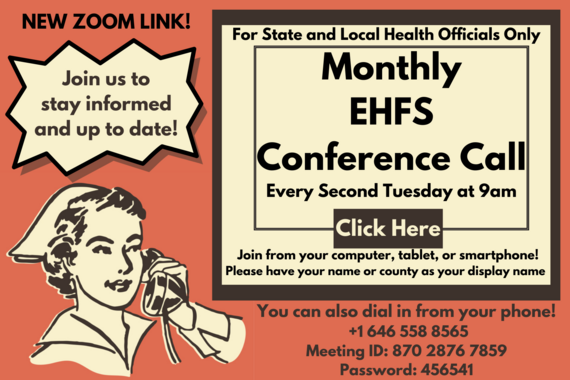
 Upcoming EHFS Webinars - Please register in advance using the link below. EHFS webinars are for state and local health officials, sanitarians maintaining CEs, and partner organizations only.
Freeze-Drying – November 19th at 3PM: Erik Kurdelak, contractor with the State of Indiana, will be joining us to present on the fundamentals of freeze-drying and food safety considerations. Please register here.
Food Safety in Schools – January, Date and Time TBD: The School Nutrition Program at OPI and Jenna Fisher will talk about the requirements for food safety in schools and the differences between our programs. After the presentations, there will be guided discussion about our programs, potential for collaboration, and time for questions. Please come prepared to participate.
National Environmental Health Association (NEHA) Training Opportunities
Find It and Fix It: Effective Strategies for Bed Bug Inspection, Control, and Personal Protection – November 5th at 12PM MT: This session will focus on moving beyond simply identifying the problem by exploring effective solutions using integrated pest management (IPM). You’ll discover the advantages and disadvantages of various treatments, how to troubleshoot chronic infestations, and confirm elimination. Personal protection methods to prevent a bed bug exposure from becoming an infestation in your own home will be shared. Register here.
Sanitization for Food Safety: Using Sanitizer Test Strips – November 26th and December 10th at 12PM MT: We’ll address differences between cleaning and sanitizing, the processes involved, and their effectiveness in preventing the spread of pathogens. We'll explore how these practices reduce infection risks and promote a healthier environment. We will discuss common sanitizers found in retail and their corresponding test kits. The dos and don’ts of using test strips will be covered. You'll leave this training equipped to implement effective cleaning and sanitizing protocols, and the knowledge and tools to use test kits properly, ensuring a safer community. Spots are limited—register here.
If you have questions related to upcoming trainings or would like to be added to the Training Announcement List, please contact Karenna at Karenna.Doctor@mt.gov.
-Karenna
 2025 license renewal has started. The yellow paper renewals are scheduled to go out on or before November 4th. Please be aware when looking up a 2024 license do not use the ‘Active’ drop down, 2024 licenses are in a 'renewed' status. However, you can use ‘renewed’ instead of ‘Active’ as one of your search criteria.
eStop has not been moved into the 2025 license year and will remain active until the end of January, as they renew on their anniversary date.
Please start collecting 2024 and 2025 license fees on all new licenses. A late fee will be added to the license fee on January 1st. Late fees cannot be waived.
New! Online payments: the licensee will need to make an OKTA account before they can access the online payment portal. When accessing the online payment, there are links to make an OKTA account.
2025 licenses will be mailed to the counties starting November 5th.
-Gail
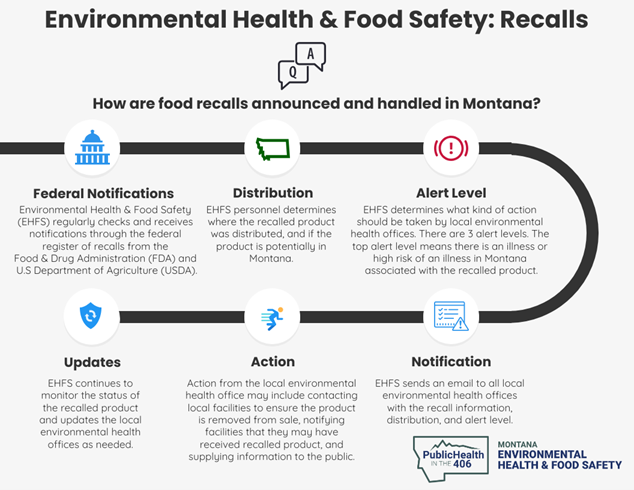
 For those of you who may be new, or if you need a refresher, check out this new infographic that shows and shares how food recalls are announced and handled in Montana.
EHFS Recall Infographic
The recall procedure starts with notifications from federal recall registers, the FDA, or the USDA. When a product is potentially in Montana, EHFS staff determines the distribution pattern and the stores or retail locations that the product may be present in. EHFS will then determine the Alert Level needed. If a Level 1 Alert is required, the highest level, this means there is an illness or high risk of an illness in Montana associated with the recalled product; think Diamond-Shruumz. Next, an email notification is sent to the all-sanitarian email list with the alert type, level, and product in the subject line. This email will also recommend an action, whether this is contacting retailers in your jurisdiction to let them know or remind them of the recall or sharing recall information with the public. EHFS will then continue to monitor the recalled product and send out updates as needed.
If you ever have questions about the recall notification process, please reach out to me.
-Kira
 A new snack trend made popular on TikTok is too spooky to attempt for those of us with foodborne illness knowledge. This fad suggests adding raw cake mix to flavor popcorn. Raw cake mix contains raw flour, which can be a source of E. coli or Salmonella infections. The recipe is currently circulating online, in time for the Halloween season, but should be avoided.
The recipe starts with melting butter and marshmallows in a saucepan over low heat, then adding a box of cake mix and a few cups of popcorn and mixing it all together. It’s then removed from heat and allegedly ready to eat. While it may seem that the flour in the recipe is being cooked, most consumers don’t realize that flour must be heated to 160 degrees F to be safe for consumption.
Consumers are generally aware of the risks of eating raw eggs found in cookie dough and other recipes, but many may not know that raw flour is an additional food safety culprit. Keep your community safe this Halloween season and spread the word that this trend is too spooky for anyone to try!
-Kira
Sources:
TikTok recipe for 'fluffy popcorn' is a dangerous mix because of raw flour | Food Safety News
‘Fluffy popcorn’ trend sends patients to the ER | MDLinx
 Tourist homes, also known as vacation rentals, are becoming more popular in Montana. Perhaps you’ve taken a call from someone who asks, “What do I need to do to start an Airbnb?” I keep a draft email ready to send. It outlines the basics of licensing a tourist home, web links to rules that regulate public accommodations, and a plan review application. It’s edited to include specific county environmental health contact information. It also outlines inspection frequency: With tourist homes an initial inspection occurs and then only upon complaint. This process helps to provide a measure of public health protection while balancing an increasingly difficult workload for many sanitarians.
But what is a tourist home? Montana Code Annotated 50-51-102 provides us a definition. "Tourist home" means a private home or condominium that is not occupied by an owner or manager and that is rented, leased, or furnished in its entirety to transient guests on a daily or weekly basis. There are situations that are clear and fall into this definition and there are those that are different enough to require a variance. Per ARM 37.111.103(4), "Prior to issuing a variance, the local regulatory authority will contact, notify, and consult with the department about any similar variances to help ensure uniform application of the law." Variance forms can be found on Connected Community.
Tourist homes have a growing place within public accommodations, yet they are not without controversy. Neighborhoods and areas within some communities have argued over their existence. Local jurisdictions can enact zoning and other regulations to prohibit tourist homes and, in some areas, they have. Our office cannot offer advice on local zoning regulations.
Tourist homes are popular alternatives to other more traditional housing. They are here and since they are not going away the licensing scenarios will continue. Montana DPHHS is here to help. Please feel free to contact us or to refer operators to us.
-Darryl
 Our office and the FDA regulate dietary supplement products. The Montana Wholesale MCA 50-57-102 defines food as “an edible substance, beverage, or ingredient used, intended for use, or for sale for human consumption. The term includes dietary supplements.” Therefore, if operators are wanting to produce dietary supplements, they should obtain licensure through our offices for either retail food, wholesale food, or both.
FDA regulates dietary supplements under a different set of regulations than those covering "conventional" foods and drug products, aka the Dietary Supplement Health and Education Act of 1994 (DSHEA).
The Dietary Supplement Current Good Manufacturing Practices (CGMP) rule in 21 CFR part 111 requires persons who manufacture, package, label, or hold a dietary supplement to establish and follow current good manufacturing practices to ensure the quality of the dietary supplement and to ensure that the dietary supplement is packaged and labeled as specified in the master manufacturing record.
More information on dietary supplement regulation can be found on the FDA’s website. The FDA also has a page dedicated to DS labeling.
-Sadie
Contact Information
EHFS Staff Listing
|
Name
|
Email
|
Phone
|
| Darryl Barton |
darryl.barton@mt.gov |
(406) 444-2089 |
| Erik Leigh |
eleigh@mt.gov |
(406) 444-5306 |
| Gail Macklin |
gmacklin@mt.gov |
(406) 444-2415 |
| Jenna Fisher |
Jenna.Fisher@mt.gov |
(406) 444-0067 |
| Karenna Doctor |
karenna.doctor@mt.gov |
(406) 444-5303 |
| Kaylie Kummer |
kaylie.kummer@mt.gov |
(406) 444-2837 |
| Kira Flagstead |
kira.flagstead@mt.gov |
(406) 417-0500 |
| Sadie Overlie |
sadie.overlie@mt.gov |
(406) 444-2823 |
| Staci Evangeline |
staci.evangeline@mt.gov |
(406) 444-5309 |
|