|
The formula contract was awarded to Abbott and no changes will be made to our standard issuance formulas. Montana WIC will continue with Similac sensitive, total comfort, advance, and soy isomil. |
|
|
WIC staff are required to complete continuing education credits yearly based on the number of hours working in WIC.
- Full time (20 hours+ per week): 12 credits yearly
- Part time (19 hours or less per week): 6 credits yearly
Credits are due by September 30th. As a reminder, they can be submitted by filling out the form in eLearn and emailed to montanawicprogram@mt.gov, or through this link: https://mdphhs.az1.qualtrics.com/jfe/form/SV_bdVRsYYQHv5N39Q
|
|
|
Resources from the state plan training can be found in eLearn under “WIC Meetings, Conferences, Webinars”.
Food package change posters will be shipped to clinics in the next few weeks. A packet of additional resources will be emailed to WIC directors by October 1st.
|
|
Every local agency staff who is paid with WIC funds must complete civil rights training by September 30th. The training can be found in eLearn and the certificate should be emailed to montanawicprogram@mt.gov. |
|
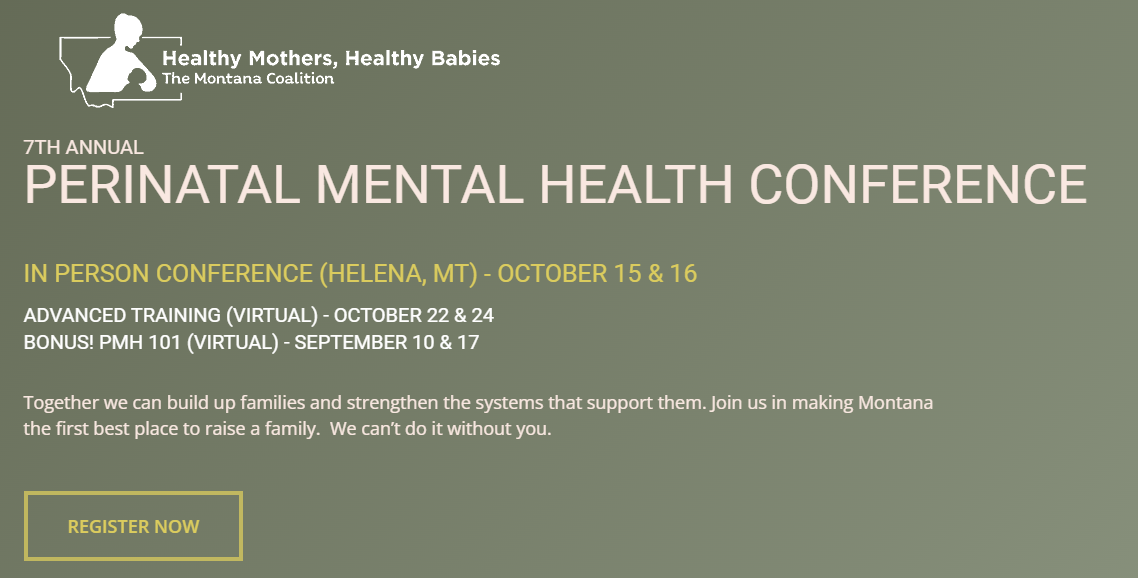 Save the date and register for the 7th Annual Perinatal Mental Health Conference. This year they will be in-person at the Delta Hotel in Helena, MT. The state office will be granting free registration to our staff, however, spots are limited! Please email Lacy Little (lalittle@mt.gov) for free registration.
|
|
|
Risk Code 338: Pregnant Woman Currently Breastfeeding
Defined as: Pregnant woman who is currently breastfeeding.
What WIC Can Do:
WIC staff can support pregnant women who are breastfeeding by:
- Support breastfeeding goals with the currently breastfed child and consider personal feelings.
- Refer mothers who have a history of premature labor or miscarriage to their health care provider.
- Provide nutrition education that supports an overall healthy diet, including:
- Limiting “empty” calories for added sugars and saturated fats.
- Choosing a variety of fruits and vegetables, whole grains, and fat-free or low-dairy products.
- Eating high protein-rich foods such as poultry, fish*, beans, eggs, nuts, and lean meats. *Pregnant women should avoid eating shark, swordfish, king mackerel, and tilefish due to concern for high levels of mercury. Albacore tuna should be limited to no more than 6 ounces per week.
- Drinking plenty of fluids. During breastfeeding, fluid needs may increase, and mothers may notice excess thirst. Women should drink enough water and other low-calorie fluids to quench their thirst. A common suggestion is to drink a glass of water with every breastfeeding session.
- Monitor weight status throughout the pregnancy to ensure appropriate weight gain.
- Inform women that the breastfeeding child may notice some changes in the human milk and wean on his/her own. Although human milk continues to be nutritionally sound throughout pregnancy, the composition of it may change, which might change the way milk tastes. For some reason, their milk production may also decrease as the pregnancy progresses.
- Issue Food Package VII to the mother, until her older infant turns one, as long as she is substantially breastfeeding.
- Provide guidance on tandem nursing. This may ease the older child’s adjustment to new baby, address the mother’s own desire to maintain closeness with the older child, and even make childcare easier in some cases as both children are fed and comforted on the breast.
|
|
Wyoming was the first WIC State Agency in the Nation to implement Electronic Benefit Transfer (EBT). They started their first EBT implementation in May of 1991, and implemented EBT statewide in February of 2002. Wyoming WIC has been delivering benefits electronically for almost 33 years and are currently working on a project to move from an offline to online EBT system. |
|
|
|