|
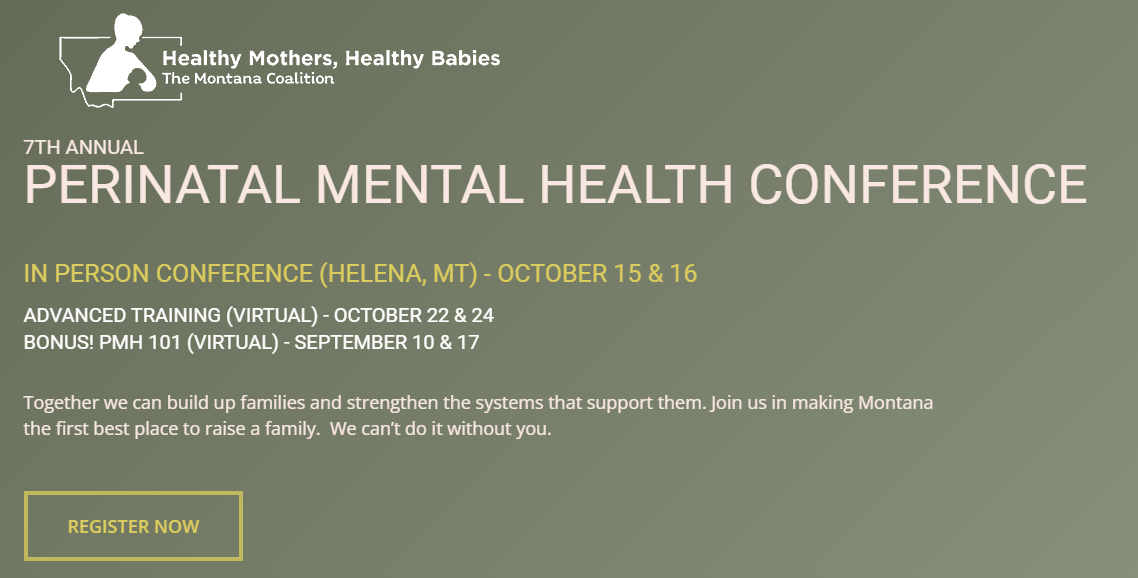 Save the date and register for the 7th Annual Perinatal Mental Health Conference. This year they will be in-person at the Delta Hotel in Helena, MT. The state office will be granting free registration to our staff, however, spots are limited! Please email Alex Bostrom (alex.bostrom@mt.gov) for free registration.
|
|
|
WIC staff are required to complete continuing education credits yearly based on the number of hours working in WIC.
- Full time (20 hours+ per week): 12 credits yearly
- Part time (19 hours or less per week): 6 credits yearly
Credits are due by September 30th. As a reminder, they can be submitted by filling out the form in eLearn and emailed to montanawicprogram@mt.gov, or through this link: https://mdphhs.az1.qualtrics.com/jfe/form/SV_bdVRsYYQHv5N39Q
|
|
Every local agency staff who is paid with WIC funds must complete civil rights training by September 30th. The training can be found in eLearn and the certificate should be emailed to montanawicprogram@mt.gov. |
|
An updated outline of clinic coverage options can be found in eLearn under local agency resources or here: Clinic Coverage Updates |
|
|
Risk code 363 – Pre-Diabetes
- Impaired fasting glucose (IFG) and/or impaired glucose tolerance (IGT) are referred to as pre-diabetes. These conditions are characterized by hyperglycemia that does not meet the diagnostic criteria for diabetes mellitus.
- Presence of condition diagnosed, documented, or reported by a physician or someone working under a physician’s orders, or as self-reported by applicant/participant/caregiver.
What WIC Can Do:
- Provide individualized nutrition education in an easy-to-understand format that is appropriate for the learning level of the participant/caregiver. Most education materials should be written for a 5th to 7th grade reading level. Be sensitive to the unique learning needs and style of the participant/caregiver, which may mean using food models, posters, and handouts.
- Provide referrals to medical providers, Registered Dietitians, and other services, if available, in their community.
- Support and reinforce the MTN and physical activity recommendations that participants receive from their health care providers.
- Providing individualized food packages, tailored to meet the needs of participants.
- Promote food choices of high nutritional quality while avoiding unnecessary or excessive amounts of calorie rich foods and beverages and reducing inactivity (like decreasing sedentary TV viewing).
|
|
|
|