Insulin Pumps
Although the vast majority of people using insulin still use injections, there is a growing population of people who are turning to insulin pumps for more efficient dosing and better control. A person with type 1 or type 2 diabetes, dependent on insulin injections, can administer multiple daily injections using a basal insulin along with pre-meal and correction bolus doses with a rapid acting analog, regular insulin, or inhaled insulin. Maintaining good control will often require four or more injections per day. The other option is to use an insulin pump in place of injections. |
|
 |
Insulin pumps are mechanical devices that deliver insulin via a small cannula that is implanted in the subcutaneous tissue. The insulin is contained in a reservoir in the pump and delivered through tubing to a “set” which includes the cannula or with a tubeless pump, such as the Omnipod, where the insulin from the pump reservoir goes directly to the cannula.
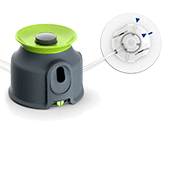
Pumps have been around since the 1970s and have evolved to the point where today’s “smart-pumps” are getting closer to mimicking the fully functioning pancreas. The pump is able to satisfy both basal and bolus insulin needs using rapid acting insulin analogs. Basal needs are covered by very small amounts of insulin being given over time while coverage for immediate needs, such as mealtime spikes and other episodes of hyperglycemia, by administration of a quick burst or bolus dose. The basal insulin is given automatically while the mealtime and correction boluses are self-administered.
|
Pros and Cons of Pump Use

Benefits
- Basal rates are highly customizable with timing and amount based on individual needs.
- The pump, once programmed, will suggest bolus dose amounts according to current blood sugar and meal contents. This is based on the individual’s calculated insulin to carb ratio and correction factor* which are programmed into the pump.
- Smart pumps are also able to prevent the common problem of “stacking” insulin by automatically calculating insulin on board*.
- If paired with certain continuous glucose monitor (CGM) systems, closed loop and advanced hybrid closed loop systems can be used. This system will automatically adjust insulin doses based on blood glucose levels.
- Both the patient and provider would have access to a plethora of useful reports via data download.
Potential Barriers
- Objection to wearing the device 24 hours a day.
- Psychological impact of dependence on the technology.
- Cost of pump and monthly supplies.
- The person must be capable of using it and able to be trained.
- Without CGM integration, there is still the need for multiple daily SMBG checks.
- Infusion sets must be changed every 2-3 days or insulin delivery may be impaired.
|
Insurance Coverage
Most insurance companies, including Medicare, cover pumps and supplies for qualified patients on the order of a physician. The prescribed pump company’s agents will help in obtaining coverage.
Omnipod DASH pump supplies are available through Part D plans. The MiniMed and Tandem pump devices are quite expensive for the initial outlay and there is the ongoing cost of supplies, all of which are billed through Medicare or private insurance. Training on pump use is typically done virtually by trained educators during the pandemic.
Three of the newest pumps on the US market and a few of their features:
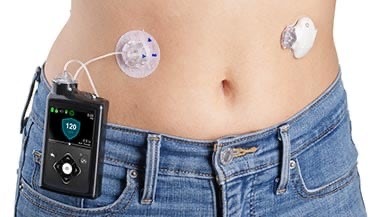
MiniMed 670G™
A battery-powered insulin pump that is integrated with the Guardian™ Sensor 3 CGM sensor and transmitter
- Pump with button activated features
- Tubing, reservoir, and infusion set that is changed every 2-3 days
- Inserter to apply the set
- Contour Next BG meter to transmit SMBG reading to pump
- Guardian CGM sensor and inserter is a part of this system
|

Tandem t:slim x2™
- Touch screen activated features
- Tubing, reservoir, and infusion set that is changed every 2-3 days
- Inserter to apply the set
- Stand alone system or can integrate with Dexcom G-6 CGM for advanced hybrid closed-loop system operability
- New software updates can be remotely downloaded to the pump instead of having to order a new pump
|
Omnipod DASH™
- Tubeless and waterproof
- Pod will last for 3 days and then new Pod applied
- Pod is controlled by the battery powered PDM (Personal Diabetes Manager) using Bluetooth technology
- PDM contains CalorieKing® nutrition information for 80,000 foods
- Optimized for Contour Next glucose monitor to transfer reading to PDM
- Allows for smartphone connectivity for patient or selected others to view data from PDM
|
|
 |
Insulin pumps are a valuable addition to the diabetes control tool chest. A pump, with or without an integrated CGM, can be a game changer for some and most find that once they start “pumping” they would never go back to multiple daily injections. An insulin pump is another tool, albeit a sophisticated one, that allows the properly trained user to reduce hypoglycemia, glucose variability, increase time in range, and avoid multiple daily injections.
*Correction factor, or insulin sensitivity factor, is based on the person’s total daily dose of insulin and estimates the number of mg/dL that one unit of rapid acting insulin will lower the blood sugar.
**Stacking insulin is a term used when someone gives a bolus dose while a previous bolus dose is still in effect. The remaining insulin activity from the first bolus dose is called the “insulin on board”. This feature only applies to bolus insulin dosing and not basal. Smart pumps allow for the insulin duration to be programmed and that is usually considered to be between 3 and 5 hours for analog insulins.
References and images:
Companionmedical.com
Medtronicdiabetes.com
Tandemdiabetes.com
Please pass along to colleagues and encourage them to Click to subscribe
|