|
Montana Highground Newsletter
September 2026
|
|
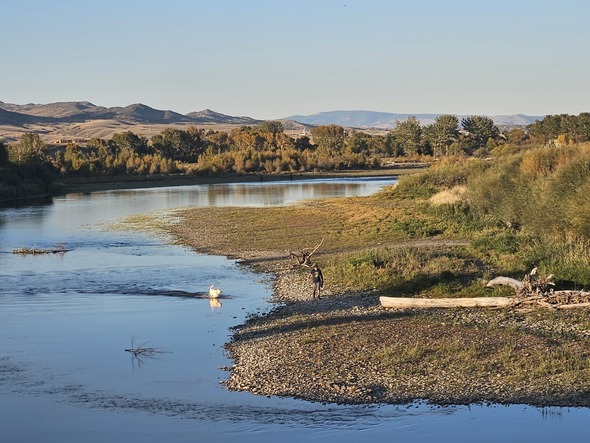 More than 223 years after Lewis and Clark traveled the Jefferson River in search of the Northwest Passage, a boy and his dog walk along the riverbank near Three Forks, Montana, as cottonwoods and willows turn gold for fall. Photo by Shylea Wingard.
The Montana Highground newsletter is a quarterly publication by The Montana Department of Natural Resources and Conservation (DNRC). This edition highlights floodplain information, education, and training events to help Montana communities, property owners, and stakeholders prepare, plan, develop, and construct projects using flood safe practices and minimize flood risk.
|
|
|
DNRC partnered with national leaders from the Association of State Floodplain Managers (ASFPM), to offer legal training on flood risk management for local Montana communities.
Two workshops in Missoula and Bozeman in September drew more than 55 floodplain administrators, planners, county attorneys, and local and state officials. The training provided an overview of the legal foundations of floodplain management, including ordinances, permitting and enforcement.
The program is a pilot that ASFPM hopes to offer throughout the nation. “We were excited to host this training,” DNRC floodplain community assistance program manager Traci Sears said. “Legal floodplain training helps communities administer consistent, sound floodplain programs that protect the health, safety and welfare of residents and property owners.”
Aimee Bailey, Carbon County Floodplain Administrator was glad she attended. "Our county has a lot of floodplain questions and issues, especially after the 2022 floods, so this was a huge help."
|
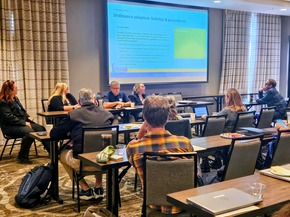 Attendees participating in the legal training. Photo by Shylea Wingard
|
|
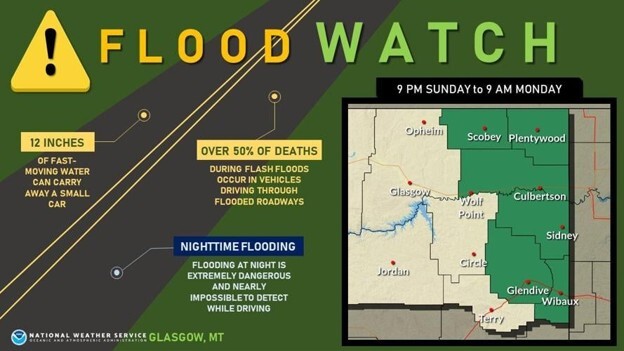 Floodplain veterans often say it is not a matter of "if" the flood happens, it is "when." This summer multiple slow‑moving thunderstorms delivered sporadic and unpredictable rainfall that pelted communities and caused localized flooding.
Glasgow experienced severe flash flooding around July 4 after receiving 2 to 4 inches of rain in one to two hours. The event damaged several businesses, eroded dirt and gravel roads, and severely damaged paved roads in multiple locations. One resident commented, "you can fix the road or building, but you can't fix the loss of income or the disruption. It is stressful and it costs money you don't have. Mostly there's a mental toll you didn't realize."
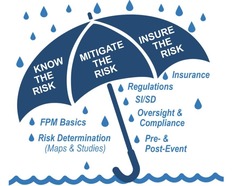
Flood resilience involves more than responding after a disaster. It also depends on planning and preparation before a flood. Are flood vents installed? Is the building elevated? Do you have flood insurance? These measures can help a property owner, business or community recover more quickly.
No community can completely eliminate flood risk. Understanding hazards, reducing vulnerabilities and maintaining appropriate insurance can help residents and communities recover more quickly after disasters.
|
|
The Big Thompson Flood of 1976 Still Matters Today
On the night of July 31, 1976, a powerful thunderstorm stalled over the Big Thompson Canyon west of Loveland, Colo. The torrential rainfall resulted in a flash flood that killed 144 people and became the single deadliest disaster in Colorado's history.
Research conducted soon after the flood found that survival often depended upon a simple but critical decision: getting out and climbing uphill to safety.
Lori Peek, professor of sociology and director of the Natural Hazards Center at the University of Colorado Boulder, said research after the flood resulted in an enduring lesson that is still valid 50 years later.
A (new) sign emerged in 1977
Today, Colorado canyons are marked by a yellow sign depicting a person climbing uphill.
The climb-to-safety signs came from an August 1977 working paper CU Boulder researcher Eve C. Grunfest, who interviewed flood survivors, first responders, and emergency management professionals to identify what people did during the flood that contributed to their survival. Many of those who perished were trapped in cars either trying to escape or parked by the river. They did not seek higher ground.
Peek says those signs endure today because they communicate something essential: Survival depends upon taking immediate action.
|
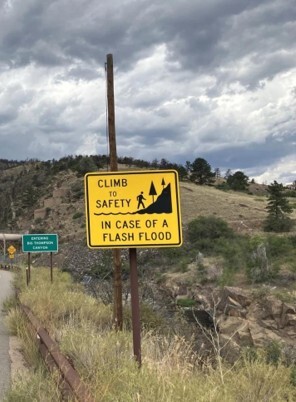 In Colorado the bright yellow signs depicting a person climbing uphill warn flood survival depends on taking immediate action. (Photo: Brad Turner/KUNC)
|
|
New Floodplain Variance Form Available Online
Variance forms play an important role in helping communities evaluate requests for exceptions to floodplain regulations when unique circumstances arise. This form helps communities ensure that decisions do not increase flood risk or create additional public-safety concerns.
For applicant's seeking a project variance from their local communities, an updated application form is available in two different formats. There is a fillable PDF version which allows the applicant to complete the form digitally with electronic signatures and a Word document version which was created for those who prefer to print a hard copy, fill out, and sign with traditional ink signatures.
Forms are available on the DNRC Floodplains website. In addition, an update of the State Model Ordinance has been posted. Applicants are encouraged to review these updates to ensure all permitting and variance submissions align with current floodplain regulations.
|
 Swan Lake Dock Photo: by Traci Sears
|
|
 |
|
Upcoming Workshops and Events
|
-
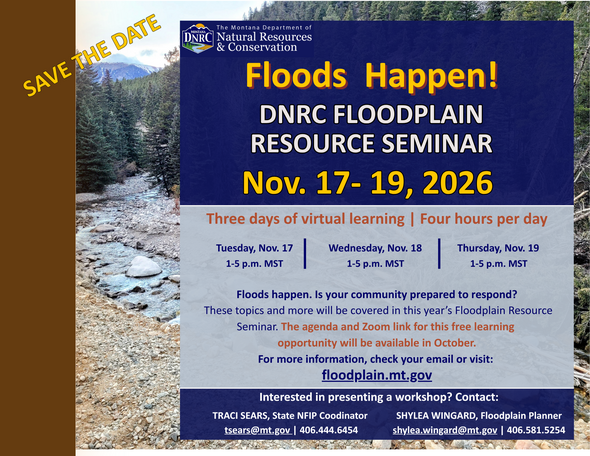
LOCAL FLOODPLAIN TRAINING
-
Oct. 1, 2026: Broadwater County Conservation County District – Realtor and Floodplain Training in Townsend, Montana. For more information, contact Denise Donnelly at broadwatercd@gmail.com
-
Nov. 17, 2026: Granite Conservation District Realtor and Floodplain Training in Phillipsburg, Montana. For more information, contact Jody Cutler at graniteconservation@macdnet.org
-
MONTANA SILVER JACKETS
-
Oct. 16, 2026: Virtual meeting. To receive an invitation or learn about participating in a Silver Jackets event, contact Amanda Peterson at amanda.peterson@mt.gov
-
FLOODPLAIN BOOTCAMP
-
Jan. 8, 2027: DNRC will kick off its virtual training series. Classes will meet for one hour each week through May and cover basic floodplain-management topics and Certified Floodplain Manager exam preparation. For more information contact Shylea Wingard at shylea.wingard@mt.gov.
-
ADVANCED FLOOD RECOVERY TRAINING
- To schedule a training for your county or community, contact Traci Sears at tsears@mt.gov.
-
STREAM PERMITTING WORKSHOPS
- Do you know how the stream permitting process works, which agency needs a permit application, or what information is needed? To set up training for your community, contact Traci Sears at tsears@mt.gov.
|
|
CFM Exam Study Webinar - A Guide to Becoming a CFM
November 4, 2026
Interested in becoming a Certified Floodplain Manager? ASFPM will offer a two-hour webinar Nov. 4, 2026, covering the certification process, study topics, preparation time and how to sign up for the exam.
|
|
 |
|
|
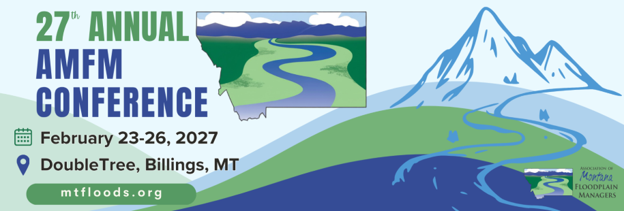
The Association of Montana Floodplain Managers invite you to learn more about its membership and its annual conference at www.mtfloods.org
Registration opens on Oct. 1.
CALL FOR ABSTRACTS IS NOW OPEN
Your workshop ideas are due Dec 1, 2026
|
|
"Learn as You Lunch" Monthly Workshop
Join the Utah Department of Emergency Management on the third Wednesday of every month for a floodplain workshop over your lunch hour (12-1 p.m.).
Participation is open and the Utah welcomes Montana's participation. Login to the on-line training via Zoom at: https://utah-gov.zoom.us/j/88436077657
Email: McKenzie Ranney, mckenzieranney@utah.gov
|
|
|
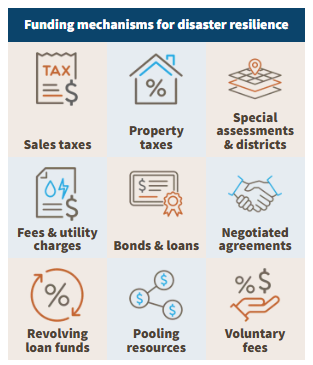
Funding for flood and wildfire mitigation projects is critical to local communities to plan and prepare for disaster events. Securing that funding is a challenge especially when grant programs are often project-based, competitive, require a match and have funding sources that vary from year to year.
Headwaters Economics has published two guides that can help local leaders and grant writers identify local funding strategies that work best for their communities: one is focused on flood resilience, and the other is focused on wildfire resilience.
|
|
 |
|
|
DNRC Grant Opportunities
DNRC administers a wide range of grants and loans for Montana, assisting cities and towns, conservation districts, private landowners, and other groups in managing natural resource and floodplain issues at the local level. Visit the Montana DNRC Grants Submission Manager to learn more.
|
|
 |
|
Bridget Lee is joining the DNRC as a Floodplain Engineer Intern.
She graduated from Montana Tech with a degree in Environmental Engineering and previously worked for Idaho National Laboratory doing air quality engineering. She enjoys backpacking, skiing and climbing in her free time.
|
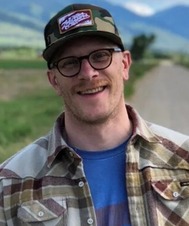
Zachariah Campbell has been hired as the state floodplain engineer supervisor. He graduated from Montana State University in 2016 with a B.S. in Civil Engineering. He brings a decade of experience focused on natural resources and water resources engineering.
Outside of work, Zachariah enjoys spending time outdoors with his wife and two kids. His favorite activities include whitewater kayaking, hunting, mountain biking, and various other outdoor activities.
|
|
|
|
Click image for directory of local floodplain managers
|
DNRC Floodplain - Community Assistance Program (CAP)
Traci Sears, State Coordinator National Flood Insurance Program
Phone (406) 444-6654 | tsears@mt.gov
Shylea Wingard, DNRC Floodplain Planner
Phone (406) 581-5254 | shylea.wingard@mt.gov
|
|
|
|
|