|
Welcome to the inaugural edition of Stories from the Frontlines.
This newsletter is dedicated to the people working every day to protect Montana’s lands and waters from invasive species. Our goal is simple: share real stories from the field that celebrate successes, highlight lessons learned, and strengthen connections across our community.
Share your story!
Your experience can provide valuable insight to others. We want to hear from field crews, natural resource managers and others who want to share on-the-ground experiences. Send a brief note about your story (photos or video are encouraged) to Russ Hartzell at russ.hartzell2@mt.gov. We may feature it in an upcoming Stories from the Frontlines bulletin.
Story by: Josh Wagoner, Montana Department of Agriculture -- Early Detection Rapid Response Coordinator
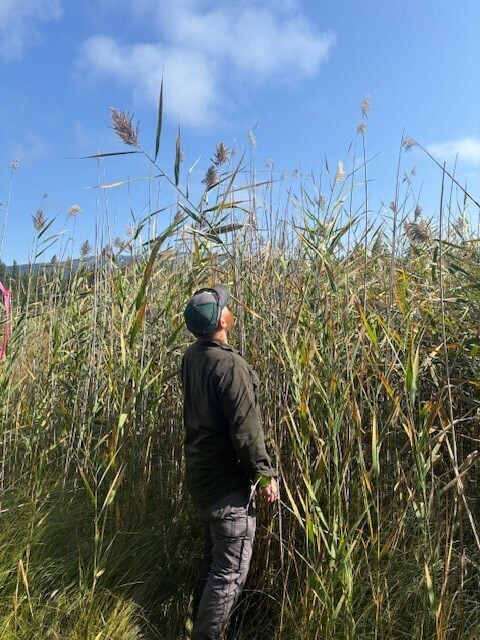
Native phragmites in Lincoln County, September 2025. Photo: Josh Wagoner
Montana’s wetland defenders have another win to celebrate.
Three suspected infestations of invasive phragmites (Phragmites australis ssp. australis) in northwestern Montana were confirmed as native phragmites (P. australis ssp. americanus) late last summer after expert review and genetic testing. That means local habitats remain intact—and limited response resources stayed focused where they’re needed most.
Why this matters
- The invasive subspecies of phragmites (also know as Common Reed) can form dense monocultures that disrupt habitat and hydrology and has contributed to serious wildfire risk in other states. It’s also difficult and costly to control once established.
- Montana also has a native subspecies that plays well with other native plants and supports healthy wetlands. Distinguishing between the two is challenging—even for experienced botanists—so careful verification is essential.
A decade of vigilance
- Invasive phragmites was added to Montana’s Noxious Weed List in 2015 as a Priority 1A species—the highest-ranked and least abundant category—triggering rapid-search and rapid-response emphasis.
- Since listing, only three additional invasive sites have been found statewide (two in Gallatin County and one in Missoula County), reflecting strong surveillance and effective collaboration.
- The latest suspected sightings in the winter 2025 came through a true team effort: Montana Department of Agriculture’s Early Detection, Rapid Response program (MDA EDRR); Montana Fish, Wildlife & Parks’ Aquatic Invasive Species (FWP AIS) Early Detection and Monitoring program; the Montana Natural Heritage Program (MTNHP); and a sharp‑eyed private citizen reporting via iNaturalist.
How the team got to “native”
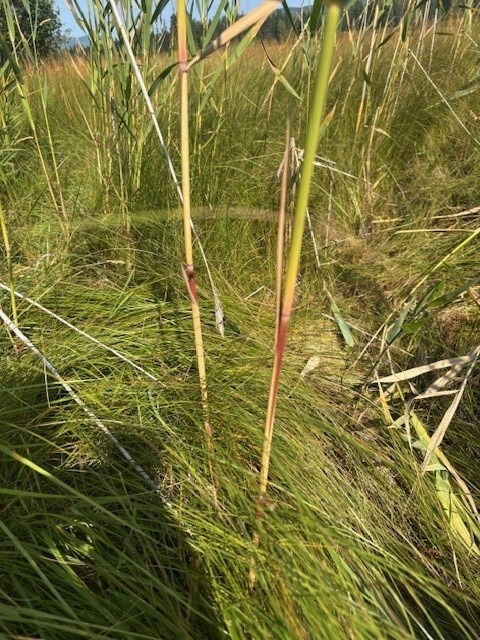
- Visual identification is tricky most of the year. From late August to early October some helpful cues appear: native stands often show a reddish hue near stem bases and begin to senesce (yellow) in September, while invasive plants commonly stay green into October.
- For a quicker verification we sent phragmites samples to the Montana State University (MSU) Extension’s Schutter Diagnostic Lab for morphological analysis and to partners for genetic testing. The verdict: all three northwestern sites are native.
Native phragmites, note early senescence (yellowing), the reddish tint at some stem bases, and other grasses intermingled throughout the stand—clues consistent with the native subspecies. Photo: Josh Wagoner
What to do on the water and in the field
- If you encounter a towering reed in a riparian area—well over head height, extremely dense, and seemingly excluding other plants—snap clear photos and capture the GPS coordinates.
- Submit your report using EDDMapS or contact MDA EDRR, FWP AIS Early Detection and Monitoring, your county weed district, or your local Extension office. Early, accurate reports keep Montana’s wetlands resilient and our management targeted.
Call to action
Your eyes on the ground help Montana keep writing winning stories. See something unusual? Report it. Preferably with photos, location, and notes on stand density and color.
Quick ID tips for late summer–early fall communications
- Look for a reddish hue at the lower stem and earlier yellowing in September (often native)
- Watch for persistent green, lush appearance into October (often invasive)
- Check stand structure: absolute monocultures with little to no understory merit extra scrutiny and a report.
Credits: Thanks to MDA EDRR, FWP AIS Early Detection and Monitoring, MTNHP, MSU Extension’s Schutter Diagnostic Lab, county weed coordinators, Extension agents, and engaged community members who report observations through platforms like iNaturalist and EDDMapS. Your collaboration keeps Montana’s lands and waters protected.
Let us know if you have a story to share. Contact MISC Program Coordinator Russ Hartzell at russ.hartzell2@mt.gov.
|