| |
Montana Highground Newsletter
June 2026
|
|
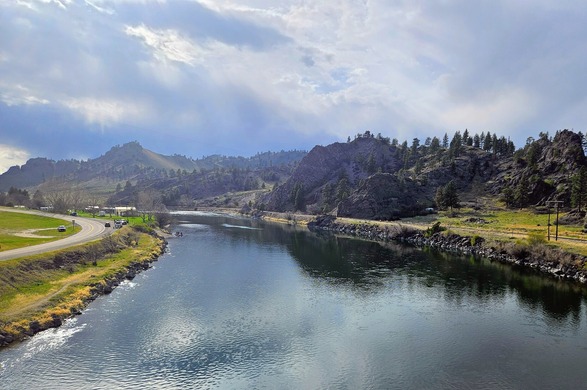
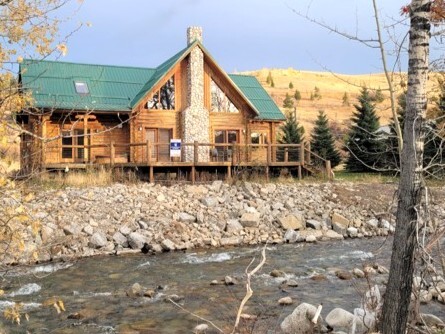
Spring comes to the Missouri River near Dearborn, MT. Much like the winter snow pack, rain has been spotty throughout the state prolonging drought conditions in many areas. This allows for floodplain professionals to prepare and mitigate for future flood conditons. (Photo: Shylea Wingard)
|
|
|
The Montana Highground newsletter is a quarterly publication of the Montana Department of Natural Resources and Conservation (DNRC). This edition highlights floodplain information, education, and training events to help Montana communities, property owners, and stakeholders prepare, plan, develop, and construct projects using flood safe practices and minimizing flood risk.
|
|
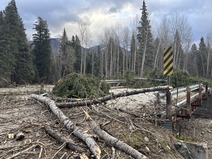
Disaster Assistance Approved for Lincoln County
On April 7, 2026, Lincoln County received a federal disaster declaration for damages caused by two back-to-back weather events that resulted in severe flooding and wind damage. Approval unlocks federal support and funding for recovery and repair to public infrastructure and facilities damaged by the December 2025 storms.
The declaration, also called Public Assistance (PA), is essential for local communities struggling to rebuild, repair and clean up after a disaster. PA will help Lincoln County address nearly $10 million in damages to washed out roads, replace damaged or destroyed bridges, and remove sediment and debris. Libby will receive funding to repair a small diversion dam on Flower Creek which provides essential drinking water to the city.
PA funding is available on a cost-share basis (75/25) to the state and eligible local governments and nonprofit organizations (NGOs). FEMA assesses the economic damage and uses a specific formula to calculate the financial impacts on state resources and local jurisdictions. From this, two types of disaster declarations can be requested: 1) Public Assistance (PA), and 2) Individual Assistance (IA). PA assists localities to rebuild public infrastructure while IA provides for individuals, households and businesses. PA and IA typically need to meet formula thresholds and are approved separately at the president’s discretion.
DNRC continues to assist Lincoln County with permitting and recovery projects located in the mapped floodplain.
For more information about Lincoln County's winter storm damage, recovery and available PA funding, click Daily Inter Lake news article from April 15, 2026.
|
|
|
 |
|
ASFPM National Conference
50 Years of Floodplain Management
|
Approximately 1,600 members of the Association of State Floodplain Managers (ASFPM) gathered for the national conference in Milwaukee, Wisconsin May 31 - June 1, 2026. Montana floodplain professionals from DNRC, private engineering, and non-profit consulting firms gathered with cohorts, experts and practitioners from across the nation for five days to exchange ideas, build connections, and learn about advanced ideas, technology and solutions to aid communities with flood preparedness, response, recovery and resilience.
Montana's floodplain leaders learned how to guide local development through FEMA policy updates, educational workshops, thought-provoking plenary sessions, and field tours showcasing innovative projects and real-world applications.
During the conference, ASFPM celebrated its 50th Anniversary as the premier flood risk management organization in the nation. Traci Sears, Montana's National Flood Insurance Program (NFIP) coordinator said, "in my opinion, the ASFPM conference is the best opportunity for connecting, sharing, and learning with professional colleagues."
 |
|
The 2027 ASFPM conference will be held in Pittsburgh, Pennsylvania, May 23-27. Set in a city where three rivers meet, the theme will be: "The Confluence of Policy, Perspectives, & Professionals."
Click for more information
|
|
|
|
$4.9 Million Levy Passes to Upgrade Glendive Levee
|
|
 |
Glendive has been working with the U.S. Army Corps of Engineers (USACE) - Omaha District to upgrade the West Glendive levee along the Yellowstone River. The $15 million project cost will be split by the USACE and the city.
To fund its share of the project cost, the city needed voters to approve a $4.9 million levy (35%). The project's future was approved by local voters on June 2, 2026. The levy passed with 1,649 votes (58%) and 1,211 votes against (42%).
The measure will fund repairs and raise the West Glendive levee by approximately three feet which is estimated to reduce flood risk by 76% during a 100-year flood event (also called the 1-percent annual chance). This may remove many west-side properties from the regulatory floodplain. If the lender or mortgage company agrees, this could eliminate the requirement for mandatory flood insurance. The levy is estimated to cost $25.87 annually for a home valued at $200,000. To review the USACE's Glendive Flood Risk Management Feasibility Study - View here
The history of Glendive's ice jam flooding is well documented at the local museum and in news articles. The 1899 ice jam took out the Bell Street Bridge, and 11 people lost their lives. Completed in 1959, the West Glendive levee has been damaged by floods in 1969, 1986, and 1994. The cost of Glendive's flooding over the years is significant in terms of loss of life and economic damage to public and private property. As such flood risk is high concern in Glendive and upgrades to the levee may improve safety, reduce future flood losses, and lower flood insurance costs for homeowners and businesses.
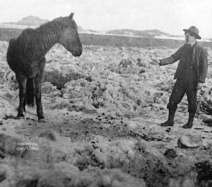
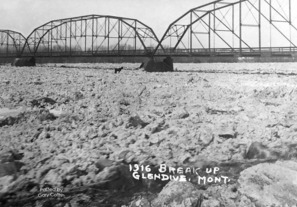
The accompanying photos share the story of a horse rescued in 1916 after being trapped by the Yellowstone River ice jam near the Bell Street Bridge in Glendive.
Photos: This horse was stranded on ice for two days in 1916. It had drifted downriver on ice from Fallon, Mont for 35 miles during the Yellowstone River breakup. The ice jammed on the Bell Bridge at Glendive and the horse was rescued. The above photo shows the horse near the bridge pillar. To learn more about this story, visit Glendive's Frontier Gateway Museum.
|
|
|
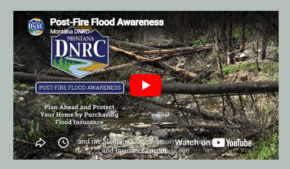
While the destructive impacts of wildfire are well known, a lesser-known effect is how wildfire can increase flood risks. Wildfires remove vegetation and leave the ground charred, unable to absorb water, and susceptible to erosion, flash floods and mud slides.
DNRC prepared a post-fire flood awareness video and press release to educate property owners and the public.
|
|
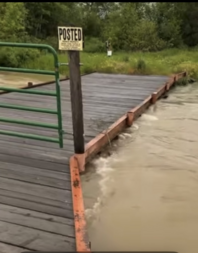
Lake County started June with heavy rainfall and runoff which caused flooding and road closures near Polson and St. Ignatius in northwest Montana.
Hydrologic conditions in the Mission Mountains triggered intense runoff in Mission Creek, Post Creek and Crow Creek - which all flow to the valley below. Water levels exceeded 700 cubic feet per second prompting emergency services assist property owners, close roads, and monitor conditions.
The DNRC's Community Assistance Program (CAP) responded to requests from the Lake County Floodplain Administrator, Tiffany Murphy, who asked for assistance and training on how to respond to the flood event, assess substantial damage. and notify property owners located in or near the mapped floodplain about repairs or rebuilding projects that could trigger permitting requirements.
DNRC floodplain coordinator, Traci Sears, said, "It is events like this that remind us how quickly flood events can arise and tell us not to take drought conditions for granted. Floods can happen anytime, anywhere."
|
|
|
Montana Floodplain Disclosure Regulations
Three mainstays in real estate are disclose, disclose disclose, followed closely by location, location, location. However, in the United States, there is no federal requirement for home sellers and their agents to disclose information about a property's flood risk or previous flood damage to prospective home buyers.
|
Many states have adopted flood disclosure and adverse property impact regulations to protect unsuspecting home buyers. According to a study by the U.S. Natural Resources Defense Council (NRDC), homes that are at risk of flooding and have flooded at least once are likely to flood again. Home buyers cannot make good purchase decisions or protect their investments if they do not have a property's flood history.
Properties in high-risk flood zones (also known as 100-year flood or FEMA's 1-percent annual chance areas) have a 26% chance of flooding over the life of a 30-year mortgage. That is why flood insurance is a mandatory requirement for structures purchased with a federally backed loan and located in high flood risk areas identified as Zones A, AE, AO, AH, V, and VE. Structures located in a moderate risk area (Zones B, D, or X) or not purchased with federally backed funds are not required by federal law to carry flood insurance, however this is ultimately a lender's decision.
Luckily for Montana buyers, state regulations (ARM 36.15.204(2)(g)), recent updates, and local floodplain ordinances require full flood disclosure in real estate transactions. All property owners or their agents are required to notify potential buyers or their agents if a property is in a designated flood hazard area. Both the real estate agent and the seller can be held liable if any known defects (flood risk, damage, or flood event) are not disclosed. In 2023, Montana officially codified a statewide residential property disclosure which requires sellers to provide buyers a statement detailing any known adverse material facts (or problems) that could affect the property's value or use. This includes previous flooding or damage.
For more information, contact DNRC Floodplain's Community Assistance Program or read "Buyer in the Know: Flood & Floodplain Disclosure Under Montana Law."
|
|
Floodplain Training Events and Resources
|
|
 |
|
Education and Training Events
|
-
2026 DNRC FLOODPLAIN ANNUAL RESOURCE SEMINAR
- Save the Dates: November 17-19, 2026
- Resource Seminar is a three-day virtual event. Workshops are offered for four hours each day on Tuesday, Nov. 17 (1 p.m. - 5 p.m.); Wednesday, Nov. 18 (1 p.m. - 5 p.m.) and Friday, Nov. 19 (8 a.m. - 12 p.m.). More details will be sent via email.
- For more information, contact: shylea.wingard@mt.gov
-
FLOODPLAIN BOOTCAMP
- Floodplain Bootcamp wrapped up the end of May. DNRC will start its next annual session in January 2027. Weekly one-hour training will be offered virtually through May. Topics will focus on basic floodplain management and prep for the Certified Floodplain Managers exam.
- For more information, contact: shylea.wingard@mt.gov
-
ADVANCED RECOVERY TRAINING FOR FLOODPLAIN MANAGEMENT
- This training helps communities streamline and coordinate recovery efforts after a disaster. Learn about the challenges to local resources and personnel, how conduct substantial damage estimates (SDEs), and what resources are available to assist.
- To schedule a training event, contact: Traci Sears, tsears@mt.gov
-
STREAM PERMITTING WORKSHOPS
- This training brings all permitting agencies together to help local communities understand jurisdictions, how to coordinate efforts and share information about what is needed and who to contact when projects and development take place along Montana waterways.
- To schedule a training event, contact: Traci Sears, tsears@mt.gov
-
FLOODPLAIN TRAINING - What Montana Real Estate Professionals Need to Know
- Did you know that properties in the floodplain are unique and may have different criteria for development, lending, or realtor representation?
- This training is approved for continuing education credit with the Montana Association of Realtors (MAR).
- The Helena Association of Realtors will host an event on May 6, 2027.
- To schedule, please contact: shylea.wingard@mt.gov
-
MONTANA SILVER JACKETS
- The Montana Silver Jackets is a group where local, state, and federal officials from both the public and private sectors meet to collaborate on floodplain management, assess needs and resources, and illuminate and share project ideas or work being done in Montana's floodplains.
- To participate in Silver Jackets, contact: Traci Sears, tsears@mt.gov
|
|
Utah's "Learn as You Lunch" Workshop Series
Montana floodplain professionals are welcome to join the Utah Department of Emergency Management on the third Wednesday of every month for a floodplain workshop over lunch (12 p.m. - 1 p.m.)
Access the on-line training via Zoom at: https://utah-gov.zoom.us/j/88436077657 | [utah.us7.list-manage.com]
The Utah Floodplain CAP team is always looking for more presenters and ideas! Reach out to McKenzie Goodenough, mgoodenough@utah.gov.
|
|
Notice of Federal Opportunities (NOFOs) Closes Soon
|
|
BRIC - Building Resilient Infrastructure and Communities
|
FMA - Flood Mitigation Assistance
|
|

|
The long-awaited Building Resilient Infrastructure and Communities (BRIC) Notice of Funding Opportunity (NOFO) was released spring of 2026. Montana Department of Disaster and Emergency Services (DES) will not accept applications for BRIC later than July 3, 2026 to allow for time to review and rank all applications prior to FEMA's submittal deadline on July 23, 2026. For more information, see: des.mt.gov/Grant-Programs/BRIC-Program
Flood Mitigation Assistance (FMA) is a competitive grant used for projects that reduce or eliminate the risk of repetitive flood damage to buildings insured by the National Flood Insurance Program (NFIP). FMA Swift Current funding is used to reduce the risk of flood damage to NFIP insured buildings after a flood-related major disaster declaration. Applications are due August 6, 2026.
|
|
|
DNRC Grant Opportunities
DNRC administers a wide range of grants and loans in Montana, assisting cities and towns, conservation districts, private landowners, and other groups in managing natural resource and floodplain issues at the local level. Visit the Montana DNRC Grants Submission Manager to learn more.
|
|
|
Click to contact your state and local floodplain managers
|
|
|
|
|