Conservation & Partnerships
In drying West, hope for wetlands found on working lands, says new study
Western Landowners Alliance, On Land, Written by: Thomas Plank
The warming climate in the American West is drying out wetlands at a greater scale than previously known. But where wetlands remain, and why, may surprise you.
A 2025 paper, “Going, going, gone: Landscape drying reduces wetland function across the American West,” published in Ecological Indicators used satellite imagery and cloud computing techniques to determine that the West has lost significantly more wetland between 1984 and 2023 than previously thought. Lead author Patrick Donnelly, a research scientist for Ducks Unlimited and affiliate faculty at the University of Montana, said climate change is mostly to blame.

Conifer Encroachment
Is this sneaky issue costing your ranch money?
Good Grazing Makes Cents, Written By: Good Grazing Staff
So, it’s clear there are many ways in which conifer encroachment can cause issues in rangeland ecosystems. But, in the spirit of GGMC, what are the financial implications to ranchers? Let’s look at some facts compiled by the Working Lands for Wildlife (WLW) Conifer Encroachment Education Project:
-
Perennial herbaceous cover in sagebrush grasslands can be cut in half when conifer cover exceeds 40% (Roundy et al. 2014)
-
Livestock ranching income can be cut by one-third as sagebrush grasslands are converted to woodland (McLain 2013)
-
Across all western rangelands, tree encroachment since 1990 has resulted in lost grazing land production valued at $4.1–$5.6 billion (Morford et al. 2022)
Chinook Students Benefit from Growing Support from Local Ranchers
Even as the school year begins to wind down, something special is taking shape for Chinook students.
Building on a tradition of local support for Chinook schools, community members are coming together in a more coordinated way to provide consistent, locally raised beef for students.
“This community takes pride in its kids,” said local rancher Christie Nissen. “When ranchers know they can help feed students with something they raised themselves, it means a lot. It is a way for agriculture to give back to the next generation.”
 Looking to buy or sell hay or straw? Need to lease pasture or have some available? Mountain West Grazing is here to help! With the launch of the grazing connection, you can easily post listings FOR FREE to connect with others in the ag community - this is your go-to resource.
Agency Updates
Funding Available Now!
Multiple Grant Opportunities
DNRC administers a wide range of grants and loans for Montana, assisting cities and towns, conservation districts, private landowners, and other groups in managing natural resource issues at the local level.
The Ranchland Stewardship Program (RSP) aims to expand and increase the use of technology to improve grazing management planning and adaptive strategies that enhance soil health. The RSP plans to use data-driven adaptive management decision-making tools to increase carbon storage in the soil, thereby increasing soil carbon sequestration on Montana’s expansive and diverse rangelands.

BLM, Forever Branded to host Wild Horse and Burro adoption events in Hamilton
The Bureau of Land Management and Forever Branded are scheduled to host a series of Wild Horse and Burro adoption events at the Matt Bischof Training Facility.
The first event will be held April 24, 4 –8 p.m. and April 25, 9 a.m.- 4 p.m., at 736 Alvista Loop in Hamilton, Montana. This event will provide the public an opportunity to adopt about 70 available wild horses and burros. Bids start at just $125. Adoptions from this event will be eligible for Forever Branded’s 2026 Missouri Branded Bonanza, a competition offering an opportunity for trainers to improve their horsemanship and for the animal to gain the skills needed to be successful in their new, domestic life. During this event, a clinic by Mustang Matt will be available to the public. Additional details to come.
 MDA Spring 2026 Pesticide Disposal Events Reminder
The Montana Department of Agriculture (MDA) is facilitating spring pesticide disposal events during the week of April 7 - 9, 2026, in Kalispell, Plains, and Missoula.
The primary objective of the Montana Pesticide Stewardship Partnership Program is to have a lasting impact on the health and water quality of the upper Columbia River Basin (CRB), knowing that protecting the upper basin will also have a sustained positive effect downstream. The Environmental Protection Agency’s (EPA) Columbia River Basin Restoration Funding Assistance Program was started in 2016 to better monitor and make a positive impact in the Columbia River Basin.
Annual pesticide waste collection events have collected nearly 884,000 pounds of pesticide waste from over 1,900 participants since the program’s inception in 1994.
“When it comes the disposal of pesticide products, Montana has limited options,” said Carli Davis of the MDA’s Pesticide Disposal and Container Recycling Programs. “Year after year, this program continues to ensure that waste product is properly disposed of in a manner that is also environmentally friendly.”
The MDA program was designed to assist individuals with disposing of any pesticides that are unusable as originally intended, or cannot be used for any other purpose, in an environmentally responsible way. In effect, the Pesticide and Waste Disposal Program protects Montana’s ecosystems and groundwater, as well as families, pets, livestock and drinking water from potentially hazardous materials.
2026 Pesticide Waste Collection Dates and Locations:
Spring Event
Tuesday, April 7 – Kalispell, MT
Wednesday, April 8 – Plains, MT
Thursday, April 9 – Missoula, MT
 Developing and Implementing a Burn Plan
This brief shares insights from a June 4, 2024, prescribed fire field day hosted by the US Forest Service (USFS) and Great Basin Fire Science Exchange (GBFSE). The field day highlighted burn plan development in the Wildland Urban Interface (WUI) of Whites Creek on the Humboldt Toiyabe National Forest. It also serves as an example of the types of relationship-building and communication opportunities and products the GBFSE makes possible through regional fire management partnerships
 Snowpack deficits continue to grow across Montana as unseasonably warm temperatures persist
As of March 1, most Montana basins are now reporting below normal snowpack, ranging from around 60% to 95% of median.
“The current snowpack percentages compare the amount of snow water equivalent in the mountains to the median amount typically seen on March 1. During March and April, these values generally remain more stable than people might expect. For example, during a low snow year like the one Montana is currently experiencing, snowpack often sits around 70-80% of median. In contrast, a high snow year might reach 120-130%,” explains Florence Miller, USDA Natural Resources Conservation Service (NRCS) Hydrologist. “Percentiles provide a different perspective by telling us how conditions rank compared to all others on record. Think of lining up all winters from lowest to highest snowpack, this year’s conditions largely range from the 5th to 30th percentiles, meaning our current snowpack ranks in the bottom 5% to 30% of all seasons.”
 FWP Public Notices & Opportunity for Comment
Podcast Corner

AoR 178: Flavie Audoin on Animal Geolocation and Virtual Fence Technologies
Just when you thought you'd heard everything about virtual fence, another podcast episode comes along. But Dr. Flavie Audoin, University of Arizona Cooperative Extension rangeland specialist, may be one of the most importance "voices" to listen to on the strengths and weaknesses of virtual fence and animal geolocation technologies. She has been in the middle of much of the early vendor comparison work as well as experimental research on animal physiology considerations and environmental applications for remote animal location detection and control. Listen to this interview to learn about the mechanisms of virtual fence options, a comparison and contrast of features on offer, and current research on graziers can better manage wild, open spaces with a back-to-the-future approach to modern herding.
|
Season Four: Succession Stories
Aging farmer demographics, rising land values, climate change and farm stress are creating a challenging environment for the successful transfer of farms and ranches to the next generation. Behind the legal, financial and familial considerations of farm and ranch transition, lies a wellspring of stories that do not often surface in conventional planning discussions. In Season Four, Reframing Rural unearths the stories laying beneath the logistics, stories from families navigating complex social and environmental factors as they work to preserve their agricultural way of life.
|
Research Center
To make the 406 Rangelands newsletter more reader friendly, the "Research Center" section has been permanently moved to the Rangeland Resources Program website. You can access it here.
April
-
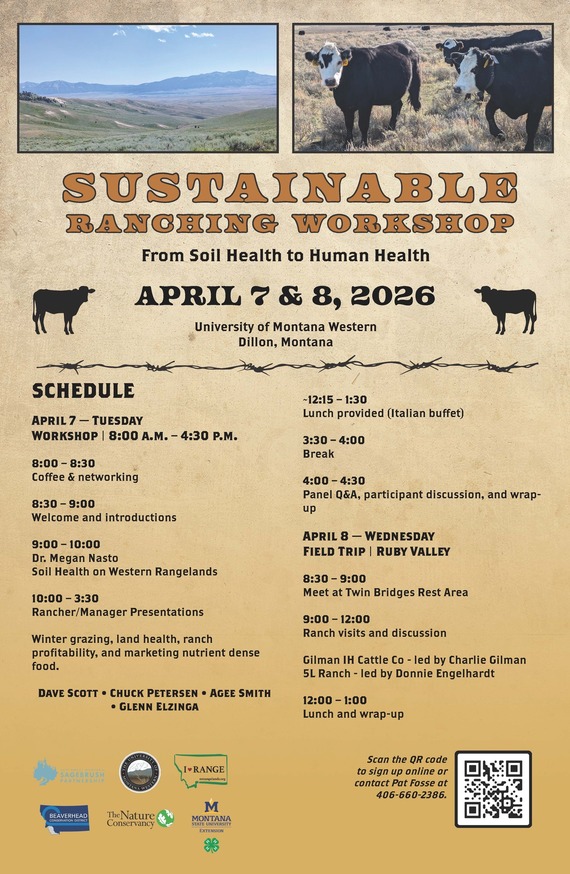
7-8 - Increasing Ranch Profitability Wkshp (Dillon, MT)
For details, click here
-
-
-
10-12 - Red Ants Pants: Women in Ag Communities Scholarships are available! Learn more and register HERE
-
-
-
-
-
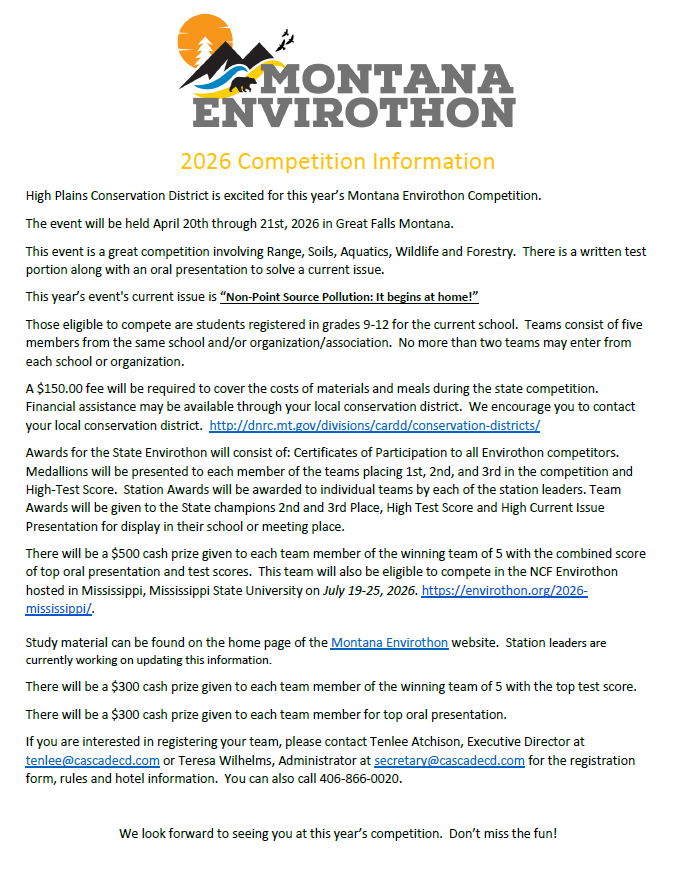
20-21 - MISC Quarterly Meeting (Bozeman, MT)
May
June
July
August
December
Contacts
Stacey Barta, State Coordinator for Rangelands
(406) 594-8481
SBarta@mt.gov
Rangeland Resources Committee:
Diane Ahlgren, Chair
Perri Jacobs, Vice Chair
Steve Carey
Sigurd Jensen
Jim Anderson
Ryan Green
|