|
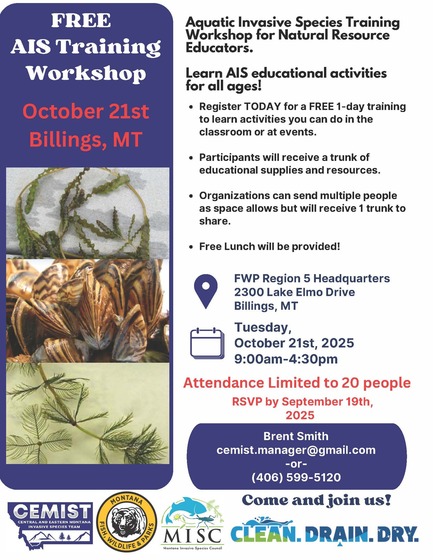
Register for Train the Trainer Workshop for Natural Resource Professionals on October 21st |
|
Registration Deadline: September 19th
Free 1-day training in Billings
As invasive species issues attract more attention, it is not unusual for agencies and organizations to receive requests from schools or teachers to provide programs dealing with invasive species. Unfortunately, many who are asked to provide these programs are not trained to lead educational programs and may be uncomfortable at the task.
Train the Trainer is designed to address the needs of organizations & agency staff so they become comfortable at providing quality invasive species education programs upon request.
The Train the Trainer Workshop combines presentations about how to work with schools and students with hands-on training/activities to deliver quality AIS education programs. Training is provided on how to interact with teachers and schools, how to deal with students of various ages and how different learning styles impact the ability to reach students.
This workshop will be instructed by MT FWP Staff and Matt Wilhelm from Yellowstone Fly Fishing School. Matt is the past educational director and professional instructor for the Invasive Species Action Network and has been an aquatic and angling educator for 23 years with over 140,000 students served statewide.
To register email Brent Smith at cemist.manager@gmail.com or call 406-599-5120.
Aquatic Pet Rehoming Event
September 27 at Montana Wild in Helena
Do you have a pet that you are no longer able to care for? Don't Let It Loose into the wild! Instead, you can find your pet a new home at the FREE Aquatic Pet Rehoming Event on Saturday, September 27, 2025, from 10:00am – 3:00pm.
This event is hosted by Invasive Species Action Network (ISAN), and animal surrenders will be accepted in the auditorium at Montana WILD in Helena. Although Montana WILD is typically closed to visitors on weekends, the main exhibit hall will be open to the public during the event and will even feature invasive species learning opportunities from partners across the state!
At this event, local pet stores and animal rescues will be accepting fish, turtles, frogs, aquatic plants, and other aquatic pets for rehoming. Non-aquatic species, venomous animals, waterfowl, or domestic pets, such as dogs, cats, rabbits, pigs, birds, and chickens will not be accepted.
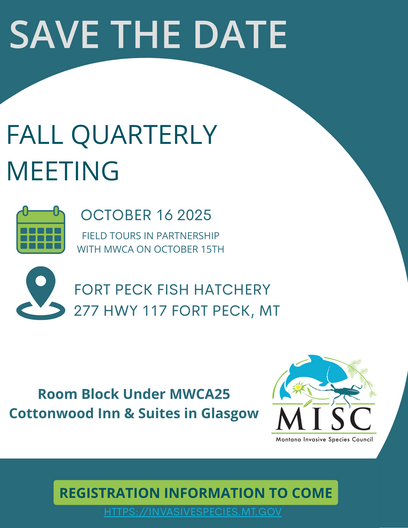
Montana Invasive Species Council Fall Meeting
October 16 at the Fort Peck Fish Hatchery
Join the Montana Invasive Species Council (MISC) at our next meeting on Oct 16th at the Fort Peck Fish Hatchery. Invited guests will sharing information about the Saskatchewan feral swine program and the North Dakota aquatic invasive species. Register to attend here.
The Montana Weed Control Association (MWCA) will hold their Fall Training at the Fort Peck Interpretive Center on October 15-16. See the draft agenda.
|
|
Tracking Ticks in Wyoming
"There are ticks in Wyoming and some of them can make you sick"
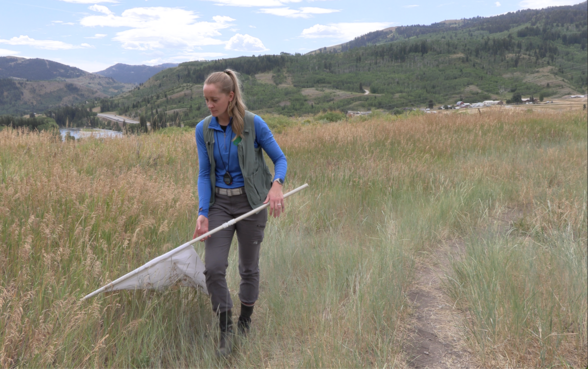
Western IPM Center - When hikers see Mikenna Smith or Kelsey Mitchell dragging a big white flag at the edge of popular hiking trails in Teton County, Wyoming, they naturally ask what the heck they’re doing. The conversation often goes something like this:
“What the heck are you doing?” hikers ask.
“Collecting ticks,” reply Smith or Mitchell, who both work for the Teton County Weed and Pest District.
“There are no ticks in Wyoming,” many hikers reply.
At that point, the women reach into a pocket and pull out a vial crawling with live, freshly collected Wyoming ticks – often dozens, sometimes hundreds.
Hikers’ replies to that are often (unprintable) exclamations of surprise.
Bottom line: There are ticks in Wyoming, and some of them can make you sick.
Continue Reading...
Mikenna Smith looks for ticks alongside a Teton County, Wyoming trail. Photo by Steve Elliott.
Click More Regional News
Rush Skeletonweed, Two Steps Forward, One Step Back
By Josh Wagoner, MDA Early Detection Rapid Response Coordinator
In the August 2024 MDA Pesticide Training Newsletter, Montana’s relative success with rush skeletonweed (Chondrilla juncea), a Montana Priority 1B Noxious Weed, was reviewed. Twelve months later, we are still succeeding, with ~4,000 total acres of rush skeletonweed in the state, 1/1000th of the 4 million acres to the west of us in Idaho, but that success is becoming more and more precarious with each passing week. Rush skeletonweed’s main inroads are our main roads in, not surprisingly, from the two interstate highways coming into Montana on the west side of the state, I-15 and I-90.
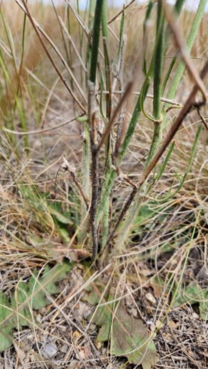
Smaller arteries, like Highway 200 and Highway 2 in the northwestern side of the state are also potential vectors, along with potentially many other roads. From roadsides rush skeletonweed can easily spread to adjacent land, where it can cause serious degradation to wildland, farm and ranchland, and even residential property, and once well-established it is almost impossible to eradicate.
This summer we have found the few previously existing rush skeletonweed sites along I-90 in Mineral and Missoula counties have greatly increased; a few plants appeared in Beaverhead County on I-15, where we have never had rush skeletonweed before; and two plants were found in the I-90 median near Three Forks, which means it made it across five counties (Granite, Powell, Deer Lodge, Silver Bow, and Jefferson) from its nearest known population in Missoula County! This is bad news and news to take seriously. The affected county weed districts and Montana Department of Transportation are doing just that, mobilizing immediately to treat known locations and wide swaths of surrounding roadsides and doing extensive surveying for additional sites, with the goal of containing and then eradicating anything found and preventing spread to other areas, but success is less likely without your help. You can contribute by looking for rush skeletonweed and reporting any suspected sightings.
|
|
|
Riparian Takeover: Stopping Woody Invasives in Their Tracks
October 27: 12:00 to 1:00 pm
Woody invasive species like common buckthorn, Russian olive, and saltcedar are thriving in Montana’s riparian ecosystems—often at the expense of native biodiversity, soil health, and water resources. This session will cover how to identify these aggressive species, understand their ecological impacts, and implement practical, site-appropriate management strategies. Whether you're a landowner, volunteer, or land manager, now is the time to take action to protect Montana’s waterways from the spread of these fast-growing invaders.
Speaker: Megan Hoyer, MDA Invasive Species Education Coordinator
Click to see more MSU Pesticide Education Webinars
|
|
 Montana Rodent Academy - September 25 in Helena
This six-hour event will provide applicator-centered training for the successful management of commensal rodents in and around structures. Instruction will cover understanding rodenticide active ingredients, selection and use of tamper-resistant bait stations, decontamination of rodent infested areas to reduce disease risk, and control of Montana’s most common structural rodent, the deer mouse. The hands-on portion of the Academy, metal bending, will consist of step-by-step instructions to create repairs that will resist rodent entry, while being aesthetically pleasing. This content will be provided by instructors representing manufacturers, distributors, regulators, and service providers who will be available to answer your questions. The cost of the training is $50, and attendance is limited.
MT Dept of Agriculture Pesticide Recertification Trainings
In-person fall recertification trainings offered at date and location below. Each training has a fee of $30. Learn more at the MDA August Newsletter.
- October 15, 2025 – Billings
- October 16, 2025 – Belgrade
- October 22, 2025 – Kalispell
- October 23, 2025 – Missoula
- October 29, 2025 – Butte
- October 30, 2025 – Great Falls
- December 10, 2025 – Helena
|
|
Common approaches to introduced species management face widespread acceptance problems in the United States
Simmons, Wade, et al., (2025). Common approaches to introduced species management face widespread acceptance problems in the United States. British Ecological Society People and Nature. https://doi.org/10.1002/pan3.70053
Decisions on whether and how to manage introduced species can be controversial, but public attitudes towards introduced species management (ISM) are poorly understood. Despite the potential disruptive impacts of such controversies on public relations and conservation goals, decision-makers are currently left with little information on the social acceptability of different management alternatives.
To better understand the social acceptability of core features of ISM in the United States, we conducted an online experiment with vignettes describing hypothetical but realistic ISM scenarios, varying targeted taxon (insect or plant), control method (mechanical, chemical and biological), risk severity (low and high) and type of non-target risk (to humans or native species).
- Not surprisingly, management with low risk was most acceptable, particularly for mechanical control. In high-risk scenarios, only mechanical control was acceptable, but only by a slim majority of respondents. Overall, chemical and biological controls showed low levels of acceptability.
- Surprisingly, there was no significant difference in how respondents ranked risks to people and risks to native species.
- Beyond differences in acceptability between management factors, we also find that the acceptability of management and attitudes towards risk were associated with respondents' demographic characteristics.
Policy Implications. Overall, our findings indicate that widespread acceptability of ISM should not be assumed. While management activities representing low-risk scenarios find some support in the public, our results highlight a disconnect between the effectiveness of common management methods and their social acceptability. Our findings highlight the need for evidence-guided ISM, which includes evidence of harmful impacts of introduced species, as well as risks and benefits of management activities, as one potential way to increase the social acceptability of non-native species management.
|
|
|
|
|