|
Save the Date
MISC Meets July 29 in Trout Creek
The next MISC Quarterly meeting will take place on July 29, 2025, at the Lakeside Resort and Motel in Trout Creek, Montana and on Zoom.
This meeting is open to the public. Persons who want to attend in-person or virtually must register before the end of day on July 24, 2025. Meeting information is available at Meetings Schedule and Meetings Archive | Montana Invasive Species Council.
Governor appoints council members to MISC
On June 17th Governor Gianforte announced the appointment of members to the Montana Invasive Species Council. These council members' terms run through May 1, 2029.
- Dylan Brown - Agriculture representative
- Martin Charlo - Confederated Salish and Kootenai Tribes representative
- Karen Laitala - County Weed Districts representative
- Dennis Longknife Jr. - Fort Belknap Indian Community representative
- Paul Rossignol - Wildlife Organization representative
- Pamela Schwend - Private Landowner representative
- Andy Welch - Hydropower Utility Industry representative
The directors of these State of Montana Departments named their designees to serve on the Montana Invasive Species Council.
- Taylor Tidwell - MT Department of Commerce
- Jake Chadwell - MT Department of Natural Resources & Conservation
- Tom Woolf - MT Fish, Wildlife & Parks
|
|

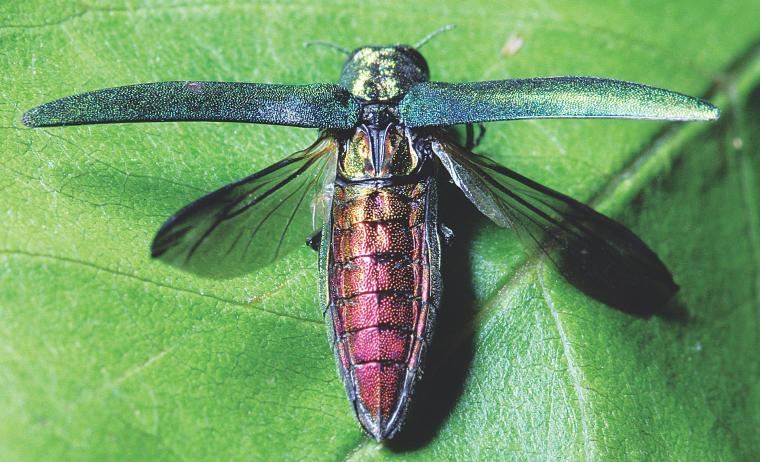
Emerald Ash Borer Response and Readiness Plan
Over the last few months, the Montana Department of Natural Resource and Conservation, Montana Department of Agriculture, Montana Invasive Species Council, and Montana State University Extension have partnered to develop the State of Montana Emerald Ash Borer Readiness and Response Plan.
This plan addresses the following objectives:
• Prevention
• Risk Assessment
• Early Detection
• Mitigation
• Restoration and Utilization
• Communication
Noxious Weed Awareness Week June 1-7
See stories and social media posts that were shared during Noxious Weed Awareness Week
 |
|
High school students pull their share of noxious weeds
MTN News Great Falls - On Wednesday, May 21, 2025, approximately 100 high school students spent some time at Giant Springs State Park to learn about invasive species, and pull their share of spotted knapweed.
|
Montana Noxious Weed Awareness Week 2025!
Stillwater County News 6/3/2025: When Pam Schwend walked into the Stillwater County Commissioner's meeting dressed as spotted knapweed on Monday, she wasn't just making a statement—she was kicking off Montana's Noxious Weed Awareness Week!
This week is all about raising awareness of invasive species and their impact on our beautiful Montana lands.
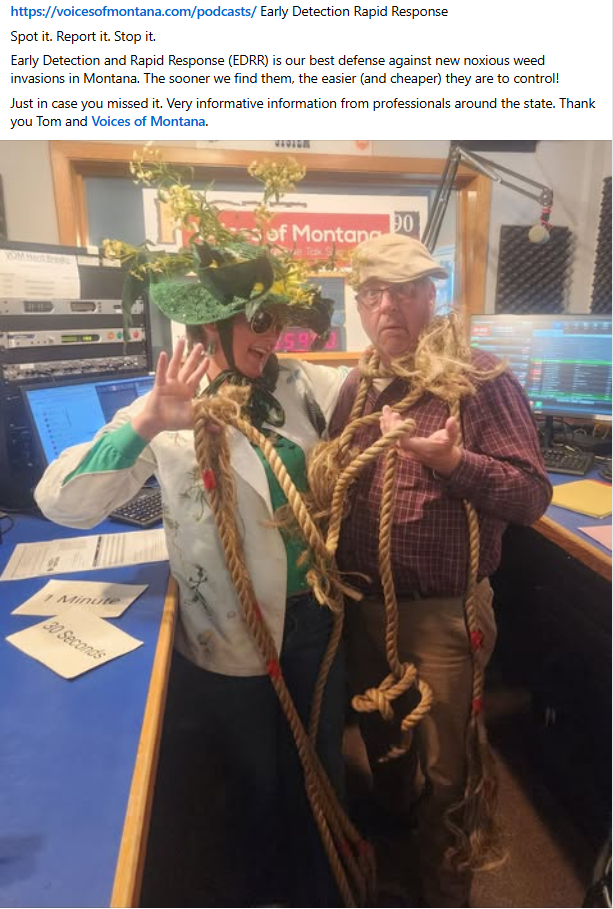
Voices of Montana Radio
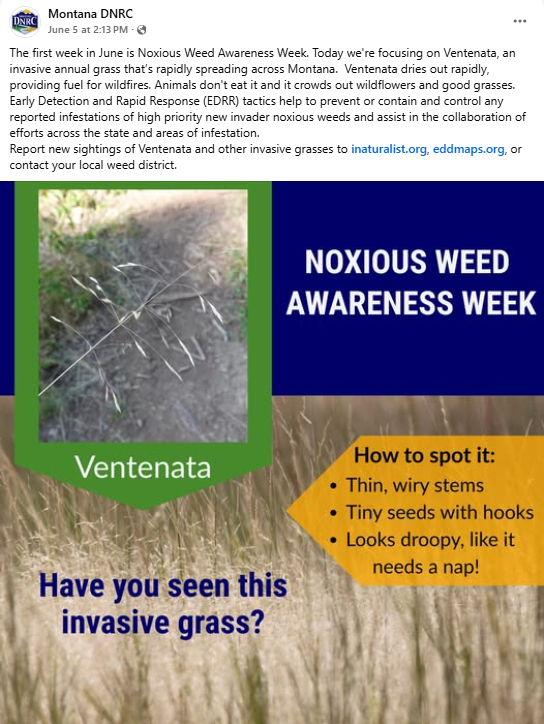
Social Media During Noxious Weed Awareness Week
69th Montana Legislature
The 69th Montana Legislature adjourned on April 30th, the 85th day of the session. MISC tracked these bills during the session.
-
HB 242 - Revise fines related to AIS. Signed by Governor 5/5/25
-
SB 167 - Provide funding for noxious weed trust. Vetoed by Governor 5/5/25. Veto override failed 6/4/25
-
SJ 42 - Interim study of noxious weed control. Filed with Secretary of State 5/6/25
Bills that Died
-
HB 57 - Designate quail as upland game bird
-
HB 829 - Generally revise laws related to aquatic invasive species.
|
|
 |
|
Watercraft inspection stations intercept 20 boats this year
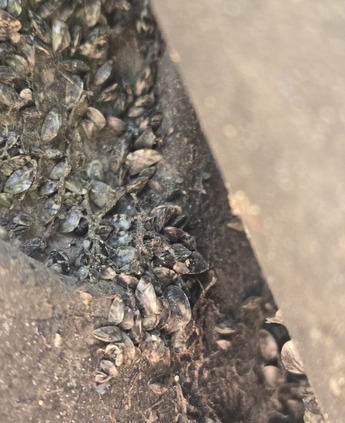
Nearly 30,000 watercraft have been inspected so far this season of which 20 mussel-fouled watercraft have been intercepted.
The most recent mussel-fouled boats were at the Wibaux Watercraft Inspection Station (June 13 & June 17) and the Ravalli Watercraft Inspection Station (June 18).
|
Boat inspection information is updated weekly on the FWP Watercraft Inspection Dashboard.
Mussels on watercraft intercepted at Wibaux watercrafte inspection station 06/17/2025
AIS Early Detection Monitoring
-
Eurasian Watermilfoil Eradication Project at Beaver Lake near Whitefish: A survey was conducted lake wide on June 3rd in coordination with the Whitefish Lake Institute. Only one plant was found during the first survey of the year. Follow-up surveys will be conducted several more times this season to ensure EWM is eradicated from the headwaters of the Whitefish and Flathead watersheds.
-
Mystery Snails in Flathead Lake: A mystery snail survey at Flathead Lake in early April identified multiple dead specimens in the Finley Point area suggesting an established population. The survey was a coordinated effort with CSKT, the Flathead Biological Station and FWP. This is the first confirmed location of the species in the state. Impacts from mystery snails tend to be minor, but their large shells can plug screens and water intakes. This population was more than likely introduced through an aquarium release.
More AIS News
 |
|
An Ode to the Infamous Dandelion
Dandelions, one of the most famous weedy plants, can be a bit of a polarizing subject: some love them, some hate them, but many often find themselves somewhere in the middle of this spectrum. Some people enjoy eating these infamous plants, while others embrace them as a source of nectar and pollen for pollinators in urban landscapes.
|
Dandelions (Genus: Taraxacum) are a widespread genus in the Aster family and contain 250 species worldwide. The two species most common in Montana are T. officinale (common dandelion) and T. erythrospermum (red seeded dandelion).
These species originate from Eurasia but have since become naturalized in many parts of the world, through intentional and unintentional introductions. Dandelions are short-lived perennial plants that can reproduce sexually (through seeds) and asexually (through the roots), can withstand a wide variety of climates and soil conditions, produce abundant seeds, and thrive in disturbed areas: all of which can contribute to the fact that dandelions are so prolific and widespread.
 Western Regional Panel Award Nominations
The Western Regional Panel on AIS (WRP) is launching an award program to honor those who work hard to protect our aquatic resources of the West from AIS. Two award categories are possible:
-
Western AIS Leader: One award shall be given to a professional individual/agency/organization that is leading the West on AIS issues. Individuals who have gone above and beyond advancing AIS prevention, early detection, management education or coordination forward in addressing Western AIS issues.
-
Best in the West: No more than 4 awards shall be given to individuals who exhibit outstanding contributions to AIS management in their commitment to management. Awarded to individuals who exhibit dedication, passion and commitment to addressing AIS issues. Outstanding interactions with the public, innovative and creative ways to address AIS issues, leadership that helps protect western waters, and doing more with less. These individuals make AIS operations the best they can be working on watercraft inspection, early detection, laboratory tasks, management and outreach.
Nomination Process:
Nominations for both categories will require submission of a description of the individual’s or entities’ dedication, passion and commitment to AIS issues that help protect the West from aquatic invasive species. Nominees do not have to be members of the WRP. Limit nomination submission to no more than 1 page.
Anyone familiar with the nominee is able to submit a nomination and are not required to be a WRP voting member. Nomination packages should include:
- Indication of award category
- Description of nominee, no more than 1 page
- High quality photo of nominee
- Contact information for award nominee and the submitting entity
Award recipients will be honored at the 2025 Joint MRBP-WRP Annual Meeting this September. Submit your nomination by August 15. Submit nomination information directly to leah@conservationcollaborations.com
|
|
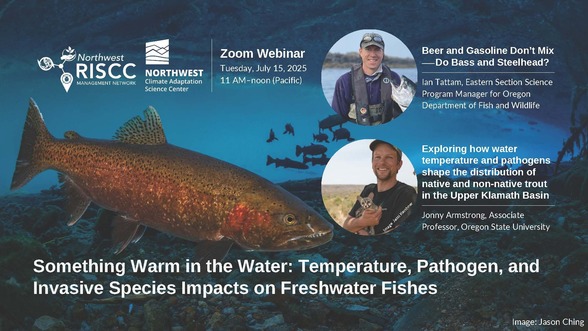 July 15. 2025 - Noon (mountain)
In this team-up style webinar, Jonny Armstrong will present NW CASC-supported research on trout, temperature, and pathogens in the Upper Klamath Basin, while Ian Tattam will discuss the Oregon Department of Fish & Wildlife’s work on non-native bass and juvenile steelhead interactions in the John Day River.
Exploring how water temperature and pathogens shape the distribution of native and non-native trout in the Upper Klamath Basin (Jonny Armstrong)
Empirical studies on disease, invasive species, and warming temperatures are often conducted in isolation, yet these factors likely have complex interactions that may lead to unexpected results. For example, temperature can mediate the impacts of pathogens on their host and host responses may depend on whether they co-evolved with pathogens. We hypothesized that fish pathogens in the Upper Klamath Basin may constrain the distributions of invasive brook and brown trout, indirectly benefiting native redband trout, which support important tribal and recreational fisheries. We used eDNA and spatial modeling to explore how the presence of six pathogens affected the landscape distributions of these three trout species.
Beer and Gasoline Don’t Mix—Do Bass and Steelhead? (Ian Tattam)
For the past 10 years we have been investigating spatial overlap, niche overlap, and predation interactions between bass and steelhead parr (juveniles) in tributaries to the John Day River.
|
|
|
|
|