|
 The Montana Department of Natural Resources and Conservation’s Rangeland Resources Program (RRP) promotes and advocates for healthy, sustainable rangelands that supports people, wildlife, recreation, clean water, and the natural scenic beauty of Montana.
News

Could bale grazing work for you?
Extending the grazing season is one of the best ways to save money on feed and reduce labor on the farm. In order to add grazing days to the calendar, farm managers must approach grazing with a plan and the willingness to be flexible. Rotationally grazing, utilizing multiple forage species and growing seasons, being thoughtful about stocking rates, adding fertility when needed, and having plentiful fence and water will increase chances for success.
|

Delivering Carnivore Conflict Prevention
|
A New Seamless Grazing Management Tool Allows Ranchers to Unlock Productivity, Sustainability, and Profitability
Forage production and harvest are the foundation of the ranching business and written grazing management plans promise to increase a producer's ability to steward their critical resources more effectively. However, the experience with most grazing management software is cumbersome, time-intensive, and rigid - failing to provide the flexibility ranchers require throughout the year. Meanwhile, the few pieces of technology that have popped up in and around cow/calf operations in the past have required an enormous amount of time, energy, and technical skill to use. Enriched Ag is on a mission to make these problems a thing of the past by simplifying the killer complexities of creating and implementing a grazing management plan.
|
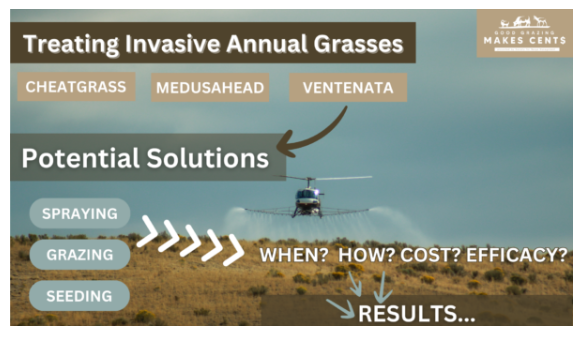
Tips, Tricks and Tactics for Treating Invasive Annual Grasses
Over 50 million acres are estimated to support more than 15 percent cheatgrass cover, “making it one of the single largest threats to the health and resilience of western working lands,” according to “A Toolkit for Invasive Annual Grass Management in the West” published by the Western Governors’ Association.
In tandem with Good Grazing Makes Cent$ Invasive Annual Grasses series, a virtual panel discussion will tackle the difficult topic of controlling invasive species including cheatgrass, ventanata, and medusahead on October 3, 2023 at 6 p.m. (MST).
Control options including herbicide treatment, reseeding, and targeted grazing will be reviewed by Justin Hossfeld, Envu Western Range Segment Manager, and Dr. Brian Mealor, Director of the Institute for Managing Annual Grasses Invading Natural Ecosystems (IMAGINE). GGMC Content Director and Oregon rancher Erika Fitzpatrick will moderate the panel, fielding live questions from the online audience regarding treatment efficacy, cost, timing, and more.
|
UI study concludes sage grouse coexist fine with cows
A 10-year University of Idaho study has recently concluded that sage grouse and cows can coexist on the same land without declines in the greater sage grouse nest success or insect abundance.
There may be benefits for the grouse living side-by-side with cows, the study suggested.
Courtney Conway, a professor of wildlife sciences at the UI, said nesting success doesn't seem to be affected by low to moderate levels of cattle grazing, and insect biomass increases with grazing.
The idea for an extensive grouse and cattle grazing research project was spurred by opposition to spring cattle grazing on federal land in the early 2000s and a lack of science to inform the debate. The project wrapped up data collection in August.
Conway joined forces with Karen Launchbaught, a professor of rangeland ecology; biologists in the Bureau of Land Management, the agency that oversees much of the sage grouse habitat in southern Idaho; Idaho Fish and Game; several ranchers who have grazing permits within sage-grouse habitat; and other partners in Idaho to bring scientific data to the debate.
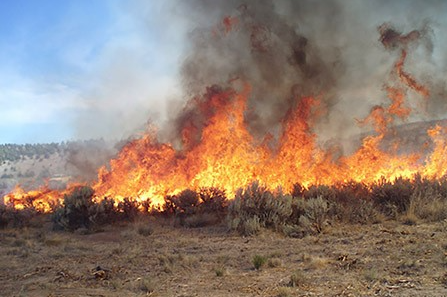
Wildfire not primary factor in invasive annual grass expansion in Great Basin
Scientists examined the assumption that wildfires are the primary factor driving the expansion of invasive annual grasses that are taking over shrubland and grassland in the U.S. Great Basin and found that annual grasses are highly competitive even in the absence of significant disturbances like fire.
In fact, according to the study conducted by scientists at the U.S. Department of Agriculture (USDA) Agricultural Research Service (ARS) and Working Lands for Wildlife-affiliated researchers at the University of Montana (UMT), almost 80% of the shrublands and grasslands in the U.S. Great Basin that have transitioned to annual grass dominance have done so without burning in the preceding 10 years.
|
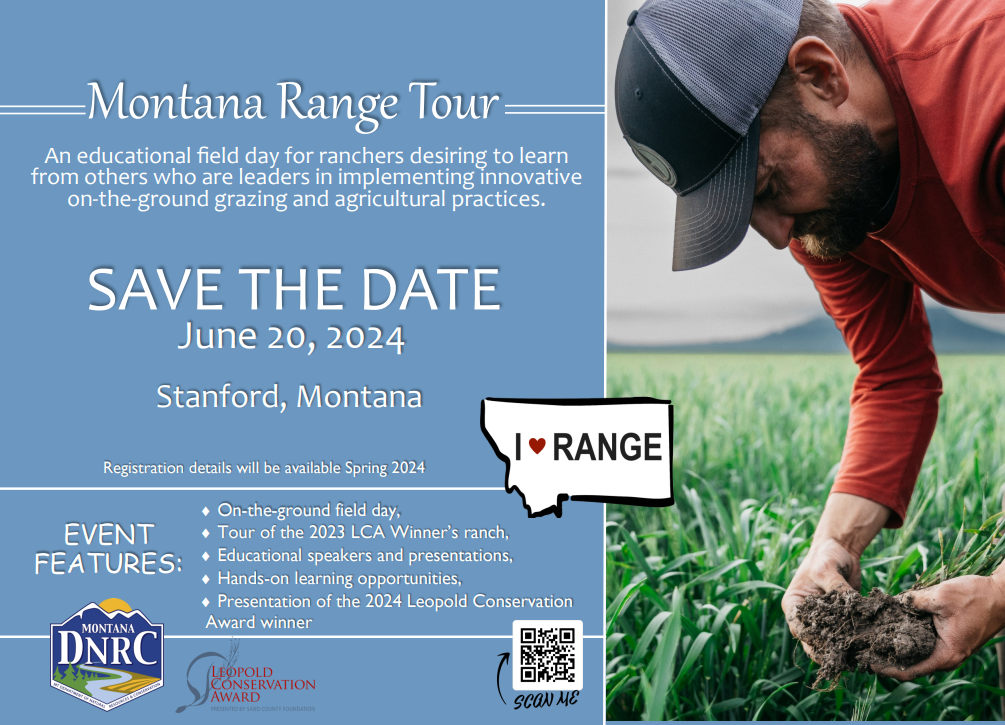
Montana Leopold Conservation Award Seeks Applicants
Nominations and applications are now being accepted for the 2024 Montana Leopold Conservation Award®.
The $10,000 award honors ranchers, farmers and forestland owners who go above and beyond in their management of soil health, water quality and wildlife habitat on working land.
Sand County Foundation and national sponsor American Farmland Trust present the Leopold Conservation Award to private landowners in 27 states. In Montana, the award is presented with the Montana Department of Natural Resources and Conservation, and the Montana Rangeland Resources Committee.
Given in honor of renowned conservationist Aldo Leopold, the award recognizes landowners who inspire others with their dedication to environmental improvement. In his influential 1949 book, “A Sand County Almanac,” Leopold called for what he called “a land ethic,” an ethical relationship between people and the land they own and manage.
Award nominations may be submitted on behalf of a landowner, or landowners may nominate themselves. The application can be found at www.sandcountyfoundation.org/ApplyLCA.
Applications are reviewed by an independent panel of agricultural and conservation leaders. Last year’s recipient was Kurt and PJ Myllymaki of Stanford.
The application deadline is March 1, 2024.
|
|
|
Conservation & Partnerships

Cowboy Quickbooks
The RSA team in partnership with our friends at Montana Roots Accounting are hitting the road and coming to a community near you (-ish!). Cowboy QuickBooks will be traveling the hi-line of Montana and hitting communities of Chester, Chinook, Malta and Glasgow in November. Register at https://ranchstewards.org/events/.
This tour features both basic and intermediate topics! You can select half day registration for $30 (mornings: basic topics, afternoons: intermediate topics) or a full-day registration for $50. Every registration includes lunch.
Our tour dates look like this:
Chester – Wednesday, November 8th
Chinook – Thursday, November 9th
Malta – Wednesday, November 15th
Glasgow – Thursday, November 16th
|


Finding Balance with Fire in Montana’s Sagebrush Country
In June, the spider web of mountains and valleys that traverse Beaverhead County in southwest Montana are in a full bloom of wildflowers. In this high, cold place in the northern Rockies, the longest river system in the United States emerges from the meltwater that seeps off the mountainsides in this season—especially this year, after an abnormally wet Spring. The air is crisp and clear, the hillsides lush and gray-green with sagebrush shrubs and, higher up, dark green with stands of Douglas fir and juniper trees.
And amidst this landscape, under the enormous blue bell of a sky scraped by mountains, Sean Claffey shakes his head in disappointment at a baby tree.
|

The last continuous grasslands on Earth: Identification and conservation importance
Grasslands are the most threatened and least protected biome. Yet, no study has been conducted to identify the last remaining continuous grasslands on Earth. Here, we used World Wildlife Fund (WWF) and International Union for Conservation of Nature (IUCN) classifications to measure the degree of intactness remaining for the world's grassland ecoregions. This analysis revealed three findings of critical conservation importance. First, only a few large, intact grasslands remain. Second, every continent with a grassland ecoregion considered in this study contains at least one relatively intact grassland ecoregion. Third, the largest remaining continuous grasslands identified in this analysis have persisted despite last centuries anthropogenic pressures and have the best chance to withstand 21st century pressures of global change. We discuss how these regions are of critical conservation importance to global grassland conservation efforts under anthropogenically driven global change. They provide essential ecosystem services, play an important role in mitigating the effects of climate change, serve as critical repositories for grassland biodiversity, are foundational for continental migration pathways, hold unique cultural heritage, and people's livelihoods depend upon their persistence.
|
Agency Updates
 |
The MT Invasive Species Council is now accepting applications for 2024 Aquatic Invasive Species (AIS) Grants.
Application period is from October 30 to January 7.
AIS grants are intended to increase local capacity and involvement to address AIS issues. Projects that focused on these AIS management components are eligible: prevention, early detection, education and outreach, research, and treatment.
This state funded program awards approximately $250,000 each year. Applicants may request up to $50,000 per project. Grant applicants can be local, state, tribal, or other government entities within the state; and Montana-based non-governmental entities.
Applications are due Sunday, January 7, 2024, before midnight.
AIS Grant Program Guidelines are here: Aquatic Invasive Species Grant Program | Montana Invasive Species (mt.gov)
The grant application form is here: grants.dnrc.mt.gov. Scroll down to AIS 2024 Grant Application.
Contact Liz Lodman at 406-444-0547 with any questions on the grant and application process. Questions can be emailed to dnraisgrants@mt.gov
|
Idaho bets big on plan to eradicate quagga mussels from the Snake River
The risks are enormous, the task is arduous and the side effects are severe. But everyone agrees it has to be done, that doing nothing would be far worse.
So with that, the Idaho Department of Agriculture began applying the product Natrix, a copper-based pesticide, to a 6-mile section of the Snake River near Twin Falls.
If successful, the 10-day operation will eradicate the invasive quagga mussels discovered near Centennial Waterfront Park just two weeks ago. The chemical will choke out the bivalves but also kill fish, including a small population of white sturgeon there. Aquatic plants and insects also will die but it is not expected to harm birds or mammals. The pesticide is expected to quickly dilute and not cause negative impacts downstream of the treatment area.
DNRC Renewable Resource Grant Program Public Comment Period ends November 10, 2023.
As part of the Renewable Resource Grant Stakeholder process, DNRC is requesting public comment on the Renewable Resource Grant Program Guidelines for the 2025 Biennium. Please submit public comments to DNRCgrants@mt.gov and be sure to include “RRG Stakeholder” in the subject line of the email.
The goals for the Renewable Resource Grant Stakeholder Group are to:
- Create clear and distinct grant programs that meet the purpose and policies in MCA 85-1-601,
- Simplify the grant applications and grant administration for the benefit of applicants and DNRC,
- Engage our stakeholders to ensure that grant programs are meeting the needs of our partners statewide.
- Improve RRG Program transparency and accountability.
For more information, please visit dnrc.mt.gov/Conservation/Grant-and-Loan-Programs/Renewable-Resource-Grants-and-Loans/RRG-Strategic-Planning.
Passed during the 2023 Montana Legislative Session, Senate Bill 83 effectively created the Western Montana Conservation Commission (WMCC) with the purpose of protecting the existing high quality of western Montana’s aquatic resources. Initiated as part of Governor Greg Gianforte’s Red Tape Relief Initiative, WMCC effectively combines and replaces the roles and jurisdiction of the Flathead Basin Commission (FBC) and the Upper Columbia Conservation Commission (UC3).
WMCC is tasked to monitor the condition of aquatic and natural resources in western Montana, support the continuation of a comprehensive aquatic invasive species prevention program, enhance collaboration among natural resource partners and agencies, undertake investigations related to water quality and natural resource utilization, and hold public hearings concerning the condition of the aquatic resources and other natural resources in western Montana. WMCC will act as a convening body to facilitate coordination between resource managers across western Montana, including all land and water west of the continental divide.
 Plant Pest Pressure: Striving to Tackle Conifer Encroachment
A local cattleman who owns and manages property near Sheridan, Montana, Terry Todd is no stranger to working on the land in the beautiful Ruby Valley. By working with the Natural Resources Conservation Service (NRCS), Southwest Montana Sagebrush Partnership, and Ruby Valley Conservation District, he is taking on conifer encroachment to help reduce wildfires, increase water quantity for stream flows, create a better space for wildlife, and to grow more grass for his 500 cattle.
Landowners in the Knowlton-Pine Hills of Southeast Montana Improve and Protect Rangelands
In 2021, siblings Staci Ketchum and Erik Peterson embarked on a mission to improve the health of their rangelands and decrease the risk of catastrophic wildlife on their properties. Having lived through two wildfires as children has made their work on their family’s land even more meaningful.
“We have been dealing with this since the early ‘80s,” says Ketchum. She recalls several wildfires that have affected the land over the years in an area where fire suppression techniques have allowed the trees to be overgrown.
Ketchum and Peterson's work in Custer and Carter counties, known as the Knowlton-Pine Hills Targeted Implementation Plan (TIP), has significant community support. Guided by a locally-led process that set conservation priorities in Custer County, the USDA Natural Resources Conservation Service (NRCS) is making a resounding impact through assistance directly to landowners funded by the Environmental Quality Incentives Program.
Rooting for Soil Health in South Central Montana
“We've just been trying to do what's friendlier to the soil and the plants and the people that eat the stuff and all that,” Vanessa Bays said as we were climbing into her combine set up with a stripper header. Vanessa and John are part of a long lineage of farming and are used to being in a combine, but not with a stripper header attached. As we rapidly moved across the wheat field harvesting grain, Vanessa leaned forward to look and quietly stated, “it took me a while to believe that it actually was doing what it was supposed to,” still in awe as residue was left standing tall in the field behind us.

October Weed Post
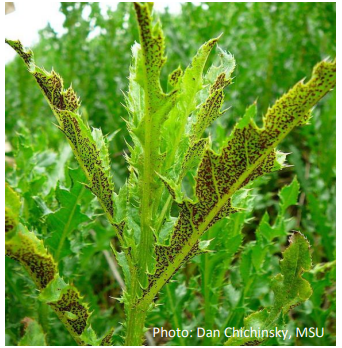
Impact of thistle rust on Canada thistle performance in a simulated crop sequence
Canada thistle (Cirsium arvense) is a perennial weed that causes significant economic losses in agriculture. There is a need for the development of integrated weed management toolsets that include Canada thistle biological controls. Thistle rust (Puccinia punctiformis) is a fungal pathogen that systemically infects Canada thistle, with the potential to reduce plant vigor over time (photo, right). The goal of this study was to integrate the thistle rust biocontrol with crop competition in a greenhouse environment and evaluate Canada thistle’s biomass production and competitive ability.
|

FWP to hold additional regional meetings to discuss 2023 Montana Gray Wolf Conservation and Management Plan
Montana Fish, Wildlife & Parks recently release a draft plan and environmental impact statement to guide the long-term management and conservation of wolves across the state.
In December, FWP staff will hold virtual and in person public meeting to answer questions about the plan and EIS. The draft 2023 Montana Gray Wolf Conservation and Management Plan incorporates updates in wolf-related research, more than 20 years of management experience, evolution in conflict management, new laws, social perspectives and public input. For more information about the draft 2023 Wolf Plan and draft EIS, please go online here.
The December meeting schedule is as follows:
- Region 1 – Kalispell, Dec. 7, 6-8 p.m., FWP Office, 490 N Meridian Road
- Region 2 – Missoula, Dec. 13, 6-8 p.m., FWP Office, 3201 Spurgin Road
- Region 3 – Bozeman, Dec. 5, 6-8 p.m., FWP Office, 1400 S 19th Avenue
- Regions 4 and 6 – Great Falls, Dec. 4, 6-8 p.m., FWP Office, 4600 Giant Springs Road
- Regions 5 and 7 – Billings, Dec. 6, 6-8 p.m., FWP Office, 2300 Lake Elmo Drive
- Virtual Meeting – Dec. 12 (visit fwp.mt.gov/aboutfwp/public-comment-opportunities/draft-wolf-mgmt-plan for login information.)
To view and submit comments on the draft plan and EIS, click here. Comment deadline in Dec. 19 at 5 p.m.
|
|
|
|

Noxious Weed Trust Fund Grant Applications Now Available
The Montana Department of Agriculture (MDA) is now accepting applications for the 2024 Noxious Trust Fund (NWTF) Grant Program.
Established by the 1985 Montana Legislature, the Noxious Weed Trust Fund provides funding for noxious weed research projects, development projects, state and community education, and on-the-ground management through a landowner cost share.
Applicants may apply for funding up to $75,000 per project. Applications are due Saturday, January 6, 2024.
To learn more about NWTF opportunities, please visit the Noxious Weed Trust Fund website at http://agr.mt.gov/NoxiousWeedTrustFund or contact Greta Dige, NWTF Program Coordinator, at 444-7882 or greta.dige@mt.gov.
To apply, please visit: http://funding.mt.gov/.
The Montana Department of Agriculture is serving Montana Agriculture and growing prosperity under the Big Sky. For more information on department programs and services, visit http://agr.mt.gov.
|
|
|
 Farmers.gov Dashboard Available
The farmers.gov local dashboard has now been expanded to 40 states and allows producers to access county specific farming data and USDA resources all in one place. Your new farmers.gov local dashboard includes farming data and USDA resources including USDA news, commodity pricing, weather forecasts, historical climate data, past storm events, USDA service center locator and additional state resources for your state and county. The dashboard transforms complex data sets into easy-to-read charts and graphs to help you quickly find information that matters to you.
2022 Census of Agriculture Data Coming February 2024
USDA’s National Agricultural Statistics Service (NASS) has concluded data collection for the 2022 Census of Agriculture. To all producers who responded to the ag census, thank you. Your information helps inform decisions that impact all who serve American agriculture.
 USDA’s Conservation Reserve Program Pays More Than $1.77 Billion to America’s Producers in Support of Conservation and Climate-Smart Agriculture
The U.S. Department of Agriculture (USDA) has issued more than $1.77 billion this year to agricultural producers and landowners through its Conservation Reserve Program (CRP), a critical piece of the Department’s efforts to support climate-smart agriculture and forestry on working lands. Right now, CRP’s more than 667,000 participants received payments from USDA’s Farm Service Agency (FSA) for their voluntary conservation efforts on more than 23 million acres of private land. Since 2021, CRP has grown by 21 percent in terms of acres enrolled, testament to the Biden-Harris administration’s program improvement efforts.
BLM extends Mont. sequestration project comment period 30 days
The Bureau of Land Management is extending the public scoping period by 30 days for an overall 60-day comment period for the Denbury Carbon Solutions, LLC Snowy River Carbon Dioxide Sequestration Project in Carter County.
The new scoping period will end November 27, 2023.
Podcast Corner
Ep 141: Not Being A “Debbie Downer” But… Might Wanna Listen In
The financial picture for ranchers this year and potentially for a few years is going to look a lot different than has for a while. Mary Jo Irmen, Farm/Ranch Strategy Expert and Author is back as she offers some strategy, considerations, and cautions on managing these potential profits. We’ll also discuss Operating Loans, which are now at a 20 year high for interest rates, and what you may want to consider. We all want to take full advantage of the highs in this next Cattle Market Cycle, but let’s talk through before we make financial decisions that could come back to bite us down the road.
AoR 108: No Farms, No Food -- Don Stuart & Addie Candib on Farmland Conservation
Don Stuart is the author of a new book "No Farms, No Food: ", a history of American Farmland Trust and the origins of national-scale efforts to bring to America's attention the loss of farmland and the need for conservation effort. Don is a former commercial fisherman, lawyer, and Pacific Northwest regional director for American Farmland Trust. Addie Candib is the current PNW regional director for AFT. Addie and Don have been effective advocates for farming and liaisons between farmers and environmental interests for decades.
|

Ghost Herd
A true story of family, fraud, land and power. Checkout this six-episode podcast to learn more!
|
Research Center
Montana State University:
Animal & Range Science
MSU Extension:
Updated MontGuides
University of Montana:
Rangeland Analysis Platform
Reversing Tree Encroachment Increases Usable Space for Sage-Grouse during the Breeding Season
USDA-Agricultural Research Service
Scientific Discoveries 2022
Rangeland Resources & Systems Research, Fort Collins, CO:
Livestock and Range Research Laboratory, Miles City, MT:
Pest Management Research, Sidney, MT:
USDA- Wildlife Services:
US Forest Service Research & Development:
Research topic: Fire
Research topic: Water, Air, & Soil
|
|
November
-
1-3 - Regenerative Conference (Santa Fe, NM)
For registration details click here
-
7 - Expanding Markets Conference (Billings, MT)
Click here for additional information
-
8 - Cowboy Quickbooks (Chester, MT)
Click here for more information
-
9 - Cowboy Quickbooks (Chinook, MT)
Click here for more information
-
8-11 - Montana Farm Bureau Annual Conference (Billings, MT)
Click here for agenda and registration information
-
11 - International Mountain Section Annual Meeting (Shelby, MT) To register contact Stacey Barta at sbarta@mt.gov
-
14-16 - Montana Association of Conservation Districts Annual Convention (Billings, MT) Click here for registration information
-
15 - Cowboy Quickbooks (Malta, MT)
Click here for more information
-
16 - Cowboy Quickbooks (Glasgow, MT)
Click here for more information
December
-
6-7 - Transboundary Workshop (Saskatchewan, Canada)
For more information click here
-
6-8 - Montana Stockgrowers Annual Convention (Billings, MT)
For more information click here
-
7 - FWP Region 1 Wolf Meeting (Kalispell, MT)
-
January
-
6 - Montana NWTF Grant Deadline
For registration details click here
-
16 - Eastern MT Regenerative Ag - Buisness Mtng
For registration details click here
-
16-17 - Innovative Crop Systems (Miles City, MT)
For more information click here
-
19 - Rancher's Stewardship Alliance Annual Banquet (Malta, MT)
For registration details click here
Contacts
Stacey Barta, State Coordinator for Rangelands
(406) 594-8481
SBarta@mt.gov
Rangeland Resources Committee:
Diane Ahlgren, Chair
John Hollenback, Vice Chair
Sigurd Jensen
Jim Anderson
Leah Lewis
Ron Devlin
|
|
|
|
|