|
Please provide any response by Friday, August 11, 2023.
WHAT IS THE MONTANA BEEF ENHANCEMENT PROGRAM?
The proposed Montana Beef Enhancement Program was created to enhance profit opportunities for Montana beef producers.
The following background information was drafted by the Montana Beef Promotion Working group in December 2022. This information may vary moving forward.
Conservation & Partnerships
Basic Ranch Bookkeeping: Webinar series hosted by the Rancher’s Stewardship Alliance
Through the “Basic Ranch Bookkeeping” webinar series you’ll be exposed to the underlying principles of accounting, get familiar with the phrases used by the professional you work with, and better understand how this can all work in unison to monitor and grow ranch profitability.
Summer School for Ranching Systems Students
Students get more than “book learning” during their summer internships. Click the button below to read about a few student highlights from the summer thus far.
|
|
|
MFBF
Hoofin' It for Hunger Registration is Open
July 10, 2023
Hoofin' it for Hunger is coming back to Dillon! We had a successful event in 2022 and we are hoping to make our race even better this year...all for a great cause! This year's race will take place at Depot Park on Saturday, September 9th. There will be 5k, 10k, and virtual runner races offered.
Register here. [t.e2ma.net]
|

New Producer Grant
This grant opportunity celebrates the ingenuity and passion of new producers and helps their dreams come to fruition. This program was developed for those who have a vision for their operation but lack the funds to put their plans into action. Successful applicants will receive a one-time $15,000 grant to support their operation's growth. Deadline to apply is August 31. Recipients will be notified by September 29 and will be invited to an awards ceremony to celebrate their achievements in the late fall.
|
MSGA's Rancher Resources Webpage
|
|
MSGA has developed a one-stop-shop webpage for events, funding, comment opportunities, and more! Members can find
- Drought Info
- Event Calendar
- State/Federal Programs
- Comment Opportunities
- Scholarships
- Industry News
- Position Papers
You can find the Rancher Resource page at www.mtbeef.org/advocacy/resources
|
|
|
2nd Annual Expanding Markets Conference - November 7th & 8th The agenda is finalized, and planning is underway for the 2nd Annual Expanding Markets Conference at the Bighorn Resort in Billings, Montana! You won't want to miss this one-of-a-kind event focusing on current and emerging market opportunities in the regenerative space. Listen to influential people in the regenerative marketplace, connect with potential buyers and shop industry vendor booths. Registration opens August 1st with limited ticket sales. Stay tuned [westernsustainabilityexchange.us11.list-manage.com] for more information. To learn more about the conference, read our blog below.
|
Emily Soreghan, Conservation Fellow with Montana Association of Conservation Districts and the Rangeland Resources Program
In Oklahoma, our most famous peak is a stack of granite boulders known as Mount Scott. It rises a whopping 824 feet above the plains. A three-mile road winds its way gently to the top, where countless prairie sunsets have flushed the faces of thrilled flatlanders.
So, needless to say, I’ve learned a lot since arriving in Montana. Even the rangelands of the East, which upon first visit appeared so familiar, have revealed their subtle and stunning differences from my beloved Oklahoma plains.
I moved here in May, with the only article of down clothing I own, for an internship with the Montana Conservation Corps. They placed me with the Montana Association of Conservation Districts (MACD) and Stacey Barta, State Coordinator for the Rangeland Resources Program at DNRC, who set me to work on their Ranchers For Rivers Project.
Since that time I’ve visited thirteen ranches, with three more to go. I’ve traveled from Culbertson to Kalispell, photographing past projects and interviewing ranchers. Ranchers For Rivers (R4R) is a project run by MACD. It helps ranchers offset the cost of managing their riparian pastures. For some, this means fencing off the river entirely. For others, exclusion wasn’t the answer. They built heated stock tanks upland, and R4R helped them with the cost of solar wells and digging pipelines.
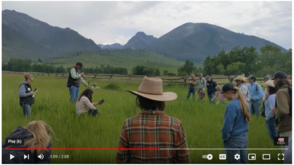
I’ve also attended four range tours. They’ve ranged (no pun intended) from Kicking Grass in Deer Lodge to the Montana Range Tour in postcard-perfect Paradise Valley. I enjoyed all of them in vastly different ways, and, of course, learned more than I can do justice to here.
The most recent of these was last week. Stacey Barta shuttled me, along with 3 of her interns in the Working Lands Internship Program, out to a few spots in the Custer-Gallatin National Forest. She aimed to give us an on-the-ground introduction to forest management. This spot in the Crazies, like so many other places in the West, is visibly marked by its checkerboard ownership.
We walked along a streambank on National Forest land, where logging has been excluded by order of Montana’s Streamside Management Zones (SMZ) Law – adopted in 1993 and updated in 2006. The law restricts and regulates commercial logging along bodies of water.
SMZs are at least 50 feet wide on either side of a stream. These buffer zones were designed to protect the watershed from unintended downstream (pun intended) effects of logging. We observed how the fire burned hotter in this gulley, having forty more years of accumulated fuels to combust than in the areas of its upstream flanks.
Barta told us management is never one-size-fits-all, and we could see it reflected on the hills above. In areas that had been neither grazed nor logged, the forest tumbled in on itself. “I thought about having you crawl in there on all fours, imagining you’re bears” Barta jokes, as we looked into one especially overgrown section. Then she got serious. “Well, could you?” It would’ve been difficult. Snow-felled trunks piled on top of each other. Hundreds of thousands of baby pines competed for sunlight.
I didn’t come to Montana as a huge fan of the logging industry. Nor of the beef industry, as a matter of fact. I’m still not signing up to lobby for either. But producers, and the idea of working land conservation, have captured my heart and mind. I’ve seen how good management can bring land back from the devastation of overuse. I’ve talked to landowners with a vested interest in passing their property on to the next generation better–more verdant, diverse, and productive–than when they came into it. I didn’t come into this with set ideas one way or the other. I know I don’t know much. I did come into it wanting to know how we can maintain a healthy human community while conserving the natural resources given to our stewardship. I’m getting a few ideas here. Thank you to Montana, for being the last best place, and to Montana producers, for their knowledge and care.
Agency Updates
 The 2022 Annual Report is Now Available!
The Montana Sage Grouse Habitat Conservation Program is happy to share the 2022 Annual Report!
The annual report overviews all Program activities conducted between January 1, 2022 to December 31, 2022, including, implemented improvements, development and conservation project consultation metrics, and the status of the Stewardship Account.
All current and past annual reports can be accessed by visiting the Montana Sage Grouse Habitat Conservation Program website and clicking the 'Program' webpage: https://sagegrouse.mt.gov/About
Submit Comments on Three Sage Grouse Stewardship Grant Public Scoping Notices
The Montana Sage Grouse Habitat Conservation Program is soliciting public comment on the proposed use of the Montana Sage Grouse Habitat Stewardship Fund to benefit sage grouse and conserve important sage grouse habitat. The Montana Sage Grouse Oversight Team (MSGOT) requests public comment on three scoping notices.
The Schultz - Gran Prairie Ranch submitted an application to enter into a 20-Year conservation lease that was reviewed and awarded funding at the October 27, 2022 MSGOT meeting. MSGOT approved modifications to the original application during its meeting on June 29, 2023.
The Schultz - Gran Prairie 20-Year Conservation Lease conserves a total of 8,023 acres of sage grouse habitat near Winnett, Montana in Petroleum and Fergus County.
The Haywire Ranch submitted an application to enter into a 15-Year conservation lease that was reviewed and awarded funding at the October 27, 2022 MSGOT meeting. MSGOT approved modifications to the original application during its meeting on June 29, 2023.
The Haywire Ranch 15-Year Conservation Lease conserves a total of 4,317 acres of sage grouse habitat near Winnett, Montana in Petroleum County.
The Nowlin Ranch submitted an application to enter into a 15-Year conservation lease that was reviewed and awarded funding at the October 27, 2022 MSGOT meeting. MSGOT approved modifications to the original application during its meeting on June 29, 2023.
The Nowlin Ranch 15-Year Conservation Lease conserves a total of 3,624 acres of sage grouse habitat near Winnett, Montana in Petroleum County.
All Conservation Lease Public Scoping Notices can be found on the Sage Grouse Stewardship Fund Grants webpage: https://sagegrouse.mt.gov/Grants
|
|

Mowing is often overlooked as a weed management tool, but it can be effective if done properly. For best results, timing and frequency of mowing should be based upon the weed’s biology and growth stage. More specifically, when and how often to mow depends upon the weed’s method of reproduction —seed only or seed plus creeping roots.
2023 Legislative Summary
The 2023 Legislative session has come and gone, leaving in its wake several important bills related to Montana Fish, Wildlife & Parks bills that passed and many more that didn’t. In our view, the biggest success was passage of SB 295. This legislation is a critical step toward federal grizzly bear delisting, at least for the Northern Continental Divide Ecosystem population, because it defines a portion of the state regulatory framework for man[1]aging and conserving bears required by the Endangered Species Act. Among other things, SB 295 directs the Montana Fish and Wildlife Commission to adopt “administrative rules” describing circumstances and the regulatory structure under which bears can and can’t be killed. Those rules will ensure that grizzly populations remain healthy and above recovery levels while allowing ranchers discretion to kill grizzlies in more conflict situations than allowed now under federal management authority.
|
|
|
|
 Biden-Harris Investing in America Agenda Lowers Energy Costs for Rural Business Owners and Agricultural Producers
As part of President Biden’s Investing in America agenda, U.S. Department of Agriculture (USDA) Rural Business-Cooperative Service Administrator Dr. Karama Neal today announced that USDA is making $21 million in technical assistance grants available through the Rural Energy for America Program (REAP) to help agricultural producers and rural small businesses access federal funds for renewable energy and energy efficiency improvements.
 Biden-Harris Administration Announces New Investments to Improve Measurement, Monitoring, Reporting and Verification of Greenhouse Gas Emissions through President Biden’s Investing in America Agenda
Agriculture Secretary Tom Vilsack today announced the U.S. Department of Agriculture (USDA) will invest $300 million through President Biden’s Investing in America agenda to improve measurement, monitoring, reporting and verification of greenhouse gas emissions and carbon sequestration in climate-smart agriculture and forestry. The new investments, made possible by the Inflation Reduction Act, will advance priorities set by the broader Federal Strategy to Advance Greenhouse Gas Measurement and Monitoring for the Agriculture and Forest Sectors, which was also released today as draft for public input and outlines a strategic framework and priority actions for improving accuracy and reducing uncertainty in greenhouse gas estimates.
Message from the State Conservationist
Hello partners in conservation,
Montana’s short summer is the perfect time for NRCS to conduct the field inventories and planning needed to develop a conservation plan for farmers, ranchers, and private forestland managers looking to improve their natural resources. Because the timeframe before snow is unpredictable and because the NRCS application ranking period for funding opportunities usually happens in the fall, we encourage customers to visit their local USDA Service Center now.
The local NRCS staff can help producers figure out current problems, assess the condition of the land, and determine options for improvement all based on individual operational goals. A conservation plan is a customized collaboration between the planner and the customer. A final plan may include land use maps, soils information, inventory data, recommended practices, and other tools and resources to help landowners make management changes or install other conservation practices.
NRCS provides funding and technical assistance to help farmers, ranchers, and forestland owners implement conservation practices that improve their environmental and economic resilience. Conservation work focused on local outcomes with the support of local partners and land managers achieves meaningful conservation across a landscape. These opportunities are open to ag operations of any scale.
To learn more about locally focused funding opportunities, and others that may be available, customers should visit their local USDA Service Center.
NRCS accepts conservation program applications year-round. Start planning now. Additional information, including full project proposals, is available on the Montana NRCS website at www.mt.nrcs.usda.gov. Click on What’s Available in My County.
Take care,
Kyle Tackett, Acting State Conservationist
USDA Expands Wildlife Conservation with New Investments in Working Lands for Wildlife
The U.S. Department of Agriculture is expanding its work on wildlife conservation, leveraging a suite of voluntary, incentive-based tools. Leveraging resources of the Conservation Reserve Program and the Inflation Reduction Act, the five-year commitment includes significant funding and staff resources, focusing their delivery to working lands in key geographies across the country through a series of new Frameworks for Conservation Action.
 Montana Hay Hotline
The Montana Department of Agriculture’s Hay Hotline is an online portal where producers can donate, buy, or sell hay. Individuals needing donated hay or producers wanting to donate hay can go to the portal using the button " Go to the Hay Hotline Application Now" and create a listing by selecting “Create an Account”. Once created you will have access to "My Hay listings." Individuals can also search existing listings to see what is currently available.
 Farm Service Agency Now Accepting Nominations for Farmers and Ranchers to Serve on Local County Committees
The U.S. Department of Agriculture (USDA) is now accepting nominations for county committee members for elections that will occur later this year. Additionally, USDA’s Farm Service Agency (FSA) is unveiling a new GIS tool to make it easier for producers to participate in the nomination and election processes for county committee members, who make important decisions on how federal farm programs are administered locally.
All nomination forms for the 2023 election must be postmarked or received in the local FSA office by Aug. 1, 2023.
Elections will occur in certain Local Administrative Areas (LAA) for members. LAAs are elective areas for FSA committees in a single county or multi-county jurisdiction and they may include LAAs that are focused on an urban or suburban area.
Customers can locate their LAA through a new GIS locator tool available at fsa.usda.gov/elections.
USDA Accepts Nearly 2.7 Million Acres in Grassland CRP Signup, Successfully Closing the Gap and bringing CRP Near to Acreage Cap
The U.S. Department of Agriculture (USDA) is accepting offers for nearly 2.7 million acres from agricultural producers and private landowners through this year’s Grassland Conservation Reserve Program (CRP) signup, which received a record setting sign-up of 4.6 million acres in offers. This working lands program allows producers and landowners to continue grazing and haying practices while protecting grasslands and further the CRP’s impacts. Grassland CRP is part of the Biden-Harris administration’s broader effort to address climate change and conserve natural resources.
“This year’s Grassland CRP signup demonstrates the continued popularity, success and value of investments in voluntary, producer-led, working lands conservation programs,” said Zach Ducheneaux, administrator of USDA’s Farm Service Agency (FSA). “Grassland CRP clearly demonstrates that conservation priorities and agricultural productivity not only have the capacity to coexist but also complement and enhance one another. Through all our working land conservation programs, farmers and ranchers play a critical role in helping secure the future of both our food production and our natural resources.”
COCO will be releasing the Fall 2023 request for concept papers on Friday, September 29. The AIM program accelerates fire adaptation concepts and reduces the risk from wildfire by funding nonprofit, capacity-building programs across the U.S. The AIM team will be hosting an informational webinar on Thursday, October 5, 2023, 10:00 AM - 11:00 AM MT.
Podcast Corner
Make Changes or Go Broke!
When you look head-on into the future of your ranch, are your management decision and day to day operations creating a viable multi-generational business, or is it over when you’re done? Making critical management changes in your operation that moves away from traditional practices can be hard. Kurt Myllymaki, a rancher and farmer from Stanford, MT joins me today as we talk about how they migrated their operation away from traditional practices they felt were creating too much stress and strain on their land, livestock, and their own quality of life… and in the long run the future of their operation.
Plant of the Month
Research Center
Montana State University:
Animal & Range Science
MSU Extension:
Updated MontGuides
University of Montana:
Rangeland Analysis Platform
Reversing Tree Encroachment Increases Usable Space for Sage-Grouse during the Breeding Season
USDA-Agricultural Research Service
Scientific Discoveries 2022
Rangeland Resources & Systems Research, Fort Collins, CO:
Livestock and Range Research Laboratory, Miles City, MT:
Pest Management Research, Sidney, MT:
USDA- Wildlife Services:
US Forest Service Research & Development:
Research topic: Fire
Research topic: Water, Air, & Soil
|