|
 Northern lights near Kalispell, November 2025
|
Introduction
Welcome to the sixth edition of the Hazardous Waste Newsletter from the Montana DEQ Hazardous Waste Program. In this semi-annual publication, we hope to provide program updates, spotlight new or commonly overlooked regulations, and let you get to know our staff. Please feel free to contact us anytime with questions or comments!
-Denise Kirkpatrick, Section Supervisor
|
|
Acronyms and Definitions
LQG - Large Quantity Generator: Hazardous Waste Generators that generate greater than 2,200 pounds of hazardous waste or greater than 2.2 pounds of acute hazardous waste in a calendar month
SQG - Small Quantity Generator: Hazardous waste generators that generate between 220 and 2,200 pounds of hazardous waste in calendar month
Check out our website for more detail on generator categories! ------->
|
|
VSQG - Very Small Quantity Generator: Hazardous waste generators that generate less than 220 pounds of hazardous waste in a calendar month
CFR - Code of Federal Regulations. Hazardous waste regulations are found at 40 CFR 260-279. Montana incorporates the federal regulations by reference in the ARM.
ARM - Administrative Rules of Montana. Hazardous waste rules can be found at rule chapter 17.53.
|
|
|
Note: The DEQ Hazardous Waste Program incorporates by reference the Code of Federal Regulations (CFR) in the Administrative Rules of Montana (ARM). For ease of reading, we are not noting the ARM citations in this newsletter. Please call or email us if you have any questions.
What's Up
The 2025 Montana Hazardous Waste Reporting Season is rapidly approaching!
Forms and instructions for the 2025 Montana Hazardous Waste Generator Annual Report will be emailed in early January 2026 to the site contact listed in our database based on the generator’s most recent submission of an EPA Site Identification Form 8700-12. Forms and instructions will also be available on the Hazardous Waste Program website. Please take a moment to ensure that your site contact is updated prior to the end of the year as necessary.
Your information will not be auto populated on the reporting forms. The information currently in our database can be found in your myRCRAid account through RCRAInfo. If you still need to sign up for a myRCRAid account, see here for a how-to.
What’s the difference between annual and biennial reporting?
Reports pertaining to even numbered calendar years are referred to as Annual Reports. All hazardous waste generators that are registered as an LQG, SQG, or took part in an Episodic Event at any time during the calendar year are required to submit a report detailing hazardous waste activities each year. Additionally, Commercial Transfer Facilities, Exporters of hazardous waste to foreign countries, and Treatment, Storage, and Disposal Facilities are required to submit a report specific to those activities each year.
Reports pertaining to odd numbered calendar years are referred to as Biennial Reports. In addition to all those required to submit an annual report, Used Oil Transfer Facilities/Processors/Re-Refiners are required to submit a report specific to those activities during a Biennial Report year. Additionally, hazardous waste generators that were an LQG at any time during the calendar year of a Biennial Report year are required to provide additional information to ensure compliance with EPA specific reporting requirements.
Need help filling out your annual reporting forms? This year we will be offering three annual report Q & A sessions live on Teams. Below are the dates and times. Links to join will be included in the email with the forms on January 2, 2026.
January 6, 2026 @ 9 AM
January 21, 2026 @ 1 PM
February 10, 2026 @ 10 AM
|
|
Regulatory Spotlight - Universal Waste
Universal waste is just how it sounds – universal. Meaning that it is very common across many different industries. Universal waste was introduced as a subset of hazardous waste in 1995. Universal wastes are hazardous wastes that are given regulatory relief from some regulations. Generators have the option of managing these wastes as universal waste or as hazardous waste. For large and small quantity generators of hazardous waste, it is usually more beneficial to manage these wastes as universal waste.
Currently, the wastes considered Universal Waste in Montana are Batteries (including most rechargeable batteries), Used Lamps/Bulbs (such as fluorescent, halide, mercury vapor, etc.), Aerosol Cans, Mercury-Containing Equipment (such as thermostats), and Recalled Pesticides.
Management of Universal Wastes:
Since May 2022, DEQ has issued 104 violations for universal waste. This includes violations for labeling, packaging, and accumulation time limits and accounts for about 23% of all violations issued. The following is an overview of management requirements for the most common universal wastes in Montana – Batteries, Bulbs, and Aerosols. The regulatory citations noted are for Small Quantity Handlers of Universal Waste – those accumulating less than 11,000 pounds of universal waste at one time. Regulations regarding Large Quantity Handlers of Universal Waste can be found here: 40 CFR 273.30-40
Packaging – 40 CFR 273.13: Undamaged batteries do not need to be stored in a container, but doing so can facilitate proper labeling. Lamps and aerosol cans must be stored in closed containers that are compatible with the waste.
Labeling – 40 CFR 273.14: Each item or container must be labeled as “Universal Waste – [Type]”, “Waste [Type]”, or “Used [Type]”. For example – Universal Waste Lamps, Waste Aerosols, or Used Batteries, etc.
Accumulation Time Limits – 40 CFR 273.15: Universal waste can be accumulated for one year from the date the item first becomes a waste. The handler must be able to demonstrate how long the waste has been accumulating. The easiest way to do this is to mark the container with the date the first item was added.
Shipping – 40 CFR 273.18: Universal waste must still ultimately be disposed at a licensed disposal facility. Hazardous waste manifests are not required for shipping universal waste but applicable shipping requirements for DOT still apply. There is no record keeping requirement for shipments of universal waste.
For further information on universal waste, check out these sites or contact our office.
MT DEQ Information Video on Universal Waste (on You Tube)
MT DEQ Hazardous Waste Website
EPA Universal Waste Website
 |
|
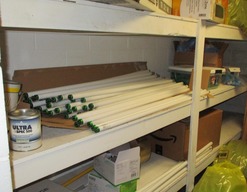
The photo to the left shows how NOT to store used fluorescent lamps. Used lamps must be stored in a container with a secured lid, labeled as Used Lamps, Universal Waste Lamps, or Waste Lamps, and labeled with an accumulation start date. This site received three violations for improper management of these lamps. |
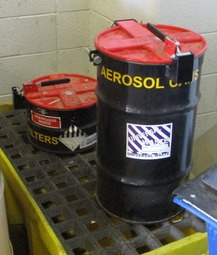
The photo to the right shows the correct way to store universal waste aerosol cans. The drum is securely closed, labeled as Universal Waste Aerosol Cans, and has an accumulation start date noted on the label. |
|
 |
|
|
Get to Know Our Staff
Julie Avina is a Hazardous Waste Specialist with the Hazardous Waste program here at DEQ. She joined the program in March of 2024. Julie graduated from Cal Poly Humboldt (formerly known as Humboldt State University) in December of 2023 with a Bachelor of Science in Environmental Science and a concentration in Ecological Restoration.
|
|
|
Julie enjoys rock climbing at the many beautiful outdoor crags in Montana, running, reading, identifying plants, and learning how to ski.
Julie can be contacted at Julie.Avina@mt.gov or 406-444-4096.
|
|
By the Numbers...
As of November 30, 2025:
|
 Marias Pass along the southern end of Glacier National Park.
|
|
Now You Know - Accumulation Start Dates
Since May 2022, the DEQ HW Program has issued 63 violations related to accumulation start dates. That is 14% of the violations issued. At about 28% of inspections, a violation related to accumulation start dates is issued. We would like to help clear up any confusion that may exist.
Accumulation start dates (ASD) are part of the basic labeling requirements for small and large quantity generators, universal waste handlers, and healthcare facilities that have notified under Subpart P. Below is a table showing how to apply accumulation start dates.
|
|
|
|
ASD Required?
|
When to apply ASD
|
Storage time limit from ASD
|
|
SQG and LQG hazardous waste in a satellite accumulation area
|
No
|
N/A
|
Indefinite under 55-gallons
|
|
SQG and LQG hazardous waste in a central accumulation area
|
Yes
|
Immediately when waste enters area
|
SQG – 270 days LQG – 90 days
|
|
Universal waste (batteries, bulbs, and aerosol cans)
|
Yes
|
When the first item is placed in the container
|
1 year
|
|
Hazardous Waste Pharmaceuticals at a Subpart P Healthcare Facility
|
Yes
|
When the first item is placed in the container
|
1 year
|
For further questions about Accumulation Start Dates, please contact our office.
|
|
Important Dates to Remember
- January 2, 2026 - Annual Report Forms and Instructions to be E-Mailed
- March 1, 2026 - Annual Reports Due to DEQ
|
|
|
|
|