|
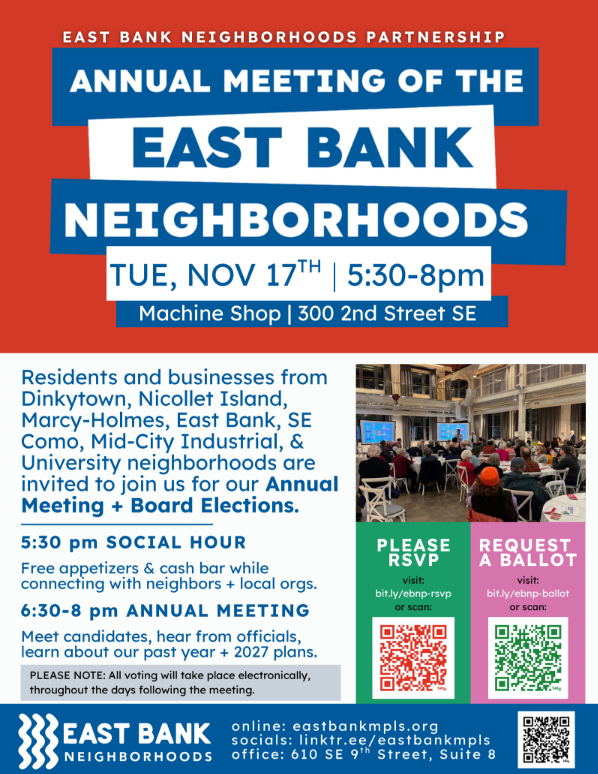
Residents and businesses from Dinkytown, Nicollet Island, Marcy-Holmes, East Bank, SE Como, Mid-City Industrial, & University neighborhoods are invited to join us for our Annual Meeting + Board Elections.
Starting at 5:30 pm, enjoy free appetizers and a cash bar, meet neighbors and talk with local community groups.
At 6:30 pm, our meeting starts, where you will learn about upcoming candidates for our board of directors, hear from local government leaders, University officials, the Minneapolis Police Department, and more.
Please RVSP here: bit.ly/ebnp-rsvp
Please Request a ballot here: bit.ly/ebnp-ballot
If you would like to host a community org table at this event: https://forms.gle/szythhbc8k7V6s2x9
If you would to know more about running for the board of directors, please visit this page: eastbankmpls.org/run
East Bank Neighborhoods Partnership Annual Meeting + Board Elections
Tuesday, November 17, 2026 | Social Hour: 5:30 pm | Meeting: 6:30 pm
Machine Shop | 300 2nd Street SE
Flyer for East Bank Neighborhoods Partnership Annual Meeting
Neighbors of Seward, clear out your closets and refresh your style completely for free! Come to our community clothing swap. Get a new look while connecting with your neighbors—what better way to spend the time?!
Browse a fresh-to-you collection of clothes, shoes, and accessories. It is a fun, sustainable way to give your wardrobe new life, and also connect with neighbors as we all get ready for Winter activities and events. Think: layering.
Please bring your clean, gently-used garments, hats, shoes, and the like to share with others. All sizes of clothing are welcome. Fall and Winter clothing preferred. Anything left will be donated.
Bring clothing to Matthews Center large multipurpose room with the flags at 12 noon on Saturday, November 28th. Then come back for the clothing treasure hunt: 1pm – 4pm. Bring a bag!
Volunteers will set out clothing on tables, sorting by age, size, and category. This event is ground-level and accessible. Sponsored by Seward Neighborhood Group (SNG).
Seward Clothing Swap
November 28th 12-4pm
Matthews Park Rec Center (2318 29th Ave S)
Flyer for Seward Neighborhood Clothing Swap
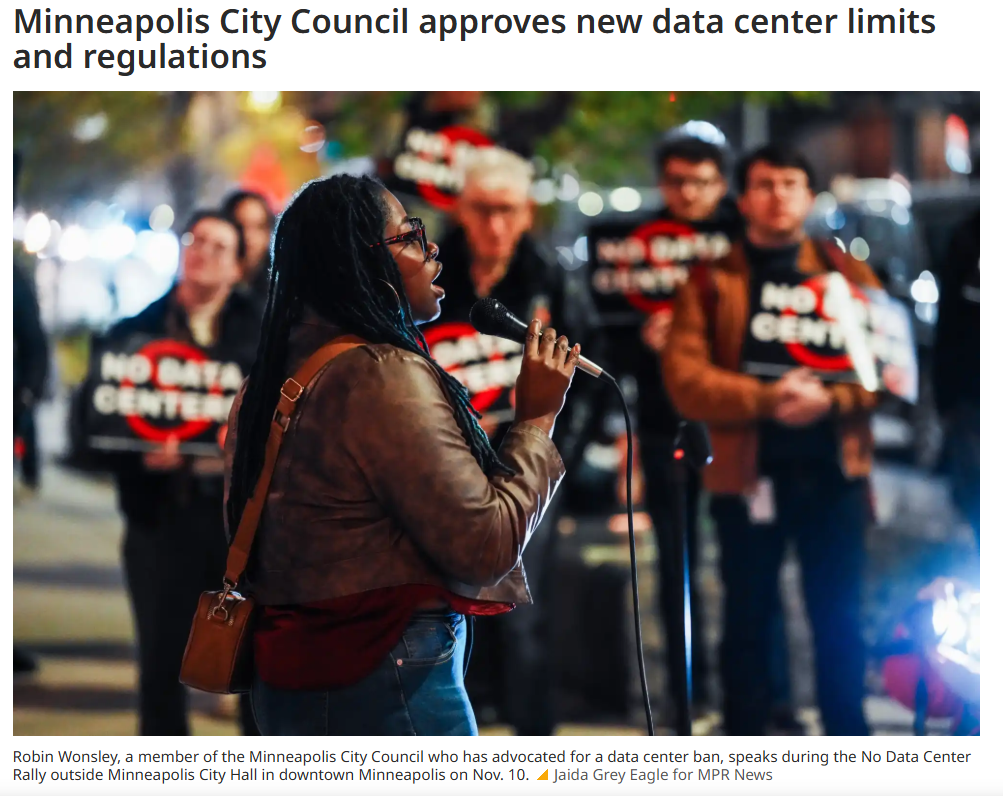
MPR News headline “Minneapolis City Council approves new data center limits and regulations” with a photo of Council Member Wonsley speaking at a rally. Photo credit: Jaida Grey Eagle for MPR News.
Summary: Thanks to strong community organizing, the City Council adopted robust, community-centered regulations on data centers in Minneapolis.
Background: Earlier this week, I shared that the City Council was discussing data center resolutions and was poised to adopt extremely weak regulations that would roll out the red carpet for Big Tech. I’m thrilled to share that thanks to strong community organizing, the City Council approved robust regulations this week that no longer gave big tech data center developers free reign in our city. Data centers will now each individually be considered and the City Council will be able to evaluate each product on a case-by-case basis. The policy will also now allow public opinion to be a factor in the approval of any proposed data center development.
Residents have been organizing against data centers in their neighborhood associations and submitting thousands of comments to City Hall. This aligns with the latest national polling, which shows that 70% of Americans oppose data centers in their communities. This week residents also held a rally outside City Hall against data centers, which I was honored to speak at.
A full ban on data centers is the only policy that honestly reflects resident opinion, so I brought forward a full ban on all data centers during the committee meeting on Monday and again during the City Council meeting on Thursday. Sadly, the City Council voted against a full ban by a 6-7 margin, just one vote shy of what was needed to pass. I am proud of my colleagues who had the political courage and clarity to resist the pressure from Big Tech to allow data centers in our city.
After the ban failed, Council Member Chowdhury brought forward a compromise amendment to eliminate primary zoning for data centers in the commercial and arts district in Downtown. Primary Zoning would legalize data centers in certain areas, meaning that the City could not legally deny a complete application for a data center. Primary Zoning rolls out the red carpet for Big Tech and surrenders the City’s ability to say no. The Planning Commission and City Council received thousands of public comments opposing primary zoning for data centers and urging the City to adopt regulations that allow residents to share their perspective on each potential data center. The Minneapolis Planning Commission also recommended overlay zoning instead of primary zoning for data centers in their October 13 review of the regulations.
The Chowdhury Overlay Zoning amendment, would allow the City Council to consider each proposed project individually, including community input as a factor. This does not ban data centers, but it allows the City to evaluate any potential proposal in consultation with neighbors and residents who will be impacted. The Overlay Zoning proposal passed 7-6.
Once Overlay Zoning passed, my colleagues and I decided to withdraw about a dozen other amendments that would have added even more protections if data centers had been given Primary Zoning.
The passage of the Overlay Zoning proposal is a victory for the working-class residents who organized for months against data centers in Minneapolis. For several months, City Hall was completely out-of-touch with the public opinion on data centers, but strong community organizing moved the needle significantly.
Mayor Frey has not spoken publicly about his stance on data centers. The most information we have about his position is from Council Member Palmisano, who read a text message from him out loud during a Council Meeting stating he would veto the policy. I hope that Mayor Frey sees the nationwide movement against data centers as well as the movement here in Minneapolis and does not veto the commonsense compromise policy the City Council adopted.
If the Mayor does veto the policy, the City Council will meet on November 20th in a special meeting to ensure that a policy is adopted before the municipal data center moratorium expires on November 21st. A veto override requires 9 votes.
I urge residents who want to limit data centers to contact Mayor Frey telling him to not veto the City Council’s ordinance. You can also reach out to the City Council telling them that if Mayor Frey does veto, you expect them to override his veto.
Key votes: A ban on data centers failed 6-7, with Council Members Rainville, Vetaw, Warren, Osman, Shaffer, Whiting and Palmisano voting in opposition. Overlay zoning for data centers downtown was approved 7-6, with Council Member Whiting joining the votes in support. Mayor Frey now has the opportunity to sign or veto the ordinance. The City Council will meet on November 20th if needed to vote on a potential veto override. Nine votes are needed to override a veto.
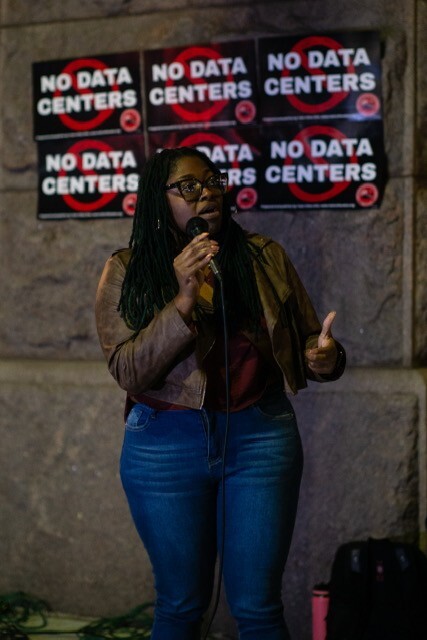
Council Member Wonsley speaking at the No Data Center rally outside City Hall.
Summary: The City Council voted 8-5 against the appointment of Billy Peterson for MPD Chief.
Background: Mayor Frey nominated Officer Billy Peterson to be MPD Chief. Last week, the Public Health Safety and Equity (PHSE) Committee began Interim Chief Peterson’s appointment hearing, and the conversation continued this week concluding in a final vote by the City Council to deny the appointment.
During last week’s hearing, Interim Chief Peterson stated that in more than 30 years with MPD, including serving in the 3rd and 4th Precincts, he could not recall ever hearing racist slurs, homophobic language, or other discriminatory rhetoric from fellow officers. This contradicts extensive documentation of racism, violence, and misconduct within MPD that occurred in these precincts over the last several decades.
This week, the City Council continued probing Interim Chief Peterson for more clarity on his claims that he has never personally witnessed discrimination within MPD. In order to gain more specific clarity on Interim Chief Peterson’s experiences and perspectives, I asked him specific yes-or-no questions about things he has personally witnessed in MPD. I asked if he has ever heard a fellow officer use the N-word or use slurs or derogatory language about Somali or East African residents, Hispanic or Latino residents, Indigenous residents, people experiencing homelessness, or residents with disabilities. I asked if he has ever heard his fellow officers use homophobic or transphobic language. I asked if he had ever heard fellow officers use inappropriate or offensive language about women. I asked if he has ever heard fellow residents mock the Black Lives Matter movement.
Interim Chief Peterson stated it was not possible to answer all of these simple questions with a yes or no. He answered all of these questions with a “I can’t recall” or “it’s not a yes-or-no answer.”
I also asked Interim Chief Peterson if he could make a commitment to not promote officers who had misconduct histories into leadership positions; a persistent problem within the department that has helped preserve its culture of racist and violent policing. He responded that he could not make such a commitment because misconduct is a relative matter and should not be an immediate disqualifier for an officer seeking professional elevation.
Interim Chief Peterson's responses ultimately raised the fundamental question if he was genuinely unable to recognize the discriminatory culture surrounding him, or could see it but was unwilling to take a stand against it. Both raised serious concerns about Peterson’s ability to identify and confront the deeply entrenched culture within MPD.
Peterson’s answers made it clear to me that he is unable or unwilling to challenge the Thin Blue Line mentality that has plagued policing for decades. The Thin Blue Line is a culture where officers protect one another from accountability, allowing misconduct to go unchecked and the so-called “bad apples” to shape the norms of an entire department. Whether through silence, willful blindness, or institutional loyalty, the result is the same: residents suffer while officers are shielded from scrutiny.
I want to make clear what this culture looks like in practice. Interim Chief Peterson served in the 4th Precinct, where former notorious MPD officer Lucas Peterson also worked. Lucas Peterson had an extensive history of misconduct allegations involving violence against Black residents, was involved in two police killings of Black men, and was caught lying while defending his conduct. Yet despite this history, he was repeatedly celebrated by MPD, receiving Officer of the Year three times.
Lucas Peterson was also involved in the fatal police shooting of Terrance Franklin in 2013, a killing that sparked widespread outrage over racist policing and helped lay the groundwork for the formation of the Black Lives Matter movement in Minneapolis. Franklin’s death became a rallying cry for residents demanding justice and accountability from MPD. Yet rather than confronting the warning signs surrounding officers like Lucas Peterson, MPD repeatedly rewarded and elevated them.
This is what the Thin Blue Line looks like in practice. Officers accused of brutalizing our residents were not just tolerated, they were celebrated, protected, and held up as examples for other officers to follow.
This is precisely why I and several of my colleagues opposed appointing a Chief from within MPD. We cannot expect transformational change from leadership that is unable or unwilling to acknowledge the culture that made these abuses possible.
Interim Chief Peterson’s entire law enforcement career has been spent within a department that state and federal investigators found engaged in systemic racial discrimination and unconstitutional policing. The findings of the Minnesota Department of Human Rights and the Department of Justice make clear how deeply rooted these problems are. We cannot achieve the transformational leadership Minneapolis deserves by continuing to elevate leaders from within the very institution that needs to be transformed.
Minneapolis does not need a Chief whose instinct is to protect the institution from scrutiny. We need a Chief whose instinct is to protect residents from the institution’s failures, who has demonstrated the courage to confront misconduct, hold fellow officers accountable, and dismantle the culture of silence that has enabled decades of harm. The City Council declined the Mayor’s nomination of Peterson in an 8-5 vote.
Key votes: Council Members Vetaw, Warren, Stevenson, Chavez, Chughtai, Chowdhury, President Payne and I voted against appointing Peterson.
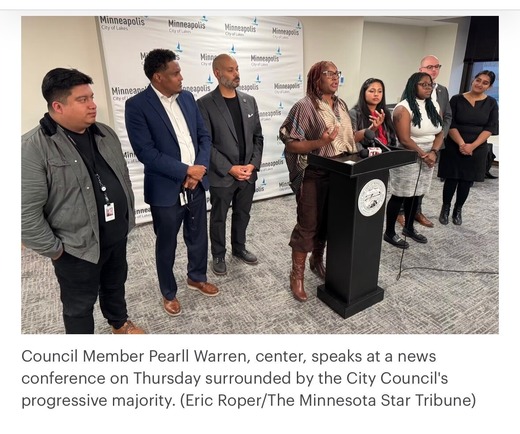
Council Member Pearll Warren speaks at a press conference alongside Council Member Wonsley and colleagues after the City Council denied the appointment of Billy Peterson for MPD Chief. Photo credit: Eric Roper, Star Tribune.
Summary: The City Council voted unanimously to fund Emergency Housing Vouchers, a Housing First program I have been championing that will provide at least 150 unsheltered people with housing and wraparound social services. This is the third time the City Council has invested in the program, which Mayor Frey has repeatedly tried to cut.
Background: In my first years in office, unhoused and housed residents were regularly coming to City Hall to protest the Frey administration's encampment sweeps. These sweeps were inhumane, costing the city a lot of money, and were not reducing homelessness. Encampments were just moving from one block to another.
The community was demanding that the city take action to help actually reduce homelessness, so my office worked with Hennepin County and the Minneapolis Public Housing Authority (MPHA) for most of 2023 to propose a realistic, data-backed solution that would move unsheltered people into housing. The proposal was modeled off of an extremely successful federally-funded program that MPHA and Hennepin County ran during the covid pandemic called Emergency Housing Vouchers. MPHA issued housing vouchers to people on the County’s coordinated entry list, and Hennepin County provided the participants wraparound social services like physical and mental health, benefits, job placements, substance abuse management, and more. The program showed incredibly strong outcomes, with around 90% of participants not returning to unsheltered homelessness after several years.
I was extremely excited to learn about this program and its documented success. The program is a type of Housing First response to homelessness, which is a model that has been widely documented to be successful in reducing the number of unhoused people in communities across the country. The Biden administration uplifted Housing First because it is a humane and effective strategy. The model posits that governments must give unsheltered residents housing and supportive services upfront, for free, and without barriers that could cause people to return to the streets. This simple idea has been effective time and time again in communities around the country and across the world. Our very own MPHA and Hennepin County were implementing a version of Housing First right here in Minneapolis, but the program was funded through federal covid-relief dollars, and would sunset once that funding expired.
So I worked with MPHA and the County on a plan to replicate Emergency Housing Vouchers but with local funding instead of federal funding. With $1.8 million/year, MPHA and Hennepin County could put 50 families and 50 individuals into permanent housing with wraparound social services.
I want to put that number in perspective. Hennepin County estimates that there are about 500-700 people sleeping on the streets each night. Our vouchers would cover 50 individuals and 50 families. Assuming a family is at minimum 2 people, we’re talking about at least 150 fewer people on the streets each night. That would mean a 20-30% reduction of the unsheltered population. That means a reduction in encampments, more open shelter beds, and more families and individuals on the path to stability and safety. I authored a successful amendment to the 2025 City Budget to make this vision a reality along with my co-author, Council Vice President Osman, and again in 2026.
Unfortunately, over the course of the past two years, the Frey administration has advocated against this program and has slow-walked its implementation. Even while navigating the resistance by the Frey administration, our government partners were making good progress. This spring, MPHA and Hennepin County were able to start issuing vouchers and placing families into housing. As of August, MPHA had received 15 referrals from Coordinated Entry, issued four vouchers, and was in the process of taking six more households.
Then, the Mayor released his proposed 2027 Budget, which revealed that he reneged on his public commitments to finally implement this program by eliminating all funding for Emergency Housing Vouchers in 2027. This created significant instability in the future of this program and MPHA paused placing residents into housing.
The mayor’s actions have jeopardized the stability and continuity of this data-backed Housing First program that will move at least 150 people off the streets and into housing. This is unacceptable and moves our whole city away from what should be a shared goal of reducing unsheltered homelessness.
In light of that, this week I moved forward an action to restore funding for Emergency Housing Vouchers for 2027 and 2028. The funding comes from the unused remainder of the rental assistance funding that City Council allocated earlier this year in response to Operation Metro Surge.
The City Council unanimously approved this allocation to restore essential funding needed to continue the Emergency Housing Voucher program, honor financial commitments made to government partners, and ensure vulnerable residents have access to housing with wraparound social services. I sincerely hope that after three years of unnecessary delay and Mayor Frey’s four attempts to defund the program, we are now on track to implement one of the most effective ways to reduce unsheltered homelessness in our city.
Key votes: City Council voted unanimously to fund $1.8 million for Emergency Housing Vouchers for 2027 and 2028.
Summary: The City Council approved a 10-month waiver that will allow the City to continue providing mental health first response while we work to bring the BCR program in-house.
Background: The City Council has been working to protect the Behavioral Crisis Response (BCR) program, which is a mental health first responder program that is dispatched through 911. The program has been incredibly successful at meeting public safety needs and diverting calls from the police.
Mayor Frey proposed fundamentally changing the scope of BCR to include responding to homelessness and doing “livability calls.” The City Council opposes this shift because there are already other City teams that do this work, the Homeless Response Team and Community Ambassadors respectively. Additionally, we are concerned about mission creep compromising BCR’s documented success at responding to mental health emergencies. We want to protect BCR’s focus and transition it from a program that we contract out, to an in-house program that is run by the City itself like our other first responders.
The City Council approved a waiver that would allow the Frey administration to continue the current contract for BCR for 18 months while we develop a plan to bring the program in-house with the current scope of focus. Mayor Frey vetoed this waiver, so the City Council approved a waiver for 12 months. Mayor Frey vetoed again, so this week President Payne brought forward a waiver for 10 months. This waiver was approved with a veto-proof majority of 10 votes. This will allow the administration to extend the current contract into 2027, which crucially would prevent a lapse in service come January 2027. It is important to note that the waiver gives the Frey administration the legal ability to extend the contract, but the Mayor himself must now actually authorize the contract extension. If he does not, residents will be left without an important public safety program that we rely on.
I am grateful to my colleagues for coming together to protect this important service and I look forward to collaborating on the next steps for bringing BCR in-house in 2027.
Key votes: The City Council voted 8-5 to override the Mayor’s veto of the 12-month waiver, one vote shy of the 9 needed to override. Council Members Rainville, Vetaw, Warren, Shaffer and Palmisano voted against the override. The City Council voted 10-3 to approve the 10-month waiver. Council Members Warren, Shaffer and Palmisano were the only votes against.
Summary: The City Council unanimously voted to request information from the Frey administration with specific metrics, outcomes, and costs of the initiative that the Mayor announced in July for increased law enforcement against open-air drug markets.
Background: In July, Mayor Frey held a press conference launching an initiative that was supposedly to address safety and livability concerns from residents and business owners. The Mayor stated that the City would be investing more resources into enforcement around “open air drug markets.”
Since the press conference, residents and stakeholders in the impacted areas have shared that there is a huge lack of clarity on what the actual goals of the initiative are, if resources are actually being allocated to these areas, and most importantly if the initiative is producing any results and improving conditions for residents. At a time when MPD leadership is admitting that their budget management has serious gaps, the City Council needs to be doing stringent oversight to ensure every dollar is going towards programs with documented outcomes. Residents deserve to know that City spending to address the opioid crisis is measurably improving the situation. Council Member Chavez, Vice President Osman and I authored a legislative directive asking the Frey administration for information to better understand this initiative and help the City Council and the public get more information on what resources were invested and what outcomes they produced.
Key votes: The City Council unanimously approved the legislative directive. A response is requested by January 27, 2027.
Summary: The City Council unanimously approved an ordinance requiring all commercial rentals have written leases to protect small business owners.
Background: Currently under Minnesota State law, a verbal agreement can be a valid commercial lease if it is for a term of one year or less. The terms of the lease, rent, maintenance terms, and any associated fees can be only orally communicated, with nothing in writing. This leaves commercial tenants vulnerable to arbitrary increases in rent or changes to previously agreed upon terms due to the lack of a formally written lease. Many tenants who hold oral leases are small business owners, especially immigrant business owners in our cultural corridors. A significant number of these tenants were devastated by the economic and human impact of Operation Metro Surge, with recovery due to loss of revenue and foot traffic ongoing. These tenants often do not have the same access to experienced counsel as a commercial landlord does, leaving these tenants more vulnerable to exploitation and arbitrary lease term changes.
After hearing about the hardships this was creating for small business owners, Council President Payne and Council Member Chavez authored an ordinance requiring that a landlord of a commercial building must have a written lease for each unit or space rented to a commercial tenant. The ordinance was approved.
Key votes: The ordinance requiring all commercial landlords provide written leases passed unanimously.
Contact Ward 2
Visit: minneapolismn.gov/ward2
Email: robin.wonsley@minneapolismn.gov
Phone: 612-673-2202
City Hall
350 S. Fifth St., Room 370
Minneapolis, MN 55415
For reasonable accommodations or alternative format please contact 311. People who are deaf or hard of hearing can use a relay service to call 311 at 612-673-3000. Para ayuda, llame al 311. Rau kev pab, hu 311. Hadii aad caawimaad u baahantahay, wac 311.
|