|
I was honored to speak on a webinar hosted by the national Vision Zero Network. Vision Zero Network is a collaborative campaign to help communities reach their goals of eliminating all traffic fatalities and severe injuries — while increasing safe, healthy, equitable mobility for all.
The webinar was called How Cities are Rightsizing Enforcement to be Effective, Cost-efficient & Equitable and it focused strategies to identify tools to make real and lasting road safety progress. I spoke alongside Yasmin Hirsi from Our Streets about the strategies Minneapolis is using to keep residents safe, and what more we need to do. You can watch the full conversation here. Thank you to Vision Zero for hosting this important conversation, and all your work!
Back by popular demand… Join Seward Neighborhood Group’s Environment Committee and the Seward Civic & Commerce Association for another clean-up along Franklin Avenue! There will be free coffee from Code Blu and treats for kids from Seward Co-op. Bring your family and friends for great fall fun. Sign up here to let us know you’re coming!
Franklin Ave Cleanup
Saturday, November 7th from 10am-noon
Meet at Zipps Liquors for supplies and treats (2618 E Franklin Ave)
Poster for Franklin Ave Cleanup
The annual Prospect Park Fall Market will be on Saturday, November 7 from 9 am - 3 pm at Prospect Park United Methodist Church. It features:
- Artisans selling wares such as pottery, quilts, fabric art, jewelry, cards & more
- Breakfast and lunch for dine in or to-go
- Silent auction of food items & art
- Fresh, homemade baked goods
- Free Kids’ Makers Room for grades Pre-K to middle school.
We hope to see you there for this great neighborhood tradition where you can find unique, locally made items! Bring your appetite and your holiday shopping list!
Prospect Park Fall Market
Saturday, November 7, 9am-3 pm
Prospect Park United Methodist Church (22 Orlin Ave SE)
Prospect Park Fall Market flyer
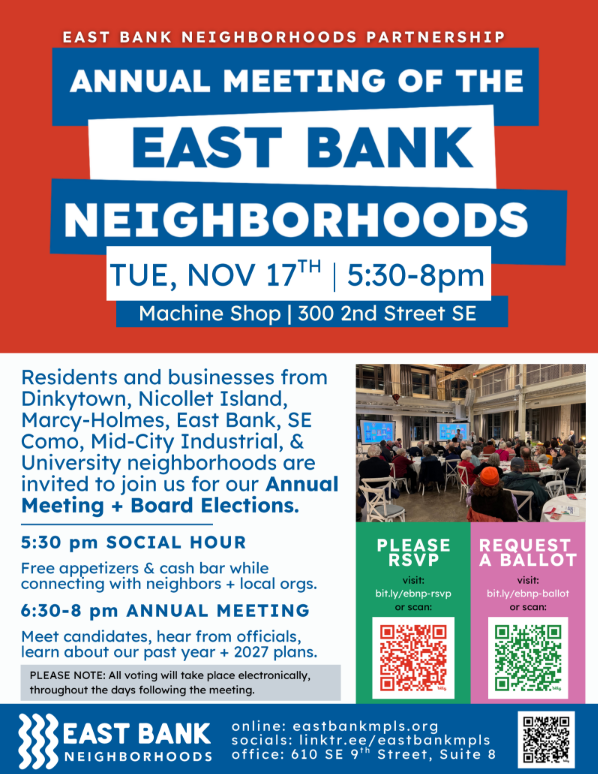
Residents and businesses from Dinkytown, Nicollet Island, Marcy-Holmes, East Bank, SE Como, Mid-City Industrial, & University neighborhoods are invited to join us for our Annual Meeting + Board Elections.
Starting at 5:30 pm, enjoy free appetizers and a cash bar, meet neighbors and talk with local community groups.
At 6:30 pm, our meeting starts, where you will learn about upcoming candidates for our board of directors, hear from local government leaders, University officials, the Minneapolis Police Department, and more.
Please RVSP here: bit.ly/ebnp-rsvp
Please Request a ballot here: bit.ly/ebnp-ballot
If you would like to host a community org table at this event: https://forms.gle/szythhbc8k7V6s2x9
If you would to know more about running for the board of directors, please visit this page: eastbankmpls.org/run
East Bank Neighborhoods Partnership Annual Meeting + Board Elections
Tuesday, November 17, 2026 | Social Hour: 5:30 pm | Meeting: 6:30 pm
Machine Shop | 300 2nd Street SE
Flyer for East Bank Neighborhoods Partnership Annual Meeting
Summary: The Business Housing and Zoning Committee discussed data center policy, and the full City Council will continue discussion and take votes next week.
Background: 70% of Americans oppose data centers in their area. Minneapolis residents sent in thousands of public comments to advocate against allowing data centers in our city. But Data Center lobbyists have been targeting Minneapolis City Hall, and Mayor Frey and some Council Members are publicly advocating for data centers to be developed in our city regardless of the serious impacts they can have on communities.
This spring, the City Council approved a six-month moratorium on data center development to give the City time to craft and adopt a policy defining what data centers are and outlining where they can be built and through what processes. Lobbyists were able to weaken this moratorium from the maximum 12 months allowed down to just six months, and to win loopholes exempting part of downtown from the moratorium. The moratorium only passed by 7-5-1 vote, and Mayor Frey did not sign the moratorium indicating he did not support it.
During the moratorium, City staff and the ordinance authors developed a proposed policy for data centers. Originally Mayor Frey’s staff recommended allowing data centers in nearly every major corridor of the city, but withdrew the proposal after massive citywide pushback. Their second proposal, which is now on the table, allows data centers to be developed in downtown Minneapolis up to 175,000 sq ft.
There has been some misinformation that the current proposed policy will protect residents from the negative impacts of data centers. This is not the case for a number of reasons:
- While the proposed ordinance limits the square footage of individual data centers, it doesn’t limit the number of data centers. Because computing technology is rapidly changing, a data center with small square footage can have vastly differing amounts of capacity. Multiple data centers with high-volume servers would be allowed under the current policy and could easily become the equivalent of several hyperscale data centers.
- The repeated claims that data centers are the key to solving the city’s revenue problem are more of a wish rather than a fact based on data. In fact, in the Data Center report the City Assessor’s Office provides several reasons on why data centers, and specifically the proposed policy, is not likely to significantly change the city’s tax revenue.
- The current proposal gives data centers Primary Zoning, which gives any data center the developer the right to build a data center in certain areas regardless of concerns about the impacts on the neighborhood or the City. There is no reason for the City to roll out the red carpet and surrender our oversight abilities through Primary Zoning. Overlay Zoning would allow the City to retain the ability to reject proposals that hurt residents.
- Currently, cities are preempted from regulating data centers based on energy use. However, the state legislature could change this policy– and with a recently elected Democratic trifecta, this could be a reality in the next several months. We should not allow data centers now based on square footage, which has no relationship to energy use, when we might have much stronger and more effective regulatory tools soon.
It’s hard to overstate how out-of-touch the current proposal is with the public opinion. Big Tech companies are spending billions trying to get local governments to allow data centers, but no amount of money has been able to overcome the massive public opposition to data centers. This week, states and cities across the country voted to limit or ban data center developments and elected leaders who campaigned on banning data centers in the midterm elections. When the City Council approved the six-month moratorium on data centers, there were 80 moratoriums in place around the country, and now there are over 400.
A recent news story reported that Mayor Frey and Council Member Rainville met with developers earlier this week and pleaded with developers to ask the city for subsidies for private development with taxpayer money. The article described the pitch as “bordered on begging” and quoted Council Member Rainville telling developers "We're here to help you with your investment — to make you rich, to help you prosper." I believe this article offers great insights into some of the dynamics at City Hall around data center development. Residents have been vocally opposed to data centers since day one. Who is the proposed policy meant to serve and who is meant to benefit financially from it?
I have consistently stated that data centers have no place in Minneapolis. If the Mayor and City Council do not have the political will to stand up to Big Tech with a full ban, then at a bare minimum, the City should not give Primary Zoning for data centers. Primary Zoning gives any data center the developer the right to build a data center in certain areas, and takes away the ability of the Planning Commission or City Council to stop a development. Most importantly, it removes the ability for the City Council to consider public opinion, or measure how a project aligns with the City’s goals, as a factor in approving a proposed data center. The City of Minneapolis should not shut residents out of this incredibly important conversation that directly impacts their neighborhoods.
In October, the City Planning Commission held a public hearing on data centers where over a thousand residents submitted comments urging a full ban or strict limits on data centers, specifically residents demanded that No Primary Zoning be given to data centers. The Planning Commission responded to the public opinion and recommended two significant amendments to the City staff proposal, one removing Primary Zoning and the other reducing the maximum allowed size from 175,000 sq ft to 50,000 sq ft. In addition to making these recommendations, several Commissioners expressed frustration that the City Council and Mayor would not consider extending the data center moratorium to continue working on a better policy.
Next week, the City Council will continue discussion and take a vote on a data center policy. I will be bringing forward a proposal for a full ban on data centers, which I am confident reflects public opinion amongst Minneapolis residents.
Key votes: The Business, Housing and Zoning Committee voted to forward the data center ordinance to Committee of the Whole without recommendation. The Committee of the Whole will discuss the policy on November 9th, and take a vote on the policy on November 12th.
Summary: The Public Health, Safety and Equity Committee held a public hearing on the Mayor’s nominee for MPD Chief, Bill Peterson. Questions for Peterson, discussion, and a vote on his appointment will take place next week.
Background: Earlier this year, former MPD Chief Brian O’Hara resigned after allegedly interfering with an investigation into potential sexual misconduct. Mayor Frey nominated O’Hara to serve a second term just weeks prior, even though he was aware of the ongoing and unresolved investigation.
The City Council asked Mayor Frey for information about his plan to nominate a new Chief, as well as what corrective measures have been made in the department to prevent future failures of accountability. Mayor Frey has so far refused to respond to this inquiry.
Several of my colleagues and I wrote Mayor Frey a letter expressing that we could not support any nominee for Chief who came from within MPD. The Department of Justice and Minnesota Department of Human Rights have concluded that the Minneapolis Police Department has a decades-long history of racial discrimination and excessive force. Any officer whose entire law enforcement career has been spent within that institution is not best positioned to lead its transformational change. While an external candidate does not guarantee effective leadership to transform our police department, it is more likely than someone who is steeped in the same culture that enabled the murder of George Floyd, Terrance Franklin, Amir Locke, and many more; landed our City in a unique state consent decree for a pattern of violating human rights and Constitutional law; and cost taxpayer tens of millions in preventable lawsuits.
In October, Mayor Frey nominated Bill Peterson for MPD Chief. Peterson currently serves as Interim Chief of MPD and has been with the department since 1995. All of the concerns my colleagues and I outlined in the letter to Mayor Frey apply to Interim Chief Peterson.
This week, the Public Health Safety and Equity Committee held a public hearing on the nomination of Interim Chief Peterson, and then had some time to ask questions. I asked Interim Chief Peterson about his experiences working in the 3rd and 4th precincts, where there was a documented pattern of racism and discriminatory policing. Specifically, I asked Peterson how often during his time in these precincts he heard his fellow officers using racial slurs or discriminatory language about race, gender, or sexual orientation. Peterson stated he never did, which is incredibly hard to believe given the findings of the Department of Justice and MN Department of Human Rights. Peterson’s claim that he has never heard slurs against racial or gendered groups in over 30 years within the Minneapolis Police Department is a huge red flag. I am very concerned about Peterson’s willingness to challenge the “Thin Blue Line” mentality of officers protecting each other from accountability.
I also asked Peterson if he would use his authority as Chief to pass a policy prohibiting any officer with a sustained misconduct history from becoming a Field Training Officer. This is a commonsense reform that would have prevented Derek Chauvin from training other officers. Given how minimal this reform is, I was disturbed that Peterson would not commit to it publicly.
Due to limited time, the Committee voted to continue the conversation at the City Council meeting next Thursday, November 12th. After City Council discussion, the City Council will take a vote on appointing Interim Chief Peterson as the MPD Chief.
I will have further questions that I plan to ask at the meeting. At this moment I am deeply concerned that the nomination of Peterson indicates Mayor Frey and some Council Members are putting Minneapolis back on the road that led to the murder of George Floyd and the global uprising.
Key votes: The Public Health, Safety and Equity Committee voted to forward the nomination to the City Council meeting without recommendation, where there will be continued questions and discussion and a vote on the appointment.
Summary: The Business Housing and Zoning Committee received a report on autonomous vehicles and factors to consider in municipal regulations.
Background: Big Tech companies are launching robotaxi autonomous vehicles (AVs) across the country. Google (Waymo) has robotaxis testing and collecting massive amounts of video data here in Minneapolis, and Amazon (Zoox) is planning to start as well. Tesla (Cybercab) has prototypes in the city currently as well.
Unregulated robotaxis pose massive risks to public safety and the local economy. They also raise many concerns around surveillance, traffic management, sustainability goals, and costs to the city. My colleagues and I requested that City staff research the potential impacts to help inform a municipal policy regulating robotaxis in Minneapolis.
We also authored an interim policy to protect workers and residents immediately, while City and state leaders develop comprehensive policies. Mayor Frey vetoed the interim protections and has not articulated any plan to protect workers or residents from the dangers of autonomous robotaxis, particularly the 10,000 rideshare drivers who face losing income immediately. My colleagues and I re-started the legislative process immediately, and intend to continue our work on developing a strong policy to protect our city from predatory Big Tech robotaxis.
This week, the Business Housing and Zoning Committee received a presentation on the research around robotaxis and had an initial discussion on some of the topics it covered, including worker displacement, surveillance, and infrastructure impacts. I look forward to many more conversations about responsible regulation for robotaxis in the coming months.
Key votes: No votes taken.
Summary: The Climate and Infrastructure Committee received an update on the Transportation Action Plan and Racial Equity Framework for Transportation, two comprehensive guides to the City’s goals for an equitable, sustainable transportation system.
Background: The Transportation Action Plan (TAP) is the City’s 10-year plan for an equitable, accessible, sustainable and connected transit system. It sets specific goals for the city to reach by 2030 and lays out dozens of strategies to achieve these goals.
The Racial Equity Framework for Transportation is a standardized set of policies and procedures for the City to use in making decisions about investments in the transportation system. It helps ensure that resources are invested in equitable ways to prevent replicating the racial discrimination of past infrastructure spending.
This week, the Climate & Infrastructure committee received updates on implementation of both of these plans. The TAP presentation affirmed that we are significantly behind on our goal of reducing car trips citywide. There has not been a meaningful reduction in car use since 2019, nor has there been a meaningful increase in walking, biking, or public transit. The number of vehicle miles traveled (VMT) is not going down citywide either. Because we are not reducing car trips, we are also falling short on our goals of reducing greenhouse gas emissions, and reducing serious and fatal car crashes.This is a serious problem that I and my colleagues will continue to work with the community to address.
The presentation noted that in order to meet our goals, each resident would need to drive just 3.2 fewer miles per day on average to meet our vehicle miles traveled reduction goals by 2030. Please think about what car trips you could cut out of your own life and replace with walking, scootering, biking, or public transit. It takes all of us!
In more positive results, we are more or less on track when it comes to pedestrian improvements to roadways and sidewalks, and have significantly increased the number of residents who are within a half-mile of a transit stop. There has been significant expansion of protected bikeways and of public transit in priority areas.
The Racial Equity Framework update showed that we are seeing reduced racial disparities in victims of severe and fatal crashes, as well as moving towards parity on commute time for white residents and residents of color. Data also suggests that having the Racial Equity Framework in place has led to more equitable distribution of City transportation and road projects and improvements.
Key votes: No votes taken.
There are more ways than ever to connect with Minneapolis 311. The new Minneapolis 311 mobile app makes it easier to report issues and request City services from your phone.
With 126 service types available in the new app, you can use it to report issues and request help with services across Minneapolis, from street and sidewalk concerns to problems with signs, trees, garbage and more.
The new 311 system also includes an improved online experience, giving you more convenient ways to connect with the City.
Download the new Minneapolis 311 app:
Contact Ward 2
Visit: minneapolismn.gov/ward2
Email: robin.wonsley@minneapolismn.gov
Phone: 612-673-2202
City Hall
350 S. Fifth St., Room 370
Minneapolis, MN 55415
For reasonable accommodations or alternative format please contact 311. People who are deaf or hard of hearing can use a relay service to call 311 at 612-673-3000. Para ayuda, llame al 311. Rau kev pab, hu 311. Hadii aad caawimaad u baahantahay, wac 311. |