|
Bring the kids for a free morning of live music, creative activities and fun.
Family Gathering Concert Series: Mae Simpson with Colin Bracewell and School of Rock 10 a.m.-2 p.m. Saturday, Oct. 17 PILLLAR Forum Café, 2300 NE Central Ave.
The series is produced in collaboration with the Minnesota Independent Venue Alliance and funded by the City of Minneapolis through Minneapolis Forward to support community and economic resilience.
Get event details and see who's performing.
Minneapolis Amplified brings local artists to unexpected neighborhood spots, from hot dog joints to flower shops, while supporting the small businesses that make our city special.
This week’s event:
Minneapolis Amplified: East Hennepin Auto Service Some S***** Cover Band Noon-3 p.m. Sunday, Oct. 18 East Hennepin Auto Service, 2100 E Hennepin Ave #16
More events are planned at small businesses across the city through December.
Minneapolis Amplified is led by Dance Agenda in partnership with the City’s Arts & Cultural Affairs Department and funded through Minneapolis Forward.
Find upcoming events and participating venues on the Dance Agenda website.
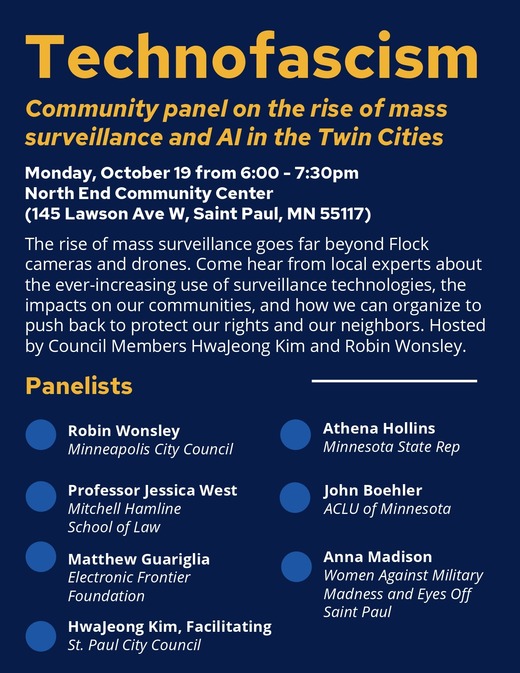
The rise of mass surveillance goes far beyond Flock cameras and drones. Come hear from local experts about the ever-increasing use of surveillance technologies, the impacts on our communities, and how we can organize to push back to protect our rights and our neighbors. Register here.
The panel will be facilitated by Saint Paul Council Member HwaJeong Kim, and the panelists are Minneapolis Council Member Robin Wonsley, Professor Jessica West from Mitchell Hamline School of Law, Matthew Guariglia from Electronic Frontier Foundation, State Representative Athena Hollins, John Boehler from ACLU Minnesota, and Anna Madison from Women Against Military Madness.
Technofascism: community panel on mass surveillance and AI
Monday October 19th from 6-7:30
New location: North End Community Center (145 Lawson Ave W, Saint Paul MN 55117)
Register here
Technofascism community panel flyer
The annual free South Minneapolis Seniors Fair will take place on Wednesday, October 21st. This fair is tailored for our senior community members and caregivers. The day will feature workshops, an elected officials panel, a resource fair, and a free lunch. The workshops will cover the City Budget, Election and Voter Services, public safety and crime prevention, and connecting with the community. The resource fair will feature vendors from the City of Minneapolis, as well as community partners and organizations that provide services to seniors.
Details
- 9 a.m. - 2 p.m. Wednesday, Oct. 21
- Diamond Lake Lutheran Church, 5760 Portland Ave. S.
Schedule
- 9 a.m. - Breakfast, Welcome address
- 10 a.m. - Breakout sessions: How to Build Community – Your Voice Matters; City Budget
- 10:45 a.m. - Attorney General Keith Ellison’s Office & Congresswoman Ilhan Omar’s office; breakout session on fraud, scams, & federal updates
- 11:30 a.m. - Lunch
- 11:45 a.m. - Elected Officials Panel
- 12:45 p.m. - Raffle
- 1 p.m. - Yoga
- 1:20 p.m. – Break out sessions: Crime Prevention; Elections and Voter Services
The Seniors Fair is sponsored by Wards 8, 11 and 12; the City of Minneapolis; and TRUST, inc
For ASL and other language interpretation, please send requests to christina.kendrick@minneapolis.gov by Wed., Oct. 14.

City crews are getting ready to sweep streets across Minneapolis. Street sweeping helps keep leaves and debris out of the storm drains. That helps keep them out of our lakes and creeks and the Mississippi River. Minneapolis Public Works will begin the big task of curb-to-curb street sweeping throughout the city Tuesday, Oct. 20.
During the four weeks in October and November, crews clean about 1,000 miles of city streets.
Stay informed
Temporary hot pink “No Parking” signs will be posted at least 24 hours before they start so the street will be clear of cars when they’re swept. The first signs will be posted Monday, Oct. 19, and sweeping will begin Tuesday, Oct. 20. Anyone who parks on the street will need to follow posted parking rules, or their cars may be ticketed and towed.
Stay informed about the parking rules through a web map (to be updated shortly) showing when your street is scheduled for sweeping, “no parking” signs on the street, and email and text alerts.
Learn more about street sweeping on the City website, Facebook, Bluesky, Threads and X.
Minneapolis voters can still vote early by mail or in person for this year’s general election.
Voting by mail
If you requested a vote-by-mail ballot, we recommend mailing it back by Oct. 27 or bringing it back in person. Check the City website for more details.
Voting early in person
Minneapolis has a main Early Vote Center open at 980 E. Hennepin Ave. We’ll also have one on the North Side and one on the South Side opening Oct. 20, with the same hours as the main site.
We’re also opening 12 special one-day voting sites all across the city Oct. 19-30. These pop-up sites have the same security measures, rules and processes as the main sites.
Find the voting sites and their open times on the City website.
Summary: The City Council voted to sustain Mayor Frey’s veto of Workers Drive Minneapolis. The mayor has not articulated any plan to protect 10,000 drivers from job displacement by AI robotaxis, nor a plan to protect residents from the economic and physical dangers of unregulated driverless cars. The City Council is continuing to fight for workers rights and public safety, along with the Saint Paul City Council.
Background: Earlier this month, I led the City Council to adopt Workers Drive Minneapolis, a regulation that would require driverless robotaxis to be licensed and to have human safety monitors in the driver’s seat. Mayor Frey vetoed the policy, and this week the City Council unfortunately voted to uphold the veto, falling just a few votes short of the number needed to override.
The veto of Workers Drive Minneapolis handed a win to Google, Elon Musk, and Jeff Bezos. These Big Tech companies are operating driverless robotaxis and have a history of taking advantage of unregulated markets. Meanwhile, thousands of working-class families in Minneapolis are now facing difficult conversations about how they will make ends meet if a breadwinner loses their income to a driverless robotaxi.
These drivers are our neighbors. Their work pays the rent, puts food on the table, and supports local businesses. They deserve a voice in shaping the future of their industry.
Mayor Frey has not articulated any plan to mitigate the massive financial harms of this veto, which a new report found to be in the hundreds of millions of dollars of local economic activity and tax revenue. Workers Drive Minneapolis provided a common-sense first step to mitigate catastrophic worker dislocation as a result of automation in the rideshare and trucking industries.
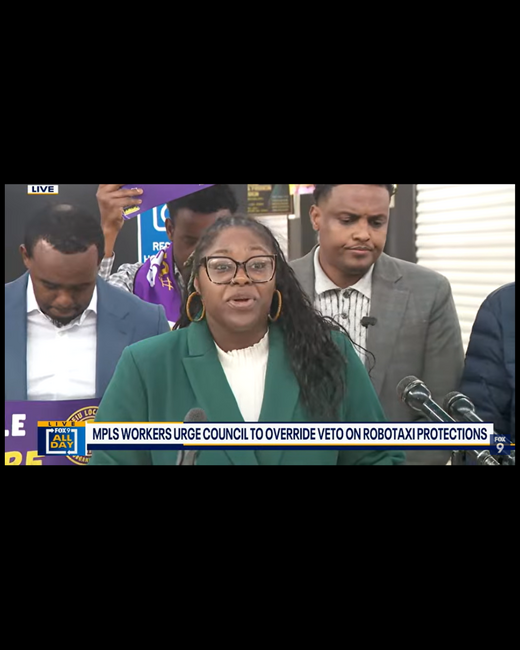
I spoke at a press conference alongside rideshare drivers and small business owners at Karmel Mall about the serious impacts that this veto will have on the local economy, particularly the East African community.
With so many residents already stretched to the breaking point financially, and with our immigrant communities under attack by the federal government, allowing Big Tech to steal thousands of jobs from immigrant workers is unacceptable.
Immediately following the vote on the veto, my colleagues and I gave notice that we are restarting the legislative process to pass regulations on robotaxis. We will continue the fight to protect our communities from the economic and physical dangers of driverless AI robotaxis. We are committed to holding Big Tech accountable and putting workers and local government in the driver's seat.
Key votes: The City Council voted 7-5-1 to override the mayor’s veto. Council Members Rainville, Vetaw, Shaffer, Whiting, and Palmisano voted to uphold the veto and Council Member Warren was absent.
Council Minority Leader Robin Wonsley speaking at the veto override press conference held at Karmel Mall alongside the Minnesota Uber and Lyft Drivers Association (MULDA), SEIU Local 26, small business owners, a rideshare users and Council Vice President Jamal Osman.
Summary: This week, Evie and HourCar announced that they would be sunsetting the carshare service on October 15th. Elected leaders are working to identify a way to preserve this important service and move it to public ownership.
Background: This week, I and the public learned that HourCar and Evie would be ending operations on October 15, leaving more than 4,000 members without a critical transportation option. This news is especially disappointing given that the Minneapolis City Council committed funding as recently as August to help sustain this essential service.
As Chair of the City’s Climate & Infrastructure Committee, I remain committed to building an affordable, accessible, equitable, and sustainable transportation system that helps us achieve our goal of making 3 out of every 5 trips by walking, biking, or public transit.
I’m working with City staff and other key stakeholders to understand what led to HOURCAR’s closure, identify immediate support for impacted residents, and explore opportunities for municipal ownership of car-sharing services to preserve this critical transportation option.
I’ll continue sharing updates as we identify next steps toward meeting our city’s climate and transportation goals.
Key votes: No votes taken.
Summary: Thanks to strong community organizing, the City Planning Commission recommended strict limits on data centers, including no primary zoning and much smaller sizes.
Background: The City Council is considering regulations on data centers. This week, the City Planning Commission held a public hearing and discussed potential regulations proposed by the Frey administration. They then amended the administration’s proposal and forwarded their recommendations to the City Council.
This week, the City Planning Commission considered and held a public hearing on the Frey administration's proposed data center regulations and passed several amendments aimed to further strengthen the proposal. About 1,000 residents submitted public testimony, nearly all of which was in opposition to data centers. Over 45 people testified in person, again broadly calling for a full ban or at a minimum strict limits. I testified at the public hearing myself. This is what I shared:
“Good evening Commissioners, I’m Council Member Robin Wonsley, I represent Ward 2 on the Minneapolis City Council and I’m the Council Minority Leader.
70% of Americans oppose data centers in their area. In our time of political division this is something there is incredibly broad alignment on. Voting to greenlight data centers goes against our constituents, which begs the question: who is it for?
Data centers exist to generate profit for big tech billionaires and it's clear from the over 1000 public comments that our residents overwhelmingly do not want them in our city. I do not want them in our city. But unfortunately it seems that the myth of trickle-down economics still holds some sway in City Hall and the current City Council is not representative of the public opinion on this issue. As an elected official, my job is to protect the public from predatory big tech to the greatest degree possible. And since a ban seems to not be viable, the number one priority must be to eliminate all Primary Zoning for data centers.
Primary Zoning is quasi-judicial which means the Planning Commission and City Council cannot vote to deny a proposed data center because of factors like the energy and water use projections, what kind of mixed use is being proposed and if that mix advances City goals, the developer’s track record in other cities, and most importantly community input. Primary Zoning surrenders the authority of local government and gives developers the keys to the city.
On the other hand, Overlay Zoning empowers the Planning Commission and City Council to actually evaluate each proposal on a case-by-case basis. Why would we choose a type of zoning that gives us less due diligence? We should fight to keep flexible options, not give them away.
It would be absolutely unacceptable to have Primary Zoning for data centers anywhere in our city and I urge the Planning Commission to forward to the City Council a set of recommendations that include only Overlay Zoning and no Primary Zoning. Thank you.”
After the Public Hearing, the Planning Commissioners discussed potential amendments to the City staff’s recommendations. Similarly to what I have heard from the public, several commissioners shared their frustration that the moratorium was not longer than the six month moratorium passed by Council this spring. Commissioners also highlighted that the city had limited scope in regulatory power due to state pre-emption. Fortunately, Planning Commissioner Angela Conley moved to remove data centers from primary zoning, which was approved 6-1. This amendment ensures that both City Council and the public will have a strong oversight over any proposed data center development in Minneapolis. Commissioner Jason Garcia moved capping the square footage at 50,000 square feet as opposed to 175,000 square feet, which was approved 5-2. These recommendations will now be forwarded to the City Council. The City Council will vote on the Planning Commission’s recommended policy in the next few weeks. Community members should keep up the pressure on City Council to ban or limit data centers until the policy is fully adopted.
While I still believe there should be a full ban on data centers in Minneapolis, the Planning Commission meeting was a huge step forward in the movement to limit them. Thank you to the community members who showed up to pressure your elected officials to stand up against data centers.
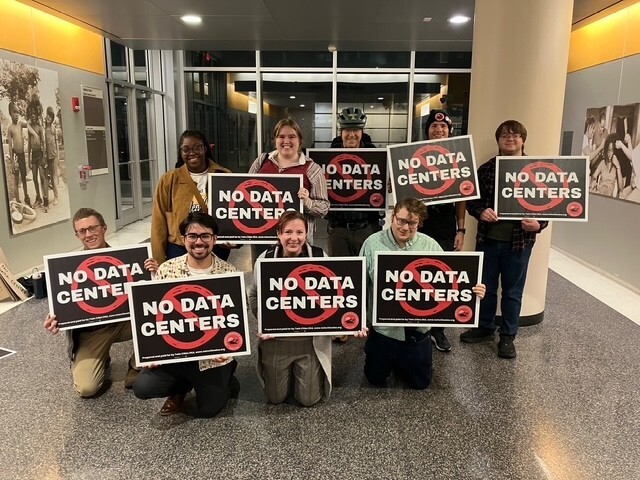
Council Member Wonsley with community members at the public hearing on data centers.
Summary: The City Council voted to deny a proposal by the Frey administration that would have fundamentally changed the current Behavioral Crisis Response program, which has been extremely successful. City Council is moving to maintain the current focus on mental health response and bring the program in-house as a permanent part of the City’s public safety response.
Background: Behavioral Crisis Response (BCR) has been widely celebrated as a successful public safety program that reduces calls to police and ensures specialized mental health responses to residents in need. The federal Department of Justice and Minnesota Department of Human Rights have commended BCR and emphasized its importance in the City’s work creating a comprehensive public safety system that respects human rights and constitutional law. BCR has responded to over 35,000 calls since it was created in 2021 and provides high-quality responsive services to residents.
Since BCR is one of the most successful parts of our City’s public safety system, it was very concerning when the Frey administration proposed contracting with a new out-of-state vendor for a new “mobile crisis response” program that would fundamentally shift the scope of BCR to include a wide variety of other services, including responding to unsheltered homelessness and “quality of life crisis.” This was particularly confusing because the City already has in-house programs like the Homeless Response Team and Community Safety Ambassadors, which focus on both safety and liveability issues. Duplicating these services and trying to combine them with a mental health response unit would create mission creep that threatens the efficacy of BCR.
This week, the City Council was asked to vote on the mayor’s proposed new contract. Council Members expressed strong support for protecting the original, successful scope of BCR and creating a transition plan to move the program in-house rather than contracting with a brand new external vendor.
The current contract for BCR expires at the end of December, and there was agreement that a gap in BCR services would be a serious problem. Council Member Palmisano suggested that the City Council voted to waive the City Council’s procurement procedures so that the city administration could work to extend the current contract for BCR and prevent a service gap while Council Members explore bringing the program in-house. I authored a motion to reflect this proposal, which passed. Since this motion was approved, the Frey administration now has the option to attempt to extend the city’s current BCR contract. If the current vendor agrees, the current contract could be extended and there would be no lapse in BCR services for up to 18 months. This would give the Frey administration and CIty Council substantial time to bring this program in-house.
At the upcoming Public Health, Safety & Equity Committee meeting on October 21st, I and several of my colleagues will bring forward a legislative directive requesting information from the City Administration on transition plans to bring the BCR program in-house as a city-run program with the same focus and scope.
Since I took office in 2022, nearly every single year the City Council has had to do a last-minute intervention to take legislative actions to maintain BCR services because the Frey administration has repeatedly put it in jeopardy. Moving the program in-house would mean we can finally end the cycles of instability and solidify our commitment to making this successful service a permanent part of the City’s public safety system beyond policing. In-house programs are also often more cost-effective than subcontracting. I look forward to continuing this work to ensure high quality mental health response services for all residents.
Key votes: City Council voted 7-5 to deny a contract with an out-of-state vendor for a new “mobile crisis response” program that would fundamentally shift the scope of the City’s successful Behavioral Crisis Response (BCR) to include a wide variety of other services. City Council then voted 11-1 to waive the City Council’s procurement procedures so that the Frey administration has the option to extend the current contract for BCR and prevent a service gap.
Summary: The City Council approved a contract with the HERC for 2027, which does not contradict our adopted goal of a HERC closure in 2028. I hope this will be the City’s last contract with the HERC, and am committed to upholding the City Council’s end of the significant work that it will take to accomplish this goal.
Background: In the fall of 2024, the City adopted a resolution supporting a full and permanent closure of the Hennepin Energy Recovery Center (HERC) no later than December 31st, 2027 and the closure of the entire facility by December, 31st, 2033.
This week, The City Council approved an amendment to a contract with Hennepin County for waste disposal services at the HERC to extend through the end of 2027. This one year contract does not put us at odds with our City position, as long as we spend all of the rest of 2026 and all of 2027 truly working to implement Zero Waste initiatives. Zero Waste was a shared priority that many City Council Members highlighted in the Climate and Infrastructure Work Plan.
As leaders of the Climate and Infrastructure (C&I) Committee, Council Member Stevenson and I have been working to advance pathways for the City to have sustainable funding for Zero Waste initiatives. That work will be presented by City staff at the C&I committee meeting next week. In addition, my office has been in conversation with the Frey administration on other actions the City Council may take to ensure we are doing our part to support a HERC closure. I anticipate legislative actions regarding some of those initiatives to occur in the next several months.
While Mayor Frey has stated his support for the HERC closing, his proposed budget for 2027 cuts Zero Waste funding significantly. This is puzzling since the mayor is also aware that Zero Waste work is on a tight timeline if we actually intend to support the HERC’s earliest possible closure. I am already working on an amendment to restore the proposed 2027 cuts to Zero Waste and I welcome collaboration with colleagues and community members who are also interested in ensuring the City is working towards our shared goals and promises.
Key votes: Council votes unanimously on a contract for waste disposal at the HERC through the end of 2027.
Summary: City Council voted to request a legal analysis about avenues to empower the City Council to subpoena the mayor’s Administration for information if needed to fulfill their duties.
Background: Since I first entered City Hall nearly five years ago, one of my ongoing concerns has been how much of the City government operates through unwritten cultural norms rather than clear, standardized policies and practices that are documented, accessible, and consistently applied.
Transparency and access to information should not depend on who occupies the Mayor’s office, who serves on the City Council, or the willingness of any particular administration or staff member to cooperate and collaborate. These are fundamental principles of good governance, and they must be institutionalized in ways that endure beyond any one group of elected officials.
Recently, Mayor Frey has imposed significant limits on the City Council’s access to information and professional staff that we need in order to fulfill our job duties. That led several of my colleagues and I to explore tools that can ensure transparency and access to information for all future City Councils and for the public. One of those potential tools is subpoena power, the ability to legally require the mayor or his administration to attend a City Council meeting to answer questions. We brought forward a request for the City Attorneys to evaluate the legal authority for City Council to subpoena the mayor’s office, and what pathways exist to gain that authority. This is a tool that cities like Minnetonka and West Saint Paul currently have and could be an additional tool to improve public transparency to the public.
This request is about ensuring that the City Council, both today and in the future, has the necessary tools to fulfill its legislative and oversight responsibilities, including when an administration is unwilling to voluntarily provide information.
Lack of transparency from the mayor’s administration has real consequences for residents. One example is transparency around fees. Since 2022, my office has pressed the mayor’s administration to be transparent about the City’s fee rates on landlords, off-duty MPD work, and polluters to ensure that everyone is paying their fair share and reduce the financial burdens on taxpayers. The administration was at times resistant to these inquiries. Even with a legislative directive, the mayor’s administration has taken over two years to answer these questions because of avoidable delays by the mayor’s staff. This has resulted in taxpayers subsidizing millions of dollars that should have been paid by slumlords, polluters, and off-duty MPD officers. Delaying and hiding information has real costly consequences. Subpoena power would help the City Council get questions answered and use information to save taxpayers money.
A functioning democracy is messy. It involves disagreement, debate, scrutiny, and sometimes uncomfortable conversations. That is not a flaw in democracy; it is an essential part of how democracy works. But when information is restricted, when staff are prevented from publicly presenting information, or when elected representatives face unnecessary barriers to carrying out their oversight responsibilities, our democracy is weakened.
Ultimately, transparency should be a standard of governance, not a privilege granted at the discretion of those in power. Our residents deserve a city government where accountability is built into our institutions, not dependent on the goodwill of individual elected officials.
Key votes: City Council voted 9-3-1 in support of the direction to the City Attorneys to provide a legal analysis of City Council subpoena authority. Council Members Rainville, Vetaw and Shaffer voted in opposition and Council Member Warren was absent.
Summary: City Council will hold a public hearing on Safe Outdoor Parking and vote on the policy, which would create managed, resourced areas for people to sleep overnight in their parked cars.
Background: Council Members Chavez, Chughtai, Chowdhury and Stevenson are authoring an ordinance to allow Safe Outdoor Parking. Safe outdoor parking provides individuals and families living in their vehicles a safe, authorized, staffed, off-street location place to park and sleep overnight. The sites will be managed by a non-profit or religious organization or a government entity. This program will help people avoid tickets, towing, or forced displacement. Safe outdoor parking is meant to help people stay safe; connect to services, support, and housing; reduce stress and trauma, and; support the City’s racial equity and public health goals.
The City of Minneapolis is in a housing crisis. Many families are sleeping on the streets each night and many more are one paycheck or one emergency away from homelessness. We need a variety of resources to solve the crisis and create safe, dignified housing for all.
Safe Outdoor Parking is one incredibly valuable strategy to help improve options for those facing housing instability and homelessness. Traditional homeless shelters do not always have capacity, nor are they necessarily the preferred resource for an individual experiencing homelessness.
Safe outdoor parking sites can connect individuals with services in a safe, secure, and stable location. Safe outdoor parking may be an effective early intervention strategy to prevent individuals who currently rely on their vehicles for shelter from moving further away from permanent housing.
I encourage everyone to attend the public hearing on Safe Outdoor Parking next week.
Safe Outdoor Parking- Public hearing
Tuesday, October 20th at 1:30pm
City Hall (350 South 5th St) - Room 390
Written testimony can be submitted any time to CouncilComment@minneapolismn.gov
Flyer for Safe Outdoor Parking Public Hearing
The Minneapolis City Council is adding another way for community members to make their voices heard during the budget process. City Council will host two informal listening sessions for residents to provide feedback on the Mayor’s 2027 recommended budget.
The dates for the upcoming sessions are:
Thursday, Oct. 29 University of Minnesota Urban Research and Outreach-Engagement Center (UROC), 2001 Plymouth Ave. N. Doors open at 5:30 p.m. Listening session from 6 - 7:30 p.m.
Thursday, Nov. 5 Whittier Elementary School Cafeteria, 315 W 26th St. Doors open at 5:30 p.m. Listening session from 6 - 7:30 p.m.
Listening session format
The listening sessions will begin with a brief budget overview. Residents will then have an opportunity to ask questions or give their opinions to City Council Members. Community members wishing to address the City Council are asked to arrive 30 minutes before the session begins to sign up to speak, similar to public hearings held in City Hall. Space will be limited.
All City Council members are invited to attend these listening sessions, however since these are not official City Council meetings, quorum is not required. There will be audio recordings of these sessions for the public record.
Other ways to participate
Residents who can’t make it to one of these listening sessions can participate in other ways, including:
Contact Ward 2
Visit: minneapolismn.gov/ward2
Email: robin.wonsley@minneapolismn.gov
Phone: 612-673-2202
City Hall
350 S. Fifth St., Room 370
Minneapolis, MN 55415
For reasonable accommodations or alternative format please contact 311. People who are deaf or hard of hearing can use a relay service to call 311 at 612-673-3000. Para ayuda, llame al 311. Rau kev pab, hu 311. Hadii aad caawimaad u baahantahay, wac 311. |