|
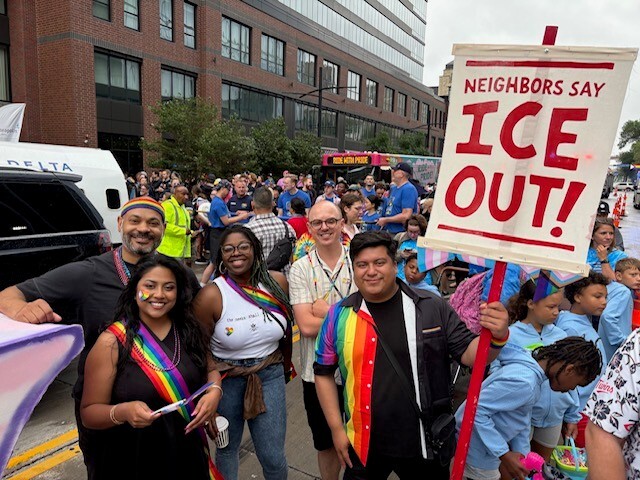
The Minneapolis City Council showed up loud and proud at the Twin Cities Pride Parade. It was particularly exciting to be there just days after the City Council repealed the ban on bathhouses, starting the process to reopening safe and welcoming spaces for the queer community that were shut down amidst homophobia and police repression in the 1980s.
Council Members Wonsley, Stevenson, Chavez, Chowdhury, and President Payne at Twin Cities Pride Parade.
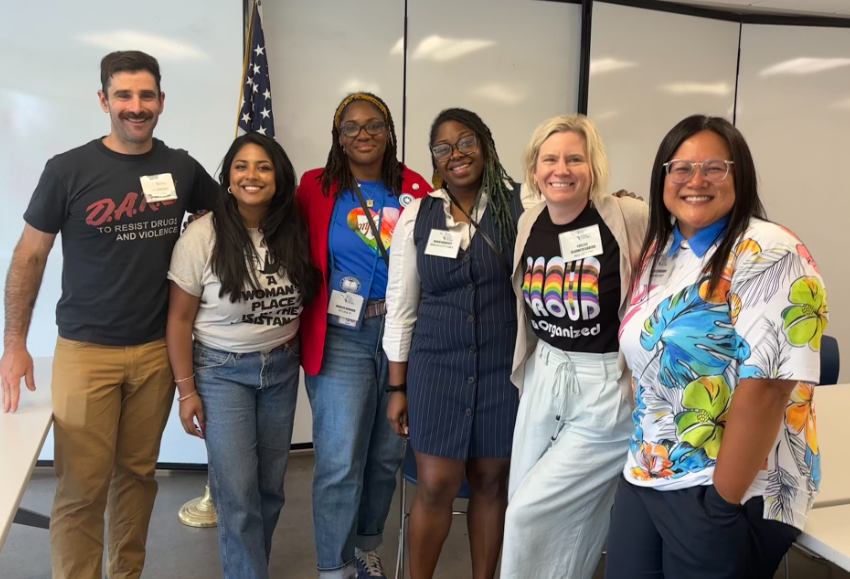
I attended the annual elected official convening by the Minneapolis Regional Labor Federation. This important gathering brings together elected leaders from multiple levels of government to collaborate directly with labor leaders in our city.
CM Wonsley standing alongside local elected and labor leaders at the MRLF elected official convening.
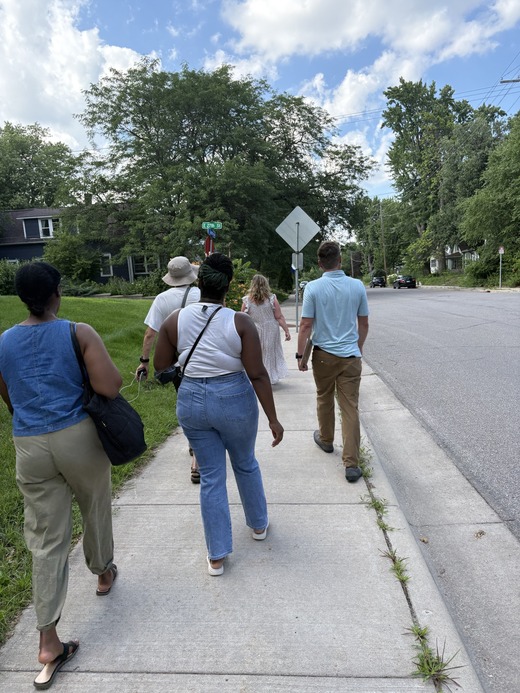
Director of Public Works Tim Sexton joined me and my staff for an on-the-ground tour of a few key infrastructure points in Ward 2. We visited intersections in Seward where neighbors have been organizing for safer streets so that Director Sexton could hear from directly impacted residents. We also toured some of the many improvements in Dinkytown that my office has supported in a variety of partnerships with MNDOT, Hennepin County, the University of Minnesota, and the University Student Government, like protected bike lanes, improved pedestrian lighting, ADA ramps, sidewalk plowing, suicide prevention fences, and safer street management on weekend nights to improve safety.
Council Member Wonsley, Director Sexton, and Ward 2 neighbors on a street where residents are asking for more safe and livable infrastructure.
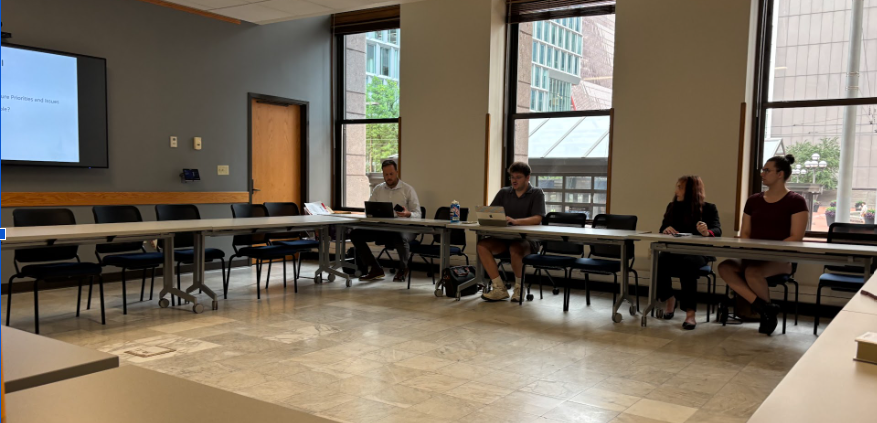
I attended the Community Environmental Advisory Commission (CEAC) along with Climate and Infrastructure Committee Vice Chair Stevenson. I appreciated the opportunity to meet directly with CEAC members who are volunteering their time and expertise to guide the City’s sustainability work.
At the CEAC meeting.
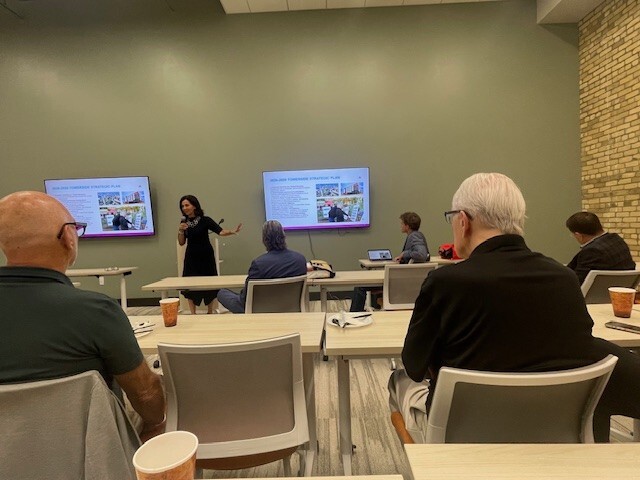
The Towerside Innovation District held their 2026 Annual Meeting to celebrate the successes of the past year and outline priorities for what’s next. The Ward 2 office presented on our shared initiatives in Towerside, including green infrastructure, affordable housing, and supporting the local hospitality and service industry.
At the Towerside Innovation District 2026 Annual Meeting.
Ossian Or's film "Dinkytown: A Tale of a Legendary Village" will have a second showing on July 18th from 4:30 to 6:30 pm at the Cedar Cultural Center.
There will be a petition for Savin' Grays as well as Bill Hunzicker's Book "Dinkytown: Four Blocks of History" for sale. Doors open at 4:00 p.m.
RSVP as soon as you can– the last showing sold out quickly and you must have a ticket to get in.
Voting for the August 11 State Primary Election begins Friday, June 26. Minneapolis voters can cast their ballot in person at the Minneapolis Elections & Voter Services Early Vote Center or downtown at the Hennepin County Government Center. Voters can also vote by mail beginning Friday, June 26, or at their polling place on Election Day, Tuesday, August 11.
Vote in person at the Early Vote Center
The Early Vote Center at 980 E. Hennepin Ave. is open 8 a.m.-4:30 p.m. Monday-Friday with extended hours, including weekends, starting on Monday, July 27. (Minneapolis City offices, including election services, are closed Friday, July 3.)
Please note: A previous Ward 2 Update incorrectly stated that there is an early voting center in Ward 2 at the Weisman Art Museum (333 E River Pkwy). There is not an Early Voting Center at Weisman for the Primary. There is a one-day pop-up planned there for the General Election set for October 26 from 10-5pm. Here is the link to early voting locations and pop-up sites: Scheduled Early Voting Locations - City of Minneapolis.
Vote by mail
Voters who applied for mail-in ballots should allow up to seven days for their ballot to arrive and plan an equal number of days for returning the completed ballot. All mail ballots need to be received by Election Day, Tuesday, August 11, to count.
Voters can also mail or drop off their ballot.
Find more details about voting on the City website.
Summary: The Public Health, Safety and Equity Committee held a public hearing on the MPD’s proposal to use drones from a company called Skydio. Over 40 community members spoke in opposition to the proposal, citing concerns about surveillance, data sharing with ICE, mistrust of MPD generally, and a lack of clarity on the purpose of the drones for improving public safety.
Background: In May, MPD presented their proposal to enter into a zero-dollar contract with a drone company called Skydio, stating that they planned to use drones as first responders. They would like to use drones in the Fourth Precinct (North Minneapolis) during a free trial period with Skydio.
Thanks to the surveillance contracts ordinance that I authored and the City Council approved, MPD had to hold a public hearing on this proposed new surveillance technology. The public hearing took place this week in the Public Health, Safety and Equity Committee (PHSE). Over 40 residents testified against the contract. Residents spoke about how it was unclear what problem these drones were trying to solve, that MPD’s own proposals for use were inconsistent, and that it was unclear what services unmanned drones could even administer that would actually be helpful in a first response capacity. Residents noted that the “pilot program” didn’t have any clear metrics of success, implying that the pilot is merely a precursor for MPD pursuing a long-term contract with Skydio at taxpayers expense after the pilot ends. Surveillance was the largest concern. Residents, including many Northsiders, shared mistrust of MPD based on MPD’s documented history of using social media to surveil activists and community members. Residents spoke about Skydio’s history of using surveillance drones to send data to the federal government, ICE, and private corporations. In addition to opposing drones generally, many residents opposed contracting with Skydio given that they work closely with the Israeli military to surveil and murder Palestinians. I recommend everyone watch the public hearing.
It’s clear to me that a drone pilot does not serve Minneapolis residents or improve public safety. MPD needs to focus on solving crimes and implementing the settlement agreement, not pursuing shiny new technology that has no documented benefit to residents. Surveillance is an extremely serious concern as major corporations and the Trump administration have a clear agenda of using surveillance to criminalize immigrants and anyone who opposes his agenda.
Key votes: The Public Health, Safety and Equity Committee forwarded the item without recommendation. The City Council will vote on the proposed pilot program at their next meeting on July 15th.
Summary: The Climate and Infrastructure Committee is creating a Work Plan to guide our work for the 2026-2029 term.
Background: I serve as Chair of the Climate and Infrastructure (C&I) Committee, along with Vice Chair Soren Stevenson. Vice Chair Stevenson and I are leading the Committee to create a work plan to help the committee focus within our scope, which includes: community infrastructure and the shared grid, and policies and programming related to the built environment, including but not limited to: climate resilience, sustainability initiatives, healthy homes, transportation, traffic and traffic-management issues, broadband capacity, utilities, special service districts, bicycle and pedestrian programming, recycling, solid waste, zero-waste measures, and severe weather mitigation and response.
We invited all Council Members to submit their priorities for Council action within the Committee jurisdiction. This week, the C&I Committee published a draft work plan, and held a public hearing for residents to submit their priorities in writing or speak in person.
In the coming weeks, we will refine the draft and adopt a finalized Work Plan. I welcome all residents to reach out.
Key votes: No votes taken.
Summary: The Climate & Infrastructure Committee held a public hearing on the proposed reconstruction of Lyndale Ave S.
Background: Lyndale Ave South is a major road that is maintained by Hennepin County. Hennepin County has proposed a major reconstruction of Lyndale Ave from Franklin Ave to 32nd St.
The Climate and Infrastructure Committee was asked to approve a resolution supporting the project. The committee received a presentation on the proposed redesign, and then held a public hearing. Residents expressed a wide range of opinions on the proposal. Key priorities included protecting mature trees from being cut down during the reconstruction, desire for safe streets for bikers and pedestrians, and a shared desire to support small businesses. Several business owners cited the dire economic impacts of the street being under construction for three years, pointing to Hennepin Ave as an example of small business closures following major construction. The City Council allocated $900,000 to support small businesses experiencing hardship due to road construction, but Mayor Frey did not administer these funds so businesses did not receive the money.
The decision to defund money for small businesses did not just impact the corridors these funds were piloted for (Hennepin Ave, Lake Street, Lowry Ave). It set a negative precedent that could have been an opportunity to redesign how transit reconstructions are approached and funded in the future. Several Council Members, including myself, will still advocate for the county to provide support for small businesses. But the City would have been much better positioned to advocate for funding for impacted businesses on Lyndale if the Frey administration had implemented the Council-led funding in 2025. Budgets reflect the City’s priorities and values, and the Frey administration’s choice to withhold Council’s funding demonstrates that the City does not believe funding for small businesses impacted by infrastructure is a priority.
While this is a complex and challenging street reconstruction, the final proposal by Hennepin County does integrate a lot of stakeholder feedback about design priorities. There is also a time sensitivity to this reconstruction, as it is needed to prevent catastrophic safety risks like sinkholes. There is also a limited window to access about $9 million in federal funds for the project.
There was significant testimony and feedback regarding the project. I want to thank everyone who made time to come to City Hall and have your voices heard even though many of you have participated in several engagement sessions over the years. Many colleagues have signaled interest in incorporating what was shared at the public hearing and public comments in the final resolution that will be considered at Council next week.
Key votes: The C&I Committee voted to forward the concept and layout to the full Council. The Council will vote at their meeting on July 15th at 9:30am.
Summary: The Climate & Infrastructure Committee received a presentation about the proposed closure of the HERC, and approved a request for additional related to converting the HERC into a sorting and recycling facility.
Background: The Hennepin Energy Recovery Center (HERC) is a trash incinerator where trash from Minneapolis is burned, along with trash from across Hennepin County. The HERC is a massive environmental justice problem that harms Black and brown communities in North Minneapolis, and residents across the city are organizing to shut down the HERC.
The City of Minneapolis has adopted a positon supporting a planned closure of the HERC by the end of 2027. Hennepin County owns and operates the HERC, and has authority over any potential closure. The City of Minneapolis can help support the closure of the HERC by reducing the waste that we send to be incinerated. For example, as of 2022, 38% of all Minneapolis residential solid waste was organics, which can be diverted from the HERC if we expand municipal organics recycling (composting). The City has many stated goals to reduce waste, and I am working with my colleagues to implement as much waste-reduction programming as possible and create sustainable funding streams to support Zero Waste work.
Last year, Council Member Rainville authored a legislative directive related to the costs and environmental impacts of closing the HERC. This week, City staff presented a response to the directive. The legislative directive did not include questions about the impacts of converting the HERC into a pre-sort and recycling facility, which is one of Hennepin County's proposed routes to closure that has increased in prominence over the last few months. A pre-sort and recycling facility would be a continued use of the HERC facility, but with significantly reduced or no incineration happening onsite, which would address the environmental justice and public health harms of incineration. In consultation with environmental justice organizations, I authored a follow-up legislative directive to build on Council Member Rainville’s directive, expanding the scope with additional inquiries that take into account a potential conversion into a pre-sort and recycling facility.
Key votes: The Climate & Infrastructure Committee unanimously supported my legislative directive about the proposed closure of the HERC and conversion into a sorting and recycling facility.
Summary: The City gave an annual report on complaints about violations of the separation ordinance, which states that the City will not use resources with immigration enforcement.
Background: Last year, the City Council strengthened the separation ordinance, which states that the City of Minneapolis does not use staff or physical resources to conduct immigration enforcement. One of new provisions that strengthened the ordinance required the City to set up a process for residents to complain about alleged violations of the ordinance, and to give an annual report on those complaints. This week, City staff presented the complaints that were reported in 2026. There were no complaints made about non-MPD staff, and nine complaints made about MPD.
Council Member Chavez asked an important question related to the City’s tracking and enforcement of the separation ordinance as it relates to City resources like parking lots and buildings, not personnel. City staff did not have the answer to these questions, but committed to following up with a memo.
Key votes: No votes taken.
The City of Minneapolis’s contract with the Minneapolis Police Officers Federation expired at the end of 2025. The City’s Labor Relations team is currently negotiating a new Police Contract.
The Police Contract is a crucial place to codify reforms in line with the settlement agreement, and to prevent MPD from continuing to do financial harm to the City and taxpayers. There have been two police contracts during the time I’ve served on the City Council, and both gave massive financial bonuses to MPD without any meaningful reforms. These were huge lost opportunities that residents and the City are still paying the price for.
This week, the Enterprise and Labor Relations (ELR) Committee held a closed session briefing to hear from the Labor Relations team about the state of the contract. Closed sessions are for Council Members to receive updates on matters related to current litigation or negotiation that cannot be shared publicly.
I shared my priorities for this police contract with the leadership of the ELR Committee and Labor Relation. My priorities are:
-
Permanent inclusion of Detective Rank. This allows the City to fully resource investigations, so that crimes get solved. This is consistently an area where MPD underperforms, and codifying a detective rank would help protect investigations from being constantly depleted for patrol.
-
Reining in off-duty. MPD off-duty work creates massive financial and legal risks for the City, and does not improve public safety. It also costs taxpayers over $1 million per year that goes directly into officers’ pockets for side gigs that they work outside the public benefit. The police contract is one opportunity to rein in off-duty.
-
Eliminating 70/30. The “70/30 Rule” in the police contract specifies that 70% of officers must be on patrol duty. Since MPD is chronically below their staffing minimum, this means all other police functions are constantly being depleted to fill patrol shifts. This is bad for departmental stability, City finances, and most importantly for public safety.
-
Coaching. MPD uses “coaching” to avoid disciplining officers. This practice undermines the settlement agreement and demonstrates that the City prioritizes protecting bad officers over public trust and accountability.
-
Banning Field Training Officers with sustained misconduct records. MPD officers with sustained misconduct records can currently still be Field Training Officers who train new officers. Famously, Derek Chauvin was the Field Training Officer for three other MPD officers when he murdered George Floyd. Under the current policies, officers like Chauvin could still be training new MPD officers.
I know that the police contract is a very important issue for many residents. I will keep you updated as the City Council learns more about the contract negotiation process and opportunities for public engagement.
Contact Ward 2
Visit: minneapolismn.gov/ward2
Email: robin.wonsley@minneapolismn.gov
Phone: 612-673-2202
City Hall
350 S. Fifth St., Room 370
Minneapolis, MN 55415
For reasonable accommodations or alternative format please contact 311. People who are deaf or hard of hearing can use a relay service to call 311 at 612-673-3000. Para ayuda, llame al 311. Rau kev pab, hu 311. Hadii aad caawimaad u baahantahay, wac 311. |