|
Voting for the August 11 State Primary Election begins Friday, June 26. Minneapolis voters can cast their ballot in person at the Minneapolis Elections & Voter Services Early Vote Center or downtown at the Hennepin County Government Center. Voters can also vote by mail beginning Friday, June 26, or at their polling place on Election Day, Tuesday, August 11.
Vote in person at the Early Vote Center
The Early Vote Center at 980 E. Hennepin Ave. is open 8 a.m.-4:30 p.m. Monday-Friday with extended hours, including weekends, starting on Monday, July 27. (Minneapolis City offices, including election services, are closed Friday, July 3.)
There is an early voting center in Ward 2 at the Weisman Art Museum (333 E River Pkwy)
Vote by mail
Voters who applied for mail-in ballots should allow up to seven days for their ballot to arrive and plan an equal number of days for returning the completed ballot. All mail ballots need to be received by Election Day, Tuesday, August 11, to count.
Voters can also mail or drop off their ballot.
Find more details about voting on the City website.
This Spring, the City Council approved my nomination to serve on the Meet Minneapolis executive board. Meet Minneapolis is one of the city’s leading tourism organizations that not only works to make Minneapolis a top destination city nationally, but also plays a key role in helping the City generate needed revenue that then supports many critical City programs and services. This week, the organization brought together board members for its annual strategy meeting. We had the opportunity to exchange feedback and share ideas on how to make Minneapolis a better place for both tourists and local residents to experience. A few priorities I’m excited to work on with my fellow board members are (1) developing Minneapolis' profile as a national leader in Civil Rights, (2) fostering more opportunities to elevate our local artist community, and (3) increasing investments into our local hospitality workforce.
 |
Metropolitan Airport Commission (MAC) Executive Director, Brian Ryks, gives a presentation on MAC’s recent successes to Meet Minneapolis board members.
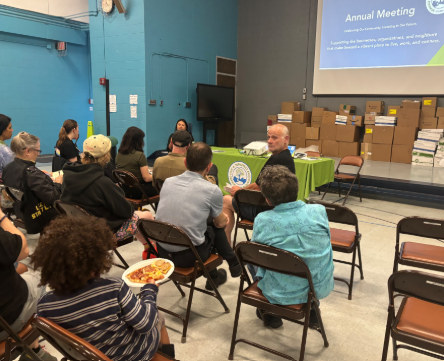
The Seward Civic & Commerce Association held their annual meeting where they had the chance to share their key priorities with elected officials and celebrate the accomplishments of local business leaders. I look forward to further collaboration on how we can strengthen support of our Seward businesses.
Local business and community meetings listen to State Rep. Samantha Sencer-Mura at the SCCA Annual meeting
In 2020, the City of Minneapolis was sued by the Minnesota Department of Human Rights (MDHR) for a pattern or practice of the Minneapolis Police violating human rights law. Now, the City is in a settlement agreement with MDHR that lists out hundreds of reforms that the City must make in order to address our persistent violations of human rights law.
Effective Law Enforcement for All (ELEFA) is the independent organization that monitors the City’s progress towards compliance with the settlement agreement. A few weeks ago, ELEFA released a progress report showing extremely concerning and poor outcomes. ELEFA hosted a community meeting this week where many community members raised serious concerns about MPD’s failure to resolve misconduct complaints, persistent experiences with discriminatory policing by MPD, and lack of community engagement by ELEFA and MPD on reform efforts.
Metro Transit has shared that buses will replace trains for the entire Blue Line between Mall of America and Target Field stations from June 29-Aug. 19 to allow for construction and repair work.
Replacement bus timing can vary and trips will take longer because of routing and traffic conditions. Metro Transit recommends planning extra time for your trip.
The METRO D Line is another alternative for service between the Mall of America and downtown Minneapolis.
Buses will also replace METRO Green Line trains between Target Field and West Bank stations:
Find replacement bus locations and maps and learn more about the Track and Signals project on the Metro Transit website.
Stay informed about service changes and project updates by signing up for email or text alerts from Metro Transit.
Pride in Policy flyer
Summary: The City Council approved a package of policies to create a more welcoming, safe, and inclusive Minneapolis for 2SLGBTQIA+ residents.
Background: The Minneapolis City Council voted on a number of actions affirming that Minneapolis is a welcoming city for 2SLGBTQIA+ residents. The council passed four ordinances, a staff direction, a legislative directive, and a resolution as part of an effort during Pride Month to show that the City of Minneapolis supports and protects the queer community.
Many of these policies have been championed by community organizations and individuals for years. Thank you to all the residents who organized to make these wins possible, to Council Member Chavez who led this effort, and to all Council Members who co-authored the actions.
The actions that the Council passed include:
A welcoming and gender-affirming Minneapolis ordinance
- For the first time ever, it enshrines a statement in city code affirming that 2SLGBTQIA+ people belong in Minneapolis.
- Establishes in city code that Minneapolis is a safe haven for gender-affirming and intersex healthcare.
- Prohibits city resources and city employees from interfering with anyone’s ability to receive gender-affirming or intersex care.
- Prohibits the City from accepting or distributing grant funds that would require the city to limit the rights of individuals based on gender, gender expression, gender identity or sexual orientation.
- Prohibits data-sharing agreements that could be weaponized against 2SLGBTQIA+ people.
- Requires City employee health plans to provide coverage for gender-affirming care and the healthcare needs of the intersex community.
- Requires all-gender ADA accessible restrooms in city-owned and leased buildings, gender-neutral signage on single-user restrooms, and prohibits denying anyone access to a restroom consistent with their gender identity in city facilities.
- Establishes a complaints and discipline process.
Gender inclusive language ordinance
- This ordinance updates the Rules of Construction, the interpretive rules that apply to every ordinance in the Minneapolis Code, to remove outdated binary gender language.
- Replaces “masculine, feminine, or neuter” with “any gender includes all genders,” recognizing all gender identities across the entire Code.
- Legally ensures every area of city code respects and reflects the diversity of residents’ gender identities.
Gender inclusive language plan staff direction
- Directs the City Clerk, in collaboration with the City Attorney’s Office, to review the entire Minneapolis Code of Ordinances and identify gender-specific references.
- Directs staff to develop a plan and recommendation to remove those references wherever practicable, with a report due to the Public Health, Safety and Equity Committee by September 9, 2026.
Expanding all-gender restroom access legislative directive
- Requests the Mayor’s Administration report on the status of existing gender-neutral restroom initiatives, including outreach to building owners, enforcement through the 311 complaint process, City-funded signage programs, and inclusion of gender-neutral bathroom information in routine City mailings.
- Requests recommendations for additional actions the City can take to expand access to gender-neutral restrooms, including a review of how peer cities have incentivized property owners to make single-stall restrooms gender-neutral.
Support transgender, non-binary, and gender-expansive restroom access resolution
- Calls on the Minnesota Legislature to amend state law to explicitly authorize municipalities to enact building standards ensuring equal restroom access in places of public accommodation, regardless of gender identity.
- Addresses a current gap where state preemption prevents Minneapolis from going beyond the 2020 State Building Code, which requires single-occupancy restrooms to be gender-neutral but limits local authority to go further.
- Recognizes that transgender, nonbinary, and gender-expansive residents face documented barriers to restroom access including exclusion and harassment.
Bathhouses regulations: ending legalized homophobia
Adult bathhouses and sex venues: licenses and business regulations ordinance
Adult bathhouses and sex venues: health and sanitation ordinance
- Repeals the 1988 ban on adult bathhouse licenses, stripping from city code legalized homophobia that weaponized the AIDS crisis against 2SLGBTQIA+ people.
- Removing language to modernize and eliminate barriers to develop licenses for adult bathhouses in the future.
- Moves building standards for adult entertainment venues into the adult entertainment code where they belong.
- Preserves Health Department enforcement powers while creating space for a future policy framework grounded in public health and evidence-based safe sex practices.
Key votes: Welcoming and gender-affirming Minneapolis, restroom access, and gender inclusive language actions passed with unanimous support. Repealing the bathhouse ban passed 9-2-1-1, with Council Members Warren and Shaffer in opposition, Vice President Osman abstaining, and Council Member Whiting absent.
Summary: The City Council approved a moratorium on new data centers in Minneapolis, with carve-outs for data centers below a certain size within downtown.
Background: Big tech lobbyists are pushing hard to build data centers in Minneapolis. Cities and counties that have allowed data centers have seen disastrous impacts on their water and energy grids. The latest polls show that over 70% of Americans oppose data centers.
Several weeks ago, Council Members Chowdhury and Chavez introduced a moratorium on data centers that will last until October while the City Council develops a regulatory framework for new data centers. The City Council adopted the moratorium, but not before lobbyists were able to weaken it with significant carve-outs for downtown. I authored a staff direction with Council Member Chowdhury to ensure that the City Council and the public has full information about the potential impacts of data centers on our natural resources, energy grid, land use, workforce, and economy. I believe that it may take longer than October to develop strong enough policies to protect residents from these fundamentally extractive developments.
During the discussion on the moratorium, proponents of data centers argued that they are needed to support our local economy and bring down property taxes. This is essentially an argument for trickle-down economics, which does not work. The state legislature handed out tax breaks for data center construction that will cost the state hundreds of millions of dollars. Additionally, big corporations are not going to invest their profits from data centers into helping our city solve critical issues like the housing crisis or environmental justice– they are going to give the profits to their shareholders.
I know some state legislators are working to repeal the data center subsidies and I urge these funds to be redirected to Local Government Aid. Cities can put these resources towards affordable and public housing, economic development, and other programs that working class people need.
The City needs to find new revenue sources to shift the burden off of property taxes. But data centers are being presented as the only choice the city has, which is completely untrue. That’s why I’m championing revenue generation proposals that tax the rich and bring in millions of dollars through equitable, progressive methods.
Several of my colleagues stated they believe that this moratorium will have a chilling effect on potential big tech companies in opening data centers here. I am hoping they are correct in their assessment and this moratorium shows big tech and corporate developers that the City Council will not be rolling out the red carpet for them to build data centers in our city. I urge residents to continue organizing to show the City Council and big tech companies what you think about data centers.
Key votes: City Council votes 7-5-1 for the data center moratorium. Council Members Rainville, Vetaw, Warren, Shaffer and Palmisano voted in opposition and Council Member Whiting was absent.
Summary: Following the resignation of MPD Chief O’Hara last month, there are huge red flags about how MPD is operating. The consequences are costing residents millions of dollars and impacting public safety. This week, the City Council approved several legislative directives I authored asking the Mayor to explain how things got so bad within MPD and his plan to turn things around– questions that residents deserve answers to.
Background: Last month, former MPD Chief Brian O’Hara resigned after an investigation concluded that he deleted evidence off his phone while he was under investigation for sexual misconduct. Chief O’Hara had the unwavering support of Mayor Frey, which has raised huge red flags about whether the Frey administration has appropriate safeguards in MPD to prevent abuse of power and protect residents and taxpayers.
The Chief’s resignation, on top of the lack of a confirmed Commissioner of Community Safety, created a massive void in public safety leadership. Additionally, Mayor Frey appointed one acting chief for a week, then appointed a different officer as interim chief, who then replaced most of the leadership of the department. This massive shake-up raises significant questions about departmental stability, consistency, and vision.
O’Hara’s resignation is just the latest in a pattern of several years of unstable or substandard leadership in MPD that the Mayor has overseen. For years, MPD has promoted questionable officers into leadership positions, which clearly contributes to why the city is under a settlement agreement, and continues to make progress on change. We do not have any assurance that there are now processes and mechanisms in place to ensure we are getting leaders throughout MPD who have high qualifications, professional experience, and moral character needed to support reform.
Chief O’Hara’s resignation also raised questions about how the Mayor’s appointed leaders are handling MPD off-duty work. It is very concerning to me that there are allegations that police officers may be hiding their off-duty hours, or potentially be double dipping working off-duty while on shift at the city. MPD officers working off-duty has undermined our public safety system and cost residents tens of millions of dollars since the 90s. The City Council has passed policies to try and rein in off-duty, but real change can only happen from the Mayor who has the sole authority over MPD. Recent events including the allegations of transphobic harassment by an MPD officer working off-duty indicate, further prove that until the City takes action to regain full management authority, the public will continue to experience harm.
O’Hara’s resignation also revealed that there are many unresolved questions about how the department handles misconduct investigations.
New information revealed about MPD has also prompted significant questions about the effectiveness of the Office of Community Safety, such as the lack of progress on the settlement agreement with the Minnesota Department of Human Rights and OCS’s continued resistance to transparency and accountability on critical public safety issues.
Instability in MPD and the City’s public safety programming impacts residents. The City Council was making tremendous progress on improving specific public safety outcomes. City Council funded a non-fatal shooting task force that was making double-digit improvements in the City’s ability to solve shootings and bring down gun violence. But that program now hangs in the balance, because the leaders that were brought on to run this program were removed from their positions.
In light of all these concerns, the City Council unanimously approved a legislative directive asking the Mayor to publicly share how he plans to stabilize MPD with high quality leadership and finally implement long-promised reforms.
It looks like this directive is already producing results. After it was released to the public, Mayor Frey published a press release with his selection plan for the next police chief. This answered one point of the inquiry, but there are many more questions that the Mayor will need to respond to.
Key votes: The City Council unanimously adopts the legislative directive asking the Mayor for his plans to stabilize MPD and answer significant operational and leadership questions in public safety.
Summary: The City Council approved a one-year extension of our current contract with ShotSpotter. An independent audit of ShotSpotter will be published in August that will help inform decisions about long-term investments in public safety strategies.
Background: ShotSpotter is a technology that detects gunshot-like sounds and reports them to 911. Cities across the country including Minneapolis are evaluating if ShotSpotter is providing a good return on investment when it comes to reducing gun violence. Existing data indicates that it isn’t– especially when we compare it to other strategies. Last year, the Mayor of Chicago declined to renew ShotSpotter and pointed to its failure in reducing gun violence as the main reason. Recent reporting has demonstrated that the decommissioning of ShotSpotter was followed by improved response times for the Chicago Police Department. More locally, Saint Paul has never had ShotSpotter and they have much lower rates of gun violence and higher rates of case closures than we do in Minneapolis.
One of the strategies that Saint Paul invested in instead of ShotSpotter was a non-fatal shooting task force, which investigates every single shooting incident with urgency, regardless of whether or not the shooting resulted in a fatality. This practice is credited with significantly improving case closure rates and bringing down gun violence citywide. During last year’s budget process I led the City Council to allocate about $2 million for a non-fatal shooting task force in Minneapolis, and in under two months it nearly doubled the rates of case closure for non-fatal shootings. We’re now on track to see significant progress like what Saint Paul achieved– and for a price tag that’s less than 1% of the police budget.
With that in mind, the Minneapolis City Council needs to take a hard look at whether or not ShotSpotter is actually delivering outcomes for residents. We requested that the City Auditor undertake an independent evaluation of the effectiveness of ShotSpotter in closing cases and reducing gun violence. The results of that evaluation are set to be published in August. The City Council can use this analysis to inform our decisions about long-term investments in public safety strategies.
The Office of Community Safety originally asked the City Council to approve a three-year extension of ShotSpotter, but I worked with them to adjust it to a one-year contract. This will allow the City Council to receive the audit in August, see what we learn from it, and make any needed adjustments as soon as the 2027 budget– instead of being locked into a three-year contract through 2029.
The Office of Community Safety proposed expanding the geographic area of ShotSpotter as well, increasing the number of microphone sensors into Ward 9 and 10. Council Members Chavez and Chughtai, who represent this area, opposed the expansion, preferring to maintain the current coverage until we do a more data-backed analysis. The majority of the City Council respected this request by the Council Members and denied the geographic expansion.
Key votes: City Council voted unanimously for a one-year extension of ShotSpotter. City Council voted 8-4 to deny expanding the geographic area of ShotSpotter, with Council Members Rainville, Warren, Shaffer and Palmisano in opposition to the denial.
Summary: The City Council appointed former state representative Jim Davnie to the Minneapolis Ballpark Authority, which could be instrumental in directing sustainable funding to public assets like the Hennepin County Medical Center.
Background: The Minnesota Ballpark Authority was established by the Minnesota Legislature in 2006 to construct a ballpark by the 2010 season. The Authority seeks to ensure that Target Field is a world-class facility that adheres to high standards of sustainability, creates economic opportunity, and serves as an anchor for the development of a vibrant new district. The Minneapolis City Council appoints one member of the Ballpark Authority Board.
The ballpark is a public asset that has the potential to generate sustainable funding for core public institutions that serve many of our most vulnerable residents, including our Black working class communities. Our public hospital, Hennepin County Medical Center (HCMC) , was on the verge of closing just a few weeks ago. The state legislature passed a short-term bailout plan, but it does not permanently solve the funding crisis. HCMC has long served as the primary point of care for many Black residents and other historically underserved communities in Minneapolis, providing essential services regardless of a person’s ability to pay. The ballpark has a role to play in securing a permanent, sustainable funding solution for this vital public institution. The City of Minneapolis gets to appoint one individual to this body, and I believe we should be putting representatives on the ballpark authority that see the ballpark as a public asset that should be leveraged for the public good.
Council President Payne nominated former state representative Jim Davnie to serve on the Ballpark Authority because he shares that priority, which I strongly supported.
Some Council Members and community members attempted to portray this decision as racist or anti-Black, since Jim Davnie is white and one of the other applicants for the seat is Black. Those accusations are unfounded and I am fully confident in the City Council’s decision to advance racial justice by appointing the candidate who is committed to leveraging the multi-million dollar asset of the ballpark to support first-line healthcare for all working class people.
Key votes: City Council appoints Jim Davnie to the Ballpark Authority in an 8-4-1 vote. Council Members Rainville, Vetaw, Warren and Shaffer voted in opposition and Council Member Whiting was absent.
Summary: The Minneapolis City Council approved the Mayor’s nominees for the directors of several departments.
Background: Under the City Charter, Mayor Frey nominates department heads and the City Council votes to confirm or deny those appointments. This week, the City Council confirmed:
- Erik Hansen as Director of Community Planning and Economic Development (CPED)
- Rachel Sayre as Director of Emergency Management
- Tim Sexton as Director of Public Works
In the next several weeks, the City Council will consider the Mayor’s nomination of:
- Enrique Velazquez as Director of Regulator Services
- Reginald Freeman as Fire Chief
Key votes: Director Sayre and Director Sexton approved unanimously. Director Hansen approved 10-2-1, with Council Member Vetaw and Warren in opposition and Council Member Whiting absent.
The City of Minneapolis is working to end traffic deaths and serious injuries on city streets. We call this effort Vision Zero, and we want to hear your feedback on the draft of the next action plan to guide our work making traffic safer.
Traffic crashes more often impact people in neighborhoods with lower incomes, Native American and Black residents, and people walking and bicycling. Every year, about 175 people are seriously hurt or killed in traffic crashes in Minneapolis. That is unacceptable, but it is preventable.
Traffic safety for everyone
We are making gains. Since a spike in traffic deaths in 2019-2021, they have decreased every year.
The Vision Zero Action Plan includes more than 80 actions we’ll work on between 2026 and 2030. Our key actions for the next four years include:
- Making safety improvements on the streets where most serious and fatal crashes happen
- Making street changes that slow down speeding. Speeding increases crashes, injuries and deaths and is a factor in most fatal crashes.
- Evaluating the traffic safety camera pilot. If the program is working well, we plan to seek State authority to continue the program beyond the pilot period.
Read the draft Vision Zero Action Plan on the City website.
Tell us what you think
Give us your feedback in a public meeting or fill out an online form:
In-person public meeting 5-6 p.m. Tuesday, June 30 Public Service Building, Room 100 505 Fourth Ave. S.
Virtual public meeting 6-7 p.m. Wednesday, July 1 Join on Microsoft Teams. (A recording will be available one week later.)
Online form Send us your feedback on the draft Vision Zero Action plan by July 19.
As the weather warms up and we spend more time outside, the number of noise complaints the City receives increases. Our 911 center gets the most calls of the year during the week of July 4.
Help reduce 911 calls to allow priority emergency calls to be answered as quickly as possible. Call 911 when:
- Someone needs medical attention
- Fireworks are directed at people or property
- Fireworks start a fire or cause smoldering
- Children are using fireworks unsupervised
Use 311 for non-emergencies
You can make noise and fireworks complaints online.
311’s regular business hours are 7 a.m.-7 p.m. Monday-Friday. 311 is closed July 3 and open 11:30 a.m.-4 p.m. July 4.
Contact Ward 2
Visit: minneapolismn.gov/ward2
Email: robin.wonsley@minneapolismn.gov
Phone: 612-673-2202
City Hall
350 S. Fifth St., Room 370
Minneapolis, MN 55415
For reasonable accommodations or alternative format please contact 311. People who are deaf or hard of hearing can use a relay service to call 311 at 612-673-3000. Para ayuda, llame al 311. Rau kev pab, hu 311. Hadii aad caawimaad u baahantahay, wac 311. |