|
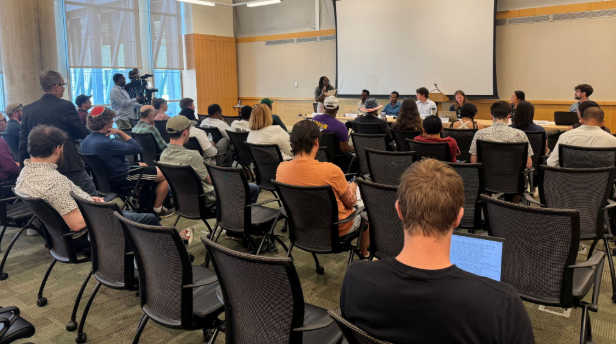
I hosted a panel to open up a community discussion on Autonomous Vehicles (AVs). Waymo cars are currently on Minneapolis streets, and have stated that they intend to start operating commercially as soon as this fall. There are so many questions about how AVs could impact our local economy, and what local government should be doing to protect drivers and riders from extractive big tech companies like Waymo.
Thank you to our brilliant panelists and everyone who attended the event. I look forward to many more conversations about how to regulate AV companies in support of workers rights and an equitable, sustainable city for all.
Council Member Wonsley with panelists on the AVs in Minneapolis panel.
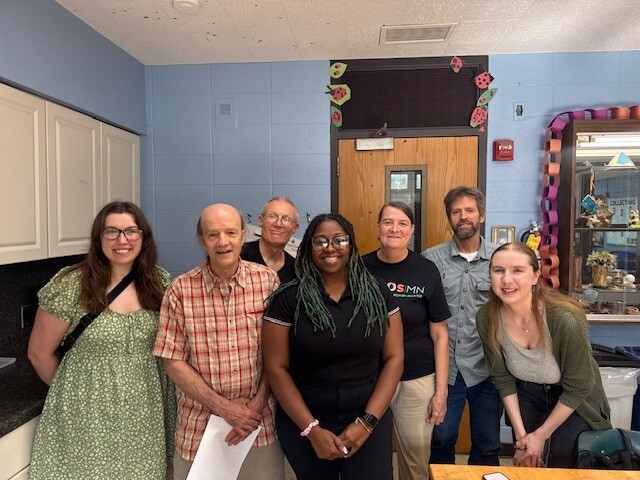
I met with a group of resident leaders in Ward 2 who are organizing for citywide investment that meets the urgency of the climate crisis. Thank you to Unidos leaders for your persistence and focus on how to meet the city’s climate goals and create a liveable future for all.
CM Wonsley meeting with UNIDOS Leaders
Election integrity is under unprecedented attack. Neighbors are organizing to keep each other safe during the midterm elections this November. Monarca Democracy Defense Trainings are an opportunity to learn about the actions we can start taking now, to get organized and ready to defend the upcoming election. Note: A prior version of this item included a broken link. The correct link is included here.
Summary: The Business Housing and Zoning Committee rejected Mayor Frey’s proposal to grant exclusive development rights for the People’s Way to the Minnesota Agape Movement.
Background: The City of Minneapolis purchased the Peoples’ Way property at 3744 Chicago Ave in June 2023. Since then, the City has worked to identify a long-term community-centered vision, ownership structure and future use for the site. In September 2024, the City issued a Request for Qualifications (RFQ) seeking organizations interested in becoming the future community owner and development partner for Peoples’ Way. Four groups responded to the City’s RFQ, and one group later withdrew from consideration.
In May, Mayor Frey’s administration announced that the Minnesota Agape Movement had been selected to become the community owner and exclusive developer for the People’s Way.
Community members and City Council Members immediately raised concerns about this selection. Minnesota Agape Movement has no development experience, yet proposed developing an ambitious multi-story building. Their tax status is unclear. The City’s own community survey reported that one of the other proposals had significantly more community support. Additionally, the selection of Agape surprised many since it has had a complicated and at times, tense relationship with residents and community members within George Floyd Square. In 2021 Mayor Frey gave Agape a $359,000 noncompetitive contract to remove the barricades around George Floyd Square at 5am without the knowledge or consent of the community, including those who had been stewarding George Floyd Square since his murder.
Council Member Chavez and Council Member Stevenson, who represent the area surrounding George Floyd Square, were clear that moving forward with Agape would further deteriorate the City’s already badly damaged trust and credibility with neighbors.
After a discussion, Council Member Chavez made a motion to refer the proposal back to staff.
Referring back to staff is a terminal action that rejects the selection, but allows the mayoral administration to bring forward a different proposal at a future time. However, after a bit more discussion about the potential paths forward, Council Member Chavez elected to withdraw this motion and instead motion to simply reject the proposal. This motion passed 4-2, with one member absent.
Key votes: The Business, Housing and Zoning Committee voted to deny the exclusive development rights for Agape back to staff. Council Members Chavez, Chughtai, Chowdhury, and Vice Chair Osman voted to deny, and Council Members Warren and Schaffer voted against the denial, and Council Member Rainville was absent.
Summary: The Climate & Infrastructure Committee held a public hearing about the proposed special assessments on property owners for the reconstruction of 38th St E and Chicago Ave (George Floyd Square).
Background: The City of Minneapolis has been planning to reconstruct the intersection of 38th St E and Chicago Ave since 2018. After MPD officers murdered George Floyd at this intersection in May of 2020, the area became the epicenter of a global movement against police brutality and systemic racism.
Since 2021, the reconstruction of the intersection now known as George Floyd Square (GFS) has included significant community engagement and discussion. Last year, the City Council approved a project layout, with construction scheduled to start this spring.
The total project cost for the reconstruction of the intersection is $14,868,343. The proposed funding breakdown was $10,415,000 in City funds, $3,892,400 State Aid (gas tax), and $636,450 in special assessments. City policy to assess adjacent property owners for all street reconstruction projects. The assessments are based on uniform assessment rates, not project cost.
The Climate & Infrastructure Committee held a public hearing on the special assessments for George Floyd Square. Many community members attended and spoke in strong opposition to making GFS property owners pay for the reconstruction. Residents spoke about how the City’s own failure to rein in MPD is what led to the murder of George Floyd, which has transformed their neighborhood and caused many of them significant financial hardship. Residents spoke about how the reconstruction of GFS and the 38th Street Thrive Plan are framed as reparative investments, and assessing property owners is the opposite of those stated values.
The Committee forwarded the assessments without recommendation, which means that the full City Council will have the opportunity to vote on them at the next meeting. I hope that prior to the final vote of the Council, City leaders can continue to have collaborative conversations about how to ensure funding for the project through equitable funding sources that do not burden property owners at George Floyd Square.
Key votes: The Committee voted to forward the assessments without recommendation. The full City Council will vote on the assessments on June 11.
Summary: The Public Health, Safety and Equity Committee rejected a three-year contract extension for ShotSpotter, and asked MPD to bring forward a one-year extension so that the City Council can have the results of an independent evaluation prior to making a decision on a multi-year contract.
Background: ShotSpotter is a technology that cities across the country have been sold as a way to help with public safety, yet data does not affirm that it actually contributes to helping solve or prevent shootings, or bring down gun violence.
The City Council is responsible for the city’s budget, and being good fiscal stewards means that we spend public money on data-backed strategies and programs. It hasn’t been conclusively proven that ShotSpotter is the best way we can use almost $4 million when it comes to gun violence reduction. Saint Paul doesn’t have ShotSpotter and has far better rates of case clearance for shootings, and lower rates of gun violence.
One of the key strategies Saint Paul uses is a non-fatal shooting task force, which emphasizes fast and thorough responses to all shootings whether or not they result in a fatality. After learning about the successes in Saint Paul, I led the City Council to fund a Non-Fatal Shooting Task Force here in Minneapolis as well. The Non-Fatal Shooting Task Force costs Minneapolis taxpayers only $1.7 million/year, and in just a month had nearly doubled our closure rates for non-fatal shootings. If we can get those kinds of results with under $2 million, it begs the question of if ShotSpotter is giving us a good return on our investment.
The City Auditor is conducting an independent analysis of the efficacy of ShotSpotter, which will be published in August. It’s not good governance to invest in a three-year contract without having the results of this independent analysis to inform our decision. In light of that, I proposed to MPD that they do a one-year extension of the ShotSpotter contract so that the Council can evaluate the data through the fall and make an informed decision next spring. This is also what our City Auditor recommended. OSC and MPD leadership also shared that they are able to advance a one year contract and are willing to bring that forward to the committee for official consideration. The committee voted to hold the contract until the June 17th PHSE meeting to give MPD the opportunity to bring forward a one-year contract.
Key votes: The Public Health, Safety and Equity Committee voted to hold the ShotSpotter contract in committee so that MPD can bring forward a one-year contract.
Local media has recently reported on the City’s contract for strategic planning and executive coaching for the Mayor and City Council. I’ve participated in these sessions since 2022 whenever my schedule permits. In my experience, some of these sessions and activities have been useful, and others were less successful because of an excessive focus on interpersonal dynamics rather than underlying differences in political priorities.
Outside of these formal sessions, I have championed many free or low-cost ways to build consensus amongst city leadership and take strategic actions. I built off the foundations laid by former Council Member Andrew Johnson to create a new norm around Committee Work Plans, which are now being adopted by every standing committee for the 2026-2029 term. Work Plans allow the City Council to do high-level strategic planning in a way that is public and transparent, and adopts the outcomes as a legislative document. I am proud of how this work has improved transparency and accountability in local government, and contributed to the City Council having unprecedented productivity over the last several years – all at no additional cost to taxpayers. Through my time in office, I’ve used these work plans as well as our standard legislative process to author or co-author over 15 ordinances that were enacted by Council, the majority of which were approved unanimously and signed by Mayor Frey.
Residents have expressed concern over whether this service is the best use of $1.4 million of taxpayer money. I agree that sessions about workplace dynamics amongst elected leaders should not be a priority for public funds. I want to be clear that the contract for strategic planning services has always been presented to the City Council as necessary for city leadership to deliver programs and services to improve residents’ lives.
Summary: Residents who would like to share their thoughts on data centers in Minneapolis can speak at a public hearing on June 16th at 1:30, or submit comments online.
Background: In May, the City Council passed a six-month moratorium on data centers. The moratorium has an exemption for data centers under 350 square feet within downtown.
The intention of the moratorium is to give the City Council time to learn more about the impacts that data centers will have on our electric grid, water usage and treatment, tax base, jobs, and the goals in the 2040 Comprehensive Plan. It also gives the City Council more time to hear what residents think about data centers. With this information, we will be better equipped to write regulations to protect residents from big tech data centers, which are fundamentally about extracting our resources for billionaires to profit from.
I worked with Council Member Chowdhury to author a research directive to ensure the City Council has a thorough understanding of these impacts before the moratorium expires in November.
Based on what other cities are experiencing with data centers, I anticipate that the City Council very well may need more than six months to study the impacts of data centers and write strong regulations to protect residents. People all over the country are telling horror stories of what data centers promised, and what they delivered. There are stories of data centers illegally stealing millions of gallons of water beyond what they were authorized to use. Data centers are driving up utility rates and creating noise pollution.
The local government’s job is to protect our city from these extractive and exploitative forces. It is our responsibility to make sure that our neighborhoods continue to become more affordable, walkable, and sustainable. We must make sure that our residents have clean water and reliable power. We must champion the creation of healthy workplaces, and living wage jobs. A recent Gallup Poll that found 7 in 10 Americans oppose data centers.
Many Trump-aligned big tech companies have a documented history of successfully using their money to stop elected officials from passing regulation. We are seeing this dynamic play out at the State Capitol and at Minneapolis City Hall, where data center lobbyists have been successful at persuading elected officials to advance extremely weak regulations or none at all. The public hearing on June 16th is an opportunity for working class people to speak out against corporate lobbyists pushing data centers in Minneapolis.
Public Hearing on Data Centers in Minneapolis
Testify in person
- June 16th, 2026 at 1:30pm
- Minneapolis City Hall (350 South 5th St) Room 370
- Any resident can speak for two minutes
Testify in writing
- Submit testimony any time before June 16th at 1:30pm
Key votes: The Business, Housing and Zoning Committee will host a public hearing on the proposed six-month moratorium on data centers, with an exemption for smaller data centers and an area downtown, on June 16th at 1:30pm. The Committee will then vote on whether to recommend the moratorium to the full City Council for final approval.
Summary: There will be a public hearing on June 17th for a policy that would prohibit law enforcement agents in partnership with the City from using masks to conceal their identities.
Background: During Operation Metro Surge, federal agents used masks to hide their identities while they terrorized our communities. Residents reached out to City Council Members asking us to do everything in our power to limit the ability of law enforcement agents to conceal their identities.
City Council Members Chavez, Chowdhury and Chughtai authored an ordinance that would require that any Joint Powers Agreement (JPA) that the City signs with another law enforcement agency would prohibit agents from wearing masks that conceal their identities under the terms of the JPA. While the City does not have the authority to legislate requirements for law enforcement agents from the state or federal government while they are acting independently outside of a JPA with the City. That said, this ordinance is a significant step that the City can take to limit the presence of masked agents in our city and to hold state and federal agents accountable for their actions.
Public Hearing on Law Enforcement Agreements in Minneapolis
Testify in person
- June 17th, 2026 at 1:30pm
- Minneapolis City Hall (350 South 5th St) Room 370
- Any resident can speak for two minutes
Testify in writing
- Submit testimony any time before June 17th at 1:30pm
Key votes: The Public Health, Safety and Equity Committee will host a public hearing on June 16th at 1:30pm about the proposed ordinance prohibiting facial coverings for law enforcement agents in partnerships with the City. The Committee will then vote on whether to recommend the moratorium to the full City Council for final approval.
Summary: MPD presented a response to the City Council’s questions about their involvement in a Homeland Security Task Force.
Background: On January 23rd, while federal agents were terrorizing our communities, the Minneapolis Police Department signed an agreement to join a Homeland Security Task Force (HSTF). At the same time, the Trump administration was launching Homeland Security Task Forces for “Operation Take Back America” under the scope of the Executive Order 14159 “Protecting the American People Against Invasion.” This obviously raised many questions and concerns about MPD’s collaboration with the federal government on their racist, violent immigration enforcement.
Council Members Chavez, Stevenson, and President Payne authored a legislative directive to get more information about MPD’s collaboration with Homeland Security in this Task Force. This week, MPD presented a response. The response was incredibly underwhelming as MPD did not actually provide answers to any of the substantive questions in the legislative directive. The committee voted to postpone the presentation to their meeting on July 8th, with the expectation that Mayor Frey and MPD provide substantive answers instead of deflecting on these important questions.
Coincidentally, it was exactly one year ago that the Trump administration led their first test of Minneapolis with a raid on East Lake Street. Residents passed that test with flying colors: they showed up to defend each other. Mayor Frey and MPD failed that test by amplifying the Trump administration’s lines that the raid was a drug bust and wasn’t an immigration matter, and that residents who showed up should have stayed at home and let Homeland Security do their job catching drug traffickers. To date, the only charges that have been filed as a result of that raid were immigration charges.
Our executive leader’s appeasement of last year’s operation on East Lake Street demonstrated weakness tho the Trump and now we see that while our executive leader was on national tv saying ICE should get the f out of Minneapolis, his administration entered into a partnership with Homeland Security collaborating with the federal government just 14 days later.
This legislative directive offered the Frey administration the opportunity to provide transparency and clarity for Council and the public about the usefulness of this partnership and how it is supporting the safety of our residents. I’m not sure why the Frey administration declined this opportunity, especially if there is nothing to hide about this Task Force.
Key votes: The Committee voted to continue the presentation to July 8th to give MPD another opportunity to respond.
Contact Ward 2
Visit: minneapolismn.gov/ward2
Email: robin.wonsley@minneapolismn.gov
Phone: 612-673-2202
City Hall
350 S. Fifth St., Room 370
Minneapolis, MN 55415
For reasonable accommodations or alternative format please contact 311. People who are deaf or hard of hearing can use a relay service to call 311 at 612-673-3000. Para ayuda, llame al 311. Rau kev pab, hu 311. Hadii aad caawimaad u baahantahay, wac 311. |