 After slightly more than 100 days on the job I’ve found that City Council meetings are like Forest Gump’s proverbial box of chocolates, you never know what you’re gonna get.
Yesterday we knew we were getting votes on the legalization of drug paraphernalia and temporarily extending the pre-eviction notice period to 45-days. Both passed, 7-6 and 8-5 respectively, and now go to the mayor for his signature or veto. I opposed both, the reasons for which have been well documented in my comments from the dais and in this newsletter.
What I didn’t expect was a testy debate over council norms and the “escalation of polarization” – as stated by one of my colleagues – triggered when I moved to return an item that would create a blanket moratorium on data centers in Minneapolis to its authors. Here’s my concern: I discovered that on May 21st the council could pass the “introduction of the subject matter of an ordinance” with the words “data center moratorium” in the title, and that alone would put a yearlong moratorium into effect with no recourse for the public, the mayor, or anyone else. Unfortunately, the author of the moratorium did not consult any downtown elected councilmembers about this idea before it was introduced. For an action that could directly affect potential real estate transactions or business leaders, this is not good process.
I’m all for the city council studying data center regulation – existing Conditional Use Permit requirements already give the city meaningful oversight – but a blanket moratorium is a blunt instrument we can’t afford in this critical economic moment. We have a lot of vacant downtown properties that need repurposing, and we are working hard at housing conversions like the Grain Exchange, but small, targeted data centers are another viable reuse. Having the option of smaller data centers could also drive additional tech investment downtown. I’ve heard from the Downtown Council that even the discussion of a moratorium has already created uncertainty for investors exploring the commercial market.
We are denying potential economic opportunities if we blindly enact an overall moratorium. The stakes are real. For example, the Sleep Number building recently sold for $235 million as a future data center in January of this year, when just one year ago its valuation was $30 million. That increase in valuation increases our commercial tax revenue and reduces the burden on residential property tax payers. We are trying to explore solutions to reverse the trend we have seen in commercial devaluations in recent years like the Ameriprise building being sold for $6.25 million after fetching $200 million a decade ago.
Instead of a blanket moratorium, we need a legislative directive to study both the pros and cons of small data centers in already-built urban locations. Some benefits already mentioned are to connect servers to Minneapolis district energy systems like Cordia, benefitting climate initiatives.
My motion failed 8-5 with Chavez, Chowdhury, Chughtai, Osman, Payne, Stevenson, Whiting, Wonsley voting to move forward a moratorium, so now on May 21st the council will take another vote on this matter. If it passes on the 21st, a data center moratorium will immediately take effect. I am uncertain as to the impact on those facilities already in process.
I also didn’t anticipate a lengthy back-and-forth about the propriety of the Council President purporting to speak for the whole council without having been asked to do so, and while only consulting with six other members of the body. He did this by entering a memorandum into the public record entitled “City Council’s Vision for Community Safety and Toddrick Barnete’s Failure to Meet that Vision” (emphasis added). As a member of said City Council who supports Barnette and finds the contents of this memo biased and incomplete, it doesn’t speak for me or my five colleagues who were on the other side of the reappointment vote.
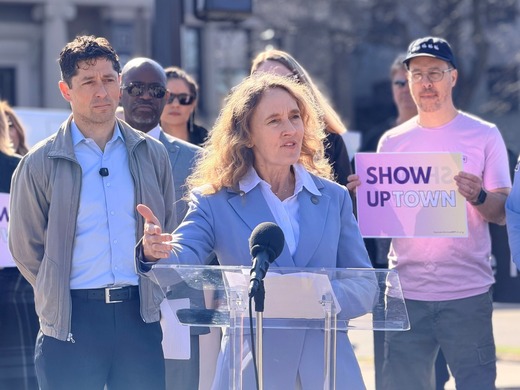
Finally, this week brought another chance to shine the spotlight on Uptown and celebrate the real successes we’ve seen as well as acknowledge the work that remains to be done. On Tuesday, the mayor hosted a press conference right outside the Walker Library and I was invited to speak, along with Kevin Norman from Uptown United, Commissioner Barnette, and Chief Brian O’Hara. The mayor shared that Uptown is a priority for his administration and credited me with a “laserlike focus” on the area. While I appreciate the kind words, the real success has come from people across multiple agencies, jurisdictions, and community coming together. As I said in my remarks: “what we are seeing…is government working the way it should: listening to constituents, developing a local plan of action, and using every tool available to bring resources to bear to get people the help they need and make sure that our public spaces are safe and belong to everyone.”

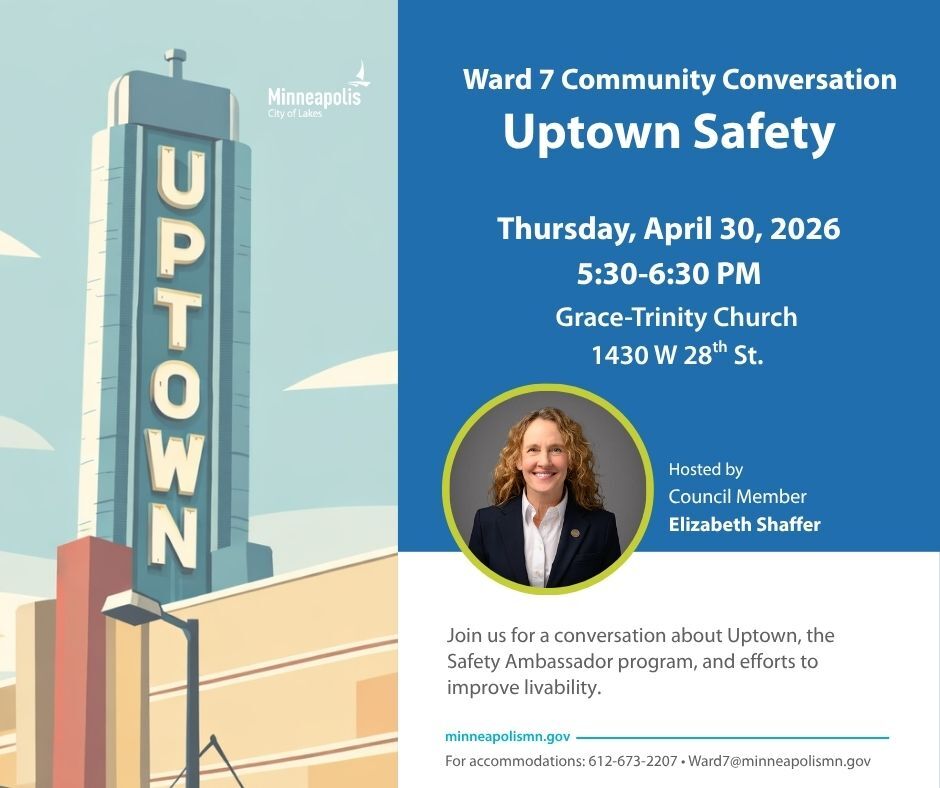 Join us this Thursday to celebrate the public safety progress we are making in Uptown and hear more details about the work to come! This month’s Community Conversations event will be a good chance to learn more from the experts. We’ll hear from Monica Herrera, with Neighborhood Safety, who will share details about the Community Safety Ambassadors coming to Uptown this November. Faith Randal, crime prevention specialist with the Fifth Precinct, will talk about trespass, directed patrols, and other MPD initiatives to address livability concerns, and Kevin Norman, of Uptown United, will speak about how residents can work together and show up for Uptown. The event is this coming Thursday, April 30, from 5:30 to 6:30 p.m. at Grace Trinity Church, 1430 West 28th Street, and we hope to see you there!
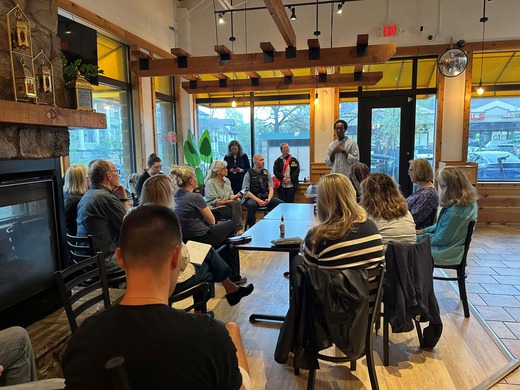 It was great to meet with everyone who attended last evening’s community meeting at Urban Eats Halal, 2300 Hennepin Ave. As you might recall, in the early morning hours of March 14th, a young man was murdered in the parking lot outside the restaurant, and at least one round from the incident ended up in a nearby home. During the meeting we heard from MPD Officer Davids, one of the Uptown directed patrol officers, Julianne Lynum, Director of Economic Policy and Development for Minneapolis, and Ali and Bisharo Abdi, owners of Urban Easts Halal and Ward 7 residents. We can support both improved safety measures for Uptown and our small businesses, and last night's dialog did just that. In case you missed it, KSTP had some nice coverage.
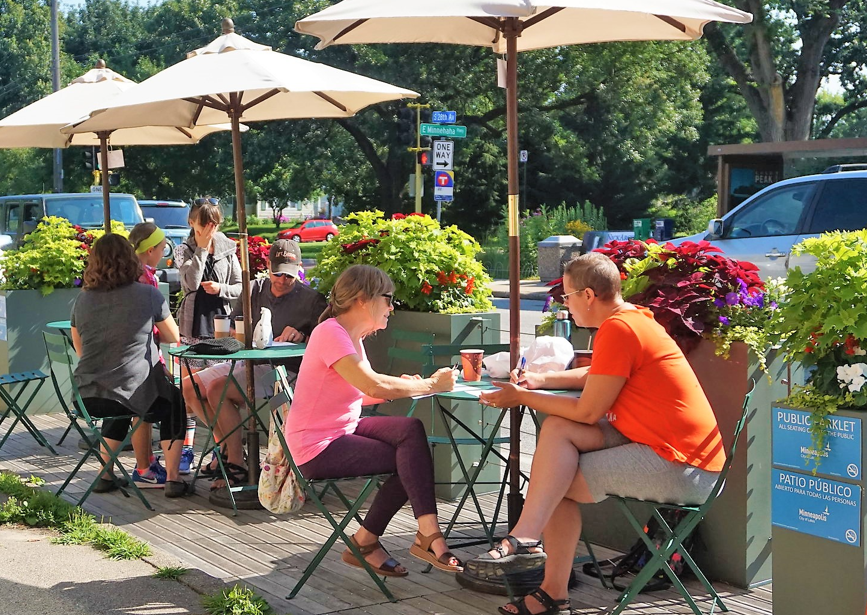 As the city begins to roll out our small business aid dollars, we are excited to announce the applications for outdoor café seating are open and that licenses are free! Thanks to the East Isles Neighborhood Association newsletter for amplifying this work:
“Applications for the 2026 Parklet and Street Café Program are now open. Parklets turn curbside parking spots into small seasonal public spaces with seating, plantings, and more. They help make our city more walkable and welcoming. Street cafés offer businesses a chance to expand their seating into the parking lane and activate the neighborhood. Street cafés operate as an extension of a business and require a license.”
Interested? Click here to apply.
A thoughtful constituent recently suggested to me that we might want to include links to upcoming neighborhood association meetings in the weekly newsletter. Good idea – we’re doing it! Here’s what’s coming up in the next month:
Monday, April 27: The Downtown Minneapolis Neighborhood Association has its monthly board meeting, 5:30 to 7:30, at the Four Seasons Hotel. Click here for more information and a Zoom link.
Monday, May 4: Kenwood Neighborhood Organization annual meeting, 6:00 – 7:30 p.m., at the Kenwood Rec Center.
Tuesday, May 5: Lowry Hill Neighborhood Association annual meeting, 6:30 – 8:00 p.m., at the Kenwood Rec Center. Click here for more information.
Tuesday, May 5: Stevens Square Community Organization Executive Committee Meeting, 6:00 – 7:00 p.m., via Zoom.
Thursday, May 7: Citizens for a Loring Park Community fundraiser for the Berger (Dandelion) Fountain restoration, at Roxy’s Cabaret, 1333 Nicollet Mall, 6:00 – 9:00 p.m. Click here for more information.
Tuesday, May 12: West Maka Ska Neighborhood Council monthly meeting, 6:00 – 8:00 p.m.. Click here for more information.
Tuesday, May 12: East Isles Neighborhood Association monthly meeting, 7:00 – 9:00 p.m., at Grace Trinity Church, 1430 W. 28th Street. Click here for more information.
Wednesday, May 13: Cedar-Isles-Dean Neighborhood Asoociation annual meeting, 6:00 – 7:30 p.m., Jones Harrison Senior Living, 3700 Cedar Lake Avenue. Click here for full details.
Wednesday, May 13: Bryn Mawr Neighborhood Association annual meeting and potluck dinner, 6:00 – 7:00 p.m., Bryn Mawr School, 252 Upton Ave. S. Full details here.
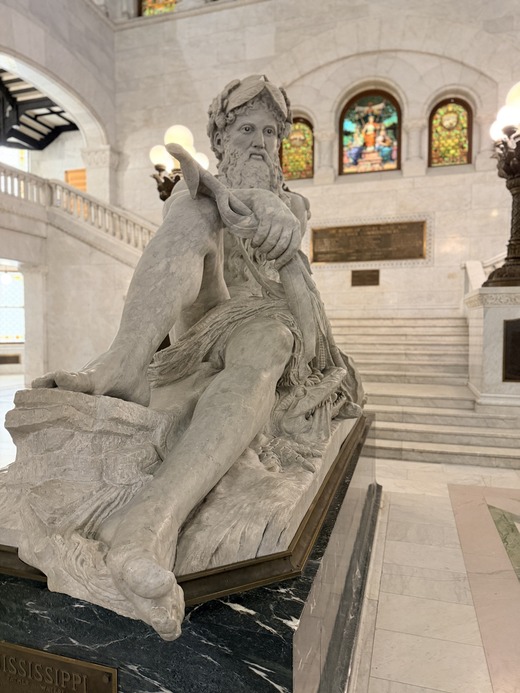 Curious what happens inside Minneapolis City Hall? During Doors Open Minneapolis, you’re invited to take a look. I will be there myself, taking a shift as a volunteer.
From 10 a.m. to 5 p.m. May 9-10, this free event offers behind-the-scenes access to spaces that shape our city — and the people who keep it running.
At City Hall and Hennepin County Courthouse, don’t miss your first chance to see the newly updated City Council Chambers and other renovated spaces. Staff will be on hand to share how their work serves the community.
Doors Open is about more than buildings — it’s about helping people feel connected to their city. By opening these spaces, we make civic life more approachable and invite everyone to better understand, and care for, the place they call home.
You can also explore City sites like Fire Station 1, the Minneapolis Traffic Management Center and other spaces that shape our city.
Plan your visit on the Doors Open Minneapolis website.
No tickets are required — just bring your curiosity.
At a public listening session coming up April 23, the Capital Long-Range Improvement Committee and the Planning Commission will discuss the projects currently under review for the Minneapolis 2027-2032 Capital Improvement Plan.
The committee invites public participation for a deeper understanding of community perspectives, to incorporate public input into discussions with City departments, and to share information about the committee’s role in shaping the City’s long-range capital planning.
Public listening session on capital projects 6 p.m. Thursday, April 23 Elliot Park multipurpose room 118 1000 E. 14th St.
The Capital Long-Range Improvement Committee
The Capital Long-Range Improvement Committee is a group of residents and business leaders who advise the City of Minneapolis on its six-year Capital Improvement Plan. They share recommendations through an annual report and project ratings system. The committee will meet until the end of June.
See upcoming committee meetings and events on the calendar or look at previous meeting agendas and minutes.
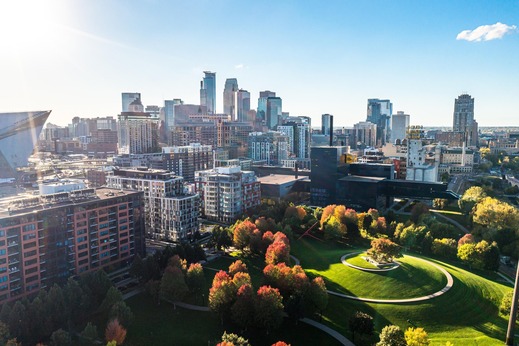 Photo: Omar Ghrayeb / @ogeevisuals, courtesy of Meet Minneapolis
As summarized in a helpful story from KSTP, the City of Minneapolis is assessing whether a new indoor playground and multi-use family play space downtown would be feasible and beneficial. We’re gathering input from parents and caregivers through a public survey. This survey includes questions about:
- Family recreation habits
- Desired amenities for an indoor playground
- How frequently you visit downtown Minneapolis
The survey takes about 8-10 minutes to complete. Responses are anonymous. You may opt in at the end if you’re interested in participating in a future focus group.
Take the survey in English, Spanish or Somali.
This survey will help the city understand whether to move forward, and if so, how to ensure any potential future space meets the needs of both kids and adults. Your feedback may be used to guide possible locations, programming and amenities such as food and beverages, so the space works well for families.
The City of Minneapolis continues to support renters and promote housing stability. Following Operation Metro Surge, the City has committed funds to emergency rental assistance. This investment will:
- Help renters at greatest risk of homelessness
- Prevent evictions before they happen
- Connect residents to these resources through community-based partners
Minneapolis residents having difficulty paying rent may be eligible for this assistance if:
- Their household earns no more than 30% of area median income
- They have received a 30-day pre-eviction filing notice from their landlord
We’re partnering with Hennepin County to distribute the money through Rent Help Hennepin and their network of community-based partners. Minneapolis households seeking this emergency rental assistance can reach out to one of these organizations to get help starting an application.
We’ve created a flyer with detailed instructions about how to access this funding. It’s available in English, Arabic, Dari, French, Hmong, Pashto, Somali and Spanish. Download the flyers.
Read more about emergency rental assistance on the City website.
This past winter, the world witnessed small businesses in Minneapolis stepping up for our community in remarkable ways, even as they experienced significant negative impacts from Operation Metro Surge. We created the Minneapolis Small Business Resiliency Fund to help them recover from losses, promote community gatherings and drive customers to our vital commercial districts.
The Minneapolis Small Business Resiliency Fund provides $7 million for license fee relief, financial support for public events in commercial areas, cultural market grants and additional resources. Staff in the department of Community Planning and Economic Development (CPED) designed the fund to get money out to businesses quickly and without too many hurdles.
Immediate relief
License fee relief: We are excited to share that over 2,000 food and hospitality businesses are already receiving license fee relief. Eligible businesses have been contacted. Business Licensing staff is processing refunds for businesses that paid for their eligible 2026 license before the fund was announced.
Fee-Free Events: This year, you can look forward to events throughout the city that bring our community together in celebration — recognizing all we’ve been through and helping to uplift and energize our small businesses. This is supported by the City covering common event permit fees for 2026 public events. Read more about which permits are covered.
If you have questions about Fee-Free Events, email the Small Business Team, or call them at 612-673-2499.
Funding opportunities
Existing business support programs are getting a boost this year thanks to monies from the Resiliency Fund. These programs will provide direct and indirect support for small businesses across the city in 2026.
Cultural business weeks: Organizations can apply now to host events during Black Business Week, scheduled for July 27-Aug. 2. Applications are due by 4 p.m. April 27. A separate request for proposals will be issued later this year for Latino Business Week events.
Business Technical Assistance Program (BTAP): Funding is available for organizations that can provide consulting services and training for entrepreneurs and small businesses. Both nonprofit organizations and for-profit businesses may apply. Proposals from service providers are due by 4 p.m. April 27.
Cultural market grants: The Cultural Market Small Business Support program is currently accepting applications for grants to cultural mall operators for activities that benefit all tenants and customers, such as security, marketing and physical improvements to common spaces. Applications are due by 4 p.m. May 13.
Great Streets Business District Support (BDS): BDS awards money to not-for-profit organizations to enhance the vitality of existing commercial districts in Minneapolis. The application period has closed and funded applicants will be notified in the next few weeks.
Learn more about these and other funding opportunities.
More to come
And — there is more to come. Additional information for venue and music activation, as well as the creative marketing activation, will be available later this spring as the City’s Arts and Cultural Affairs department solidifies details with partners.
To receive future updates about funding opportunities, sign up for Plan. Launch. Grow., the monthly newsletter from our Small Business Team.
Learn more about the Small Business Resiliency Fund. |