|
April 26th, 2026
Welcome to April in Minneapolis, the only time of year where you need a winter coat, an umbrella, and sunscreen just to walk the dog!
As we head into the final stretch of this legislative cycle, the City Council is entering our last "Super COW" (Committee of the Whole) period. This intensive phase consolidates our committee work so we can efficiently tackle major city business before returning to our standard Council calendar. Our office is working hard to ensure Ward 11’s priorities remain front and center during these critical discussions, and we will be returning to our normal committee schedule on April 13th.
Amidst this busy schedule, we continue to prioritize the most important (and my favorite) part of this job: constituent services. Due to the incredible amount of civic engagement we're lucky to have in Ward 11, our office has a temporary backlog of emails and voicemails we are continuing to respond to. Please know our team is working diligently to answer your questions about what the Council has been up to, and continue to connect neighbors with resources.
You can find more City resources below -- thank you for continuing to show up for our community!
Yours in service,
Jamison Whiting
Council Member, Ward 11

As always, I am excited to share our office's scorecard for the previous City Council Meeting on March 26th, 2026.
Scorecards are documents drafted by our office after every council meeting and include agendas of the meeting, how I voted, explanations of why I voted the way I did, and the final outcome of those votes. My goal is to offer complete transparency about how I am voting and why. You can find all of our Ward 11 council scorecards on our City Webpage.
If you have any questions about our scorecards or how I voted, please email my Office at ward11@minneapolismn.gov.
Last week, the City Council worked in close partnership with residents, community organizations, and government partners to secure an additional $2.8 million in rental assistance to support residents impacted by Operation Metro Surge. These funds will be generously matched by the Wilson Foundation, resulting in nearly $6 million in rental assistance for residents in Minneapolis.
For many families, the difference between stability and eviction comes down to whether they can keep up with rent - especially for families who are one unexpected expense away from falling behind.
As expressed in our last newsletter -- I want to recognize John Wilson and the Wilson Foundation, for their incredible generosity. Since the beginning of Operation Metro Surge, John has spent his time seeking out mutual aid groups who are doing the on-the-ground work connecting resources with residents, matching donations to expand their impact. He and his foundation have spent millions of dollars supporting our most vulnerable around the city, getting aid where it’s needed the most.
I have been in active conversations with John about the best way to support our residents since the beginning of the federal occupation, and its never been clearer that this kind of philanthropic leadership is exactly what is needed in this moment.
Thank you, John, for your incredible dedication, and we hope others will follow your example!
The Minneapolis City Council voted to move forward with a plan to help small businesses impacted by Operation Metro Surge.
The $7 million Small Business Resiliency Fund was approved by Mayor Jacob Frey and the City Council last month and outlined by the Community Planning and Economic Development (CPED) department on Tuesday, March 24. It will provide license fee relief, support for events and activations in commercial areas, cultural market grants and more, all in an effort to recover from the $81 million in restaurant and small business losses as a result of the federal immigration enforcement earlier this year.
CPED staff designed the fund to get money out to businesses quickly and without too many hurdles. By City estimates, the Surge cost Minneapolis businesses $81 in lost revenue as many temporarily closed to avoid further impact.
The resiliency fund is divided into two categories: direct financial relief, and activation and marketing support, both aimed at stabilizing small businesses and driving customers back to commercial corridors.
Learn more about the Small Business Resiliency Fund.
The City of Minneapolis is proud to share that Tim Sexton, Director of Public Works, was unanimously elected to the board of the National Association of City Transportation Officials (NACTO).
As Public Works director, Sexton oversees a department of 1,300 employees who build, operate and maintain the City’s public infrastructure and deliver critical services, including solid waste and recycling collection, safe drinking water, street maintenance and emergency sewer and road repairs.
During his tenure, Sexton has helped his team achieve several exciting milestones for the City, including the opening of Hennepin Avenue South, launch of the City’s traffic safety camera pilot program, Minneapolis water being named “Best in Glass” by the American Water Works Association, the addition of dozens of electric vehicles to the City’s fleet and much more.
Learn more about Public Works Director Sexton's election to the NACTO board.
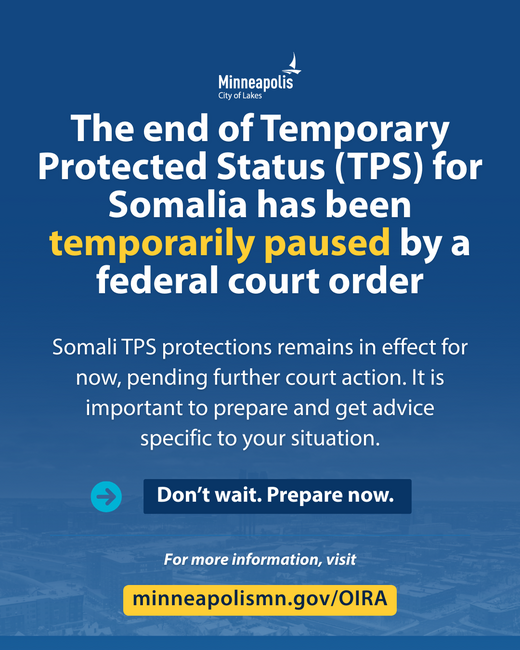   
The Somali Temporary Protected Status (TPS), set to end on Tuesday, March 17, has been temporarily paused by a federal court order. The end of TPS could have resulted in the loss of immigration status, work authorization, and deportation.
According to the court order, people with TPS or pending TPS applications keep all their rights and protections during the pause. Somali TPS remains in effect, pending further court action.
Be prepared
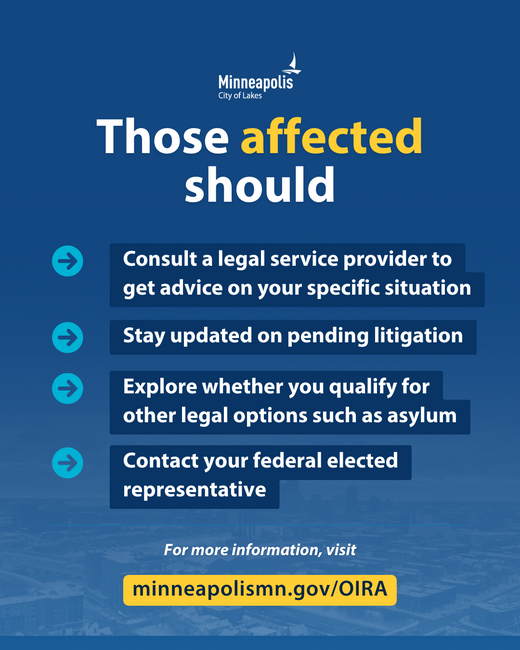
It’s important to prepare and get advice specific to your situation. You can connect with an immigration lawyer to:
- Get advice on your personal case
- Stay updated about laws and active litigation
- Explore other legal options, like asylum
Find links to free legal help on the Know Your Rights and Resources page on the City website.
If you or your family have been affected by immigration enforcement, watch out for scams. Scammers often target people looking for help with their immigration situation, such as legal services. Protect yourself by knowing what to watch for. Get the facts, check before you act and use trusted sources to stay safe.
Check credentials
Only work with a licensed attorney or Department of Justice (DOJ) accredited representative on your immigration matter. In the United States, notaries are not lawyers and cannot give legal advice or file immigration paperwork.
You can:
Be cautious
Protect yourself from scams
- Use a licensed attorney or accredited representative.
- Get copies of the forms prepared for you.
- Never send original documents with your application unless U.S. Citizenship and Immigration Services asks.
- Check official sources like USCIS.gov.
Red flags for scams can include:
- Promises to speed up your case
- Requests for payment by gift cards, wire transfer or cash
- Pressure to sign blank or incorrect forms or give away original documents
- Unsolicited service offers through social media, including from people outside Minnesota
Get information from trusted sources
Resources

The City of Minneapolis is celebrating 20 years of growing the city’s tree canopy with our annual City Trees Sale. Trees are vitally important, offering environmental, economic and social-emotional benefits to the community.
Sign up for the Public Health Matters newsletter to get updates about the City Trees program.
Free trees for Green Zone residents
City Trees offers free trees for residents living in Green Zones. The City and its partner, Tree Trust, will help you select and plant your tree. You can apply for a tree any time during the year. To quality, you must:
- Live in a Green Zone
- Have enough green space for the tree(s)
- Commit to watering the tree every week for the first three years
If you qualify, visit Trees for Green Zone Residents to request free trees.
City Trees for businesses
Minneapolis businesses, nonprofit organizations and apartment buildings with five or more units can purchase trees for their property for $30 each. The City partners with Tree Trust to provide these low-cost trees and professionally plant them for businesses.
Visit Trees for Businesses to order $30 trees for your commercial property or nonprofit organization.
It’s spring break season, which means a lot of travel is happening. Measles is on the rise in the United States. Many measles cases in Minnesota come from unvaccinated travelers. Measles can be very dangerous for kids, pregnant women and older adults.
If you’ve been exposed or show signs of measles, call your health care provider right away so they can:
- Take steps to lessen the severity of the case
- Treat the exposure before symptoms start
Symptoms usually appear one to two weeks after exposure. Call your health provider right away if you notice symptoms like:
- High fever
- Cough
- Runny nose
- Red, watery eyes
- Ear infection
- Diarrhea
- A rash that usually starts on the head and spreads downward
Together, we can keep our families and communities safe!
Learn more about how to protect yourself and others from measles.
Video: Learn how vaccinating children against measles protects their health and the well-being of the community.
Minneapolis City leaders are warning residents about the latest scam targeting permit and zoning applicants. Scammers are asking people and businesses with active land-use permits or zoning applications to pay bogus fees to complete the process.
While planning officials are not aware of anyone in Minneapolis who has fallen victim to the scam, they still urge extreme caution when receiving emails like these.
Scam details
Scammers pose as City or county planning and zoning officials. Information includes:
- An email with fake invoices associated with land use or zoning applications
- Instructions to pay fees right away or face delays or cancellations in the process
- Formatting and imagery that are closely consistent with City or county branding and processes
- Emails from similar City or county usernames but use an @usa.com naming convention or something similar
- Correspondence usually timed to coincide with ongoing, legitimate milestones in the permit process, like a hearing or committee approval
City process and reporting scams
Any legitimate City email correspondence will come from an official @minneapolismn.gov address. The City will never ask for payment via PayPal or other wire transfer, gift card or other electronic methods.
If a request seems suspicious, do not respond, download attachments or click any links. The City also recommends calling 311 to report the suspected scam. Operators can then alert the proper City departments.

For two decades, Minneapolis 311 has helped residents get the information and support they need from city government. Since its launch in 2006, the non-emergency help line has made it easier to report issues, ask questions and access city programs.
The service gives people one number for non-emergency city needs and keeps 911 free for emergencies.
Over the years, 311 has grown from a call center into a multi-channel service hub. Residents can now contact the service by phone, web, email, text or mobile app.
Minneapolis 311 operates from 7 a.m.- 7 p.m. Monday-Friday, with trained staff ready to assist.
City leaders hope the anniversary reminds more people to use 311 for non-emergency needs. To celebrate, the mayor declared March 11, 2026, National 311 Day in Minneapolis, honoring 20 years of helping residents connect with their city.
Learn more about Minneapolis 311 on the City website.

|