|
This week, I was recognized by Black Women of Impact for my leadership in public service alongside several phenomenal Black women leaders including local civil rights leader Dr. Nekima Levy Pounds, and Emmy award winning journalist Georgia Fort. I truly count it as a blessing to be able to advance transformative change on behalf of Black and working class communities, and I’m deeply appreciative of the recognition.
Council Member Wonsley receiving the Black Women of Impact- Twin Cities Honors
Celebrate spring at the Van Cleve Annual Egg Hunt! Kids enjoy age-based egg hunts, candy games, a bounce house, safe archery, and art projects. First 100 children get free candy bags. This family event offers a fun-filled afternoon of activities and lasting memories. Free event but please pre-register. Rain or shine!
Van Cleve Egg Hunt
- April 4th, 10:30-12
- Van Cleve Park- 901 15th Ave SE
Join Seward Neighborhood Group and neighbors for an afternoon potluck and clothing swap. We will spend the afternoon sharing lessons and learning from each other how to build community with our neighbors. Whether you are new to the Seward community or a long-time community-builder, there is space for you to join the conversation. All ages are welcome. There is no cost for attendance.
Clothing for all ages are welcome for the swap. Spring and Summer clothes preferred. Anything leftover will be donated.
Potluck and conversations will be held in the Rec Multipurpose Room. Clothing Swap will be in the School Multipurpose Room. We will have greeters to help you find each room.
Want to volunteer? Click here to see the behind-the-scenes of organizing.
Flyer for the Seward Community Potluck and Clothing Swap
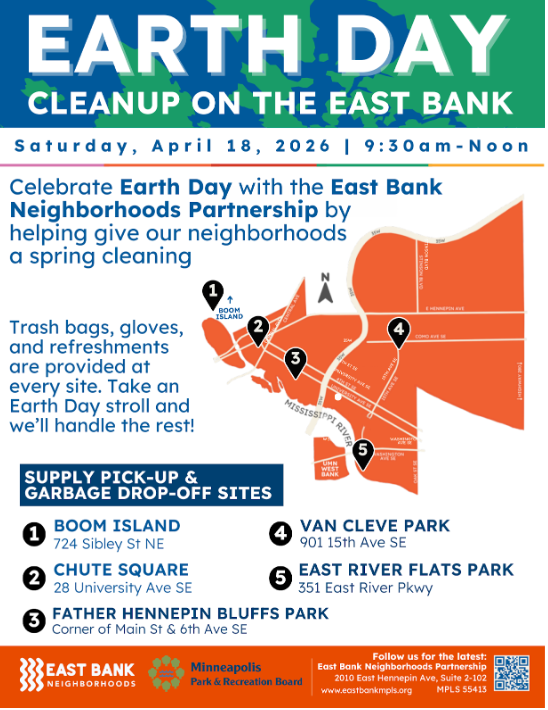
Join the East Bank Neighborhoods Partnership for Earth Day Cleanup on the East Bank!
Trashbags, gloves, and refreshments provided at each cleanup site. Take an Earth Day stroll and we’ll handle the rest!
Earth Day Cleanup on the East Bank
- Saturday April 18th 9:30am-noon
-
Supply Pickup and Garbage Drop Off Sites
- Boom Island
- Chute Square
- Father Hennepin Bluffs Park
- Van Cleve Park
- East River Flats Park
Flyer for Earth Day Cleanup on the East Bank.
Metro Transit is expanding the arterial bus rapid transit (BRT) network in the region. The METRO H Line is a planned bus rapid transit line that will provide faster and more reliable transit service, using enhanced station platforms and comfortable buses. On March 23, Metro Transit will release the H Line Draft Corridor Plan for public feedback through May 4.
The H Line corridor is approximately 17 miles long and is proposed to have 45 stations spaced 0.4 miles apart, on average (see map here). The H Line will run from downtown Minneapolis to the Sun Ray Transit Center on Saint Paul’s East Side, providing enhanced east-west service connecting the two cities. The route will travel on Washington Ave, Pleasant St SE, 15th Ave SE, and Como Ave SE in Minneapolis, and on Como Ave, Maryland Ave, and White Bear Ave in Saint Paul.
The H Line alignment was selected through the Network Next study. It was adopted by the Metropolitan Council in March 2021. Visit metrotransit.org/network-next for more details. Today, the H Line corridor is primarily served by Routes 3 and 80, in addition to Routes 54 and 64. Route 3 is planned to be discontinued when the H Line opens. The H Line, G Line (Rice Street), and new local Route 66 are planned to replace Route 3 in the corridor.
Draft Corridor Plan
The corridor plan identifies the location of stations and platforms. Metropolitan Council approval of this plan will set the location of platforms within the intersection. This is an important step before beginning project engineering.
Metro Transit will lead public engagement through the public comment period. Public Works and CPED staff review materials and coordinate with Metro Transit on City and County projects along the alignment.
Schedule:
- Draft Corridor Plan – Public Comment Period, March 23 - May 4
- Recommended Corridor Plan – Public Comment Period, Late Summer 2026
- Final Corridor Plan – Met Council Adoption, Fall 2026
- Engineering – Fall 2026 - 2027
- Construction – 2028 - 2029
Project webpage with Draft Corridor Plan: https://www.metrotransit.org/h-line-project
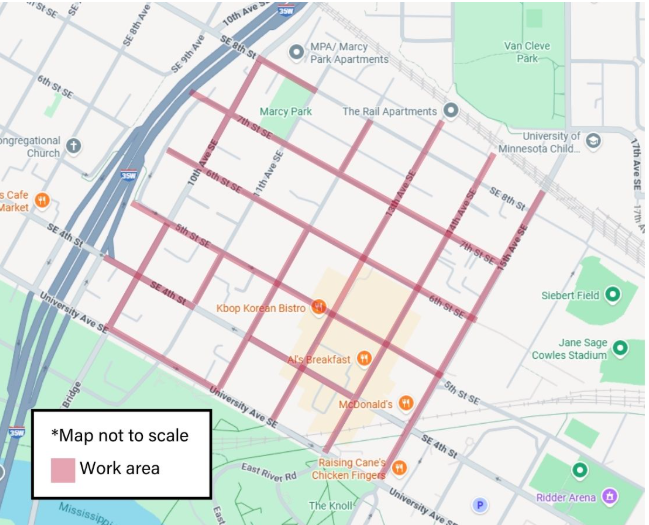
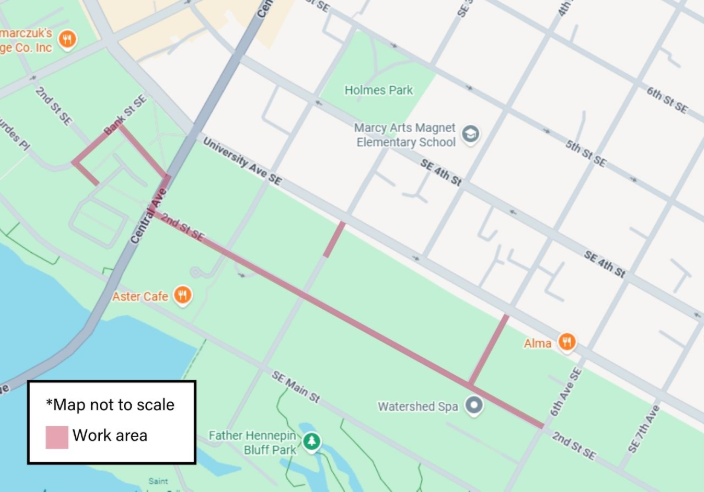
Starting as early as March 30, 2026, CenterPoint Energy and authorized contractors will upgrade the natural gas infrastructure along multiple streets in Dinkytown. This work may last up to 4 weeks.
Map of natural gas upgrades phase 1.
Click to edit this placeholder text.
Map of natural gas upgrades phase 2.
Contractor summary
CenterPoint works with multiple contractors to complete construction projects in a safe and timely manner. You will see these contractors working in your area and may be contacted by them at various stages of the construction process. Employees of authorized contractors will have CenterPoint identification cards. You are encouraged to ask to see identification before allowing technicians inside your home.
Marking utilities
CenterPoint Energy will locate public underground utilities. This is an important safety preparation, done before construction begins. The utilities will be marked with spray paint and flags.
If you have installed any private lines such as sprinklers or dog fences, we ask that you mark them with a material that is convenient for you. Examples include spray paint, flags, and wooden sticks used to stir paint. Marking sprinkler heads is sufficient. If any utility flags are left in residents' yards after restoration is complete, they may be removed and thrown away.
Natural gas main work
To increase the safety and reliability of CenterPoint's gas distribution, natural gas mains are replaced with modern piping. Main is replaced by either boring underneath one side of the road or trenching in the road. Please keep in mind that some intersections may not be permanently restored until after the work is complete. Until then, customers may see temporary backfill such as dirt or gravel.
Service line and meter work
After completing main work, service line work can begin to connect your property to the main. CenterPoint will send notice before the service crew arrives on site. For most properties, the crews remove at least one sidewalk panel in front of the house, excavate a hole by the outside meter and bore the service line from the sidewalk to the house.
Customers with outside meters will be notified prior to the meter's replacement or connection of their service lines to the new main, and a technician will schedule appointments to relight the gas service on each property. The crew will also make appointments with residents to move inside meters outside.
Visit the Construction Definitions page for more information.
Restoration
The final step in an infrastructure project is to restore the areas that may have been impacted by construction. Restoration is typically on site for a few weeks after the completion of other construction activities. Until then, temporary restoration is done by the utility crews. For more details visit the Restoration Practices page.
Traffic impacts
Most traffic impacts will be restrictions on street parking, closure of one sidewalk at a time, and lane shifts. Crews will work with owners on maintaining access to and from their property. Additional traffic impacts and road closures will be communicated as they are in place.
Additional Resources
Summary: The Progressive Majority secured another $2.8 million in rental assistance to keep families housed. This will be matched by a philanthropic partner for a total of $5.6 million.
Background: Residents in our city are still struggling in response to the federal occupation. We are in a looming eviction crisis. The City has estimated that residents are behind on rent by at least $15.7 million per month.
Last month I led Council to allocate $1 million in rental assistance funding. This week, members of the Progressive Majority worked in close partnership with residents, community organizations, and government partners to secure an additional $2.8 million in rental assistance to support residents impacted by Operation Metro Surge. These funds will be generously matched by the Wilson Foundation, resulting in nearly $6 million in rental assistance for residents in Minneapolis.
Council Member Jamison Whiting attempted to reduce the allocation to $2 million. He ultimately withdrew this proposal after significant pushback from progressive Council Members, who noted that with a $3 million philanthropic match on the table, reducing the City contribution was incredibly unstrategic. Instead, he proposed that the City draw all $2.8 million of the funding from the Affordable Housing Trust Fund (AHTF) rather than dividing it between the AHTF and the City’s cash reserves. This motion failed.
Spending this money now to prevent eviction is more cost effective in the long run. It’s always cheaper to prevent eviction than to rehouse people after they’ve been evicted. The City is going to spend millions of dollars because of housing instability caused by Operation Metro Surge. Approving this additional funding is one key step for mitigating a massive housing and homelessness crisis. We also need the state legislature to contribute tens of millions of dollars to rental assistance, which is why I and many of my progressive colleagues have continued to work with state legislators on advancing a rental assistance package that recently passed through the Senate.
But we need a Both/And approach to prevent evictions— both money and time. Council has secured nearly $7 million to cover lost rent money, but tenants also need time for those dollars to get out to the community partners who distribute them to landlords. Without both money and time, we cannot prevent evictions.
The City Council also passed a policy to give renters time: Pause Evictions, Save Lives. This policy would have extended the timeline before an eviction from 30 days to 60 days. The policy was supported by residents across the city, mutual aid organizers, and a majority of the City Council, but Mayor Frey vetoed it. This week, the City Council voted 7-6 to override the veto, short of the 9 votes needed. The Saint Paul City Council unanimously passed a temporary extension to 60 days through the end of 2026 yesterday, granting this needed protection to thousands of residents just across the river. While the measure did not move forward in our city yet, I’m grateful that the leadership and initiative taken by me and my progressive colleagues has inspired other city leaders to take action to mitigate the coming eviction crisis.
According to HomeLine, Minneapolis is already surpassing eviction rates from 2025, which was a record breaking year. Council Member Chowdhury re-introduced a policy to extend the pre-eviction filing timeline. Renters need more time to stay housed and we are not giving up on this policy that we know residents urgently need.
Key votes: Council voted 10-3 against Council Member Whiting’s proposal to fund rental assistance from the Affordable Housing Trust Fund. Council Members Whiting, Shaffer and Palmisano were the only votes of support. Council then voted unanimously to support a motion by Council Member Chavez and the progressive majority to allocate $2.8 million for rental assistance from a blend of sources.
Background: Mayor Frey has proposed that the City spend nearly $40 million on a “community safety training and wellness center.” This “Cop City” project is fundamentally a list of MPD wants, not resident needs. To fund the acquisition of a site for this project the Mayor proposed defunding nearly $6 million in funding for green infrastructure, neighborhood traffic safety, and even ADA compliance for sidewalks.
This week, Council was asked to vote on a $6 million purchase agreement for a dilapidated warehouse in Ward 11 that the Frey administration called a “unicorn” property for Cop City. The Frey administration also asked us to authorize the reallocation of $6 million in bond dollars away from traffic calming, ADA accessibility, and improvements to animal shelter. I and several of my colleagues were ready to vote both of these items down, but the Council ultimately voted to refer them both back to staff. This action removes the item from Council consideration for now, but the Frey administration can bring it back at any time and confirmed that they do intend to do so.
Council received hundreds of emails and phone calls from residents opposing this project and urging investment into capital projects that support basic needs for working class communities, like traffic calming, social housing, and green infrastructure.
The City prioritizing resources and time to purchase new land rather than focusing on the specific training requirements that MPD currently is out of compliance with is poor governance. The most recent settlement agreement compliance report repeatedly highlights the lack of progress on the settlement agreement is due to failure of executive leadership. At the same time, there are so many unanswered questions about the training and wellness needs for our Neighborhood Safety Department. The Frey administration still hasn’t outlined a plan to implement the Safe and Thriving Communities Plan and scale up our preventative, responsive, and restorative services to create an ecosystem where all Minneapolis residents are safe and thriving. Rather than focus on shiny new projects, we should be working to hold MPD and the administration accountable in getting this work done.
I am excited to continue working with the community and my colleagues to prioritize the City’s capital dollars for green infrastructure, social housing, traffic calming, and other resident priorities.
Key votes: Council voted 7-6 to refer the Cop City purchase agreement and $6 million bond reallocation back to staff. I voted against the referral along with Council Members Stevenson, Chavez, Chughtai, Chowdhury, and President Payne.
Summary: City Council has allocated $7 million to support small business resilience. While I have some concerns about how the City is dispersing this funds, it’s a significant investment to help our small businesses and commercial corridors survive the impacts of Operation Metro Surge.
Background: Earlier this month, Council Member Chavez led the Council to allocate $7 million to support small businesses to survive the impacts of Operation Metro Surge. This week, Council approved the Frey administration’s plans to disperse the funds through various programs.
Some of the proposed initiatives, like funding local artists and covering costs for more activation for block parties and events in the community makes sense, and I see cascading benefits that could come from those investments. However, I was surprised and concerned that the Frey administration proposed using over half of the $7 million to waive fees that businesses pay the City.
I am very skeptical that utilizing $4 million dollars for waiving fees is the best way to maximize benefits for small businesses. I’m also concerned about the equity impacts. For example, a restaurant downtown with a liquor license and entertainment license may save thousands of dollars in fees, while a small bakery in a cultural corridor who was disproportionately impacted by the occupation saves less than $300.
I hope that this fund will get needed resources to small business owners in strategic ways. If the outcomes of this program are not what we hoped, we should keep in mind the administration’s choice to keep 60% of the funds, instead of getting money out the door and into the hands of small business owners or community organizations who know how to activate their neighborhoods.
Key votes: Council voted unanimously in support of the $7 million small business resiliency fund allocations and guidelines.
Summary: In partnership with graduate workers, I authored a resolution urging the University of Minnesota to comply with state law and recognize all graduate workers as part of the bargaining unit.
Background: The Graduate Labor Union – United Electrical Local 1105, or GLU-UE for short, is the labor union representing graduate workers at the University of Minnesota. The grad student unionization campaign began in February 2023, and after just four weeks, a supermajority of 2,800 total graduate workers signed union cards. In April 2023, 97% of grad workers voted “yes” to form GLU-UE.
In 2024, the state legislature expanded the definition of “public employee,” including a new category of graduate students at the University of Minnesota in the bargaining unit, called Graduate Fellows and Trainees. Despite the language and intent of the legislation, the University of Minnesota has denied Graduate Fellows and Trainees union representation. Graduate Fellows and Trainees do the same work as other Graduate Workers, but are left without Paid Leave, Earned Sick and Safe Time, protection from harassment or overwork, or union representation. This also gives the University the ability to reclassify work outside of the bargaining unit and undermine union strength and labor protections.
The University of Minnesota is a major employer in Ward 2 and citywide. It’s incredibly disappointing to see the U spend taxpayer money trying to union bust grad students instead of complying with the new PELRA policy and recognizing the entire bargaining unit including Graduate Fellows and Trainees.
I authored a resolution urging the U to settle the dispute with the union by simply following the clear language of the state policy and recognizing all graduate workers as part of the bargaining unit. Council approved the resolution.
Key votes: Council approved the resolution 10-2. Council Members Rainville and Shaffer voted in opposition.
Summary: In response to community requests, I authored a resolution opposing Trump’s recent foreign policy in Cuba and urging normalized relations.
Background: In prior years before I entered City Hall, the City Council had passed many resolutions related to how international affairs impact our constituents and urging humane foreign policy actions by the federal government. Just a few examples include Urging Cessation of War and Combat operations in Iraq from 2007, condemning the January 2017 Presidential Executive Orders on Immigration Enforcement and Refugees, and approving a Unity With Ukraine resolution in 2022.
The Council has also approved multiple resolutions in solidarity with the Cuban people. In 2018 Council approved a resolution about building a new, cooperative relationship between the United States and Cuba, and in 2021 my predecessor Council Member Gordon authored a resolution promoting medical and scientific collaboration between Minneapolis and Cuba.
This year, residents asked me to bring forward a resolution to express our city’s opposition to this cruelty and calling for normalization of relations with Cuba. The Trump administration’s economic and foreign policy actions are contributing to starvation and dire humanitarian conditions for our Cuban neighbors. This resolution is a simple way to express solidarity with people who are living in terrible conditions because of the US government.
International issues like these come before the Council because they matter to residents. Minneapolis is a diverse multiracial city, and for residents have been active in international movements for decades. When residents identify an opportunity for local government to weigh in on the issues that matter to them and their community, I am honored to support them in advancing those values. This Council is the legislative body of the largest city in the state, and our official positions are transmitted to our federal legislators so they can best advocate for and represent the people of this city.
Key votes: Council approved the resolution 7-6. Council Members Rainville, Vetaw, Warren, Shaffer, Whiting, and Palmisano voted in opposition.
Summary: I authored a resolution in support of a delegation of Minneapolis residents who are advocating for European financial institutions to divest from corporations that enable ICE.
Background: A group of Minneapolis residents have organized a delegation to head to Europe to advocate for financial institutions to divest from corporations that are financially benefiting from the human rights abuses and violations taking place through ICE. This delegation is being organized in partnership with a Europe-based human rights advocacy organization that brings people who are harmed by financial institutions’ choices to share their experiences with decision-makers and advocate for divestment.
It has been widely reported that corporations like Palantir have had a huge role in providing the tools to the US federal government to violate the human rights of residents. We no longer have a functional federal government that adheres to rules of laws or is interested in regulating corporations who profit from human rights violations. This means we must find allies and partnerships elsewhere to hold these corporations accountable.
I am very grateful for these residents who are doing critical work that could lead to significant global changes. History has shown that successful movements against fascist governments require mass solidarity and resistance. Encouraging European countries to divest from corporations that enable DHS and ICE is a strategic action when the reality is we cannot rely on the federal government to police themselves. Minneapolis residents’ resistance against ICE inspired the nation, and now some are continuing their work of resistance in a different scope through international divestment organizing.
Key votes: Council approved the resolution 9-4. Council Members Rainville, Vetaw, Warren and Shaffer voted in opposition.
Contact Ward 2
Visit: minneapolismn.gov/ward2
Email: robin.wonsley@minneapolismn.gov
Phone: 612-673-2202
City Hall
350 S. Fifth St., Room 370
Minneapolis, MN 55415
For reasonable accommodations or alternative format please contact 311. People who are deaf or hard of hearing can use a relay service to call 311 at 612-673-3000. Para ayuda, llame al 311. Rau kev pab, hu 311. Hadii aad caawimaad u baahantahay, wac 311. |