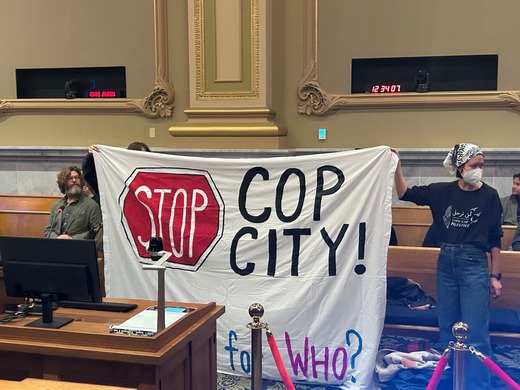
 This week the City Council made front page news in the Minnesota Star Tribune. Not because we passed $2.8 million in additional emergency rental assistance. Not because we debated approving the purchase of a site in south Minneapolis for a new training and wellness facility for our first responders. And not because the council upheld the Mayor’s veto of temporarily extending the pre-eviction notice period from 30 to 60 days.
No, it was for matters far less substantive, but highly illustrative of how out-of-touch the council is from its core responsibilities. The article’s subheading is a pitch-perfect distillation of what frustrates so many residents about the dynamics of local politics: “While debating whether to normalize relations with Cuba and urge Europe to stop doing business with Homeland Security, acrimony broke out among council members.”
Did you catch that? The cause of our rancor was a debate about foreign policy and lobbying European financial institutions. Is any of that going to bring more jobs and housing to our city? Lower your property taxes? Make our streets safer? The answer, of course, is no.
During the last election, I heard something consistent from residents across Ward 7: they are tired of a city council that performs for an imagined global audience while the pressing, day-to-day concerns of actual Minneapolitans — public safety, affordability, economic vitality, basic livability — are treated as boring afterthoughts.
City Council fiddles, while Uptown — proverbially — burns.
In the midst of the furor, I was attempting to describe what I understand to be the core job of City Council: enacting ordinances that govern our city, creating policies that direct city operations, managing city finances, and engaging residents in decision-making. That’s the job description. It’s a big job.
Watch my direct comments here.
I don’t think national and global events are irrelevant to our work. They’re not. Decisions made in Washington or Brussels or St. Paul shape what’s possible here. But there’s a difference between understanding that context and thinking our job is to weigh in on every global development. When we pass resolutions about matters entirely outside our authority — as the council has gotten in the habit of doing — we don’t amplify our voice, we dilute it. We signal that we think the world is listening to us, when the reality is that they are tuning us out.
And based on what we witnessed Thursday, I can’t blame anyone for doing that. Moving forward, I am committed to raising the level of decorum on the dais and sharpening the rigor of our discussion so that Minneapolitans can understand the real stakes of the substantive issues and challenges that will determine whether Minneapolis becomes a success story or a cautionary tale.

 On Wednesday, March 25th I spearheaded an exciting meeting at the Fifth Precinct to bring leaders from a range of government agencies together to discuss new and coordinated strategies for addressing the challenges in Uptown, especially those related to unsheltered homelessness, open air drug use and drug dealing, crime, and overall livability concerns.
It was encouraging to hear the work that is already happening. MPD is now working more closely with staff at the Walker Library to address crimes they see occurring around their property. This coordination has already led to the apprehension of someone with an outstanding murder warrant.
In addition, law enforcement now has access to a location in the Rainbow building where MPD, Park Police, and Metro Transit police can have a more visible presence in the heart of Uptown to deter crime. This is thanks to the generosity of the building owner, and even Annunciation families who are bringing snacks to support the officers who drop in.
The Fifth Precinct has also implemented directed patrols focused on the Uptown and Stevens Square/Nicollet Avenue area. Two extra officers are spending roughly 5 hours a day split between these two focus areas, and have already made a number of arrests.
Faith Randall, the Fifth's Crime Prevention Specialist has been working with local businesses and the Community Prosecutor on posting and enforcing trespassing notices, so that people who are coming to Uptown to cause problems are geographically restricted from being there. Everyone is welcome in Uptown, unless you're there to cause trouble.
We were also joined by leaders from Hennepin County Opioid Response and the Minneapolis Department of Health. Commissioner Chaplin stated Minneapolis will start rolling out the Mobile Medical Unit to Uptown periodically, starting as soon as April. The Mobile Medical Unit will hopefully soon have approval to carry Brixadi, a drug which can help people get off of fentanyl and on the path toward sobriety by curbing withdrawal and cravings. County and City officials are committed to providing services in such a way that we are meeting people where they are and not just attracting more problematic behavior.
We agree that we can't simply arrest our way out of this problem. Pairing social services with effective law enforcement combines compassion with respect for the rights of the general public.
Our gathering this week included other elected officials, law enforcement leadership from MPD, Park Police, and Metro Transit, representatives from the Mayor's Office, Hennepin County Library security, the County's opioid response team, the Minneapolis Health Department, Metro Transit community affairs, and CPED. This problem doesn't belong to any one agency, and neither does the solution.
All of us have heard from residents, housing providers, and the business community that Uptown's decline can no longer be overlooked.
This group will be meeting monthly, and we will be adding whomever we need to our group, including probation officers. With all of us coming together, the renaissance of Uptown isn't something that will happen “someday,” but begins now.
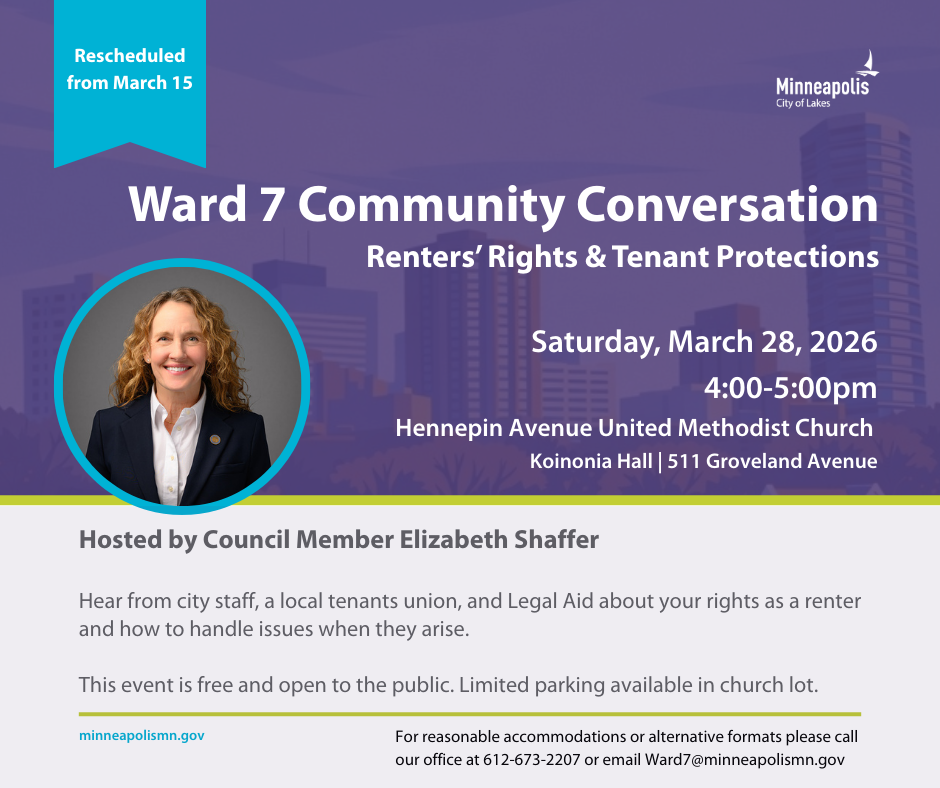 One final reminder: we’re hosting our next Ward 7 Community Conversations event on Saturday, March 28th from 4:00 to 5:00 p.m. at Hennepin Avenue United Methodist Church (511 Groveland Ave.) in Koinonia Hall. This event was originally scheduled for March 15th, and postponed due to weather. You'll hear from city staff, the fire inspector, and the president of a local tenants union. We have several buildings in our ward dealing with renter’s right issues right now so I am hopeful this team of resources will provide valuable information.
The event is free and open to the public. Parking is available in the church lot.
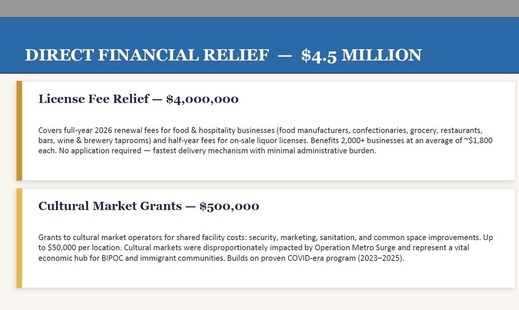 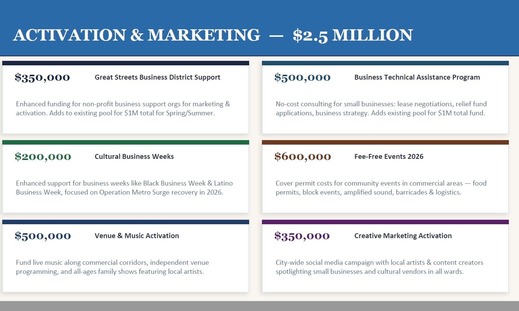 The Minneapolis City Council voted to move forward with a plan to help small businesses impacted by Operation Metro Surge.
The $7 million Small Business Resiliency Fund was approved by Mayor Jacob Frey and the City Council last month and outlined by the Community Planning and Economic Development (CPED) department on Tuesday, March 24. It will provide license fee relief, support for events and activations in commercial areas, cultural market grants and more. We anticipate that Ward 7 organizations will be able to apply for some of these activation funds, and other money will cover the full or partial costs of business license fees for the food and hospitality industries that were among the businesses hit hardest by the Surge.
CPED staff designed the fund to get money out to businesses quickly and without too many hurdles. By City estimates, the Surge cost Minneapolis businesses $81 billion in lost revenue.
Learn more about the Small Business Resiliency Fund.
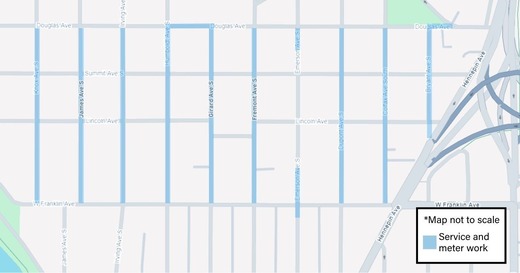 Starting as early as March 30, 2026, CenterPoint Energy and authorized contractors will upgrade gas service lines and gas meters in Lowry Hill, and has advised that this work may take up to 7 weeks to complete. As you’ll see from the map, above, construction work will take place at many points within the Logan to Hennepin/Douglas to Franklin square that comprises much of Lowry Hill. Work will begin with subsurface utility location, so look for spray paint, flags, and stakes, and will then be followed by the actual line and meter replacements.
The work itself will be performed by authorized CenterPoint contractors, and you may be contacted by them at various stages of the construction process. Employees of authorized contractors will have CenterPoint identification cards. You are encouraged to ask to see identification before allowing technicians inside your home.
For more detailed information, please be sure to visit the CenterPoint homepage for this project.
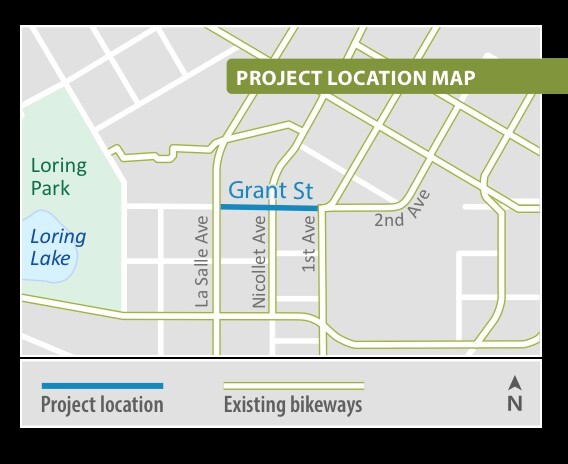 We’ve received word that Public Works is planning to install a two-way protected bikeway along the section of Grant St between 1st Ave and La Salle Ave in 2026. This bikeway project has been in development for multiple years, and this connection will link existing bikeways on 1st Ave, 2nd Ave, Nicollet Ave, and La Salle Ave. Public Works says the bikeway is intended to improve comfort and safety for people biking, and will also function as a traffic-calming measure by narrowing travel lanes to current standards. The current street configuration (travel lanes and parking lanes) will not be impacted with the bikeway project.
The bikeway will be installed in coordination with street resurfacing in summer/fall 2026. There will be a special assessment levied for the resurfacing project, but the bikeway project will not include any special assessments. Public Works says it plans to share more information with property owners and residents through engagement related to the resurfacing project.
Yard waste season will start the week of April 6, 2006, and will be collected every week on your regular garbage pickup day through November 23 - 28, 2026. Yard waste collection is included in the base fee for your Solid Waste & Recycling service. There's no extra charge for the collection of properly prepared yard waste. If you do not use the City's collection service, contact your hauler for information. By state law, it's illegal to throw yard waste in the garbage. It’s also illegal to use a traditional plastic bag for yard waste picked up at your home.
On March 17, the Hennepin County Board of Commissioners approved a resolution authorizing abatement of 2026 property tax late-payment penalties for eligible taxpayers experiencing hardship due to Operation Metro Surge.
Pursuant to state law, property taxes are due on May 15 and October 15.
With this new action, penalty abatement applications and full payment of past-due taxes are due by:
- June 30, 2026 (first half), and
- November 30, 2026 (second half).
This effectively provides property owner an additional six weeks of time to pay without penalty. Property owners can submit applications in person at the Government Center or using a form on the county website.
It’s important to note, the Board’s March 17 action creates a special abatement that is separate from the existing process, and it does not affect a property owner’s ability to request penalty abatement for any reason once every ten years.
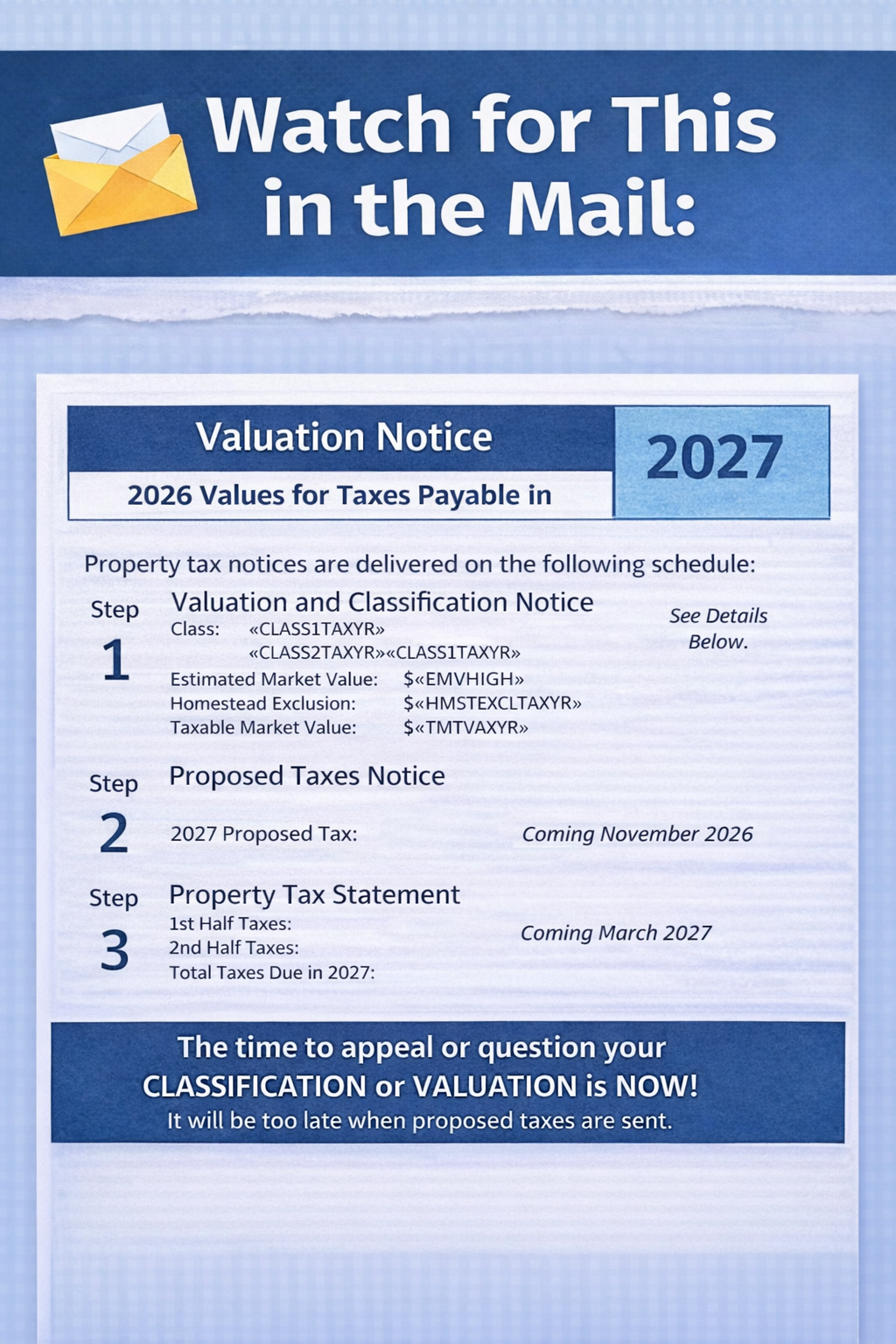 Another reminder: Property owners in the ward should by now have received their property valuation notices for 2027.
While staff in the City Assessor’s office works hard year-round to arrive at accurate valuations, property owners don’t always agree with the assessment number and they do have appeal rights, which can be found on the city assessor’s website.
Remember that property valuations can be informally appealed by directly reaching out to your assessor, whose contact information is found on the back of the notice. The most crucial point is that any agreements reached informally must be finalized by April 3rd, otherwise they must be formally appealed to the Local Board of Appeal and Equalization (also detailed in the link). |