|
Hennepin County Attorney Mary Moriarty announced the office has created the Transparency and Accountability Project (TAP) in the wake of Operation Metro Surge.
TAP’s purpose is to collect and assess evidence submitted by the public of potentially unlawful behavior by federal agents. It is staffed by HCAO prosecutors and an HCAO civilian investigator.
A new portal for community members to share photos, videos, and descriptions of any incidents that may involve unlawful conduct by federal agents has been created to support TAP. The previous portal for evidence in the Renee Good and Alex Pretti shootings has served its purpose and been closed. HCAO will investigate and pursue charging where appropriate. TAP is staffed by prosecutors and a civilian investigator from our office.
Public Information Submission Process
Fill out this form
Step 1: Describe the incident using the form
Step 2: Provide contact information
Step 3: Submit photos and video
If you have any questions or need assistance, please contact 612-348-5935 or email TAP@hennepin.us
The City has compiled a list of prescription drug resources and delivery options. The information includes lists of:
- Local pharmacy chains that deliver.
- State and local pharmacy assistance programs
- Nonprofit and charitable assistance programs
- National discount programs
- Combination delivery and low-cost options
Find a list of prescription drug resources on the City website.
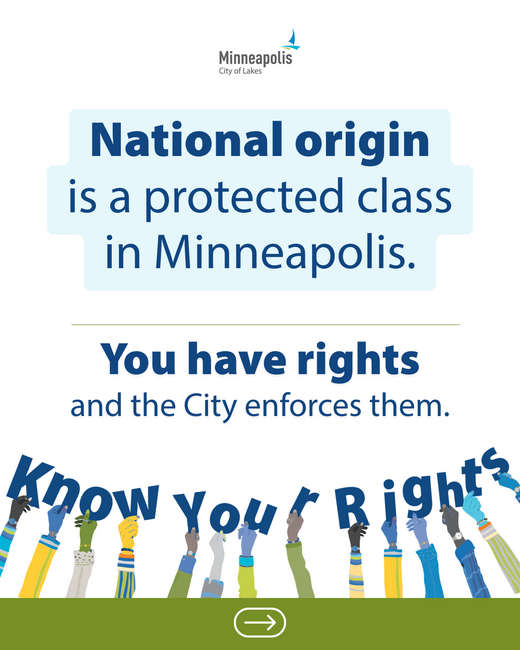
In Minneapolis, you’re protected by law against discrimination based on where you or your family come from – or where someone assumes you come from – including your culture, accent, appearance and language. These protections apply in employment, housing, businesses, City services and more.
This is about discrimination in daily life in Minneapolis – not immigration enforcement. While the City does not have jurisdiction over federal agencies, we do enforce our Civil Rights Ordinance, and discrimination is not allowed here.
Report discrimination by employers, landlords, businesses, City services or others by visiting the City website or by calling 311. You can also contact the department at 612-673-3012 to schedule an intake call.
If a situation involves federal action, there are other places to report concerns:
- Minnesota Attorney General’s Office Report impacts of federal actions in Minnesota that may affect civil liberties or state rights. Federal action reporting form
Find links and more information on the City website.
The March 2026 Recruitment Cycle for the City’s Appointed Boards & Commissions (ABCs) opened March 1. We’ll accept applications through March 31. We’re recruiting for 93 seats on 13 different ABCs.
Learn more at www.minneapolismn.gov/government/boards-and-commissions
The ABCs that are part of this month’s recruitment cycle include—
- Audit Committee
- Bicycle Advisory Commission
- Community Commission on Police Oversight
- Homegrown Minneapolis Food Council
- Minneapolis Advisory Committee on Aging
- Minneapolis Advisory Committee on Housing
- Minneapolis Advisory Committee on People with Disabilities
- Minneapolis Arts Commission
- Minneapolis Workforce Development Board
- Pedestrian Advisory Committee
- Public Health Advisory Committee
- Safe & Thriving Communities Work Group
- Workplace Advisory Committee
For more information, including reasonable accommodations, alternative formats, or technical help completing an application contact the ABC Administration Team at (612) 673-2216 during regular operating hours [Mon. – Fri., 8:30 a.m. to 4:30 p.m.] or by email at ABCadmin@minneapolismn.gov.
Increased federal immigration enforcement activities in our city are disrupting daily life. Some people are afraid to go to work, school or the grocery store.
We created a Virtual Resource Center for community members to find partner resources for food, housing and mental health support.
- Visit the Virtual Resource Center to find information including:
- Rent and eviction assistance
- Mental health resources
- Domestic violence resources
Download a resource flyer to post or share with your networks.
If you’re looking for a way to make a donation to support the community, you can now find links to local organizations on the City website.
Donating to a local foundation
Monetary donations can assist local organizations that provide:
- Food
- Rental assistance
- Mutual aid
- Other resources
Find a list on the City website of local organizations receiving donations.
You can also find resources on the City website including ways to:
- Submit incidents around federal actions to the state attorney general
- Submit reports of potential unlawful conduct by federal agents
- Find a vehicle abandoned due to ICE detention
This is a non-exhaustive list of local foundations. Information and links to local foundations are provided solely for the convenience of the public and are not an endorsement, approval, or recommendation of that organization or service. The City of Minneapolis assumes no responsibility for the content or operation of other websites.
You have rights as a renter if you’re at risk of getting evicted from your home. Property owners cannot immediately evict you for not paying rent. They must give you written notice at least 30 days in advance. The notice must tell you how much you owe and how you can pay it.
People who rent their homes are important members of our community. Renters make up more than half of the population in Minneapolis.
Find more detail on eviction policy on the City website.
Resources
- Legal assistance. Low-income renters in Minneapolis have the right to a lawyer in eviction cases. We have free and low-cost services for renters that include help legal help, advocacy, education and more.
Learn more about legal resources.
Rental properties must have heating systems that work properly and safely. They must be able to keep the indoor temperature at:
- 65 degrees F from Sept. 15-30
- 68 degrees F from Oct. 1-April 30
- 65 degrees F from May 1-15
What to do when the heat isn’t working
- If your heat isn’t working, tell the property owner or manager right away.
- If they don’t take steps to fix it immediately, call 311 or 612-673-3000 to report it. 311 is open 7 a.m. to 7 p.m. on weekdays.
- Outside of 311 hours, call 911 to report low heat or no heat.
The 311 agent or 911 dispatcher will take your contact information, and an inspector will contact you to visit your rental unit as soon as possible. From Sept. 15 to May 15, there is always an inspector on call to help renters with no or low heat.
Safety and resources
If a housing inspector, fire inspector or other City employee comes to your home, they will introduce themselves and tell you why they’re there. You can always:
- Ask a City employee to identify themselves and show you their badge.
- Request a translator.
- Call 311 to verify the employee's identity and reason for being at your address.
Nobody in a City uniform will ever ask for your immigration status or participate with any federal immigration enforcement activity. Our officers do not wear masks to hide their identity.
If you need emergency shelter, contact Hennepin County at 612-596-1900 or visit its website.
If you need a warm space to be during the day, Hennepin County and its partners offer warming spaces. Call 612-204-8200 for overnight options. If you’re in physical danger of freezing, call 911.
If you have questions about your renter rights, call HOME Line at 612-728-5767 or Legal Aid at 612-334-5970.
Many residents and businesses are experiencing financial hardship during this difficult time. While the City cannot forgive unpaid utility bill balances, we have flexible payment plans that may help if you’re having trouble affording your bill for City water, sewer, stormwater and solid waste.
You can call Utility Billing at 612-673-1114 to discuss which option may be best for you. Call center hours are 8 a.m.-4 p.m. Monday-Friday. Please have your account information ready.
From March 2-20, the City will be accepting grant applications to help pay for repairing failing private sewer pipes and connections to the public sewer. Homeowners can receive grants between $5,000 to $10,000 and may need a match to receive the funds. Funding will be awarded on a lottery-based system.
This year’s funding is expected to provide grants to 32-36 property owners. You can look at information now to get ready and then apply when applications open.
Everyone has constitutional protections — regardless of immigration status.
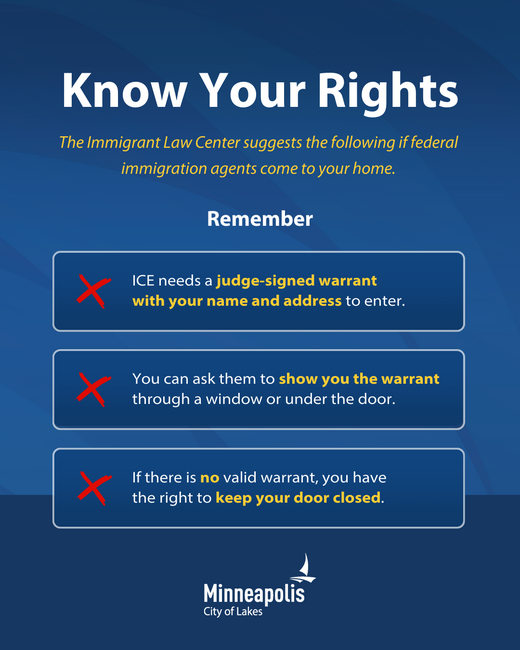
Before opening your door to ICE, know your rights, as recommended by the Immigrant Law Center. Remember to assert them calmly and safely.
The Immigrant Law Center of Minnesota suggests the following if federal immigration agents come to your home.
- ICE needs a judge-signed warrant with your name and address to enter.
- You can ask them to show you the warrant through the window or under the door.
- If there is no valid warrant, you have the right to keep your door closed.
Find more know-your-rights resources on the City website in:
This is a difficult time for everyone in our city. If you're in crisis or know someone who is, the Cope mobile crisis team can help 24/7. Cope responds to anyone in Hennepin County who needs an urgent response — whether one person, families or communities.
Cope has bilingual and bicultural staff available for face-to-face, phone, and video visits. It uses interpreters when needed.
Call 612-596-1223 or visit Hennepin County’s website. If the situation is life-threatening or you need immediate response, call 911.
The City of Minneapolis did not make any deals or concessions with the federal government or ICE to end Operation Metro Surge. We remain governed by our separation ordinance. The City – including MPD – does not participate in federal civil immigration enforcement or help ICE with civil immigration enforcement investigations.
Read more on the City website.
You can watch the full news conference on YouTube.
Stay up to date on the City’s response to Operation Metro Surge on the City website.
People are showing up for Minneapolis. Often, that starts with everyday choices: where to eat, shop, gather and spend time. That idea is at the heart of MPLS for MPLS, a new initiative from Meet Minneapolis encouraging residents to intentionally engage with neighborhood businesses and workers during a challenging moment for the city.
The effort also provides practical information about which businesses are open and what may look different right now, including modified hours and knock-for-entry policies.
Small businesses are the heartbeat of Minneapolis neighborhoods. They help shape the character of each block, create welcoming places for residents and visitors to gather, and provide livelihoods for thousands of workers and families. When those businesses struggle, the ripple effects are felt across the community and throughout the city’s economy.
Read more on the Meet Minneapolis website.
The Minneapolis City Council passed a resolution recognizing February 2026 as Human Trafficking and Exploitation Awareness Month. Human trafficking often goes unnoticed. This resolution raises awareness about the signs and impacts of human trafficking and our ongoing investments in prevention, training and survivor-centered services and resources.
Survivors of sex trafficking are often hiding in plain sight and may show signs of substance use disorder.
Other signs include:
- Missing school or work regularly
- Telling inconsistent or rehearsed stories
- Dating someone much older
- A history of running away or being homeless
- Sexually inappropriate pictures on social media
- Unusual tattoos, like a crown or the word "daddy"
- New expensive clothes, money, jewelry, etc., without explanation
City investments and ongoing work
The City continues to advance coordinated and cross-department efforts focused on prevention, harm reduction and access to care.
In 2026, this work will include:
- Developing specialized training for firefighters and service providers.
- Strengthening policies that support stability and fair access to employment.
Learn more about the campaign and ongoing work on the City’s website. |