|
In addition to strengthening our separation ordinance, the council also passed a resolution I authored with my colleagues expressing statements of position pertaining to oversight of, and accountability for, the Minneapolis Police Department. Highlights include updating the corrective action matrix to establish consequences for police officers who violate any current or future separation ordinances; requesting that these violations be placed in Category D, which includes 160-300 hours of suspension and/or demotion, and Category E, which would result in termination; and opposition to any use of so-called “less-lethal” weapons for crowd control against people in Minneapolis.
We hope Mayor Frey will take this ask seriously and ensure the human rights of our neighbors are
I wanted to give you an update regarding the city’s budget which was adopted by the council unanimously. I authored the following amendments and resolutions:
- $1,200,000 to implement certain elements of the Thirty-Eighth St. THRIVE Strategic Development Plan
- $650,000 to create a Thirty-Eighth St. THRIVE Capital Fund
- $100,000 for events, marketing, and branding strategy
- $250,000 to create a Thirty-Eighth St. Cultural District Heritage Land Trust
- $200,000 for a consultant to conduct implementation planning for the Thirty-Eighth St. THRIVE Strategic Development Plan
- $1,400,000 to reinstate emergency housing vouchers (address homelessness), which were cut from the mayor’s proposed budget
- $527,836 Funding approved for immigration legal services, bringing the program’s total in 2026 to, which is the highest figure ever allocated for this program in Minneapolis.
- Funding an additional staff member in the Office of Immigrant and Refugee Affairs, which will provide community engagement and support for immigrant and refugee communities.
- $200,000 for a Street Vendor Grant and Compliance Program to ensure our communities continue to have access to permitting classes and pathways to vending.
- $15,000 to study a Tiny Homes, Big Dreams Program, which is a tiny home village that could be City-owned and/or -operated and meant to be another tool in addressing the public health emergency that is homelessness
- $700,000 to establish public restrooms along the Nicollet Ave. transit corridor
- $150,000 to fund opioid treatment resources, services, and supports for underserved communities in South Minneapolis.
- Resolution urging the mayor’s administration to terminate the City’s contract with ZenCity Technologies and using those resources instead to fund civilian investigators.
- Resolution urging the mayor’s administration to reinstate funding for the Community Connections Conference
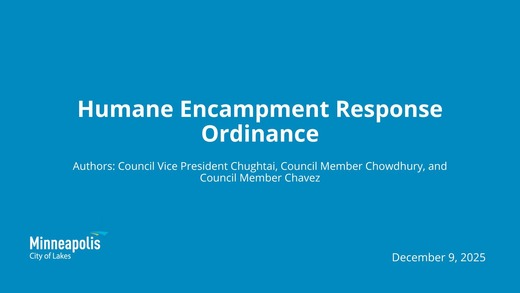 I’m also proud to share that the council passed by an 8-5 vote an ordinance introduced by Council Vice President Chughtai, Council Member Chowdhury, and myself. The ordinance seeks to establish the foundation of a humane and public health response to encampments within the City of Minneapolis.
This ordinance seeks to address, in part, the public health issues that arise when individuals lack adequate sanitation, bathrooms, and other resources while living in an encampment. Impacting the health and well-being of both unsheltered individuals within an encampment and also neighboring residents and businesses. Additionally, this ordinance provides a foundational framework for a standard and humane procedure for encampment removal.
With this action, the City will address public health and safety concerns for unsheltered individuals by establishing a standard procedure for a pre-closure notice that includes the date and time of an encampment removal, contact information for community partners who can assist individuals in finding shelter, and information on warming and cooling centers during inclement weather. This also ensures that unsheltered individuals are given the basic dignity of time to make plans before a closure, gather belongings, seek out resources, and have transparency. The pre-closure notice will also be given to all pertinent community partners to ensure transparency in city operations and to provide them with time to create responsive plans, if necessary.
Key provisions of the ordinance include:
- Detailed City public health response within ten days of an encampment forming and coordination with jurisdictional partners.
- The City provides a pre-closure notice notifying of an encampment removal to both unsheltered individuals within the encampment and to service providers.
- The City provides storage for unhoused individuals experiencing an encampment removal.
During the budget process last year, I authored an amendment to create a pilot program designed to improve public safety by helping employ adults encountering homelessness or housing instability with sustainable low-barrier work and income while increasing the cleanliness and livability of the Southside Green Zone (SGZ) by creating teams of workers who will focus on cleaning up the area.
The SGZ encompasses high levels of pollution and racial, political, and economic marginalization, and is disproportionately impacted by public safety, homelessness, and cleanliness issues. Some of the funding was meant to go to a non-profit organization(s) to establish and administer the program with services including background checks; securing vital documents needed for employment; conducting day employment community projects; and paying weekly wages.
I’m pleased to share with you that the council approved a contract with an organization to administer the program. Program participants will be engaged in day employment tasks that improve neighborhood cleanliness and safety, such as trash collection, graffiti removal, snow clearing, and ice control. The program also provides barrier-reduction services, assisting participants in securing identification documents, resolving minor legal issues, and accessing long-term employment and housing resources. Program administrators are required to provide daily supervision, uniforms, payroll services, and ongoing data collection on program outcomes.
The City established specific performance measures to evaluate success, including participant employment and housing outcomes, program retention, and measurable improvements to public safety and community livability within the target area. The contract term is one year.
At yesterday’s council meeting, we also voted on passage of the wrecking provisions ordinance that I mentioned in previous newsletters. The ordinance came about after the demolition of Smith Foundry, where structures containing harmful materials were demolished with little-to-no notice to residents in the surrounding area.
Our office worked closely with City staff, the City Attorney’s Office, and community to develop a process by which a wrecking permit applicant must identify and disclose any potential materials or conditions that could cause adverse health impacts on residents during the wrecking process. This could include exposure to toxic or hazardous chemicals in building materials, mold, poor air quality, or other factors. The permit applicant would then be required to implement specific mitigation measures to protect public health and safety. Other provisions will also be considered to protect the well-being of our community.
The current ordinance was not strong enough to ensure the health and safety of nearby residents, which City staff said was a mistake, and the procedures used in the Smith Foundry demolition process needed to be improved upon.
I want to thank the community, including neighbors and neighborhood associations in East Phillips and Midtown Phillips, who really led on these efforts. They also held my office and City staff accountable to ensure we take action that will benefit the health and safety of residents throughout the city. I am also grateful that City staff took this issue seriously enough to work in close partnership with various department staff, community, and my office.
This ordinance is a big win for environmental justice, specifically in areas like Phillips that have been disproportionately taken advantage of historically.
 Also during last year’s budget process, I authored an amendment to provide a loan or grant to an organization to purchase land with a goal to help local community growers decolonize food systems, address food insecurity and poverty, build cultural empowerment, and support youth employment initiatives.
At the council meeting, we voted to approve an agreement with City of Lakes Community Land Trust (CLCLT) to procure and hold land in trust for the purposes of ownership stability. Via a long-term ground lease with the grower, CLCLT will facilitate ongoing urban farming on the purchased lot(s). Tamales y Bicicletas was identified as the grower.
The City of Minneapolis Office of Immigrant and Refugee Affairs in partnership with the City of Saint Paul Immigrant and Refugee Program hosts a biweekly immigration forum to offer immigration-related updates to the community. The topics covered include:
- Federal immigration news and resources.
- City, community and advocacy organization updates.
- Other topics important to immigrant, refugee and new American communities.
Find dates on the OIRA events calendar. Get a link to the meeting series by email. Learn more about the Office of Immigrant and Refugee Affairs on the City website. Find resources and know your immigration rights on the City website.
 Sidewalks are an important part of Minneapolis’ transportation system, and they should be open for everyone. That’s why the Minneapolis ordinance requires property owners to clear sidewalks within 24 hours after a snowfall for houses and duplexes and four daytime hours for all other properties. It’s the law, and it’s the neighborly thing to do. If your walk’s not cleared, the City could have it cleared and you would be billed.
Don’t forget your garbage, recycling and organic carts. Crews need a 36-inch-wide path from your carts to the street or alley.
If you need help clearing snow, you can call 311 for a list of resources that might be available.
Read more on the City website.
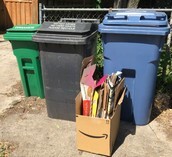
A lot of people have extra recycling this time of year. Here’s how to set out extra recycling on your recycling day:
- For boxes that do not fit in your recycling cart, you can place them next to your recycling cart in another box. Keep boxes set outside of the cart smaller than 3 feet by 3 feet and less than 40 pounds. This is for safety and proper sorting.
- Put any extra bottles and cans next to your recycling cart in cardboard boxes or paper bags. (If you use plastic bags, the entire bag will be disposed of as garbage.)
Remember there's no charge to get another recycling cart. If you regularly have more recycling than will fit in your cart(s), contact the Garbage, Recycling, and Cleanup office at 612-673-2917 to request another cart.
The minimum wage across the city of Minneapolis will adjust for inflation to $16.37 on January 1, 2026 for all businesses (regardless of business size). Coverage depends on the physical location (in Minneapolis) of the employee while the employee is performing work.
For information about any of the City's labor standards, visit the City’s website, call 311 or email the Labor Standards Enforcement Division. To report a violation, submit details on the City website or call 311.
On Dec. 9, a 20-year-old U.S. citizen was tackled, handcuffed and taken into federal custody while simply walking in his own neighborhood. Mubashir stood with Mayor Frey and Chief O’Hara to share his story, a story that makes clear just how deeply his constitutional rights were violated.
What happened to Mubashir is not policing. It’s targeting. If this can happen to a U.S. citizen in broad daylight, it endangers everyone, especially our immigrant and refugee communities, who are already carrying the weight of fear and uncertainty.
Our residents deserve better from the federal government. Minneapolis will not stand by while our neighbors are profiled or abused. We demand answers, accountability and immediate changes. Everyone deserves dignity, safety and their full rights under the Constitution.
Watch the video.
See the full news conference: U.S. citizen wrongfully detained in Minneapolis. Please note the video contains footage that viewers may find distressing.
Find the latest information about the City of Minneapolis’ response to federal actions.
Resources
It’s very important to know your rights, be prepared and contact an immigration attorney if needed. If you or someone you know is impacted, there are resources available, including free legal clinics with immigration attorneys:
Find more legal resources and know your rights information on the City website
Contact the Ward 9 Office
Email: jason.chavez@minneapolismn.gov
Phone: 612-673-2209
City Hall
350 S. Fifth St., Room 370
Minneapolis, MN 55415
For reasonable accommodations or alternative format please contact 311. People who are deaf or hard of hearing can use a relay service to call 311 at 612-673-3000. TTY users call 612-263-6850. Para ayuda, llame al 311. Rau kev pab, hu 311. Hadii aad caawimaad u baahantahay, wac 311. |