|
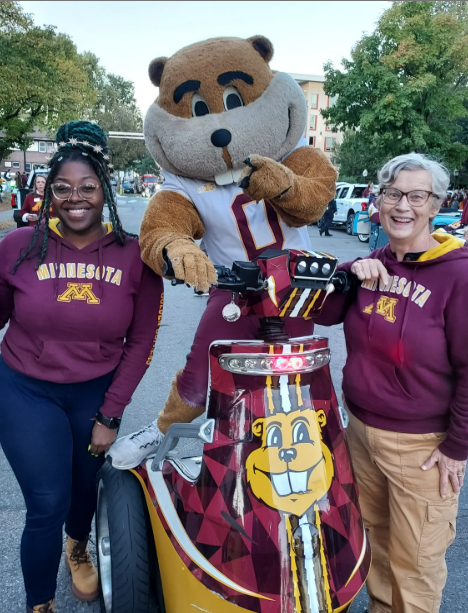
I had a fabulous time at the University of Minnesota Homecoming Parade. Falcon Heights City Council Member Paula Mielke and I participated as dignitaries, the elected officials currently representing students. Homecoming is such a unique and joyful moment for the University community, from current students to generations of alumni.
Council Member Wonsley and Falcon Heights Council Member Paula Mielke at University of Minnesota Homecoming.
In response to years of student concerns about sidewalk lighting and public safety, my office launched the Dinky After Dark initiative. Working hand in hand with the University of Minnesota administration, Undergraduate Student Government, and East Bank Neighborhoods Partnership, Dinky After Dark successfully secured a $500,000 investment from the City of Minneapolis at the end of 2024. Although Mayor Frey vetoed this budget, Council overrode the veto and the funding was preserved. This summer, LED pedestrian lights were installed in Dinkytown so that students coming to campus have more visibility and safety. The project responds to community concerns about nighttime safety and aims to improve visibility for residents and University of Minnesota students.
Dinky After Dark shows the power of community advocacy and Council action to reduce nighttime crime, improve visibility, and create more livable environments for residents and students in the area.
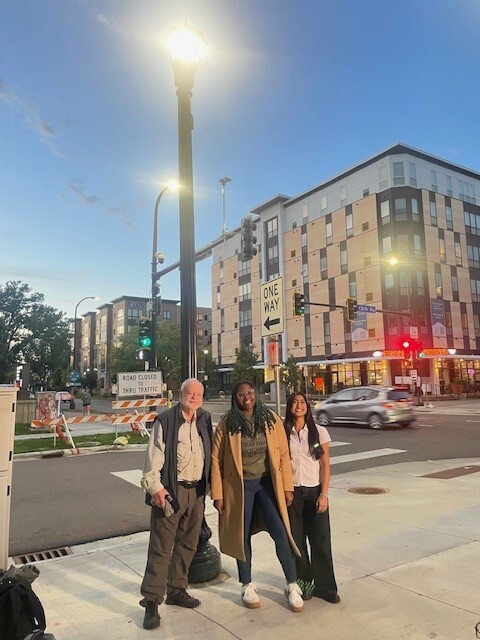
This week, key stakeholders celebrated the new lights in Dinkytown together. Thank you to everyone who made these lights possible!
Ted Tucker, President of the East Bank Neighborhoods Partnership, Council Member Robin Wonsley, and Siya Shelar, Local Government Liaison for the University of Minnesota Undergraduate Student Government under one of the new pedestrian lights in Dinkytown.
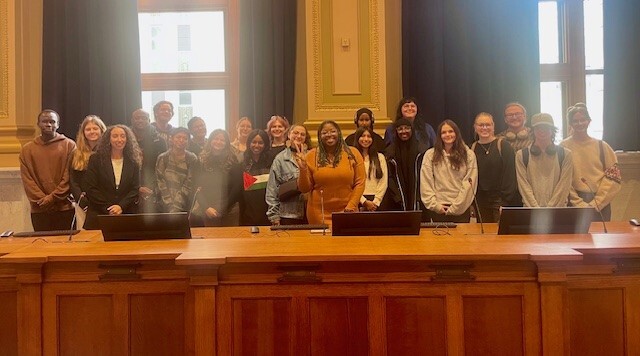
Ward 2 is home to Augsburg University, and I was thrilled to host a group of Augsburg students at City Hall for a tour and discussion. The students are in a class called "Better Cities: Urban Problem Solving," and I appreciated their interest in topics like the East Phillips Urban Farm, Minneapolis 2040 Plan, Transit Action Plan, and the checks and balances in our government structure.
Council Member Wonsley with students from Augsburg University Class "Better Cities: Urban Problem Solving."
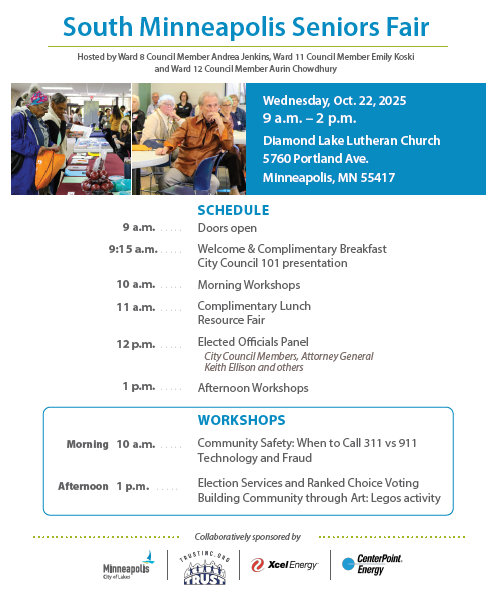
You’re invited to the South Minneapolis Seniors Fair co-hosted by City Council Members Andrea Jenkins, Emily Koski, and Aurin Chowdhury. The fair will include community meals, resources, workshops, and a panel by local elected officials including Attorney General Keith Ellison.
South Minneapolis Seniors Fair
Wednesday October 22nd, 2025
9am-2pm
Diamond Lake Lutheran Church- 5760 Portland Ave
Flyer for the South Minneapolis Seniors Fair
Voters, make your plan for the voting option that works best for you. You can vote early in person or by mail, or you can vote at your polling place on Election Day, Nov. 4.
Vote early in person
- The Early Vote Center, 980 E. Hennepin Ave., is open for early voting in person 8 a.m.-4:30 p.m. Monday-Friday. The Early Vote Center will have expanded hours starting Oct. 20.
- Five pop-ups will open for a day of voting each:
- 10 a.m.-5 p.m. Oct. 21 Weisman Art Museum
- 11 a.m.-6 p.m. Oct. 22 Minneapolis Public Service Building downtown
- 11 a.m.-6 p.m. Oct. 23 Urban League Twin Cities
- 11 a.m.-6 p.m. Oct. 24 Midtown Global Market
- 11 a.m.-6 p.m. Oct. 27 Webber Community Center
Vote early by mail
Voters can also mail or drop off their ballot. If you applied for a mail-in ballot, allow up to seven days for your ballot to arrive, and plan an equal number of days for returning your completed ballot. All mail ballots need to be received by Election Day, Nov. 4, to count. Important change: Mail ballots that are dropped off in person must be returned to the Elections & Voter Services office, not polling places, by 5 p.m. Nov. 4.
Find more details about voting on the City website.
Summary: After nearly a year of work, Council unanimously adopted a resolution supporting the Safe and Thriving Communities Report as a guide for the City’s comprehensive approach to community safety.
Background: The Safe and Thriving Communities Report and Plan is a detailed plan for the City of Minneapolis to build a public safety system that includes preventative, responsive, and restorative services. It includes a detailed 10-year guide for the legislative, budgetary, operational, and community engagement steps needed to make this vision a reality.
The Safe and Thriving Communities Report was developed by the New York University Policing Project under a $1 million contract with the City. The NYU Policing Project also conducted an Asset and Gap Analysis of the City’s current public safety system. The report identified that 47% of all 911 calls are good candidates for responses other than police.
While the Safe and Thriving Communities Report was widely celebrated by city leaders, it was never formally adopted. I believe that residents deserve not only verbal commitments that city leaders will implement the plan, but formal legislative action committing that we will move in that direction. Formal adoption also helps ensure alignment between the legislative and executive branch and helps prioritize resources. In light of this, I authored a resolution to formally establish the Safe and Thriving Communities Report as a guide to the City’s approach to a comprehensive public safety system. The resolution passed unanimously.
Key votes: Council unanimously supported my resolution to formally adopt the Safe and Thriving Communities Report as a guide for the City’s public safety system.
Summary: I brought MetroTransit leadership to present on their Safety and Security Action Plan.
Background: Our office invited MetroTransit leaders to present the work they've done to improve safety and security around the MetroTransit system. We were grateful to be joined by MetroTransit General Manager Lesley Kandaras and Interim Chief Dotseth.
Ward 2 is lucky to have fantastic MetroTransit infrastructure, including lightrail, Bus Rapid Transit, and regular bus service as well as service by MetroMobility. Ward 2 has some of the highest rates of transit ridership in the City, including many students and young people who may be using public transit regularly for the first time.
The City has a goal that by 2030, 3 out of every 5 trips will be made without a car. Public transit use will need to increase significantly to meet this goal– and a safe and secure public transit system for all riders is a crucial part of making this happen.
Safety on public transit is part of an effective coordinated citywide public safety system. MetroTransit leadership understands this as well and reported significant progress in advancing their Safety & Security Action Plan, which included the successful roll out of a Homeless Action Team, a pending Safety Ambassador program, and an improved system of community policing.
The City Council has committed and invested resources to collaborate with MetroTransit partners to maintain safety and uplift usage of our public transit system. I’m looking forward to continuing these efforts as we build a public transit system that works for all residents.
Key votes: No votes taken.
Summary: The Public Health and Safety Committee received a report on strategies and programs that have been effective at preventing youth and adolescent delinquency.
Background: Council President Payne and Council Member Chavez authored a directive requesting a report on Youth and Adolescent Diversion/Deflection, Intervention, and Delinquency Prevention Programs. The Public Health and Safety Committee received a presentation on this important topic this week.
I am a strong proponent of these types of programs. As the report highlights, diversion is a win for everyone: data confirms that it is one of the most effective ways to help at-risk youth avoid criminal activity or delinquency, it is more cost-effective than law enforcement and criminalization, and it leads to lower contact with law enforcement as adults. You can watch the full presentation and discussion to learn more.
I look forward to supporting the expansion of these programs in conjunction with my colleagues on Council as well as partners at Hennepin County, Minneapolis Public Schools, and more.
Key votes: No votes taken.
Summary: Council is taking legislative action to improve oversight of contracts administered by the Mayor without a public vote.
Background: Under City financial policies, the City Council must approve any contracts over $175,000. However, the Mayor’s administration may enter into contracts below this threshold without Council approval. This allowed department heads to approve contracts under $150,000 through their administrative process, with the rationale that this would cut bureaucratic tape and administrative work for both city staff and small vendors interested in contracting with the city.
However, this practice came into question last year after Council and the public learned about several problematic contracts that the Frey administration was planning to execute without Council approval, including a zero-dollar contract with the controversial organization OUR Rescue and vendors with questionable expertise with personal relationships with department heads. Additionally, the City Auditor has determined that the Frey administration’s inconsistent contracting procedures create unnecessary risk for the City.
In light of this, my office worked with the City Attorney’s office to strengthen financial oversight of the Mayor’s administration by requiring quarterly disclosure of all contracts that the City enters without Council approval. This is a commonsense positive step to improving transparency in our local government and supports Council’s oversight functions in a systemic proactive way.
The need for this ordinance as well as other needs to improve oversight over the administration was highlighted this week when the City Auditor presented on the Mayor’s proposal to significantly underfund the Office of the City Auditor. The Office of the City Auditor is a fully independent review body that does not answer to either the Mayor or the Council. The City Auditor highlighted that “the Mayor’s office resisted an investment in oversight in 2025… and I am concerned it is once again doing the same.”
In light of this, it’s more important than ever that the Council use our full legislative and budgetary authority to support checks and balances over the Mayor’s administration. I look forward to continuing these efforts.
Key votes: Administration and Enterprise Oversight Committee votes unanimously to approve the ordinance I authored strengthening oversight over the Mayor’s contracting.
Here are the updates from Public Works about recent streetlight repairs for the weeks of September 30 – October 14:
- New Theft
- Completed
- Minnehaha Parkway (but possible new theft in different section, will verify)
- Dinkytown Greenway
- Stinson Blvd
- In Progress
- Midtown Greenway prep. work related to stainless steel shroud and rivet design/fabrication/test fitting
- Next Steps
- Midtown Greenway and Hiawatha trails
- Continued coordination with Xcel for Bde Maka Ska (Xcel waiting on specific parts)
Click to edit this placeholder text.
Contact Ward 2
Visit: minneapolismn.gov/ward2
Email: ward2@minneapolismn.gov
Phone: 612-673-2202
City Hall
350 S. Fifth St., Room 370
Minneapolis, MN 55415
For reasonable accommodations or alternative format please contact 311. People who are deaf or hard of hearing can use a relay service to call 311 at 612-673-3000. TTY users call 612-263-6850. Para ayuda, llame al 311. Rau kev pab, hu 311. Hadii aad caawimaad u baahantahay, wac 311. |