|
Representative Ilhan Omar hosted a Town Hall to share updates and answer questions from residents. I greatly appreciate Representative Omar’s leadership and the many ways she has uplifted the needs and priorities of Minneapolis residents.
I have always seen Representative Omar as a northstar in legislating from a place of values and outcomes for the communities she represents. And while there are many ways that my work as a legislator on the local level is very different from what Representative Omar does in Congress, there are sometimes parallels. At the federal level, the legislative body has allocated funding for programs, but the chief executive is withholding those funds from actually being administered to serve the American people. Unfortunately, we are currently experiencing the same dynamic at the city level. City Council, which is the legislative body of the city, has allocated funding, but the Mayor, the chief executive, is not allowing those funds to be administered. This has meant that there are crucial services being withheld from Minneapolis residents, including 100 permanent supportive housing vouchers for chronically unsheltered individuals and families, and increased civilian investigators to close unsolved cases and help bring closure to victims of serious crimes.
It’s very unfortunate that we’re seeing this kind of unwillingness to faithfully implement programs that would materially help our city. Just like at the federal level, it will take community organizing and movement building to hold our local executive accountable.
Representative Omar and I are both big believers in grassroots power. At both the federal and the local level, it will take residents organizing the demand that the funding available to our community needs goes where it’s supposed to, and improves lives for our neighbors. Later on this newsletter, I share information about how to participate in the 2026 Budget Process. This is one great avenue to get involved in advocating for your priorities at the local level.
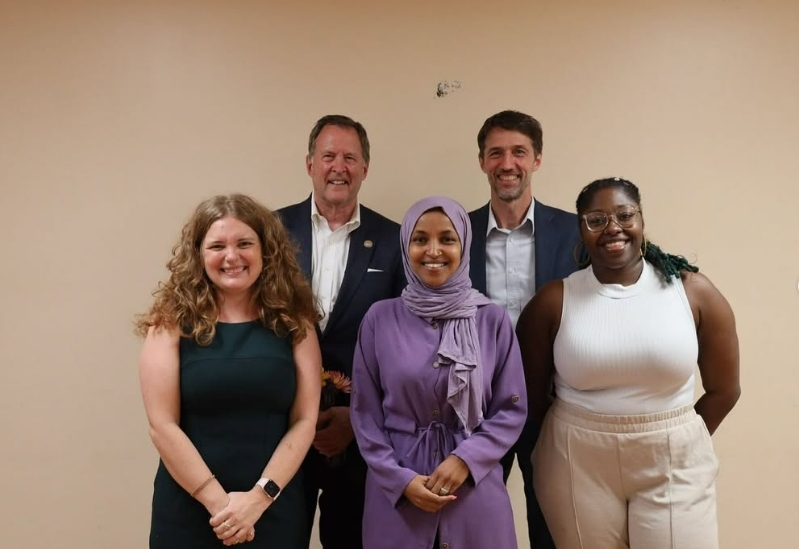
Elected officials at Representative Ilhan Omar’s Town Hall on October 1st, 2025. Back row: City Council Member Michael Rainville, State Senator Doron Clark. Front row: State Representative Sydney Jordan, Representative Ilhan Omar, Council Member Robin Wonsley. Photo Credit: Office of Representative Ilhan Omar.
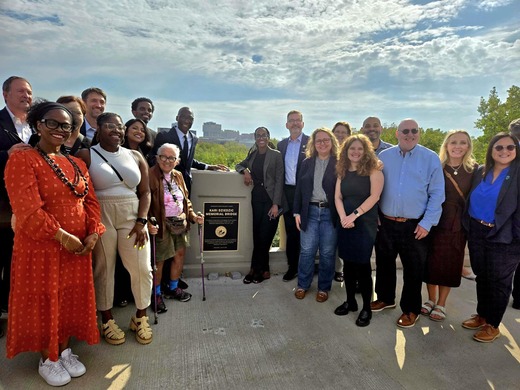
I was honored to join elected and community leaders to dedicate the 10th Avenue Bridge in honor of Senate Majority Leader Kari Dziedzic. We heard moving comments by several of Majority Leader Dziedzic’s colleagues and family members about her leadership, diligence, determination, and kindness. Her legacy and memory are a gift to our city, and the 10th Avenue Bridge can now uplift this legacy as the Minnesota Senate Majority Leader Kari Dziedzic Memorial Bridge.
Council Member Wonsley stands with city, county, and state elected leaders at the Senate Majority Leader Kari Dziedzic Memorial Bridge.
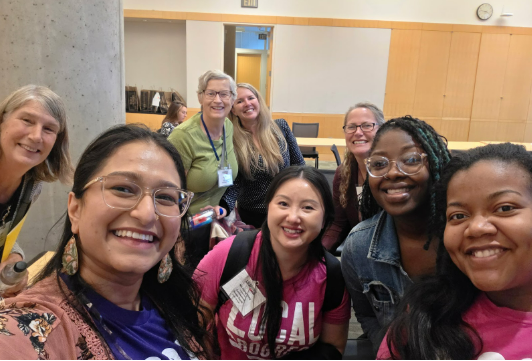
Local Progress is a nonpartisan nonprofit organization that brings together a movement of local elected officials advancing a racial and economic justice agenda through all levels of local government. I’ve been a proud member of Local Progress for several years, and I believe this collaboration is more important than ever given the current federal administration. I joined the Local Progress Minnesota State Strategy Meeting and enjoyed sharing a day with elected officials from cities, counties and school boards across Minnesota who share common values and vision for a Minnesota where everyone can thrive.
Council Member Wonsley standing with Local Progress members from across the state
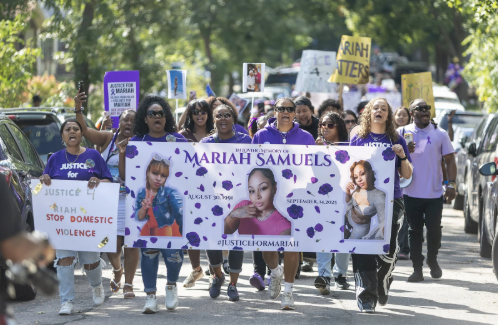
I want to take a moment to honor and acknowledge a tragic death in our community. A few weeks ago, a 34-year-old woman named Mariah Samuels was murdered by her ex-boyfriend despite having sought help from MPD multiple times and going to court to request a protective order. This weekend, her family and community rallied to march from her home to the 4th Precinct Police Station to demand answers and accountability.
It is deeply disturbing that a Black woman who requested help from MPD against a clear and specific threat did not receive the protection she needed. It follows a pattern that is similar to the recent experiences by Davis Moturi and Allison Lussier, both of whom requested protection from MPD multiple times, but did not receive it.
The Minnesota Department of Human Rights investigations found that MPD has a confirmed pattern or practice of discriminatory policing against Black and Native residents. MPD has also struggled to administer effective programming to prevent or respond to domestic violence, which disproportionately impacts women of color.
Mariah Samuels’ murder raises many concerns about MPD’s current operations and why she did not receive the protection she deserved. I remain committed to working with the community and my colleagues to follow the lead of Mariah Samuels’ family in honoring her memory.
Community members rally to honor Mariah Samuels and demand justice and accountability. Photo Credit: David Pierini, North News.
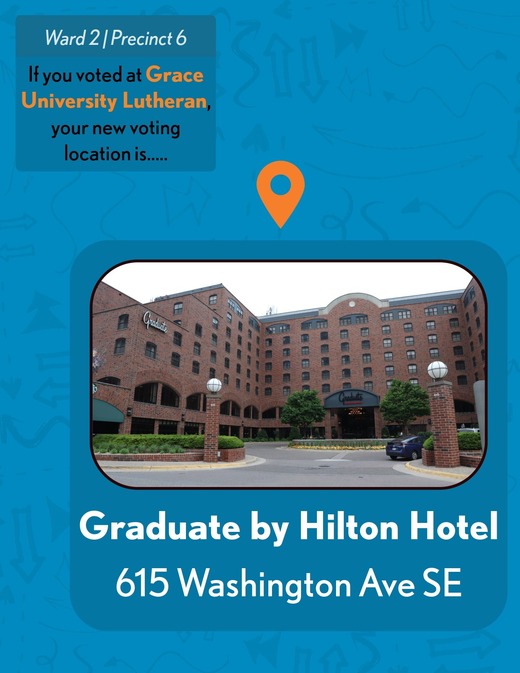
Get election ready! The 2025 Minneapolis Municipal Election is on Tuesday, November 4, 2025. There are polling place changes this year, including one temporary change in Ward 2, Precinct 6, as follows:
Former site: Grace University Lutheran Church, 324 Harvard St SE
New site (2025 + 2026 only!): Graduate by Hilton Hotel, 615 Washington Ave SE
There are renovations at the church that will prevent us from using the usual space for two years. All registered voters in the precinct will receive a reminder postcard from Hennepin County regarding this change.
You can always verify your polling place at pollfinder.sos.mn.gov
Ranked choice voting will be used in this election; voters ‘rank’ up to three candidates in order of preference. Make sure you are prepared! Resources like what’s on the ballot, voter assistance options, how to use ranked choice voting, and more can be found at vote.minneapolismn.gov
Important Dates:
- Early Voting: September 19-November 3
- Minneapolis Early Vote Center, 980 E Hennepin Avenue
- Early Registration Deadline: Tuesday, October 14
- Deadline to return your mail-in ballot: Election Day, Tuesday, November 4 at 5 p.m.
- Drop off is at 980 E Hennepin Avenue ONLY. Do not bring mail-in ballots to the Hennepin County Government Center.
- Election Day, Tuesday, November 4: 7 a.m. – 8 p.m.
Flyer for the new polling place for Ward 2 Precinct 6
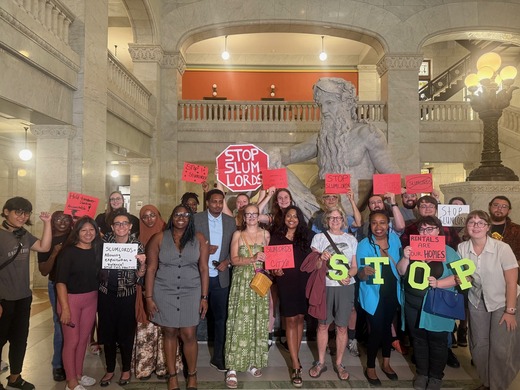
Summary: The Business Housing and Zoning Committee held a public hearing on the Slumlord Tier Oversight and Protection Ordinance (STOP Slumlords), where they heard powerful testimony from residents who have lived in substandard housing that the City’s current housing enforcement system had not corrected.
Background: Council Members Osman, Chowdhury, Cashman and I are authoring the Slumlord Tier Oversight and Protection ordinance, STOP Slumlords.
This week, my co-authors presented the ordinance to the Business Housing and Zoning Committee. Then the Committee heard testimony from dozens of residents sharing horror stories about living in unsafe and unhealthy rental units, calling the city for help, and not receiving any corrective measures from the City. I recommend that everyone watch the public hearing. It makes it clear that the status quo of housing enforcement is not working for our majority-renter city.
I believe that STOP Slumlords will significantly support better housing enforcement and renter protections throughout the city. Ward 2 has a significant portion of the city’s Tier 3 units and is a majority-renter ward. Ward 2 has the largest population of students in the state, and often these renters are first time tenants.
Since entering City Hall, my office fields constituent concerns from renters who are experiencing problems with substandard housing quality. They raise concerns to their landlords and to the city, but nothing improves. The Mayor’s administration has told renters and Council offices that the best tool in these situations is to call 311 to report the concern, but we’re not seeing those 311 calls translate into enforcement on the landlords or improved housing conditions for renters.
The city must have robust enforcement to protect tenants or else landlords know there will be no consequences for bad actions and the majority of people who live in Minneapolis and rent will suffer as a result.
My office has also recently learned that a 407-unit building in Ward 2 that primarily houses students has been operating without a license for five years. It's unclear how this occurred and I am awaiting to see what corrective measures the Mayor’s administration plans to take. This mistake is deeply troubling and reaffirms that there needs to be significantly more oversight over Regulatory Services’ handling of rental licensing generally. Slumlord Tier Oversight and Protection is absolutely a step in the right direction, and Council may need to do more in the upcoming term to build off of this if there are not significant operational changes within Regulatory Services soon. I look forward to the final vote on STOP Slumlords and many future conversations about how we can create a healthier ecosystem for renters in our city.
Key votes: The Business, Housing and Zoning Committee voted 5-1 to recommend the ordinance for approval. Council Member Vetaw was the only vote of opposition. The full Council will vote on STOP Slumlords on October 9th.
Elected officials and community partners kicking off the Slumlord Tier Oversight and Protection ordinance.
Summary: Mayor Frey vetoed an ordinance that Council passed at the request of community groups to help improve transparency in commercial property sales.
Background: On September 25th, the Minneapolis City Council passed the Commercial Advance Notice of Sale ordinance (CANS), an ordinance to support small business owners in Cultural Districts, many of whom are BIPOC, in owning their storefronts. The ordinance is a tool in fighting gentrification of our Cultural Districts and the university area, corridors where small businesses are vulnerable to displacement. Mayor Frey vetoed the ordinance.
Under the CANS ordinance, commercial property owners are required to give notice to the City and their tenants 60 days prior to the commercial property being made available for sale. This information would then be made publicly available, increasing transparency and giving interested local entrepreneurs a front row seat in purchasing their storefront.
It is deeply frustrating to have yet another valuable ordinance vetoed by Mayor Frey, who has issued more vetoes than the previous two mayors combined, with the majority of those vetoes targeting legislation that could reduce inequities in housing, business and labor, and in economically disenfranchised areas of the city.
“Small business owners need protections against outside displacement by property owners and developers,” said Council Member Jason Chavez. “Transparency in property sales in our communities is about racial justice, it’s about economic justice, and it’s about providing opportunity. The mayor stating in his veto letter that business owners in our Cultural Districts are having difficulty paying rent is exactly why this ordinance is needed, and it’s why his use of the veto pen to appease special interest groups yet again is counterproductive and a failure of leadership.”
“This ordinance was written in collaboration with community centered small businesses who had a very simple ask: when our building is up for sale, can you help us fight gentrification and have a seat at the table? It is nothing more and nothing less,” said Council Vice President Aisha Chughtai. “In explaining his veto, Mayor Frey talks about vacant storefronts, a misleading notion since this ordinance only applies to tenant occupied commercial buildings. This was a straightforward policy meant to bring transparency to the public and help bring equity to our cultural districts. I’m deeply saddened that the community members whose expertise informed this policy are being disregarded.”
“The university area is suffering because corporate chains buy and sell commercial property without any transparency, and small businesses and the community are completely shut out of the process. The same dynamic plays out in areas of the city that have been historically marginalized,” said Council Member Robin Wonsley. “The only people who win with the current status quo are big developers motivated by profit. Our ordinance helped change that status quo and Mayor Frey made it clear he values corporate dollars over our community.”
Key votes: On October 9th, Council will vote whether to override Mayor Frey’s veto of the Commercial Advance Notice of Sale. Nine votes are required to override the veto.
Summary: I brought forward a legislative directive to advance a request by Minneapolis resident Davis Moturi to release the outcomes of MPD’s investigation into their mishandling of his case.
Background: Starting in February 2024, South Minneapolis resident Davis Moturi began reaching out to the Minneapolis Police reporting concerning actions by his next door neighbor, John Sawchak. Mr. Sawchak, who is white, was making violent racist threats against Mr. Moturi, who is Black. Mr. Moturi contacted MPD dozens of times requesting protection, but did not receive it. In October 2024, Mr. Sawchak shot Mr. Moturi. The Hennepin County Attorney’s Office immediately issued a warrant for Attempted Murder, 1st Degree Assault, Stalking, and Harassment. MPD arrested Mr. Sawchak five days later.
The victim and his family, Council Members, the Hennepin County Attorney's Office, and residents have raised many concerns about what actions MPD and other city departments took between February and October, how and why communication about a clear and specific threat did not lead to preventative or protective action, communication and lack thereof between MPD and the Hennepin County Attorney's Office, the delay between the shooting and the arrest, the process of the arrest itself, compliance with the Minnesota Department of Human Rights Settlement Agreement, MPD's initial public statements after the shooting, and the role of racial bias in a Department that has a pattern or practice of discriminatory policing.
The City Council requested an after action review of the City’s actions in the case involving Mr. Moturi. The review is currently underway by the City Auditor and will be returned in early 2026.
Separately from the audit requested by the Council, MPD leadership has stated that they conducted an internal review of the case. They have not released the outcomes of that review.
On September 18th 2025, Davis Moturi emailed the City Council requesting the outcomes of MPD’s internal review. He has asked MPD for the information, but has not received it.
Mr. Moturi wrote: “If they [MPD] have made changes based on the results of their internal review, the public should know what changes they've made and what specifically from their handling of the case led them to make those changes. If they are not making any changes based on their review, the public should know why they won't begin that process if, by their own admission, there are ‘necessary changes’ that need to be implemented. I recently learned of the murder of Mariah Samuels, and noticed that both of our cases are eerily similar. A black person in fear for their lives, and a department who can't be bothered to forward a case for consideration of charges in our time of greatest need. The community and I deserve answers- and accountability.”
These words both resonated and troubled me deeply. Mr. Moturi has yet to get justice on the violence he experienced and while it will still be a bit more time until he receives full answers, I believe he should access this information now. With this context, I brought forward a legislative directive requesting the information from MPD. I am hopeful MPD’s internal assessment will be publicly accessible soon.
There is still so much work that has to be done outside of the settlement agreement to get MPD to a standard that Black residents in our community can look to as a credible body that can actually help them be safe.
Key votes: The Public Health and Safety Committee voted unanimously to approve the legislative directive requesting the results of MPD’s internal review of Davis Moturi’s case.
Summary: I organized a presentation by the Minnesota Research Justice Center and the Ramsey County Prosecutor to educate the Minneapolis City Council about their non-fatal shooting task force, which has shown remarkable success in bringing down gun violence in Saint Paul.
Background: Last year, while overall national homicides numbers declined, Minneapolis was a noted exception. This is deeply troubling considering the amount of funding that is devoted to public safety. This signals that the issue is not funding, but operational. Resources that are allocated to public safety should be utilized using national best practices and backed by data.
MPD continues to have issues with solving/clearing cases in many categories, which ultimately leaves victims without justice and those who are committing gun violence are still able to harm others in our community. The St. Paul Police Department (SPPD) formulated a non-fatal shooting taskforce in January of 2024. In 2023, before the unit was established, St. Paul Police reported a clearance rate of 38.3% on non-fatal shootings. By the end of 2024, it nearly doubled to 70%. The non-fatal shooting task force has been credited with helping St Paul significantly reduce violence crime this year. For comparison, MPD’s clearance rate was 26% for non-fatal shootings in 2024. That is a low number that signals we are not getting justice for victims.
I believe that Minneapolis has a lot to learn from St. Paul’s non-fatal shooting task force, so I invited the Minnesota Research Justice Center and the Ramsey County Prosecutor to educate the Minneapolis City Council about how we can replicate their success.
The presentation included extremely interesting data on the outcomes of the task force. In addition to a 70% clearance rate on non-fatal shootings, St. Paul is now experiencing a historic year of low homicides, with a 70% decrease from 2024. In Minneapolis on the other hand, 2024 was a violent year, and this summer included several mass shootings. The presentation underscored the need to make sure our City’s resources are being allocated to evidence-backed strategies that increase public safety.
I also appreciated the presenters sharing the need for leadership and political will to achieve success. All of the speakers highlighted and dispelled concerns of potential barriers that are often raised when trying something new and innovative. St. Paul and Ramsey county initially started this program without any extra funding, but reprioritized existing resources to support this critical work. Their return on investment has been so incredible that the presenters highlighted neighboring suburban cities that have decided to replicate their non-fatal shooting task form in hopes of replicating St. Paul’s success. There is no reason other than political will stopping us from replicating this successful violence prevention strategy in Minneapolis.
Data out of St. Paul indicates that increased investigative resources on non-fatal shootings can provide measurable success in enhancing public safety. It’s also worth noting that unlike Minneapolis, St. Paul does not invest in unproven methods related to gun violence prevention like ShotSpotter or the mounted patrol. Fiscal responsibility coupled with high standards of performance metrics ensure that services and programs are advancing the City’s public safety goals and such principles should guide council’s investments into our city’s public safety services.
Because of the impressive success of non-fatal shooting task forces in St. Paul as well as in Denver, Colorado. I included a non-fatal shooting task-force as one of the City Council 2026 budget priorities, which we approved in June to send to the Mayor. I strongly believe MPD should incorporate strategies such as a non-fatal shooting taskforce in their work. This week’s presentation was incredibly informative and I anticipate it will help inform the City Council’s upcoming budget conversations, especially those related to public safety needs.
I look forward to continued partnerships with elected officials and community leaders in St. Paul, state legislators, and the Minnesota Justice Research Center to help strengthen MPD’s non-fatal shooting investigations and case closure, to improve public safety outcomes for Minneapolis residents.
I recommend everyone interested in public safety and violence prevention watch the presentation.
Key votes: No votes taken.
Summary: My office is working to save Stable Homes Stable Schools and Emergency Housing Vouchers, the city’s two strongest data-backed programs to prevent and reduce homelessness.
Background: In August, Mayor Frey released his proposed 2026 Budget, which included cutting the Emergency Housing Vouchers that Council funded as an ongoing allocation. Emergency Housing Vouchers (EHV) would provide permanent housing and wraparound social services to 50 families and 50 individuals experiencing chronic unsheltered homelessness, through a City partnership with Hennepin County and the Minneapolis Public Housing Authority (MPHA). EHV is based off of a successful partnership during the height of the Covid pandemic that had incredibly successful outcomes at long-term housing stability.
Understandably, community members as well as several council members were extremely alarmed to learn that the Mayor had not implemented the 2025 funding for EHV and was proposing cutting the funding going forward. At a time when unsheltered homelessness is a priority concern for many residents, we need to be using every tool at our disposal to humanely and effectively end homelessness.
The Mayor has stated that his reasoning for defunding EHV is to preserve Stable Homes Stable Schools (SHSS), a homelessness prevention program that ensures that public school families have stable housing. SHSS is a fantastic program, yet, the Frey administration has failed to provide the sustainable funding that it requires.
There is no reason that EHV should have to be cut in order to fund SHSS– our city needs both programs to be fully funded. Yesterday, my office met with Community Planning and Economic Development staff to receive a briefing to better understand why the Mayor’s administration was pitting EHV and SHSS against each other. I had several questions regarding the choice to defund EHV, especially as the city continues to waste fiscal and staff resources on strategies that have been proven to be ineffective in actually reducing homelessness. City staff shared that while they were in agreement that there was a need for EHV, they are trying to respond to the fiscal cliff that SHSS is approaching in 2026. Staff shared they were aware there were financial concerns around the sustainability of the program, but were unaware of the magnitude until a few months ago. The Mayor’s staff shared that their current budget will result in the following projected budget shortfalls for Stable Homes Stable Schools: $3.2 in 2026, $4.3M in 2027, and $4.9M in 2028.
These numbers are incredibly concerning and I am frustrated that staff acknowledged they were aware of the financial instability of this program when significant changes were made in 2023, such as expanding the program with one-time dollars. I am also concerned that while new enrollment into SHSS was paused this past July in response to the upcoming fiscal challenges, the Mayor’s only strategy to stabilize and sustain this program for the long-term is to eliminate critical and data-backed homelessness programs like EHV.
The City Council will need to use our budget mark-up process to ensure that the 240 families in the current SHSS program do not experience housing instability in 2026 and beyond. Additionally, Council will need to ensure that EHV is fully funded in order to humanely and effectively decrease unsheltered homelessness in our city. At minimum, 150 unsheltered residents will continue to stay outside unless Council reinstates the funding that the Mayor is proposing cutting. This would occur while the City continues to spend hundreds of thousands of dollars annually on evictions, which do not reduce homelessness.
The City’s partners in the EHV program, Hennepin County and the Minneapolis Public Housing Authority, have already put significant resources into trying to implement the program this year. The consequences of either EHV or SHSS being cut or reduced will have negative impacts for both those receiving those services and our governmental partners who utilize a Housing First approach in responding to unsheltered homelessness.
I will be continuing conversations with my colleagues, government partners, and the administration to bring forward proposals to fully fund both programs during the Council's mark-up session in December. I will provide updates on this work as additional information comes up between now and council’s budget deliberations in December.
Key votes: No votes taken.
The 2026 City Budget process is underway. I strongly encourage all residents to participate so that your priorities can help shape the budget. You can share your thoughts and feedback by testifying in person or submitting written testimony:
In person budget hearings with public testimony:
- Monday October 6th at 1:30pm
- Wednesday November 19th at 6pm
- Tuesday December 9th at 6pm
- Public hearings are at the City Council Temporary Chambers located in the Public Service Building: 250 South 4th Street, Room 350.
- Any resident can testify for two minutes about their priorities for the City’s 2026 Budget.
Submit written testimony:
- Testimony can be submitted in writing at any time using this form.
- Submissions can include personal/individual comments, or official organizational statements.
- For “Subject or File Number,” write 2026 Budget.
Contact Ward 2
Visit: minneapolismn.gov/ward2
Email: ward2@minneapolismn.gov
Phone: 612-673-2202
City Hall
350 S. Fifth St., Room 370
Minneapolis, MN 55415
For reasonable accommodations or alternative format please contact 311. People who are deaf or hard of hearing can use a relay service to call 311 at 612-673-3000. TTY users call 612-263-6850. Para ayuda, llame al 311. Rau kev pab, hu 311. Hadii aad caawimaad u baahantahay, wac 311. |