|
Residents have raised deep concerns about some of the University of Minnesota Board of Regents’ proposals for finance and operations in 2026. I submitted public input to the Board of Regents for inclusion in their docket. I urged the Regents to:
- Reconsider the large tuition hikes on working class students and navigate budget challenges with an emphasis on equity.
- End financial engagements related to weapons manufacturing and the defense industry.
- Cut the contract that enables Immigration and Customs Enforcement (ICE) use of the University gun range
- Support University workers.
You can read the full letter here. The Board of Regents will vote on the President’s Proposed 2026 Budget on June 18th.
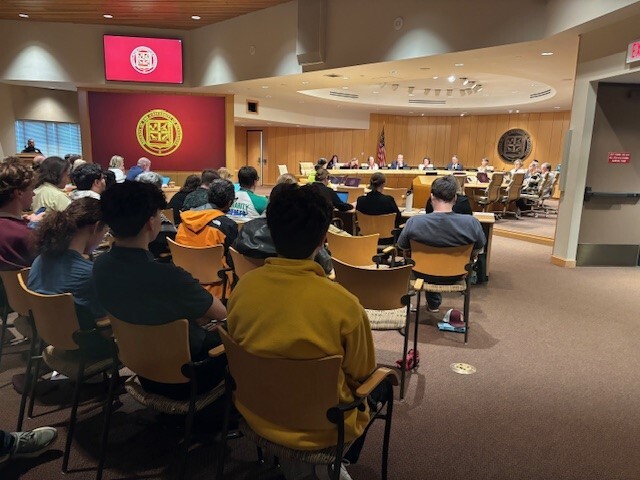
Council Member Wonsley at the Board of Regents meeting discussing the 2026 Proposed Operating Budget.
I attended a meeting of the Minneapolis Advisory Committee on People with Disabilities (MACOPOD) to introduce myself to committee members, learn about their priorities, and discuss opportunities to collaborate. The Neighborhood and Community Relations Department, which holds a significant portion of the City’s work with people with disabilities, reports to the Administrative and Enterprise Oversight Committee, which I chair. The committee will be receiving a presentation from the department next month which will help inform the committee on gaps and needs the council should be focusing on. Thank you to MACOPOD for your efforts to ensure that Minneapolis is an accessible and welcome place for people of all abilities to thrive.
Summary: The Minneapolis Tourism Improvement District was signed into law at a signing ceremony celebrating the historic step for tourism and hospitality growth.
Background: Last week, the Council approved the creation of the Minneapolis Tourism Improvement District (MTID). This week, the ordinance was signed into law at a ceremonial signing with the Mayor, Council authors, Meet Minneapolis, and Minneapolis hospitality community leaders.
This bold initiative is expected to generate an estimated $7 million annually through a 2% assessment on lodging properties, providing sustainable funding for tourism promotion. The MTID will fund high-impact initiatives designed to attract more overnight visitors and elevate Minneapolis’ competitiveness among peer cities. Priorities include integrated marketing and PR campaigns, sales efforts to drive group and meeting bookings, destination branding, and the development of signature visitor experiences. The district will also support sustainability programs and workforce development, helping to cultivate a vibrant, well-equipped hospitality sector.
The MTID is the result of a strong collaboration between local hotels, Meet Minneapolis, and city leadership, demonstrating what is possible when stakeholders align around a shared vision for sustainable tourism.
Council Member Wonsley along with co-authors Council Members Cashman and Rainville, Mayor Frey, and leadership from Meet Minneapolis and the hospitality industry at the signing ceremony for the Minneapolis Tourism Improvement District.
Summary: The Office of Community Safety gave their regular quarterly presentation on the five public safety departments, as well as the new public safety program pilots they are developing.
Background: The Office of Community Safety (OCS) includes five departments that provide public safety services: Police, Fire, 911, Neighborhood Safety, and Emergency Management. The Office also manages the development and implementation of new public safety programs to fill gaps in our current prevention, response, and restorative services. This week, OCS provided an update presentation on their work over the second quarter of 2025.
Substantive progress is being made on developing new public safety programs using the blueprint outlined in the Safe and Thriving Communities Report and the analysis by the NYU Policing Project. These data-backed plans conclude that the City has already diverted about 9% of our 911 calls away from police response to a more appropriate response for the situation, and that 47% of the remaining 911 calls are good candidates for non-police response too. Despite some delays by the Mayor’s administration, it is very encouraging to now see these plans being taken seriously and implemented effectively. Thanks to support from the Council, the Office of Community Safety and Performance Management and Innovation are now working together to develop pilot programs for Transit Safety, Traffic Control Response to Non-Injury Vehicle Collisions and Juvenile Deflection.
Also thanks to Council’s persistent efforts, Community Safety Ambassadors are now on the ground on East Lake Street and East Franklin Ave. When the Mayor proposed cutting these programs last year to fund police raises, I and my colleagues made it clear that we did not support eliminating these initiatives and found alternative funding sources. Months later, we can see the fruits of those decisions. This reaffirms my commitment to using Council’s budgetary and oversight authority to protect and expand our diverse and data-backed public safety programming.
Another notable item presented in the quarterly update was MPD’s data on response times, which shows that the 3rd Precinct response times are in line with the response times for the 2nd and 5th Precincts as well as for the City as a whole. There has been an inaccurate narrative that the lack of a physical 3rd Precinct building within the precinct boundaries has caused delayed response times. The data MPD presented this week disproved this narrative. In fact, MPD reports that response times in the 4th Precinct are significantly longer than the city average, despite having a 4th Precinct building within the boundaries of the area. This is important to note as the city continues to build out a new comprehensive safety system and prioritize investments in the upcoming years.
Key votes: No votes taken.
Summary: The City Council has nominated appointees for the Safe and Thriving Communities Work Group, the community advisory body to help support the creation of a comprehensive public safety system beyond policing.
Background: The Safe and Thriving Communities Report and Plan is the City’s 10-year plan to create a public safety system that reduces our reliance on police using data-backed strategies to prevent violence, respond to crime more effectively, and support healing and restoration.
One of the steps in the Safe and Thriving Communities Report and Plan is the creation of a community advisory body to support the creation of our new public safety system. The idea for a community advisory body related to public safety was also brought to me by Ward 2 residents during a community meeting about the South Minneapolis Community Safety Center. The Community Safety Center is a multi-million dollar investment that is intended to shift Minneapolis away from the status quo of a police-only system, and towards the vision outlined in the Safe and Thriving Communities Plan. Ward 2 residents proposed creating a consistent venue for oversight and involvement in the implementation of this new model of a public safety building.
Based on both the recommendation of the Safe and Thriving Communities Report and the input of Ward 2 residents, I led the Council to establish the Safe and Thriving Communities Work Group earlier this year. I believe that resident input is crucial to keeping the City on track with its stated goals of building out a comprehensive public safety system.
The Safe and Thriving Communities Work Group will advise the Mayor and Council on the creation of the new Community Safety Center model, as well as the implementation of the comprehensive community safety system as a whole.
This week, the Public Health and Safety Committee approved the slate of appointments for Work Group members. The full Council will vote on the nominations next week.
Thank you to everyone who applied to serve on the STC Work Group. I look forward to seeing the outcomes from this body.
Key votes: The Public Health and Safety Committee votes unanimously in support of the nominations for the Safe and Thriving Communities Work Group. The full Council will vote on June 18th at 9:30am.
Summary: Staff delivered a presentation
Background: Staff delivered a presentation on their implementation of the three sidewalk snow and ice plowing program pilots this past winter. They reported clearing over 17 miles of sidewalk serving over 900 addresses. This is a strong first year to help the City refine our sidewalk plowing technology, systems, and services as we move towards City-led sidewalk plowing.
Safe and accessible sidewalks for all residents, all year round is an essential part of being a welcoming, equitable city!
This year’s pilot did not utilize the full budget available for programming. While any snow-related program needs to spend resources intentionally to prepare for a surprise late-winter snow event, this year’s data raises questions as to how much would have been accomplished with a snowier season and full implementation of the budget. I look forward to working with my colleagues and community members on the continued advancement of City-led sidewalk plowing.
Key votes: No votes taken.
Summary: The Mayor asked the City Council to approve two new collective bargaining units for MPD leadership. There are many unresolved questions about how these new bargaining units relate to the consent decree and the City’s stated goals around police staffing and operations.
Background: The City’s Labor Relations team asked the City Council to approve two initial collective bargaining agreements (CBAs) for groups of workers in MPD who have previously not been represented by unions: Inspectors and Commanders and Assistant and Deputy Chiefs.
I have questions about how the employees represented in the new proposed units relate to MPD’s supervisory structure and the consent decree. Specifically, I want to ensure this contract does not limit the city from implementing the consent decree and also does not erode the city’s managerial authority as it relates to reassigning or removing officers from their position. Prior to the murder of George Floyd, the city leadership often experienced several public outcries in response to leadership at precincts, resulting in swift reassignments.
I will continue to discuss the issue with my colleagues, community members, and experts in police labor agreements.
Key votes: The Administration and Enterprise Oversight Committee voted to approve the CBAs. The Council will take up the items on June 18th at 9:30am.
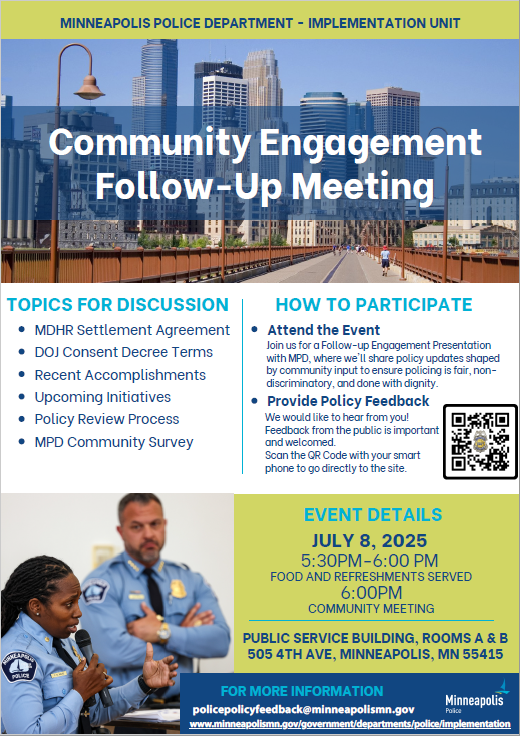
The Minneapolis Police Department Implementation Unit warmly invites community residents, local businesses, City of Minneapolis staff, and partner organizations to a Follow-up Community Engagement Presentation.
Date: Tuesday, July 8
Time: 5:30 p.m.
Location: Public Service Building
Address: 505 S. 4th Ave., Minneapolis, MN 55415
This presentation will provide important updates on MPD policy changes that have been shaped by continued community engagement. The goal is to keep stakeholders informed and ensure that MPD’s policies are aligned with the priorities outlined in the Settlement Agreement.
Topics will include updates on:
- Use of Force
- Stop, Search, and Arrest
- Discriminatory and Impartial Policing
- MPD Mission, Goals, Vision, and Values
We look forward to your participation as we continue working together to build a safer, more accountable Minneapolis.
Flyer for the MPD Implementation Unit Follow-Up Community Engagement Event.
An assessor from the City of Minneapolis Assessor’s Office will be visiting every home in the Como neighborhood to verify property characteristics. This is part of an ongoing process to assess all of the homes in Minneapolis. (Minnesota Statute 273.01)
Assessors wear neon vests and carry city identification and their field device. They will move through the neighborhood as a team. They do not drive city vehicles.
If you would like to schedule an appointment for an interior review with the assigned assessor, please call or email Billie Kurek, Assessor at (612) 673-2471 or billie.kurek@minneapolismn.gov.
For more information about this process go the assessor webpage at www.minneapolismn.gov
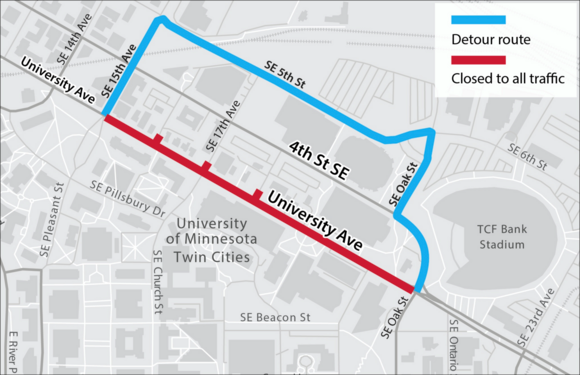
Hennepin County will close University Avenue between 15th Avenue and Oak Street beginning Monday, June 16. The closure is scheduled to last two weeks.
If you drive on University Avenue, plan an alternative route or follow the posted detour shown below using 15th Avenue, 5th Street, and Oak Street. Expect delays and allow extra time.
For information about how to travel on the University of Minnesota campus during this closure, including details on walking, biking, parking, and campus transit, visit the University of Minnesota Parking and Transportation Services project page.
On Friday, June 27, University Avenue is scheduled to reopen. It will be restricted to a single lane from I-35W to Oak Street through August.
If you have questions, please contact the project team at transportation@hennepin.us
All dates are tentative and weather dependent.
Map of road closures.
Over the weekend, I-94 entrance and exit ramps between I-35W and Huron Blvd. will be closed. Both directions of I-94 will close in the same area. Crews are doing a traffic shift from the eastbound lanes to the westbound lanes this weekend, so they’ll be able to continue their bridge repair work along eastbound I-94.
To avoid the closure, follow the posted detour of I-35W to Hwy 36 to I-35E to I-94.
By 5 a.m. on Monday, June 16, I-94 will reopen and be reduced to two lanes in each direction on the west side of the interstate through mid-August. Six ramps will remain closed through mid-August.
Plan ahead by checking 511, give yourself additional time to reach your destination, and remember to drive with care in work zones.
Find details on the Minnesota Department of Transportation website.
Contact Ward 2
Visit: minneapolismn.gov/ward2
Email: ward2@minneapolismn.gov
Phone: 612-673-2202
We've moved while work is being done in City Hall. Our office is in:
Room 100, Public Service Center
250 South 4th St.
Get directions
For reasonable accommodations or alternative format please contact 311. People who are deaf or hard of hearing can use a relay service to call 311 at 612-673-3000. TTY users call 612-263-6850. Para ayuda, llame al 311. Rau kev pab, hu 311. Hadii aad caawimaad u baahantahay, wac 311. |