|
Summary: After a public hearing, the Business Housing and Zoning Committee voted in support of my ordinance to ban AI software that landlords use to manipulate rent and vacancy levels, hurting Minneapolis renters.
Background: I am authoring an ordinance along with Council Members Ellison and Chavez that would ban the use of rental algorithms that use non-public data to advise landlords on rent or vacancy rates. Algorithmic pricing became a headline last year when the US Department of Justice sued a company called RealPage for what they call an “algorithmic pricing scheme that harms millions of American renters.” You can read more about rent algorithms and our proposed ban in last week’s Ward 2 update.
Nationally, renters spent an extra $3.8 billion last year because of overall pricing algorithms — or an average of about $70 per month. RealPage’s own clients report a 15 percentage point increase in tenant turnover, meaning more renters are being priced out. Banning algorithmic pricing is a way for our city to ensure that this harmful AI technology is not a barrier to our citywide goal of an equitable and affordable housing market.
This week, the Business Housing and Zoning Committee heard public testimony on the ordinance. I want to personally thank the several residents in Ward 2 who sent public comments as well as testified in support, including a representative of the University of Minnesota Undergraduate Student Government. While rent-setting algorithms hurt many renters, students are uniquely impacted as newer renters who have limited geographic options and are often subject to predatory and exploitative practices.
Key votes: The Business Housing and Zoning Committee forwarded the ordinance with recommendation and the full Council vote will take place on Thursday, March 27th, at 9:30am.
Summary: Staff have completed a report on strategies to identify and track vacant properties as part of my ongoing efforts to reduce the number of vacant commercial properties in the city, and have more tools for dealing with residential vacancy.
Background: Addressing commercial and residential vacancy has been one of my priorities. Residents first reached out to my office with concerns about vacant storefronts properties in key commercial corridors. At worst, these vacant properties were attracting public safety and livability concerns issues, at best they were still lost opportunities for economic development and vibrant local corridors. Residents also reached out to Council to share their frustration at the homes and apartments in their neighborhoods that they have seen sit empty year after year.
It became clear to me that filling vacant properties is a priority for many residents, and could be a concrete way to improve our neighborhoods.
Currently, the City’s only tools to handle vacant properties is to rehabilitate them or demolish them, leaving residents who experience the impacts of an absentee landlord with little recourse. Both of these tools are very expensive and have limited usefulness, so the City does not frequently use them. I have been working with community members, interjurisdictional partners, and my colleagues to give the City more tools to address vacancy.
Last year, Council approved a policy I authored that tripled fines on chronically vacant and hazardous properties. I am looking forward to receiving the data about how the administration has implemented this new policy and the impacts on our communities.
Now, I am working with Council Member Ellison on giving the City more tools to address properties that are vacant for prolonged periods of time and are not in bad condition. Adding tools like fees and citations for prolonged vacancy would mean the City could do more to support landlords with resources and recommendations on how to activate the property by finding a tenant, connecting them with local community development organizations, or maybe other technical assistance that addresses the barriers of filling these spaces. Last year, Council Member Ellison and I passed a legislative directive that resulted in a staff presentation about how vacancy fees could be implemented on properties that are vacant for more than six months. To continue exploring enforcement, we passed a staff direction on strategies for identifying and tracking vacancies. This week, we received the report from staff.
I look forward to continued collaboration with city staff and community members, with the intention to take legislative action later this year so that we can start filling vacancies and ensuring vibrant and healthy neighborhoods for everyone.
Key votes: The Business, Housing and Zoning Committee voted to receive and file the report.
Summary: The Public Health and Safety Committee received a quarterly update from the Office of Community Safety, and the five departments within in (Police, Fire, Neighborhood Safety, 911, and Emergency Management)
Background: The Office of Community Safety (OCS) gave a presentation to the Public Health and Safety Committee (PHS) to share updates. You can watch the presentation and discussion and review the slides. Highlights included:
- The Neighborhood Safety Department is hiring a new director, estimated to start in the next few months. I was disappointed that there has not been community engagement on the priorities for this role since this department relies significantly on community organizations and relationships outside of the City to be successful in its work.
- The Office of Community Safety is beginning the process of establishing the Safe and Thriving Communities Work Group, a community advisory body that the Council created last month authored by myself, Council Member Chavez, and Council Member Chowdhury.
- The Office of Community Safety is meeting weekly with the NYU Policing Project to support implementation of the gaps identified in the Minneapolis Community Safety Ecosystem Assets and Gaps Analysis.
- MPD reported that in the first quarter of 2025, there has been a 47% reduction in robberies, 40% reduction in carjackings, 32% reduction in gunshot wound victims, 24% reduction in auto thefts, and 11% reduction in aggravated assaults. They are achieving these reductions at their current staffing levels using more efficient, proactive and precision techniques. They also credit the reduction in the diversification of response to other services like 311, social workers, and BCR response. This was very affirming to hear and reinforces the need to prioritize the programs and services identified as gaps in the NYU Policing Project. The project identified that 47% of current 911 calls could be diverted to alternative responses, further lessening the reliance on police for non-police matters and allowing them to focus on critical issues like the 5,000 case backlog that need to be investigated.
- MPD did not have data available on their timeline to hire the five additional Civilian Investigators that I led Council to allocate last year, or the impacts of these additional positions on the backlog of thousands of cases that have not been solved or closed.
- MPD has benefitted from the staffing flexibility provided by the temporary suspension of the 70/30 policy in the last police contract. This provision expires at the end of 2025.
- Emergency Management is assessing and planning for H5N1 (bird flu), smoke and air quality issues, and the possible increased needs and vulnerabilities in emergency resourcing due to federal cuts.
- The Fire Department is working on integrating BCR into their department.
- The Neighborhood Safety Department is hiring several positions as they rebuild their department’s basic structure and operations.
Key votes: No votes taken.
Summary: Council received the first quarterly report on the data and outcomes of the City’s encampment closures.
Background: Last year, Council approved an ordinance authored by Council Members Chowdhury, Chavez, and Vice President Chughtai that requires the administration to report on key data about their closures of encampments of unhoused residents, such as what triggered the closure, the cost of resources and staff time used in the closure, how many residents were offered services and how many were successfully connected to temporary or permanent housing.
This ordinance has already proven to be incredibly valuable. This week, the Frey administration published their first required quarterly report. There is a memo, a slideshow, and various supporting documents that are now public on the citywebsite and will be archived on the public Legislative Information Management System. It revealed that the City spent at minimum $330,000 on closing encampments, the vast majority of which was MPD staff time. Of the 227 unsheltered people who were evicted in closures, City staff offered 75% of these residents connections to a shelter. It’s important to note that staff could not confirm there was in fact bed availability when these offers were made. Of these 227 residents, only 9 were connected to a shelter due to City intervention. I found these numbers troubling and hope that next quarterly presentation will have better context to this data, such as the actual availability of shelter space when evictions occur. The Council Members on the Business, Housing and Zoning Committee discussed what these numbers reveal about the inefficacy of the Frey administration’s current approach.
Key votes: No votes taken.
Summary: The Frey administration withdrew a proposal to contract with Reverend McAfee’s organization Salem, Inc. At the request of the administration, the Administration and Enterprise Oversight Committee (AEO) voted to refer all the contracts back to staff, who have expressed an intention to bring the rest of the contracts forward at the Committee of the Whole on March 25th.
Background: As I shared in a newsletter earlier this week, the Frey administration has withdrawn a proposal to contract with Salem, Inc after significant public outcry about the organization’s leader, Reverend Jerry McAfee, who has a public history of homophobic comments and recently made violent threats against Council Members. Additionally, two violence interrupters who have worked for Reverend McAfee were charged with multiple felonies in a shootout after a community barbecue last week.
At this week’s Administration and Enterprise Oversight Committee meeting, the Frey administration requested that the entire package of proposed contracts be returned to staff so that they could remove the contract for Salem, Inc. The committee voted unanimously to do so.
The committee also had a discussion about the proposed contract with Cure Violence Global. Cure Violence is a national organization that has been selected to provide technical assistance to the Neighborhood Safety Department (NSD) for administering violence interruption contracts and services. I and several other Council Members have persistently advocated for NSD to ensure all administration of programs and services were meeting national best practices and standards. This contract with this technical assistance provider will support the administration of these complex programs, especially since NSD has many vacancies, and many of the staff are newer to the department and lack subject matter expertise in violence interruption programs.
After a presentation and discussion, the AEO Committee voted to forward the Cure Violence Global contract to the full Council.
Key votes: The Administration and Enterprise Oversight Committee voted 4-2 to forward the MinneapolUS violence interruption contracts back to the Frey administration. Council Members Vetaw and Palmisano voted in opposition. The package of contracts without Salem, Inc will come to the Committee of the Whole on March 25th. The AEO Committee voted unanimously to recommend the contract with Cure Violence Global, which will go to the full Council for final approval on March 27th.
Summary: I, Council Vice President Chughtai, and Council Member Chavez nominated the Sanctuary Supply Depot for the City’s Public Health Heroes Award in recognition of their crucially important health equity work supporting unhoused residents.
Background: Every year, the City of Minneapolis recognizes individuals and organizations with the Public Health Heroes Award. Public Health Heroes awards honor community members making our city a healthier place to live, learn, work, and play.
Council Members were offered the opportunity to nominate Public Health Heroes in our communities, and I nominated the Sanctuary Supply Depot, along with my colleagues Council Member Chavez and Council Vice President Chughtai. Sanctuary Supply Depot is a Minneapolis-based mutual aid collective facilitating the collection and distribution of basic survival supplies for our unhoused neighbors. Volunteer teams do regular distribution at encampments several times per week, building ongoing relationships of trust with the residents there. Sanctuary Supply Depot believes unhoused neighbors know best what they need, and do their best to listen and provide it, whether that’s tents, tarps, fresh water, portable phone chargers, etc.
The work of Sanctuary Supply Depot compliments the work of the Minneapolis Health Department by filling gaps in the City's current approach. While the Health Department has a positive role in public health resources at encampments, Sanctuary Supply Depot provides day-to-day materials that prevent disease and illness, improve health outcomes, reduce harm, prevent exposure deaths and frostbite, and generally support holistic public health and wellness for unsheltered residents.
Public Health Heroes are organizations that build on our urban community’s cultural diversity, wisdom, strengths, and resilience; center the community’s voice; and connect people and resources. The Sanctuary Supply Depot uses a mutual aid model based on the idea that unsheltered residents know what they need, and the community can come together to collectively meet these needs from a place of solidarity.
While I hope that Sanctuary Supply Depot is selected to receive this award, I’m sure that many fantastic organizations and individuals will be nominated and I look forward to celebrating the winners at the public community event on April 9th.
Key votes: Public Health Heroes will be awarded on April 9th, 2025 from 11am-1pm at the Public Service Building (505 S 4th St) Room 100. All residents are invited to attend.
Summary: Property owners will be receiving notices in the mail that include their property classification, estimated market value, and taxable market value.
Background: The City Assessors Department has mailed the 2025 Notices of Valuation and Classification (“value notices”).
The value notices inform property owners of their January 2, 2025, property classification, estimated market value, and taxable market value. If property owners have questions about their property value they should contact the City of Minneapolis appraiser (listed on page 2 of the notice) that is responsible for their property. The appraiser is their first point of contact to resolve any valuation issues. If, after working with our staff, the property owner does not agree with the outcome, they can file an appeal with the Local Board of Appeal and Equalization (LBAE). The City Assessor’s team will guide property owners through the process. I
In addition to the value notices being mailed, the payable 2025 tax statements were also mailed by Hennepin County. These are different than the value notices. The tax statement informs property owners of the property tax that is due in 2025. This tax is based on their 2024 market value.
If property owners have questions about their homestead classification, they need to contact Hennepin County at 612-348-3046 or email ao.homestead@hennepin.us.
City staff will provide a 2025 Assessment Report to the Budget Committee on March 24. It will be an informative overview and update on the 2025 assessed market values.
Key votes: No votes taken.
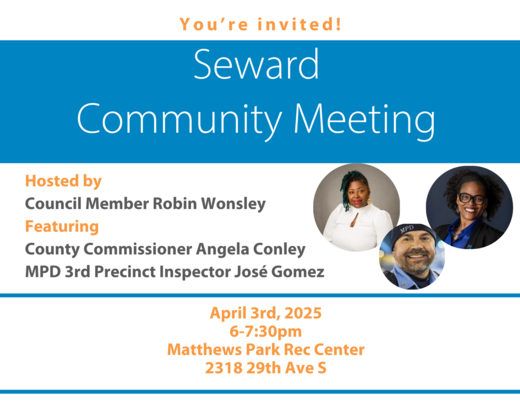
Save the date for a Seward Community Meeting! I’ll be joined by County Commissioner Angela Conley and MPD 3rd Precinct Inspector José Gomez to share updates, answer questions, and hear your priorities. All Seward residents and community members are welcome.
Seward Community Meeting
April 3rd, 6-7:30pm
Matthews Park Rec Center
2318 29th Ave S
Seward Community Meeting Flyer.
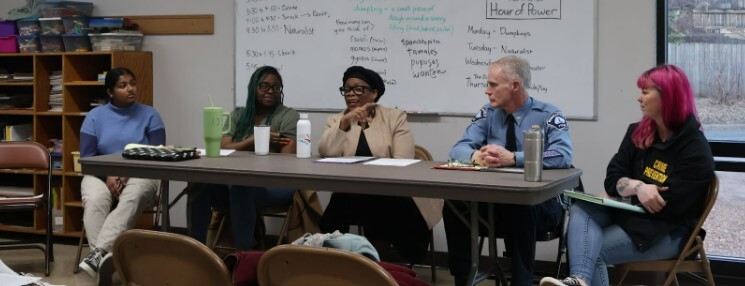
I hosted a Community Meeting in Prospect Park along with County Commissioner Angela Conley, 2nd Precinct Inspector Nick Torborg and Crime Prevention Specialist Teila Zoller, and representatives from the Prospect Park Association and Tower Hill Committee. Residents asked great question which led to thoughtful conversation on encampment response, diversifying public safety staff and recruitment strategies, street-level commercial spaces, and much more. Thank you to all Prospect Park partners for your participation and collaboration.
Panel of speakers at the Prospect Park Community Meeting.
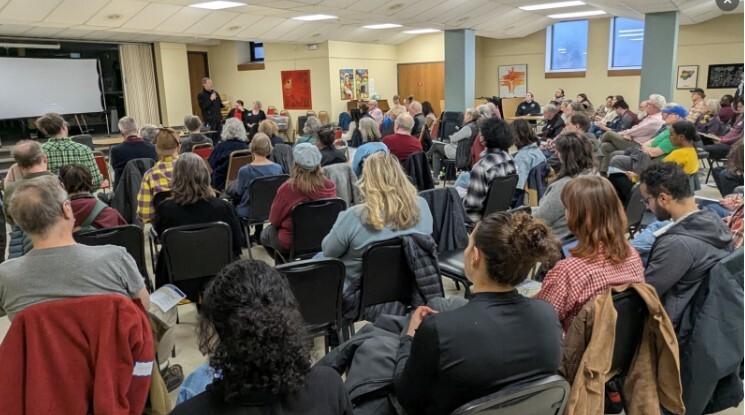
The East Bank Neighborhoods Partnership is the new neighborhood organization representing residents from Nicollet Island-East Bank, Marcy-Holmes, Southeast Como, Dinkytown, University, Stadium Village, and Mid-City Industrial. EBNP had their first ever meeting of the East Bank Neighborhoods last week, and it was standing room only! My office presented on our work on vacancy fees, banning rent-setting algorithms, and commercial advance notice of sale. It was wonderful to connect with East Bank residents through this new organization.
Residents participating at the first East Bank Neighborhood Partnership meeting. Photo Credit: Chris Lautenschlager, Executive Director of East Bank Neighborhood Partnership
Glendales Townhomes is home to 184 families and is a treasured part of the Prospect Park community. The Minneapolis Public Housing Authority (MPHA) operates Glendale, and has initiated a conversation about possible redevelopment over the coming years.
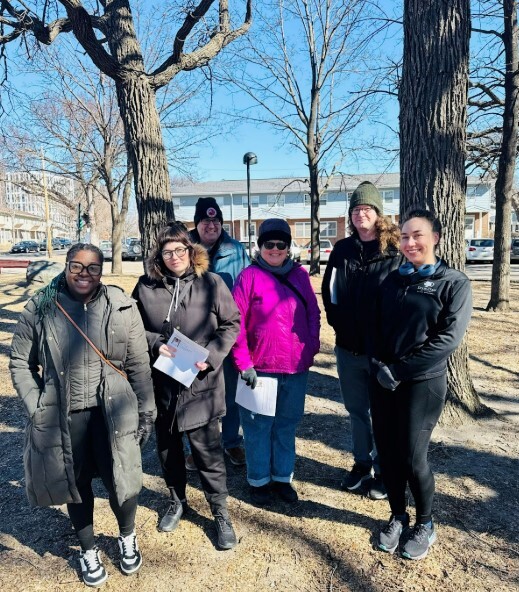
Residents have recently reached out to my office to request that I clarify and reaffirm my position regarding demolition of Glendale, historic designation of Glendale, and addressing concerns that residents are being intimidated by MPHA with threats of demolition or displacement. In response to this request, I wrote a statement and distributed copies in English, Somali and Oromo at the doors of Glendale residents. I hope this can help Glendale residents be aware of the City Council office’s role as it relates to Glendale, and know how to reach my office with any thoughts, questions or concerns. Thank you to the volunteers who came out to help my office team distribute flyers!
Council Member Wonsley with volunteers prior to flyering Glendale Townhomes.
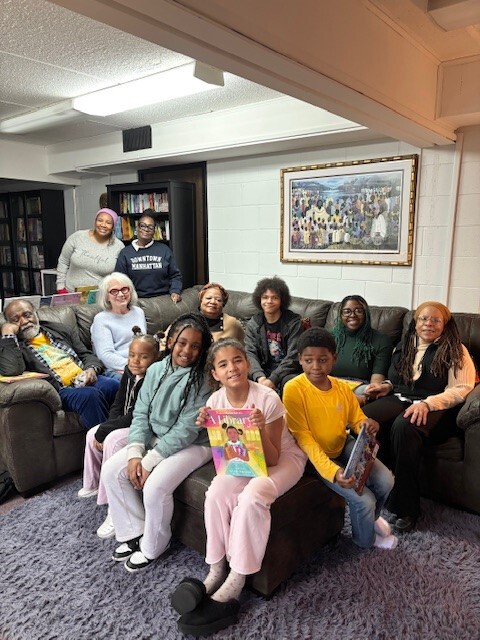
I had the joy of presenting at We Win When We Read, an event hosted by the WE WIN Institute. WE WIN Institute is a community-based non-profit committed to providing free programs and services for children and youth in our community. WE WIN strengthens academic outcomes for children ages 5 to 18 in the greater metropolitan area using a culturally relevant curriculum with an integrated focus on reading, writing, critical thinking, and visual & performing arts as vehicles to achieve academic success.
The WE WIN Institute describes We Win When We Read:
We Win when We Read distributes Black books to Black children free of charge. We cultivate experiences that shift the mindset of youth and families by highlighting the best of Black excellence in books and culture, thus growing a love and joy of reading. We Win When We Read is a collaboration of We Win and Racial Justice Network. Racial Justice Network is a multi-racial, grassroots organization based in Minnesota and led by Nekima Levy Armstrong, an award-winning attorney, civil rights activist, and former law professor. Racial Justice Network is committed to fighting for racial justice and building bridges across racial, social, and economic lines.
Only 14% of Black children in the Minneapolis Public School system read at or above grade level. By creating community and trust around reading and books We Win when We Read aims to increase reading ability, comprehension, and critical thinking.
Thank you WE WIN for the opportunity to engage and read with a wonderful group of youth.
Council Member Wonsley with WE WIN Institute leadership and youth participants.
Contact Ward 2
Visit: minneapolismn.gov/ward2
Email: ward2@minneapolismn.gov
Phone: 612-673-2202
We've moved while work is being done in City Hall. Our office is in:
Room 100, Public Service Center
250 South 4th St.
Get directions
For reasonable accommodations or alternative format please contact 311. People who are deaf or hard of hearing can use a relay service to call 311 at 612-673-3000. TTY users call 612-263-6850. Para ayuda, llame al 311. Rau kev pab, hu 311. Hadii aad caawimaad u baahantahay, wac 311. |