|
At yesterday's City Council meeting, we authorized the City to enter into two Joint Powers Agreements with Hennepin County. One of the Agreements allocates $250,000 in ongoing funds for winter warming shelters (5 years), and one allocates $100,000 to the Minnesota Indian Women’s Resource Center (MIWRC) specifically.
It's one thing for the City to declare homelessness a public health emergency, but such a declaration is meaningless without taking action to address it. With about 70 percent of individuals experiencing homelessness being Indigenous or People of Color, neglecting the public health needs of unsheltered people disproportionately impacts the health, quality of life, and life expectancy of BIPOC communities.
The funding we passed is catching the City up to the rising needs caused by the increase in people experiencing homelessness, which has not been adequately addressed from a public health perspective.
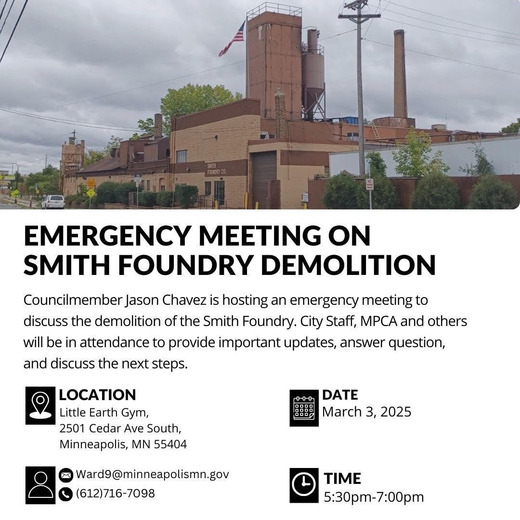 My office received an influx of constituent correspondence regarding demolition occurring at the Smith Foundry. The health and safety of Ward 9 residents has always been my top priority, so I understand and share the well-founded concerns raised by residents.
I am hosting an emergency meeting to discuss the demolition of the Smith Foundry. City staff, the Minnesota Pollution Control Agency, and others will be in attendance to provide important updates, answer questions, and discuss the next steps.
When: Monday, March 3, 2025
Time: 5:30PM- 7:00PM
Where: Little Earth Gym, 2501 Cedar Ave South
At yesterday’s meeting, we passed a new boulevard ordinance after months of discussion. As the ordinance previously existed, food producing plants were not permitted to be grown in the boulevard. Increasing land access within the City for growers is one of the strategies within the Minneapolis Food Vision, which was approved by City Council and the mayor in March 2023.
In addition, the Climate Equity Plan supports this effort: “Allow growing of edible produce on boulevards for personal use.” Urban agriculture is also complementary to many of the Minneapolis 2040 plan goals and policies.
Many of you reached out to me to oppose the ordinance as it was originally drafted as the ordinance required a permit and a $50 fee to place a raised bed in the boulevard. I want to thank you for your input and assure you that I would not have supported requiring a $50 permit fee or permit. Thanks to the leadership of Council Member Chowdhury, the fee was removed from the ordinance and raised planting beds will now be permitted to grow in the boulevard without a permit.
Urban agriculture supports access to local, sustainable, and healthy foods, and we know that BIPOC community members disproportionately have less access to these foods. Getting this ordinance over the finish line is good for our health, the health of our environment, and was done through an equity lens.
The City Council in 2021 authorized a contract with an organization at Harvard University to create a Minneapolis-specific report and plan for building out unarmed public safety services. That process resulted in the Safe and Thriving Communities Report and Plan (STCRP), which was presented to the Minneapolis City Council and the public in July of 2023. The report recommends that within the first 12 months of implementation, the City should “Establish a Community Advisory Board composed of government executives, community partners, stakeholders, and community members.”
Council Member Wonsley, Council Member Chowdhury, and I authored a resolution to establish a Safe and Thriving Communities Work group, fulfilling this recommendation and creating an ongoing venue for community input on the implementation of the Safe and Thriving Communities Report and Plan.
I believe it is important to work closely with residents to achieve a comprehensive safety system and this is a step towards that.
 On December 10, 2024, there was a fire at an encampment on the 2400 block of 15th Ave. S., which displaced unhoused residents and at least eight renters who lived next to the encampment. On January 6, 2025, there were fires at two encampments, one located at Lake and Columbus and another on 29th St. and 14th Ave. S. This led to the displacement of over 230 residents who were unhoused and left many residents in the area feeling unsafe because of the fires.
Since then, community members have worked to address gaps that have not been fulfilled under the City’s current approach, such as providing temporary winter shelters. We should be able to count on the City’s response to keep residents safe and warm, which unfortunately has not been the case.
I previously brought forward a legislative directive requesting an update to the City Council relating to an overview of the winter plans for safety and well-being, including inter-jurisdictional services, resources for people experiencing homelessness and the surrounding community from inclement weather, and community safety concerns. We received this presentation at last week’s Public Health & Safety Committee meeting. There, we also heard public Information on the Emergency Preparedness Plans relating to emergencies around unsheltered homelessness and any plan to mitigate risk faced by people who are unsheltered or unhoused during extreme weather.
The full presentation can be found here.
This week, Council authorized contracts for the East Lake Street Community Safety Ambassador Pilot Program; and one in the amount of $256,836, for the same one-year term for the East Franklin Avenue Community Safety Ambassador Pilot Program.
These pilots came about due to a budget amendment that I authored and Council passed, which will enhance community safety and support in these vibrant areas. The work of these ambassadors will continue violence interruption and de-escalation, connecting residents to services and treatment within the corridors. This work is intended to reduce arrest, incarceration, and racial disparities by developing a more effective, equitable, and non-punitive system of response to the problems associated with unmanaged behavioral health needs.
Safety ambassadors will be a friendly, visible, and welcoming presence. They will share information about special events, businesses, and services located in the district; offer support to help people with wellness concerns; report hazards or emergencies; check-in with local businesses; and connect with the community to build trust, calm tensions, and prevent violence.
Further, safety ambassadors will serve as a safety escort to walk with residents to their destination in the district boundaries; connect residents to social services, City services, or other resources; help residents file a public safety-related report; provide basic first aid or CPR, including opioid overdose medicine such as Narcan; do wellness checks on people in public spaces; and offer outreach to connect and inform the public about events, services or businesses. They will not provide law enforcement service, carry weapons, respond directly to 911 calls, or provide transportation.
 The Native American Community Clinic-Housing (NACC-H) project is a proposed six-story, new construction, mixed-use development that will include 83-units of affordable multifamily rental housing with a new clinic space for the Native American Community Clinic. The new 39,000-square-foot clinic will integrate NACC’s physical, mental, and behavioral health services along with administrative space under one roof in response to the increased demand for services.
The housing amenities include offices for the supportive services staff, a community room, mail room, and an outdoor amenity deck. Positioned above the clinic, a portion of floors three through six will include 80 of the 83 total units with three units on the third floor. Unit types will include one-, two-, three- and four-bedroom rental units affordable to individuals and families at or below 30%, 50%, and 60% of the Area Median Income. Nine units will service households coming out of long-term homelessness and will be filled through Hennepin County's Coordinated Entry process. Simpson Housing will provide supportive services for units with supportive housing services.
Due to increased project costs and not receiving anticipated funding from other public funders, the NACC-H project had an approximately $2,000,000 financing gap. The developer requested gap financial assistance from the City as well as other governmental funding partners. Pending final loan approval from the City and Minnesota Housing, this project is fully funded.
At yesterday’s Council meeting, we voted to authorize additional funding of up to $1,000,000 from the Affordable Housing Trust Fund to close the financing gap; and we passed a resolution authorizing tax-exempt bonds of up to $22,000,000 for the NACC-H project.
I authored a resolution in relation to the Hate Crimes Prevention Technical Assistance Program (Program), which is a City-led funding opportunity to partner with service providers to provide technical assistance to organizations in Minneapolis seeking to address and prevent hate crimes. The goal of the Program is to prevent and appropriately respond to hate crimes by providing guidance to vulnerable organizations. The program is open to one or more service providers to provide technical assistance to organizations in Minneapolis seeking to address and prevent hate crimes. The total funding available for the Program is $200,000.
The resolution I authored, along with Council Members Cashman and Chowdhury, establishes processes to make and execute funding agreements for grants and disbursement of funds for eligible expenses consistent with the Guidelines adopted by the Council. Per those Guidelines, eligible activities include:
- Conducting community outreach to identify potential recipients of technical assistance.
- Conducting site assessments that include recommendations for physical improvements (e.g. lighting, cameras, other security features).
- Conducting organizational or procedural assessment to make recommendations on changes in policy, procedure, or training.
- Providing staff or members with training on how to identify, document, and report hate crimes.
- Support for identifying and pursuing funding for recommended improvements
- Reporting and evaluation of funded activities.
 Hennepin county announced yesterday an overdose spike alert and it coincides with the eviction of the large encampment that took place on Cedar earlier this week. The overdoses were concentrated in south Minneapolis. This is not a new phenomenon, and we saw the same thing multiple times after large evictions last year.
Between Feb. 24 and Feb. 27, there were 38 suspected overdoses reported. Naloxone was administered in 15 incidents. Two of the overdoses were fatal, with the suspected drug being fentanyl in one incident and alcohol in the other. The zip codes with the most incidents are 55404 and 55408 in South Minneapolis.
Resources can be found on the Hennepin County website.
I recently authored, along with Council Member Emily Koski, an action directing staff to undertake research and analysis to produce a report of different types of special assessments used in Minneapolis and a landscape of municipal and nationwide special assessment assistance programs.
As you’ll read below regarding the 24th St. E resurfacing project, the City of Minneapolis conducts a broad range of assessments that cover capital improvements, outstanding fees or fines, street maintenance and lighting, special service districts, and park board property. As the cost of living increases for many Minneapolis residents, we see the hardship that some assessments can cause low-income residents.
This staff direction will direct the City Auditor's Office to undertake research and analysis to produce a report. It will Increase the City Council’s understanding of constraints and opportunities to make different types of special assessments more equitable or affordable for low-income property owners. And it will enable the City Council to compare other municipalities’ efforts to make different types of special assessments more equitable or affordable for low-income property owners.
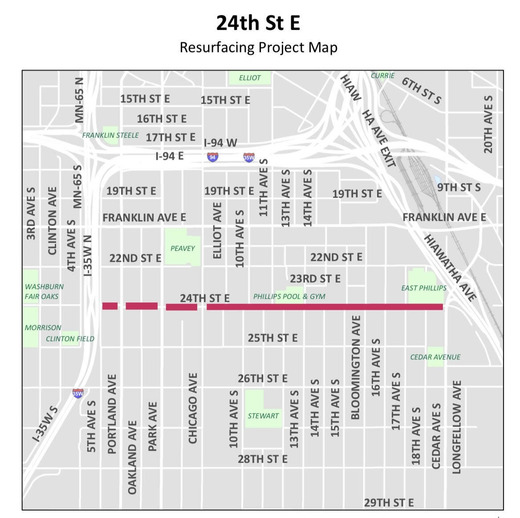 Public Works will be resurfacing E. 24th St. this year. The work they will be performing is resurfacing is mill and overlay, which has been a successful pavement management process performed by Public Works since 2008. The construction is expected to take place during the 2025 construction season and will take about two weeks to complete.
Last year, the City upgraded the sidewalk corners (pedestrian ramps) to meet current MnDOT and federal standards. The cost for these pedestrian ramp improvements are not a part of the assessment to the property owners as they are paid by Public Works.
In 2025, the City will be issuing assessments for property owners that are on the resurfacing route. To provide more information on this project, the Department of Public Works will hold an informational meeting on Monday, March 10, at 6:00 PM to address any questions that you may have about this project and related assessment. Representatives from Public Works will be available to answer questions you may have. The meeting will be held at the Phillips Community Center, 2323 11th Ave S. Minneapolis, MN 55404.
 Recruiting members for boards and commissions opens March 1. We’re looking for applicants with a diversity of backgrounds and experiences representing the demographics of Minneapolis to strengthen the work of the City. Translation and interpreting are available so all residents can participate.
Serving on City boards and commissions offers a direct way for residents to advise City leadership about topics important to them. This is a way to help make changes and improvements that affect your community.
Applications will be taken in March for these boards and commissions:
- Advisory Committee on Aging
- Advisory Committee on Disabilities
- Advisory Committee on Housing
- Bicycle Advisory Committee
- Community Commission on Police Oversight (applications open until March 16)
- Homegrown Food Council
- Pedestrian Advisory Committee
- Public Health Advisory Committee
Apply March 1-31, and stay up to date on vacancies, position descriptions and timelines by visiting the City website.
 If you or someone you know is a college, graduate or law student, encourage them to apply for the Urban Scholars Internship Program. This summer leadership internship is for college and graduate students interested in public sector careers.
When I was 19 years old and in my first year of college, I had the opportunity to join the Urban Scholar program and work in the Minneapolis Public School District. As an alumnus of the program and now a Council Member, I take immense pride in watching this program continue to nurture leaders, visionary thinkers, dedicated advocates, and passionate activists. I am constantly inspired by the incredible individuals who come through this program. They make up a new generation of leaders ready to push boundaries and drive change. Our city will continue to thrive because of their energy, ideas, and dedication.
The 2025 Urban Scholars program runs from June 2 to Aug. 15. The program is a full-time summer program providing internships, professional development and mentorship opportunities for young professionals. The interns work full-time with the employers four days a week with leadership development every Monday. Candidate applications are due March 17.
 With the early warming up in our weather, some people may want to tidy and rake up their yards. But pollinators nest in the broken stems of plants and overwinter in leaf piles. To protect them, please do not rake any leaves or clean up your yard until temperatures are consistently above 50 degrees.
Yard waste collection will begin the week of April 7.
Minneapolis is working to start a pilot for traffic safety cameras and wants to hear from you. Take a new survey to share your feedback on camera locations. A new State law allowing this pilot requires protections for fairness, equity and privacy. Camera enforcement is proven effective at saving lives and reducing crashes. It’s one part of the City's effort to get to zero traffic deaths and serious injuries.
The pilot will launch as early as August with about five camera locations that will enforce speed limits. The pilot will run for up to four years and may expand to a maximum of 42 locations. The program may also expand to enforce red lights. The City will gather feedback on potential camera locations through mid-May. Read more information about the traffic safety camera pilot on the City website.
Come to a public meeting March 12. You’ll get updates about the City of Minneapolis and Minneapolis Police Department’s path to meet the requirements of the Minnesota Department of Human Rights settlement agreement. Effective Law Enforcement For All (ELEFA), the independent evaluator of the settlement agreement, will present the updates.
ELEFA will present an overview of its role in the settlement agreement, describe its requirements and how it checks compliance, and provide implementation updates from the first semi-annual evaluation report.
- 5:30-8 p.m. Wednesday, March 12
- 5:30-6 p.m. Food and refreshments
- 6-8 p.m. Event presentation
- Ukrainian American Community Center, 301 Main St. NE
If you have questions or require accommodation to attend, please contact ELEFA.
Learn more about the March 12 information sessions on this flyer (PDF).
You can also learn more about the evaluator and its work on its website.
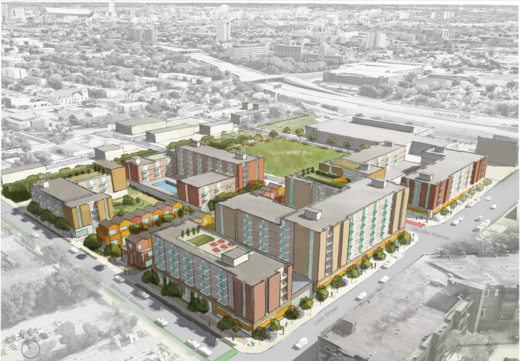 The City of Minneapolis has unveiled a draft development framework for the New Nicollet Redevelopment project, guided by input from thousands of community members. Through 14 in-person and virtual events, 2,245 survey responses, and 520 in-person interactions, the community’s voice is represented and shaping every aspect of this project.
The bold vision would transform the former Kmart site into a thriving hub of green space, a variety of housing options and small business opportunities.
The New Nicollet Redevelopment site spans 10 acres of land between the Midtown Greenway trail, Lake Street, First Avenue and Blaisdell Avenue. The City's plan includes reconnecting Nicollet Avenue. A few of the top resident priorities emerging from community engagement include enhanced public spaces, a variety of housing choices for households at all income levels and a new grocery store.
Next steps
The project team will seek approval of the development framework from City Council and the mayor this spring. Construction on Nicollet Avenue is expected to begin later this year.
Read more and sign up for updates on the City website.
Contact the Ward 9 Office
Email: jason.chavez@minneapolismn.gov
Phone: 612-673-2209
We've moved while work is being done in City Hall. Our office is in:
Room 100, Public Service Center
450 South 4th St.
Get directions
For reasonable accommodations or alternative format please contact 311. People who are deaf or hard of hearing can use a relay service to call 311 at 612-673-3000. TTY users call 612-263-6850. Para ayuda, llame al 311. Rau kev pab, hu 311. Hadii aad caawimaad u baahantahay, wac 311. |