|
Summary: Staff presented a response to the legislative directive about the city’s approach to winter safety, particularly for unhoused neighbors, in extreme cold weather and other emergency situations.
Background: Earlier this year, Council President Payne, Council Member Chavez and I authored a legislative directive requesting an overview of the administration’s winter plans for safety and wellbeing, including inter-jurisdictional services and resources for people experiencing homelessness and the surrounding community from inclement weather and community safety concerns. This legislative directive was sparked by community concerns about the lack of adequate warming shelters and other safe and accessible spaces for unsheltered people during the winter, which has led to use of propane and other fire hazards in encampments.
Staff responded to this legislative directive with a thorough and thoughtful presentation that was jointly delivered by the Regulatory Services Department, the Fire Department, the Office of Emergency Management, and our partners at Hennepin County. The presentation outlined the current services that are available, and staff set some clear goals on specific ways to improve programming.
Hennepin County leadership and staff worked to ensure an extra 85 emergency shelter beds were available on extremely cold nights during this winter, and are planning to expand these conversations on an ongoing basis to continue to increase the number of beds, centralize information about availability of various temporary housing options, provide transportation to shelter, and other logistical coordination that can keep unhoused residents safe during extreme cold and other weather events.
This work is incredibly important. An article in the Star Tribune last month outlined how all shelter beds are regularly filled and many people are turned away, especially on cold nights. Despite claims from some elected officials that unsheltered residents are refusing service or shelter, the reality is that there are not enough beds and services to meet the need.
Thank you to staff who continue to work to develop streamlined and effective humane services for unsheltered residents during extreme cold and other weather events. My colleagues and I will also be working with staff to get regular reporting updates on city staff’s progress on implementing many of the great recommendations they provided in the report, and will ensure to keep the public informed on when those updates will take place.
Key votes: No votes taken.
Summary: The Public Health and Safety Committee received a report on the City's awareness campaign highlighting the intersection between human (sex) trafficking and substance use.
Background: The Minneapolis Health Department and local partners are leading a public awareness campaign to reach victims and survivors of human trafficking and sex trafficking.
In a recent survey of 9th and 11th graders in the West Metro, 1.4% of respondents indicated that they had traded sexual acts, with significantly higher rates amongst youth who had histories of substance use, mental health struggles, or learning disabilities. This translated to over 100 respondents, and almost certainly undercounts the true number of young people who are impacted by sex trafficking and human trafficking. The average age of entry into trafficking in Minnesota is between 12 and 14 years old.
The City’s campaign was designed in consultation with survivors of sex trafficking and with local artists. The digital ads are in public restrooms, public transit, and other public spaces that are meant to reach impacted youth. The messages focus on hope and pathways to exit, the messages that survivors emphasized would have been most helpful to them.
Thank you to staff and community partners on this incredibly important work.
Key votes: No votes taken.
One of the ads in the Minneapolis Health Department’s sex trafficking awareness campaign.
Summary: The Administration and Enterprise Oversights received our first quarterly update on Outcomes Minneapolis, a new citywide performance management program.
Background: Performance management is how large organizations like city governments track their effectiveness. The City of Minneapolis has used performance management in the past, but under the Frey administration there has not been a consistent use of performance management.
The city has dozens of departments that run hundreds of different programs, but often these programs are not being tracked for specific data on what outcomes they produce to improve residents’ lives. This lack of consistent, relevant data on outcomes means that Council and the public often have to make decisions about investments in programs without relevant information on what the programs are actually delivering. Without specific goals and metrics, it’s also challenging for the Council to use our oversight authority to ensure the Mayor is administering programs effectively.
In response to this, the administration has made a commitment to develop and implement a new performance management program called Outcomes Minneapolis. I am strongly supportive of this effort. The public and Council should be able to know the specific, measurable goals of each city program and have access to transparent and consistent data about how we are doing at meeting those goals.
I have requested that staff from the Performance Management and Innovation (PMI) Department give quarterly updates on their development of Outcomes Minneapolis. This week, they gave their first 2025 quarterly update.
This year, Outcomes Minneapolis is focusing on helping each department establish clear, measurable, and relevant metrics. The goal of these metrics is to identify what specific deliverables accurately reflect a program’s success.
In the coming months, there will be public dashboards on the city’s website that ensure Council and the public will have access to early data on how well each program is doing at meeting each of these metrics.
Staff presented that they are hoping to enter into a partnership and receive in-kind services from a performance management organization called Results for America. Results for America offers programming for local governments to help implement performance-based contracting. I asked staff to ensure that our existing relationship with Results for America has gone through the proper channels for in-kind services, and if staff plans to enter into a contract with them or another technical assistance provider that any agreement comes before Council through the proper procurement procedures.
I look forward to continuing to support the development of a robust, consistent performance management system to ensure that Council and the public can make informed decisions about city resources.
Key votes: No votes taken.
Summary: Four months after the due date, staff presented a response to Council’s legislative directive on the procurement practices that the Neighborhood Safety Department uses for violence prevention contracts.
Background: The Neighborhood Safety Department (NSD) has been under scrutiny by Council, national organizations, and the media for several years due to substandard practices and failure to adhere to national best practices for violence prevention program management.
As mismanagement concerns grew throughout last year and Minneapolis experienced an increase in homicides, I and several of my colleagues attempted to use our oversight authority to get updates from Mayor Frey and Commissioner Barnette that the Neighborhood Safety Department was improving their practices in order to keep residents safe. Mayor Frey and Commissioner Barnette did not provide assurance that NSD was functioning well and using procurement practices that would help bring down homicides and violence.
Despite our best efforts to address the concerns with NSD, by fall of 2024, many of the issues were still unresolved. Council Member Chavez and I wrote a legislative directive to formally request answers and information to address these concerns. Council approved this legislative directive with a return date of October 7, 2024. The administration refused to present it until this week.
The presentation did provide some substantive information on specific changes that have been implemented to improve procurement practices in NSD. Many of these were due to the city entering into a settlement from a lawsuit alleging that the city used an illegal procurement process to arbitrarily select recipients for millions of dollars using substandard accounting methods.
There were a number of key questions that staff were unable to answer, such as what transparency and accountability protocols are in place for contracts under $175,000. Contracts under this amount do not have to go before Council for approval and currently, there is no mechanism of transparency on these contracts for both the Council and the public. I look forward to receiving the answer to this and several other questions in a staff memo that will be provided in the coming weeks.
While this presentation reflected some progress towards implementing improved procurement practices, I continue to be concerned by the fact that NSD has 50% staff vacancy, incredibly high turnover, low levels of specific subject matter expertise on violence prevention, and has produced no data on their outcomes for two years to inform their current programming.
Key votes: No votes taken.
Summary: The Minnesota Department of Transportation presented to the Climate and Infrastructure Committee about their decision to remove at-grade options from consideration for the Rethinking I-94 project.
Background: The Minnesota Department of Transportation (MNDOT) is planning to reconstruct the highway I-94 corridor between downtown Minneapolis and downtown St Paul. The Rethinking I-94 process has been underway for several years. I am a member of the Policy Advisory Committee (PAC), which includes elected officials and community leaders from the districts and neighborhoods in the I-94 corridor.
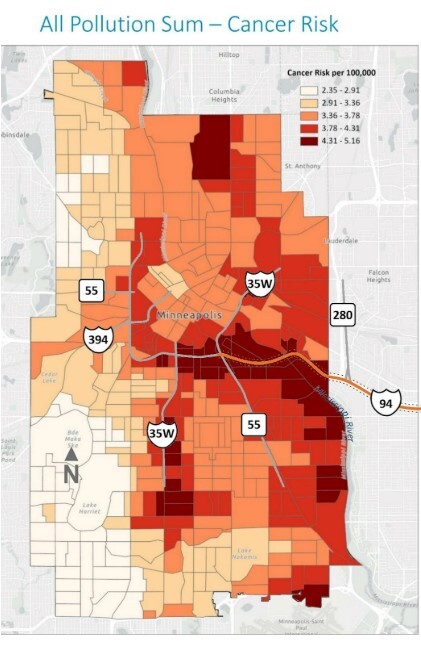
I have been a strong supporter of replacing I-94 with an at-grade multimodal boulevard. The current highway contributes significantly to health issues for those along the corridor, including increased cancer risk. Currently, the state and other governmental partners have a once-in-a-generation opportunity to build a corridor that centers environmental and racial justice.
A boulevard would still support car traffic, but it would also massively expand accessibility for buses, bikes, pedestrians, and create new land area for housing, small businesses, and green space. It would reconnect neighborhoods by filling in the highway trench.
Recently, MNDOT announced that they are planning to remove the at-grade option from further study or consideration. This directly contradicts the official policy of the City of Minneapolis, does not align with the state’s new Vehicle Miles Traveled (VMT) policies, and ignores the large number of residents who are organizing around the need for highway removal as part of a safe and healthy future for our communities.
MNDOT presented to the Climate and Infrastructure Committee. Council Members raised the same concerns that the community has been stating. In particular, it is striking that MNDOT is not considering reduction in Vehicle Miles Traveled (VMT) as one of the criteria for evaluating different options. Transportation is Minnesota’s largest source of greenhouse gases and we must reduce VMT dramatically to meet our climate equity goals.
Council Cashman raised great questions about the public health impacts of poor air quality caused by the highway, and the fact that highways have the most deadly and high-injury crashes. MNDOT did not have satisfactory answers to these concerns. Council Member Chowdhury emphasized that further study of at-grade boulevard options would be consistent with community support for this idea.
I will continue to advocate for an at-grade boulevard alongside the broad coalition of residents and elected leaders who know that we cannot continue to invest in outdated, harmful highways.
Key votes: No votes taken.
A map depicting increased cancer rates along the I-94 highway corridor.
Summary: The Trump administration has paused the finalization of the Department of Justice Consent Decree for 30 days. I have urged the City to take this possibility seriously, and will continue to lead efforts to hold the Frey administration accountable for implementing the consent decree regardless of any actions by the Trump administration.
Background: After the murder of George Floyd, the Department of Justice (DOJ) launched a federal investigation into MPD and the City of Minneapolis, which resulted in a report outlining MPD’s pattern and practice of racially biased policing, misogyny, and excessive force. The City of Minneapolis was in negotiations to reach a settlement agreement. This process was drawn out until the eve of the inauguration of President Trump, with Council approving the agreement in early January 2025.
Last year, several Council Members voiced concern that the current pace could have negative impacts due to the Presidential election. Unfortunately, that is exactly what happened. Trump’s Attorney General has asked the judge to pause the consent decree for 30 days, and the judge agreed. I will share updates about any new relevant actions taken by the DOJ or the city during the 30-day pause, as well as any next steps that emerge after the 30-day pause.
I remain committed to ensuring that the provisions in the consent decree are implemented despite the Trump administration. I will be bringing forward legislative actions in the coming weeks to keep the Frey administration and any future mayoral administration’s on track with this crucial work of fully implementing the consent decrees with both the Department of Justice and the Minnesota Department of Human Rights.
This is also another opportunity to appreciate the courageous leadership of the Minnesota Department of Human Rights, which entered into a legally-binding settlement agreement with the City over a year ago and is the current strongest tool of accountability on reform.
Key votes: No votes taken.
Minneapolis is working to start a pilot for traffic safety cameras and wants to hear from you. Join in a community open house to hear more and share your feedback on camera locations. A new State law allowing this pilot requires protections for fairness, equity and privacy.
Camera enforcement is proven effective at saving lives and reducing crashes. It’s one part of the City's effort to get to zero traffic deaths and serious injuries.
The pilot will launch as early as August with about five camera locations that will enforce speed limits. The pilot will run for up to four years and may expand to a maximum of 42 locations. The program may also expand to enforce red lights.
The City will share more details around the traffic safety camera pilot and get your feedback on potential camera locations at two upcoming open houses:
In-person open house 4-6 p.m. Tuesday, Feb. 25 Presentation at 4:30 p.m. Minneapolis Central Library, Doty Room (second floor, up the escalator), 300 Nicollet Mall
Online open house6 p.m. Thursday, Feb. 27Join on Teams.
The City will gather feedback on potential camera locations through mid-May. An online survey will be available soon, and the City will also take part in other events over the next months.
Read more information about the traffic safety camera pilot on the City website.
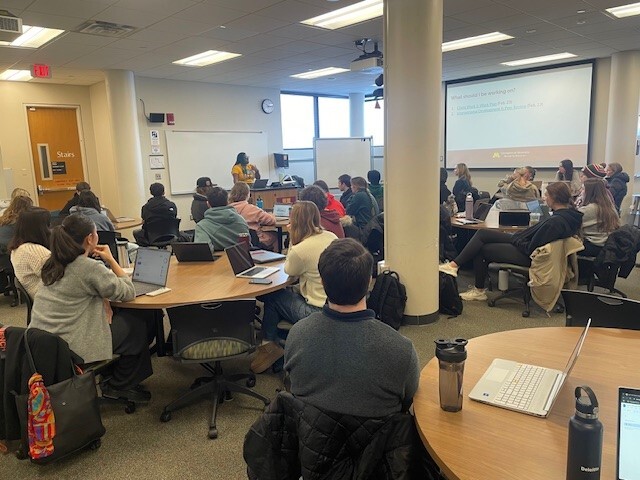
My office has partnered with the Carlson Impact Lab at the University of Minnesota’s Carlson School of Management. Carlson Impact Lab focuses on hands-on practical experiences. In our partnership, students act as consultants for the Ward 2 office in helping us advance priorities for the residents of Ward 2 and the city. It’s a win-win!
This semester, students at Carlson Impact Lab are working to advance priorities around a student grocery co-op to improve student access to healthy affordable food, equitable methods to diversifying municipal revenue streams beyond property taxes, neighborhood-led public art for traffic calming, and year-round support for small businesses in Dinkytown.
Council Member Wonsley speaking with Carlson Impact Lab students.
I attended Representative Ilhan Omar’s Black Leader Happy Hour. This opportunity to connect with other local Black leaders in government, community, industry and nonprofits was incredibly valuable in light of the ongoing anti-Black and xenophobic attacks coming from the federal government. Thank you Representative Omar for your consistent leadership for Congressional District 5, Minnesota, and the country.
Council Member Wonsley and Representative Omar at the Black Leaders Happy Hour.
I hosted my first Pillars of Prospect Park office hours of 2025. We discussed the outcomes of the 2025 Budget process and local issues including the Witch’s Hat, biochar, truck traffic, and historic designation of Glendale. Thank you Pillars for hosting me!
If you or someone you know is a college, graduate or law student, encourage them to apply for the Urban Scholars Internship Program. This summer leadership internship is for college and graduate students interested in public sector careers.
The 2025 Urban Scholars program runs from June 2 to Aug. 15. The program is a full-time summer program providing internships, professional development and mentorship opportunities for young professionals. The interns work full-time with the employers four days a week with leadership development every Monday.
Candidate applications are due March 17.
Payment Assistance Resources Are Available for Customers
CenterPoint Energy encourages those facing hardship to call the company to find out about payment arrangements and be referred to resources that may be available to them.
Under Minnesota’s Cold Weather Rule, residential customers who are having difficulty paying their heating bills are required to set up a payment plan with their utility to prevent disconnection of their service between Oct. 1, 2024, and April 30, 2025. The Cold Weather Rule applies to both homeowners and renters. To arrange a payment plan, CenterPoint customers can call 800-245-2377 from 7 a.m. to 7 p.m., Monday-Friday, or visit CenterPointEnergy.com/PaymentAssistance.
CenterPoint representatives can also refer customers to resources that provide financial assistance for heating costs such as Minnesota's Energy Assistance Program. This federally funded program helps pay for home heating costs and furnace repairs for income-eligible households. Applications are still being accepted for this program, and funds remain for Minnesotans this heating season.
Winter Energy Guide
CenterPoint recently launched its Winter Energy Guide, a comprehensive online resource hub that helps customers throughout the winter heating season. The guide features practical and important safety, energy savings and bill management tips to help customers stay safe and warm throughout the winter season. The Winter Energy Guide can help customers:
-
Prepare a winter emergency supply kit. A winter emergency supply kit should have various supplies including water, non-perishable food for customers, their loved ones and pets, first aid kit, cold weather supplies such as blankets and supplies to have on hand in case of an outage.
-
Track energy usage. By managing their accounts online, customers can access an interactive chart that displays their energy usage trends and gives them insights into ways to save energy.
-
Take easy actions to reduce energy use. CenterPoint offers a variety of free energy-saving tips that can make a difference in the amount of energy used such as adjusting thermostats, opening blinds during the daytime to take advantage of the sun's warmth and sealing air leaks.
-
Implement vital safety tips: CenterPoint offers tips for customers and their loved ones to stay safe throughout the winter heating season including by using space heaters appropriately, testing carbon monoxide and smoke alarms, and by knowing how to identify and report a suspected natural gas leak.
Energy-saving Tips: CenterPoint offers a variety of free energy-saving tips that can make a difference in the amount of energy used:
-
Make sure your heating system is operating safely and efficiently. An annual inspection and tune-up by a qualified technician are recommended. Change or clean your furnace filter regularly to help maximize your furnace’s efficiency and life.
-
Turn down your thermostat. By lowering your thermostat by 7-10 degrees at night or when away for at least eight hours, you can potentially save 10% on heating costs. With a programmable thermostat, your heating system can work around your schedule.
-
Keep warm air in and cold air out of your home. Use caulk or weather-stripping to seal leaks around doors, windows and other openings such as pipes or ducts. You can also roll up towels and push them against the bottom of the door’s interior to help prevent heat loss. Close fireplace dampers when not in use, so you don’t lose heat.
-
Use window coverings and blinds effectively. If it’s sunny outside, open your window coverings during the day to capture warmth from the sun, and close your coverings at night to keep warmth inside.
-
Circulate warm air with your ceiling fans. Set your ceiling fans to turn clockwise slowly to move warm air from the ceiling to your living levels.
Safety Tips: CenterPoint offers tips for customers and their loved ones to stay safe throughout the winter heating season
-
Use space heaters safely. Make sure your space heater has an automatic shut-off, and keep children, pets and all items at least three feet away from it. A space heater that uses natural gas, propane or wood should be vented to the outside. Stoves and ovens should never be used for space heating.
-
Test your carbon monoxide (CO) and smoke alarms to make sure they work properly. Change batteries regularly. Alarms don’t last forever, so replace them according to the manufacturer’s instructions.
-
Know the signs of CO poisoning. Early symptoms such as headache and fatigue are similar to the flu, but without a fever. Continued CO exposure can lead to more severe headaches, dizziness, nausea, difficulty thinking clearly and fainting. If everyone in a household is experiencing these symptoms, it could be CO poisoning. If you suspect you could have CO poisoning, leave the area immediately, get fresh air and call 911.
-
Immediately report a suspected natural gas leak. If you smell the “rotten egg” odor of natural gas, immediately leave on foot, go to a safe location and call both 911 and CenterPoint Energy at 800-296-9815. Don’t use electric switches and outlets, phones (including cell phones), drive or start a car inside or close to the location or do anything that could cause a spark.
Contact Ward 2
Visit: minneapolismn.gov/ward2
Email: ward2@minneapolismn.gov
Phone: 612-673-2202
We've moved while work is being done in City Hall. Our office is in:
Room 100, Public Service Center
250 South 4th St.
Get directions
For reasonable accommodations or alternative format please contact 311. People who are deaf or hard of hearing can use a relay service to call 311 at 612-673-3000. TTY users call 612-263-6850. Para ayuda, llame al 311. Rau kev pab, hu 311. Hadii aad caawimaad u baahantahay, wac 311. |