|
Summary: The Council is working to stay updated on and respond to the Trump administration’s rapid series of harmful executive orders and their potential impacts on residents and the city.
Background: This week, the Trump administration continued their barrage of executive orders targeting marginalized communities, threatening basic services and infrastructure, and criminalizing immigrant residents.
This week, Intergovernmental Relations (IGR) Committee Chair Aurin Chowdhury organized a presentation in the IGR Committee from the city’s state and federal lobbyists. The presentation included the information we know so far about the quickly evolving situation.
I have worked to organize internal briefings by the City Attorney’s Office and a public presentation in the Committee of the Whole on February 11th so that Council and the public have accurate and updated information as we continue to learn more about the impacts of these executive orders.
I also want to note the recent news that the University of Minnesota will be complying with ICE immigration orders. I am incredibly disturbed by this news. I want to highlight the city’s commitment to not participate in immigration enforcement, and urge the U to align with the city’s policy.
Council also unanimously passed a resolution supporting the Neighbors not Enemies Act, a bill by Representative Ilhan Omar that would repeal the Alien Enemies Act of 1789 (HR630). The Alien Enemies Act is a dangerous and outdated law that has given unilateral power to the President of the United States to determine how and if foreign nationals should be apprehended, restrained, secured, and removed during times of war. The provisions within this legislation create grave concerns of abuse of executive power to target immigrant, refugee, and religious minority groups through the bypass of the judicial process and without due process.
Key votes: Council unanimously passes a resolution of support for the Neighbors not Enemies Act, a bill to repeal the Alien Enemies Act of 1789.
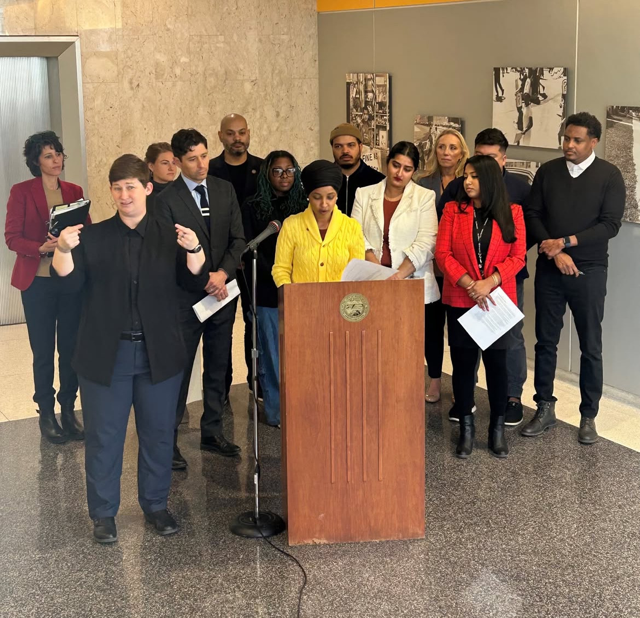
Representative Ilhan Omar speaking alongside Council, the Mayor, and the city’s Office of Immigration and Refugee Affairs following the Council’s unanimous support for Representative Omar’s Neighbors Not Enemies Act.
Summary: Council unanimously approved the ordinance I authored allowing the city to charge fees on MPD’s off-duty work, the first significant regulation to the incredibly problematic off-duty program.
Background: The Minneapolis City Council voted unanimously in support of my ordinance enabling the city to charge fees on off-duty work by MPD officers. The off-duty program has been recognized as fundamentally inequitable by the US Department of Justice. The ordinance is the first significant reform to the off-duty program.
Within the first several weeks of entering City Hall in 2022, my office engaged with several frustrated residents who were troubled by the city’s off-duty program. Many wanted to understand why MPD officers were frequently parked along Lake Street providing security to private construction companies while the city continued to talk publicly about their staffing challenges and shortage of police officers. Residents were upset and perceived this as the city enabling a “pay-to-play” system for police services,where corporations were able to pay to receive police services when other residents were not receiving them. The concerns of residents, in addition to community groups who have been advocating for accountability to this broken system for decades, led my office to begin to work to take legislative action.
After over two years of work, I was proud to bring forward an ordinance to enable the city to recoup fees along with my co-author Council President Payne. Council voted 13-0 in support of this ordinance, which is the first step to reining in an inequitable and fiscally appalling program and is crucial for advancing our goal of an equitable citywide community safety system.
MPD’s off-duty program allows officers to work private side jobs using city cars, uniforms, and materials. The ordinance would allow the city to charge fees to recoup costs of all city resources used by officers when working off-duty, as well as offset the costs of administration and any other program costs borne by taxpayers.
For decades, both subject matter experts and directly impacted residents have been telling city leaders that MPD’s off-duty system is ripe for corruption and is a bad deal for residents. Small business owners have spoken publicly about the financial exploitation and discrimination they face in the off-duty system. In 2023, the US Department of Justice outlined how MPD’s off-duty program is fundamentally inequitable in an investigation in MPD. City leaders have spoken publicly about their concerns with off-duty since at least 2019, when MPD officer Mohamed Noor shot and killed a resident named Justine Ruszczyk after working off-duty and starting his on-duty work with very little sleep. A 2019 internal audit of off-duty led to clear and actionable recommendations, which were never implemented. Mayor Frey convened an Off-duty Task Force in 2020, but the group ceased meeting without any outcomes.
Yet despite the clear need to rein in off-duty, there has been a lack of political will by city leadership to implement significant regulations. This inaction has had a high cost to residents. Analysis by city staff in August 2024 determined that a $19/hour fee for use of a squad car would be consistent with vehicle costs, which could have recouped the city up to $1.4 million in 2024.
I want to outline the next steps that will be coming forward as I and my co-author, Council President Payne, continue the urgently needed work of regulating off-duty. President Payne and I authored a legislative directive requesting a comprehensive fee study, which MPD will present a response to by May 1. This fee study will provide updated figures for the full cost of vehicles, materials, uniforms, administration, and any other costs that taxpayers currently subsidize in off-duty work. With these updated figures, Council can amend the fee schedule and implement fees on off-duty work to begin being implemented on January 1, 2026.
Key votes: Council votes unanimously in support of my ordinance allowing the city to recoup fees on MPD off-duty work. The best available data currently suggests a fee level of $19/hour for use of a squad car, but MPD will present updated numbers for the full cost of the program by May 1. Council can then set the fee level and begin charging fees starting in 2026.
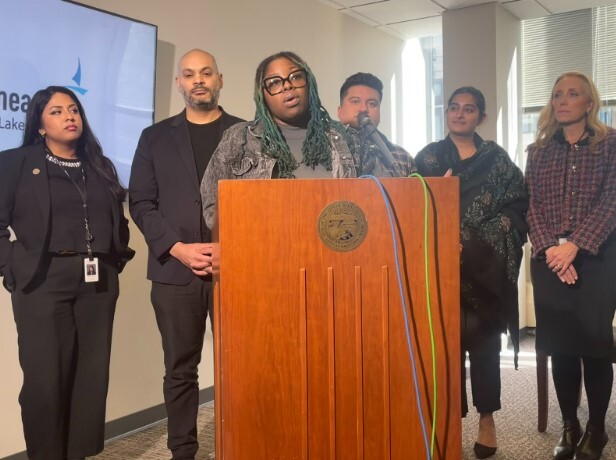
Council Member Wonsley speaking after the unanimous passage of the MPD off-duty fees ordinance.
Summary: I led the Council to unanimously vote against appointing a representative from an infamous corporate landlord to serve on an advisory board.
Background: Some of the commercial corridors in the city are designated Special Service Districts (SSD). Businesses located in SSDs can assess themselves to pay an additional tax which is pooled to fund services or amenities that benefit the entire district. For example, businesses in SSDs may pay into a fund which goes towards services like snow clearing, lighting, trash pickup, or public art. SSDs are governed by advisory boards. Advisory board members have a significant leadership and advisory role over the condition of the commercial corridor.
This week, Council was asked to approve a variety of appointments to advisory boards on SSDs around the city, including to the Dinkytown SSD. One of the nominees was a representative of Greystar Management, a Property Management Company that operates in the University area and is one of the largest apartment owners and management companies in the country. Greystar is one of the landlords currently being sued by the US Department of Justice and a coalition of ten Attorney Generals, including the Minnesota Attorney General. The lawsuit alleges that these landlords participated in an unlawful scheme to decrease competition among landlords in apartment pricing, harming millions of American renters.
I have worked with Council Member Ellison to organize a presentation by a representative of the Minnesota Attorney General’s Office in committee to share an overview of this lawsuit. The presentation will take place at the Business Housing and Zoning Committee on February 4th at 1:30pm. This presentation is open to the public and will be livestreamed on the city’s youtube channel.
I along with Council Members Chavez and Ellison have introduced an ordinance that would ban the use of rental algorithms on Minneapolis units. This ordinance is independent of the lawsuits, but it is a way for our city to ensure that this harmful technology is not a barrier to our citywide goal of an equitable and affordable housing market.
With this context, I felt that a representative of Greystar is not the right person to serve on the Dinkytown SSD or any advisory or leadership role in the city. My colleagues voted unanimously to block this nomination.
Key votes: Council votes 13-0 against appointing representative of Greystar Properties to the Dinkytown Special Service District Advisory Board.
Summary: Council voted unanimously to allocate emergency gap funding to support a critical winter warming center organized by a community organization in the absence of adequate city services.
On January 30, Council Member Chowdhury, Council Member Osman, Council Member Chavez, and Council Vice President Chughtai brought forward a resolution that reallocates $100,000 in contingency funds to the City’s Regulatory Services Department to provide emergency funding to support the operations of the Minnesota Indian Women’s Resource Center (MIWRC) for its pop-up warming center.
As Minneapolis faces frigid temperatures, MIWRC and community members have come together to provide a space for warmth for our unhoused neighbors. Some Council Members have visited the warming center, which is largely volunteer-run, to see first hand the work being done. Hennepin County has contributed an additional $100,000 in funding to help MIWRC to sustain this warming center. The funding will go towards staffing, meals, security, and other operational costs.
Earlier this month, several Council Members attended a multijurisdictional meeting organized by Metropolitan Urban Indian Directors (MUID), where each government agency was asked on how they were meeting this current moment and whether they would be supporting MUID in responding to the multiple crises our local Indigenous communities are experiencing. Several council members, including myself, affirmed that the City Council recognizes the urgent crisis facing Native community members and the necessity of a multijurisdictional approach to address their needs. The Council remains deeply committed to the well-being of the Native American community and will continue to work alongside community leaders and organizations to advocate for long-term solutions. While this emergency funding represents a critical first step, we urged other jurisdictions to follow suit and take proactive steps to address this crisis in a meaningful and coordinated manner.
“We are in a moment where on the coldest nights of Minnesota winter, current warming centers are at capacity,” said Intergovernmental Relations Chair Council Member Aurin Chowdhury. “Minnesota Indian Women’s Resource Center stepped in to add capacity and help save lives and give a hand to people to get stability. We as a City Council are stepping up and working alongside Hennepin County to sustain this critical resource. This is a positive step, however it is symptomatic of the need for a multijurisdictional strategic plan that should have been organized years ago. I am resolute in working across levels of government to make that possible now.”
“As temperatures have plummeted this winter, our unsheltered neighbors have been met with indifference from the Frey administration,” said Council Vice President Aisha Chughtai. “Community members, who have stepped in for decades to take care of one another when systems have failed them, once again came together to provide a safe haven from dangerous, below-freezing weather. There has been a failure of our institutions to provide life saving resources for our unhoused neighbors, and MIWRC is one of the organizations doing incredible work to close the gap by providing a warming shelter. The Council took swift action to ensure this life saving warming shelter remains available through the rest of the winter.”
"No person should be forced to spend the night outside, and that is especially true in the middle of winter," said Council Member Jason Chavez. "I believe that the City’s current approach to helping our unhoused neighbors is ineffective, so I’m beyond grateful that MIWRC, together with community, stepped up to open its doors for our neighbors. When government falls short in fulfilling their responsibility to its residents, community fills in the gaps. MIWRC staff and volunteers are filling those gaps with their warming center and supply depot, and this funding is the least we can do to support their efforts."
“Our unhoused neighbors, especially Native community members, deserve safety, warmth, and dignity,” said Council Member Jamal Osman. “I believe the MIWRC has been a lifeline in my ward and this funding will help them continue their vital work. But this isn’t just about emergency action—it’s about making sure every resident has the support they need.”
You can find the full resolution here.
Key votes: Council votes unanimously to allocate $100,000 in one-time emergency funding to the MIWRC for their winter warming center.
Street light repair due to wire theft has stopped for the season due to the frozen ground and conduits. Lighting staff will continue to monitor conduits and resume repairs as soon as it is warm enough in the spring. Street light repair due to outage or other issues will continue through the winter, however, there is a significant backlog. Please continue to report street light outages to 311.
The City's Partnership Engagement Fund is now open for applications. Community-based organizations, groups and individuals can apply for funding for small-scale, meaningful projects to make Minneapolis communities more socially connected, healthy and safe. Begin the process by filling out the required interest form and then starting your application.
See the full timeline.
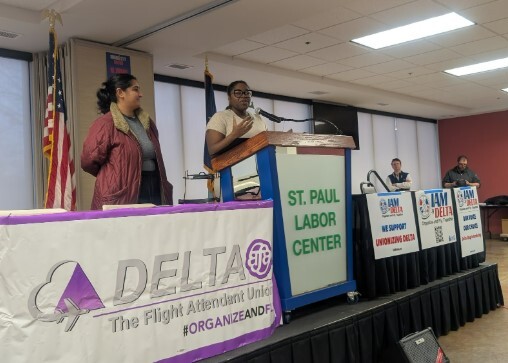
In April, 2023 I led Council to unanimously adopt a resolution in support of Delta employees organizing a union and urging Delta to practice neutrality. Nearly two years later, the organizing drive is stronger than ever. I was honored to attend a rally by Delta workers along with Council Vice President Chughtai to read the resolution and reiterate the city’s ongoing support for this labor effort. Thank you to the International Association of Machinists, Association of Flight Attendants, and all the workers who continue this important effort.
Council Member Wonsley and Council Vice President Chughtai speaking at a rally for Delta Airlines workers organizing a union.
Junauda Petrus is the city’s new poet laureate for 2025-2026. Petrus succeeds Heid E. Erdrich in this prominent literary role. A multidisciplinary artist, Petrus spans stage, screen and page in her work. She blends ancestral storytelling, speculative fiction and poetic verse around themes of Blackness, queerness and womanhood.
The administration of the Poet Laureate Award is overseen by The Loft Literary Center. The Loft is hosting a public celebration in honor of Petrus Feb. 13 at its headquarters in downtown Minneapolis.
Co-founder of the experimental artist collection Free Black Dirt, Petrus is known for creating innovative performances. Her acclaimed debut novel, The Stars and the Blackness Between Them, received the 2020 Coretta Scott King Honor Book Award. In 2023 she released her first children’s book, Can We Please Give the Police Department to the Grandmothers? It is based on an abolitionist future and became a Minnesota Book Award finalist.
Deeply rooted in the cultural, social and historic fabric of Minneapolis, Petrus will use her visionary voice as poet laureate to celebrate the city’s beauty, struggle and magic through poetry.
Read more about the City of Minneapolis and The Loft Literary Center’s Poet Laureate Award on the City website.
Come get a progress update on the South Minneapolis Community Safety Center and Lake Street Safety Center. Hear about services and resources in the centers and how your feedback is being used to shape plans.
There is one more update session left of this series. We encourage residents in Ward 2 to attend, but any Minneapolis community member is welcome.
In person 5-7 p.m. Wednesday, Feb. 5 Matthews Park, 2318 29th Ave. S.
City staff will be available for a Q&A after the presentation. Community members can also learn more about other safety programs in the city. A light dinner will be available for attendees.
Learn more on the event flyer in English, Español, Af-Soomaali, Hmoob and Oromo.
Visit the City website to:
- Watch a previously recorded online session.
- Read a summary of frequently asked questions from previous sessions.
- Find more information on the safety centers.
Flyer for Office of Community Safety meeting at Matthews Park on February 5th
Contact Ward 2
Visit: minneapolismn.gov/ward2
Email: ward2@minneapolismn.gov
Phone: 612-673-2202
We've moved while work is being done in City Hall. Our office is in:
Room 100, Public Service Center
250 South 4th St.
Get directions
For reasonable accommodations or alternative format please contact 311. People who are deaf or hard of hearing can use a relay service to call 311 at 612-673-3000. TTY users call 612-263-6850. Para ayuda, llame al 311. Rau kev pab, hu 311. Hadii aad caawimaad u baahantahay, wac 311. |