|
Summary: Council adopted a balanced and equitable budget that lowers property taxes and invests in resident priorities. Mayor Frey vetoed the budget, but Council overrode the veto.
On Tuesday night, Council adopted the City of Minneapolis budget for 2025. My last newsletter includes a detailed breakdown of how the 2025 budget lowers property taxes while equitably investing in resident needs and priorities. On Wednesday, Mayor Frey vetoed the budget. On Thursday morning, Council voted to override the Mayor’s veto, ensuring that the 2025 City Budget maintains the equitable investments the Council championed.
This budget was one that both Council and the Frey administration could have celebrated together. Instead, it has been disheartening to see significant misinformation be shared by Mayor Frey and his administration around this budget. I do not believe it would be productive to try to address every false statement, but I do want to address specific inaccurate claims by Mayor Frey that the 2025 Budget includes harmful cuts by the Council that will inhibit the city’s response to encampments. None of the actions that Council took this budget cycle stops the Mayor from executing encampment evictions. The administration still has the ability to enact its current encampment strategy, which has resulted in significant resources and taxpayer money being used to evict people from one block, only for them to move down the street. Years of data show that this inhumane tactic not only does not reduce homelessness, but also exacerbates other public health issues including the opioid crisis. Despite the overwhelming evidence that it is counterproductive, evictions are still a tool that the Frey administration can utilize.
What Council did do this budget cycle was reprioritize existing resources to advance a Housing First approach, which data continuously shows is the most effective way to respond to unsheltered homelessness. Council’s action means that significant resources will be put into strategies that actually reduce homelessness. One of these strategies is my amendment for emergency housing vouchers, which based on Hennepin County’s estimates, could house up to 30% of unsheltered residents. Another is the expansion of the very successful Stable Homes Stable Schools program to protect families with children in public schools from housing instability and homelessness. A third is funding to keep Avivo Village shelter open, which currently houses about 100 people. You can read more about each of these actions and the other housing-related investments Council made in my budget overview newsletter.
I extend much gratitude to Budget Chair and Council Vice President Chughtai and Budget Vice Chair Koski who used their leadership to significantly improve the budget process. The Budget Committee was transparent in communications with both the public and the administration about our overall budget process. The committee also executed a public and democratic process that enabled Council Members to both discuss and advance our key priorities, which reflected deep gaps in services to many communities throughout the city. Committee leadership worked tirelessly with Council Members to ensure that many of those priorities were included in the 2025 Budget. I look forward to continuing this work next year and building upon the success we achieved.
Similar to this year, in 2025 Council will need to use our oversight authority every single step of the way to ensure that the Frey administration actually administers city operations in alignment with the adopted budget and with Council’s policy direction. The Mayor has shown an unwillingness to respect the legislative body’s authority, and his attempt to veto the city budget is further confirmation of that.
I am glad this body overrode the veto and I look forward to working with my colleagues and with residents next year to continue to raise the bar on equity in the city budget.
Key votes: Council votes to override Mayor Frey’s veto of the 2025 Budget, which could have caused a completely unnecessary government shutdown. Council Members Ellison, Osman, Cashman, Chavez, Koski, Chowdhury, Vice President Chughtai, President Payne, and I voted in support of overriding the veto.
Summary: Council approved the resolution I authored opposing the criminalization of the eleven University of Minnesota students and alumni who held a nonviolent antiwar protest in solidarity with Palestinian human rights. It was vetoed by Mayor Frey and there was not a supermajority on Council to override the veto.
Background: In October, University of Minnesota students, alumni, and community residents held a protest at Morrill Hall to advance demands around divestment from the State of Israel and boycott of Israeli academic institutions. University of Minnesota Police arrested 11 students and alumni, and they have now been evicted from student housing, suspended for up to 2.5 years, charged over $5,0000 each, and one has been charged with a 4th degree felony.
I worked with impacted students and community members to author a resolution urging the University of Minnesota to rescind these academic charges, suspensions, evictions, and financial penalties, and instead urging the University to work with the students to accomplish their goals around divestment and boycott. It also urges the County and City Attorneys to consider the historical and political context of this protest, and to not pursue any charges.
Campus activism and nonviolent protest have been central to many crucially important social movements like the civil rights movement, LGBTQ liberation movement, and many anticolonial struggles around the world. Nearly all of these nonviolent protests were criminalized and repressed at the time but are now widely celebrated and praised for taking bold and necessary action to achieve social change.
At the same time that the University of Minnesota is criminalizing student anti-war protestors, they recently celebrated student activism in the 1970s that pushed the U to create the Department of African American Studies using exactly the same tactics as the students they are stringently punishing today. I know that decades from now, the University of Minnesota community will look back and honor students who protested for Palestinian human rights in 2024. We don’t have to wait thirty years to acknowledge that those who are protesting against a genocide are taking a courageous stance.
Going into a Trump presidency, we are likely to see increased criminalization and repression of protest for human rights and social justice. It has been disappointing to see the University of Minnesota appear to participate in this approach by passing stronger anti-protest policies and by arresting students advocating for Palestinian human rights. Earlier this year, students were arrested when they peacefully protested on the campus mall, essentially sitting on the grass. The students protesting this October were inside a building. The University arrested them both. While the University has attempted to deflect the conversation at hand by centering alleged property damage, the reality is these arrests demonstrate an extreme hostility to those protesting about Gaza, no matter how they do it.
It is crucial that we draw a clear line that the criminalization of nonviolent protest undermines free speech protections and democracy and that we do not condone criminalization and repression by the University, by the County, or by the City.
It must also be reaffirmed that criticism of the State of Israel and opposition to Zionism is not the same thing as antisemitism. The State of Israel is committing internationally-recognized war crimes that would not be possible without the complicity of the US in funding this genocide with taxpayer money, US institutions including Universities investing in the Israeli economy, and US academic and cultural institutions continuing to normalize occupation and genocide. Economic strategies like boycotts and divestment must be taken up by institutions across the country and across the world to achieve an end to this tragedy.
Boycott and divestment, the actions that the students were protesting for the University to take part in, are nonviolent economic strategies. Boycotts and divestment are nonviolent methods to motivate policy change. They are the same nonviolent strategies that were successfully used to bring down Apartheid in South Africa, and contributed to the success of many other social movements. It is incredibly troubling to see students using nonviolent protest to advance nonviolent strategies like boycotts be portrayed as violent and be criminalized.
Unfortunately, Mayor Frey chose to veto the resolution. This is particularly troubling given that we are likely to see increased criminalization and repression of protest for human rights and social justice under a Trump presidency. Now more than ever we need community leaders who are willing to use brave and strategic nonviolent protest to advance our shared goals.
Council voted on whether or not to override the veto, and while a majority of Council Members voted in support of overriding, there was not the 2/3 majority required to override. It is unfortunate that the Mayor and some of my colleagues on Council cannot see the tragic injustice being committed and do not have the courage to stand up for what’s right. As the Ward 2 Council Member, I am extremely proud to represent students, faculty, staff, and other members of the University community who are fighting to end the ethnic cleansing that has killed thousands of innocent people, including many women and children.
I applaud students for taking bold and necessary action and I look forward to working with community members and my colleagues to continue to find ways to support Palestinian human rights and support residents who use nonviolent protest to advance our shared goals of peace and safety for all.
Key votes: Council votes 7-6 to approve the resolution in solidarity with nonviolent student anti-war protestors. President Payne, Vice President Chughtai, Council Members Ellison, Osman, Chavez, Chughtai, and I voted in support. Mayor Frey vetoed the resolution. Council needed 9 votes to override the resolution but the vote was still 7-6 and the override failed.
Summary: Council approved my proposal for the city to formally support a few changes to state policies, most importantly a state bill to end slavery and subminimum wages for incarcerated workers.
Background: Every year, Council creates a list of priorities for the State Legislature. This year, Intergovernmental Relations Chair Aurin Chowdhury led the Council through a helpful and collaborative process to streamline updates to the State Legislative Priorities.
I highlighted the following priorities for the City’s State Legislative Priorities:
-
Supporting investments in workforce development for childcare workers. On the City level, I am leading the Council to increase funding for workforce development programs for early childhood education teachers. I am also working long-term in conjunction with Minneapolis Public Schools and other local partners on building workforce pathways from the public schools. That said, the staffing shortage in the childcare and early childhood education industry is a very significant problem that will require significant resources to address. The City should be strongly advocating at the state level for increased funding in these programs as well. This was included in the staff’s proposed 2025 priorities document.
-
Expanded municipal fee authority. Under state law, the city has the authority to charge fees to recoup the costs of programs and services it provides. However, these fees are limited to the specific costs of the program or service, and cannot include secondary costs or externalities that are also incurred. Pollution reduction is an example: the city has programs to give polluters air filters and other emissions reduction technology. Under current state law, the city can charge polluters for the costs of the technology, but cannot charge for the impacts of asthma or poor air quality. This is one example, but there are many similar scenarios in areas like housing, transportation, labor, and more. The limitations in State law puts the city in the position of subsidizing many of the impacts of exploitative landlords, big polluters, developers, and more. Last year, I worked with Senator Fateh and Representative Sencer-Mura to introduce new language that would adjust the law from “Fees must be fair, reasonable, and proportionate and have a nexus to the actual cost of the service for which the fee is imposed” to “Fees must be fair, reasonable, and reasonably related to the entire cost to the city of providing the service, permit, or license, including costs for public health, public safety, and other public impacts.” This bill did not make it for a hearing last year, but I am continuing my efforts with state legislators to pass it in 2025. This amendment was included in the staff’s proposed 2025 priorities document.
-
Increasing Local Government Aid. Local Government Aid is a crucial way to reduce the property tax burden on residents. The current formula for LGA is not equitable and there is an ongoing conversation about how to adjust the distribution of LGA to help meet all cities’ needs more equitably and to increase the allocation for Minneapolis. This amendment was included in the staff’s proposed 2025 priorities document.
-
State Office of Violence Prevention. As violence prevention strategies are adopted and expanded nationwide, several states have established Offices of Violence Prevention. In 2023, the Biden Administration established the first Office of Gun Violence Prevention. Currently, the State of Minnesota offers violence prevention services to residents through several different departments. A singular office could support cities and counties doing violence prevention work and increase multi-jurisdictional collaboration and initiatives. I brought forward this amendment and it passed 11-0.
-
Just cause eviction protection. Just cause eviction protections are a type of renter protection aimed at ensuring that no renter is unjustly evicted. These laws are an important policy tool to prevent displacement and promote housing stability. The state legislature made strong efforts towards anti-displacement enforcement efforts that resulted in the passage of several wrongful eviction protection laws in 2023. This year, I look forward to partnering with state legislators on additional policies that protect renters from acts of retaliation that can lead to displacement, as well as protection from discriminatory or arbitrary contractual lease terminations. I brought forward this amendment and it passed 11-0.
-
Ending slavery and subminimum wages for incarcerated workers. State Representative Cedric Frazier and State Senator Clare Oumou Verbeten are bringing forward a Bill to End Slavery in Minnesota, which would mandate an end to all subminimum wages, including forced labor in correctional institutions by reclassifying prisoners as workers with a right to employment. Many criminal justice advocacy organizations will be at the Capital this session to support the Bill to End Slavery. This fall, The Urban and Outreach Engagement Center hosted a forum on the bill where it was shared that paying people in prison slave wages steals $100 million a year from the poorest communities in Minnesota, including children, families, and victims via child support and restitution. Prisoners are forced to work jobs for an average of $0.25 an hour, often coming home without skills or savings. This practice exacerbates systemic issues and increases recidivism. There’s significant data backed evidence to demonstrate that if we want to end the revolving door to the criminal justice system, there needs to be an end to subminimum wages for prisoners. I brought forward this amendment and it passed 10-1. Council Member Palmisano voted in opposition. I was deeply disturbed by the fact that any of my colleagues could oppose ending slavery. I look forward to working with many community groups, incarcerated workers, and advocates to help end slavery in Minnesota.
You can read the final State Legislative priorities here.
Key votes: Council approved all six of my amendments to the 2025 State Legislative Priorities. All passed unanimously, except for ending slavery for incarcerated workers, which passed despite one vote of opposition by Council Member Palmisano.
Summary: Instead of accepting Mayor Frey’s proposal to re-open George Floyd Square to traffic, Council voted to support Council Member Jason Chavez’s proposal for a pedestrianized layout that centers community priorities and needs.
Background: The Frey administration brought forward a proposal to open George Floyd Square to traffic. This did not align with the priorities expressed by neighbors of the square and those most impacted by the future design. Relations between George Floyd Square leaders and neighbors and the administration have been strained for years due to questionable tactics used by the city when engaging the community. In June of 2021, Mayor Frey chose to send city employees to re-open George Floyd Square at 4am without giving the public any notice. This action was deeply traumatizing and sent a clear message to residents that the city’s executive leadership intended to erase the needs of residents and neighbors, and erase the globally-recognized protest movement that was born in South Minneapolis following the murder of George Floyd by the Minneapolis Police.
After a long period of community engagement, the Mayor’s administration proposed a concept layout for George Floyd Square. A concept layout is the broadest level of design proposal and is the basis for more detailed proposals for construction and development. The Council voted to return the administration’s proposal to re-open George Floyd Square to Committee. Returning to Committee means that the layout was not adopted as proposed, but will continue to be workshopped and revised by Council Members, staff and community. Council Member Chavez authored a resolution outlining Council’s priorities for the layout, including local-only access for business and residents and emergency vehicles, a pedestrian plaza model, a work group to address the 24 demands that residents set as a prerequisite for reopening the square, and the creation of a racial justice and healing center.
Thank you to South Minneapolis residents and Council Member Chavez for working tirelessly with residents to advance a vision that honors George Floyd, and honors the history of protest in this city. George Floyd would not have gotten justice without protest, and there is a clear effort by the Frey administration to erase that reality. Residents have shown a commitment to honor and uphold this reality and this legacy, and Council Member Chavez’s efforts show real political leadership to advance resident priorities and needs.
Key votes: Council votes 8-5 to refer the Mayor’s proposed concept layout for George Floyd Square back to Committee, and approves Council Member Chavez’s resolution for a pedestrian concept layout. Council Members Rainville, Vetaw, Jenkins, Koski and Palmisano voted in opposition.
Summary: I am introducing an ordinance to ban the use of software that uses algorithms to set rent rates.
Background: The United States Department of Justice is taking legal action against the company RealPage in conjunction with a bipartisan coalition of state and federal leaders. RealPage is a service for landlords that recommends rent levels based on algorithms. According to RealPage’s own data, over 7% of rental units in Minneapolis use RealPage and Minneapolis landlords accept RealPage’s recommended rent rate 46% of the time. The Department of Justice is suing RealPage on the grounds that it is violating antitrust laws and consumer protection laws by essentially artificially manipulating the market to drive up rents. I am introducing an ordinance that would ban the use of algorithmic rent-setting for Minneapolis landlords. This is a simple consumer protection policy that we can implement as part of a growing national movement to limit exploitative big corporations from manipulating our housing market and harming renters for their own profit.
Key votes: Council unanimously votes on introducing an ordinance to ban rent setting algorithms.
Come get a progress update on the South Minneapolis Community Safety Center and Lake Street Safety Center. Hear about services and resources in the centers and how your feedback is being used to shape plans.
Any Minneapolis community member is welcome to attend. The next opportunity to attend is:
Online 5:30-6:30 p.m. Dec. 17 Join the Zoom meeting Meeting ID: 864 5356 9079 One tap mobile 305-224-1968 or 309-205-3325
City staff will be available for a Q&A after the presentation.
Learn more on the event flyer in English, Español, Af-Soomaali, Hmoob and Oromo.
Find more information on the City website.
I was proud to sign onto a letter in solidarity with AFSCME 2822, a union representing 1200 clerical workers in Hennepin County, including library support staff and service center workers in their call for a $30 county minimum wage. Everyday at all hours, AFSCME 2822 workers are keeping the county running: fostering welcoming spaces in our libraries, getting residents ID’s, supporting residents in accessing public benefits, and beyond. These same staff, which are resident’s first point of contact with the county, are also the lowest paid, many of whom must work multiple jobs and rely on county benefits to survive. I encourage all residents to sign on to the solidarity letter as well.
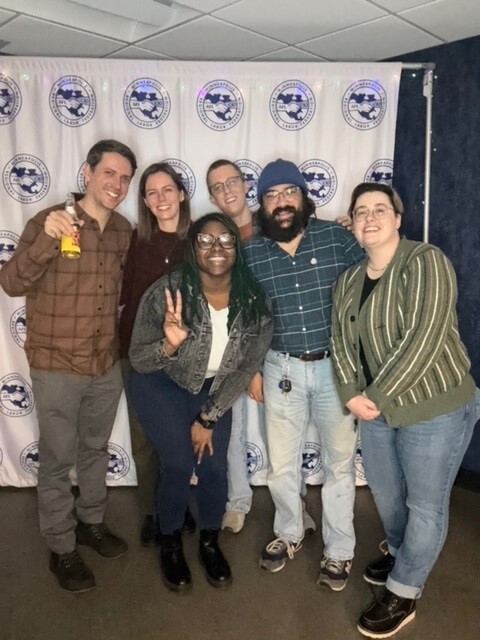
I had a great time at the Minneapolis Regional Labor Federation (MRLF) annual holiday gathering. It’s always great to cap off the year connecting with labor leaders and community members to celebrate worker power.
Council Member Wonsley with local labor leaders at the Minneapolis Regional Labor Federation holiday party.
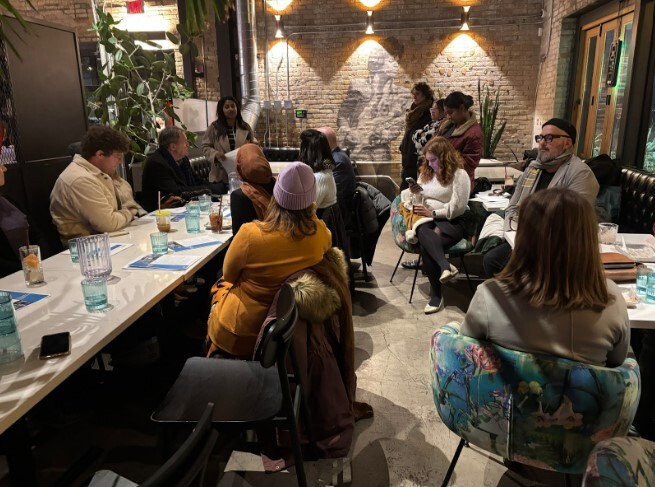
Intergovernmental Relations Chair Aurin Chowdhury organized an end-of-year happy hour for the State Senators and Representatives who make up the Minneapolis delegation to connect with Council and members of the executive branch. It was a great opportunity to reflect on the work we did as a city and state legislature this year, and gear up for 2025.
City and state leaders at the Minneapolis delegation happy hour.
I attended the annual Holiday Breakfast hosted by the Towerside Innovation District. As always, it was a wonderful opportunity to connect with Prospect Park leaders. The keynote speaker also mentioned the importance of social housing, a priority I recently advanced with several of my colleagues as an amendment to the 2025 Budget.
Towerside Innovation District leadership speaking at the Towerside Holiday Breakfast.
Contact Ward 2
Visit: minneapolismn.gov/ward2
Email: ward2@minneapolismn.gov
Phone: 612-673-2202
We've moved while work is being done in City Hall. Our office is in:
Room 100, Public Service Center
250 South 4th St.
Get directions
For reasonable accommodations or alternative format please contact 311. People who are deaf or hard of hearing can use a relay service to call 311 at 612-673-3000. TTY users call 612-263-6850. Para ayuda, llame al 311. Rau kev pab, hu 311. Hadii aad caawimaad u baahantahay, wac 311. |