|
Summary: The Administration and Enterprise Overtime Committee was asked to approve letters of agreement to change MPD’s policies on vacation accruals and critical staffing overtime. Both proposals had insufficient information on the cost to taxpayers.
Background: The Human Resources department brought forward two letters of agreement (LOAs) to change policies for MPD. LOAs are a tool for unions and employers to negotiate policy changes outside of contract negotiations. One of the key “reforms” that was celebrated in the most recent police contract was that it integrated all the outstanding LOAs into one contract, creating a unified policy document rather than a piecemeal package of agreements. At that time, the city’s labor relations team stated a desire to move away from adopting new LOAs because they impede workforce management.
Despite that stated intention, labor relations brought forward two new LOAs for MPD. One is for a policy change related to maximum vacation accruals, and another related to critical staffing overtime. Staff confirmed that neither of these policies was discussed during contract negotiations which directly contradicts the strategy they claimed to be adopting.
The first LOA would extend the maximum vacation that officers, inspectors, commanders, deputy chiefs, and assistant chiefs can accrue and/or cash out from 400 to 500 hours. Extremely confusingly, the fiscal note for this LOA states there would be a $0 impact for these changes. This does not accurately represent the cost to taxpayers. If all eligible officers were to take their full vacation accrual at one time, it would be likely to have huge impacts on MPD’s budget. I and several of my colleagues requested a more accurate fiscal analysis from staff. I motioned to forward the item without recommendation, giving us the opportunity to consider the LOA at Council when we may have more information.
The second LOA would establish a type of overtime called Critical Staffing Overtime (CSOT). While normal overtime is compensated at 1.5x an officer’s hourly rate, CSOT shifts are compensated at 2x hourly rate. The community group Communities United Against Police Brutality reached out to Council with a number of concerns around this provision. Many of these concerns resonated with me.
I also had several questions about how CSOT fits into the overall picture of office schedules. The previous interim police chief put in place a variety of policies to safeguard against officers working too many hours, which is dangerous for both the officer and the public, but Chief O’Hara has rolled back some of these safeguards. Here are some critical takeaways from the discussion that took place:
- Previously, there was a safeguard to ensure officers who work six shifts had to have a day off to rest, to prevent extreme fatigue that can put officers and the public in danger. Currently, MPD leadership were unable to share how many officers who have picked up critical staffing overtime shifts who were working past six days in a row.
- It was unclear that CSOT and off-duty are both tracked to ensure that no officer is working while in a state of extreme fatigue.
- MPD’s internal use of the word “critical” is vague and not necessarily tied to responding to priority calls. MPD leadership did affirm that MPD has used critical staffing overtime for encampment clearings, which I find deeply concerning.
- MPD leadership could not speak specifically to how they limit the possibility of officers abusing the CSOT system.
Residents have raised concerns that CSOT incentivizes officers to not take standard overtime shifts in order to get them reclassified as CSOT and earn more money for the same work.
In terms of the frequency and cost of CSOT, MPD leadership shared that officers worked a total of 112,000 hours on CSOT in 2023, and in 2024 they are on track to work 138,000 hours. So far in 2024, MPD has spent over $12 million on CSOT. They did not have a projection on how the cost of continuing CSOT in 2025 would compare to the cost of not continuing it and returning to only standard overtime, nor could they speak to the financial risk that could come from workers’ compensation or police misconduct claims due to extreme levels of overtime. They were unable to list the budgetary impact of CSOT in their 2025 budget, citing $0 on the fiscal note. This reinforces residents’ concerns that approving this LOA is a blank check to MPD with zero accountability.
As with the LOA about vacation accrual, the Committee voted to forward the item without recommendation to give MPD leadership and HR the opportunity to answer the outstanding questions on both items’ financial impact on taxpayers.
The police contract that council approved in July cost taxpayers $9 million dollars and made MPD some of the highest paid officers in the country. The financial cost associated with these LOA’s would increase that total figure, but it’s unclear by how much or for what benefit to the public.
Both items also underscore the serious need for an updated MPD staffing study. The first version of this study outlined all the ways that the city can reduce the workload on officers and fully staff all police calls with a number of officers far below the staffing minimum, and far below even the current staffing level. The Frey administration and MPD have had since February of 2022 to move forward with actions that would lower the workload of officers and expand public safety workers who can effectively respond to 911 calls. The recent Safe and Thriving Communities Gap Analysis, which is covered later in this newsletter, affirmed that 47% of 911 calls are candidates for diversion from MPD to another response. The slow-walking of this staffing study continues to impede the city’s ability to provide effective public safety services, and contributes to the massive budgetary impacts of excessive reliance on MPD at a time where we have a budget shortfall.
Council continues to wait for an updated MPD staffing study, which can provide much needed updates on how we can reduce the workload on officers so that we are not considering the use of expensive and potentially dangerous tools like CSOT.
Key votes: The Administration and Enterprise Oversight (AEO) Committee voted unanimously to forward both items without recommendation. They will be considered by the full Council on December 5th at 9:30am.
Summary: I authored a staff direction to research independent legal counsel for legislative bodies.
Background: Under the City Charter, the legislative branch (Council) and executive branch (Mayor) share one legal counsel, the City Attorney, who is appointed by the Mayor and confirmed by Council. Any potential changes to this structure would require a charter change. This staff direction begins that conversation.
Despite the promises of government structure creating strong boundaries and lanes between the executive and legislative branch, there still continues to be issues, especially as it relates to Council having access to standardized, neutral legal counsel from the city attorney’s office. I think it would be of great benefit for this body as well as the executive administrative side of the city to understand how other localities operate their legal services.
The government structure ordinance that was passed in 2022 was implemented via ordinances, which are much easier to amend and change than charter changes. The stated intention of this method was to allow us to experience the new government structure and make any necessary changes to improve the implementation. This has been described as a “trial” period.
After two years, there are significant challenges with how the city attorney’s office operates in providing advice and guidance to both branches of government. This current system struggles with managing the interests of the executive and legislative branch, which inhibits both branches of government to effectively carry out their responsibilities. The consequences of this isn’t always visible to residents because legal consultation often happens in closed meetings, but the role that the city attorney’s office has played has concretely impacted Council’s ability to advance resident priorities on matters like carbon fees, regulation of MPD’s off-duty work, and bus lanes.
It took many many years of conversations about the former government structure before the Charter Commission offered a change to voters on the 2021 ballot. We can’t explore possibilities until we have more information about the landscape. The staff direction is a start of a conversation to learn of potential opportunities and see if there is a shared desire to improve our system.
Key votes: The Administration and Enterprise Oversight (AEO) Committee voted unanimously in support of the staff direction. It will be considered by the full Council on December 5th at 9:30am.
Summary: I authored a legislative directive to determine what the administration would need to offer more mediation and restorative justice programs to residents.
Background: Since entering City Hall, I have been vocal about the need for the city to close the gaps of services needed for victims. In 2022, I brought a budget amendment forward to allocate funding for the city to begin to do work that would address this gap. Unfortunately, it was unsuccessful and it is unclear what actions, if any, have taken place to address these needs since then.
The recent shooting of resident Davis Moturi by his next door neighbor in what appears to be a racially motivated attack underscores the urgent need for programs and services that can help mediate conflict between neighbors, as well as identify situations that require preventative or responsive intervention. The shooting also highlights the urgent need for victims' services for both victims of crime and bystanders or neighbors who may be secondarily impacted. As outlined in the Safe and Thriving Communities Plan, the city’s guide for comprehensive public safety, investing in healing and restoration is crucial for interrupting cycles of violence and trauma.
The Hennepin County Attorney's Office and Minneapolis City Attorney's Office have developed successful restorative programs on a small scale, but restorative services have not been fully established and resourced within the city's Office of Community Safety. MPD and NAACP may be entering into a new partnership focused on mediation, but I hope that this legislative directive can provide Council and the public with the status of the city’s current work and outline what resources would be needed to significantly expand these services.
Key votes: Public Health and Safety (PHS) Committee unanimously approves legislative directive. It will be considered by the full Council on December 5th at 9:30am.
Summary: The Neighborhood Safety Department gave a presentation with a lot of clarifying context on the community trauma response funding proposal.
Background: A few weeks ago, the Administration and Enterprise Oversight (AEO) Committee received a report on the city’s spending of American Rescue Plan Act (ARPA) spending on community trauma response. Council Members and residents had many questions about which organizations had been selected and why, and the geographic distribution of the programming. I and other Council Members asked the Neighborhood Safety Department (NSD) leadership to share any information they had that demonstrated these organizations' experience or expertise in trauma response or violence prevention.
This week, NSD leadership gave an in-depth presentation that provided much more context and clarity. You can watch the presentation here starting at 1:16:00.
Key votes: The Administration and Enterprise Oversight (AEO) Committee voted unanimously to approve the Community Trauma Response contracts. The item will be considered by the full Council on December 5th at 9:30am.
Background: The City Attorney’s Office gave a presentation outlining the work of their civil division on risk mitigation for the city.
Summary: The City Attorney’s Office (CAO) is the city’s legal representation. The CAO has two divisions: Criminal, which prosecutes misdemeanors, and Civil, which includes Civil Litigation, Client Services, Implementation for the Settlement Agreement, and Labor and Employment. I requested that the CAO come present an overview of their Civil Division’s work, since it is hugely influential to nearly every element of the city’s work but often invisible to residents.
You can watch the presentation and discussion by the Committee here starting at 1:47:00.
Key votes: No votes taken.
Summary: The City Attorney’s Office has stated that the City Council and Administration cannot collaborate on and adopt plans. This is an extremely significant and troubling opinion. The Public Health and Safety Committee has delayed consideration of the Safe and Thriving Communities Report and Plan Resolution to have a larger conversation about the implications of this opinion.
Background: Since 2020, Minneapolis residents have made it clear that they wanted the city to create and enact a new public safety system that does not replicate the city’s history, but includes a variety of programs and services that go beyond policing.
The Minnesota Department of Human Rights settlement agreement and pending Department of Justice consent decree outline the legally mandated reforms to MPD, and the city has also received a 10-year plan for non-law enforcement safety services called the Safe and Thriving Communities Report and Plan. Safe and Thriving Communities provides the city with a detailed 10-year action plan on how the city can build a system that provides all residents with a variety of preventative, restorative, and responsive safety services.
The city celebrated the Safe and Thriving Communities Report and Plan when it was released more than a year ago, and while there has been some progress on some elements of the plan there has been no formal adoption of the plan. I have consistently advocated for the administration and Council to formally adopt this plan. Plans help clarify alignment around multi-year goals, which helps the executive and legislative branches use their respective authorities effectively. It also ensures that the public has an understanding of the city’s current actions and how they fit into a shared vision and direction. The lack of a clear plan for public safety has created challenges with transparency, administrative priorities, council’s ability to budget effectively, and more. That is why I have been working with the Frey administration for the first year to formally adopt the Safe and Thriving Communities Report and Plan as the city’s 10-year plan for public safety.
For several months, my office has met with the Office of Community Safety Commissioner Toddrick Barnette to discuss the process for an interest in formal adoption of the Safe and Thriving Communities Report and Plan. During our last conversation, Commissioner Barnette shared that the executive administration would not be bringing the Safe and Thriving Communities Plan to Council for legislative adoption. Given this, I decided to move forward with a resolution that expresses strong support for adoption of the Safe and Thriving Communities Report and Plan.
This resolution aimed to show to the public that Council is more than ready to formally adopt a public safety plan in conjunction with the Mayor’s administration. It would also act as a public record upon which residents could hold us accountable to. Additionally, this resolution would solidify our commitment to fully fund and expand our non-armed safety programs, since Council is the city’s budgeting body. Lastly, this resolution would indicate to the public that despite whatever actions or inactions may happen under this administration, Council intends to use the Safe and Thriving Communities Report and Plan as our guide for funding, oversight, and policymaking to improve public safety in our city.
However, just a few days before the Committee was set to consider the resolution, the City Attorney’s Office gave an opinion that under the new government structure, the City Council and Mayor can no longer work together to adopt any action plans.
This is an extremely consequential opinion. Cities nationwide, including Minneapolis, use action plans to improve alignment around long-term goals and help the executive and legislative branches prioritize, strategize, budget, and uphold transparency and accountability on cities’ most pressing issues. Minneapolis uses many plans, such as the Transportation Action Plan, Racial Equity Framework for Transportation, Climate Equity Plan, Zero Waste Plan, and more to guide our policymaking, budgetary, administration, and oversight priorities. The new opinion from the City Attorney’s Office means these plans will no longer happen in the City of Minneapolis.
Action plans are a critical component of cohesion for our government. Eliminating adopted action plans as a tool effectively ensures that there is no formal alignment between council and the administration on the most important issues of our city, regardless of who is in office.
My colleagues on PHS were understandably alarmed by this new opinion and its many implications. Committee members commented on the deep impacts this would have on large elements of our government’s operations, including the need to massively restructure staff positions from the executive administration to the legislative branch to support a huge increase in the passage of ordinances.
I and my colleagues need time to process this new information and strategize on how to effectively move forward in a landscape where strategic multi-year plans are not a tool that is available to us. I motioned to delay the resolution until the first PHS cycle next year to give Council Members time to process this information and figure out next steps.
Key votes: The Public Health and Safety (PHS) Committee votes unanimously to delay consideration of the Safe and Thriving Communities Resolution to create more time for consideration of the City Attorney’s new opinion that action plans are not a tool that can be used under the new government structure. The PHS Committee will return to the item in early January at the first meeting of the year.
Summary: The Public Health and Safety Committee received a report on the city’s strengths and gaps on implementing a public safety program that goes beyond policing. The presentation affirms that the city is making progress towards shifting to a comprehensive system, and that there are many opportunities to continue to diversify public safety services.
Background: The Safe and Thriving Communities Report and Plan is the city’s detailed 10-year action plan on how the city can build a system that provides all residents with a variety of preventative, restorative, and responsive safety services. The city has a contract with the New York University Policing Project to help implement the plan. The first part of this contract was to assess what the city’s accomplishments and assets are in terms of implementation, and where there are gaps and opportunities to prioritize this year.
The presentation was extremely interesting and I encourage everyone to review the slides or watch the recording here starting at 2:35:00. Some highlights include:
- The city is already diverting almost 9% of 911 calls to non-police response, including Behavior Crisis Response, Traffic Control, Animal Control, and 311.
- 47% of 911 calls are good candidates for diversion from police response.
- Minneapolis has a strong portfolio of responsive services, as well as room to improve.
- Minneapolis has lots of room to improve preventative and restorative services.
- There are dozens of specific and actionable recommendations that the city now has to take action on to improve our public safety system.
- The city should continue to use both internal and external evaluation to assess and fill gaps.
This presentation underscores that Council is successfully leading the development of a public safety system that goes beyond policing. I am so excited to continue working with my colleagues, residents, community leaders, and national experts to expand this work.
Key votes: No votes taken.
Summary: Council received a quarterly update from the Office of Community Safety.
Background: Council receives quarterly updates from the Office of Community Safety, which includes a report from each of the five departments within OCS as well as a report from the Commissioner of Community Safety, who leads the coordination of the five departments. The presentations from Fire, MPD, Neighborhood Safety, Emergency Management, and 911 included the latest updates on each division’s staffing, recent priorities, upcoming priorities, and more. You can watch the presentation here starting at 0:12:55.
I was pleased that the Neighborhood Safety Department (NSD) shared that they have increased their collaboration with the city’s Procurement Department, as well as with national technical assistance providers. However, I was deeply concerned to learn that the City Attorney’s Office has informed the NSD that contracts with community providers cannot include client services such as temporary housing, food, and transportation. These services are indispensable to violence prevention work as they allow providers to intervene in the lives of residents who are at risk of committing violence and offer them the basic needs and resources that are required to divert them into a safer situation. This is a widely recognized practice that cities and counties around the country support through contracts with community groups, including Hennepin County. It’s therefore extremely confusing that the City Attorney’s Office is now stating that these types of expenditures are ineligible for public funds. This conversation needs to continue so that we can ensure our NSD is able to offer contracts that support all the services needed for violence prevention professionals to be successful.
Key votes: No votes taken.
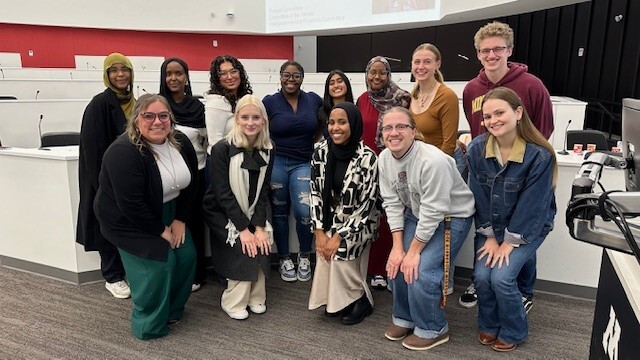
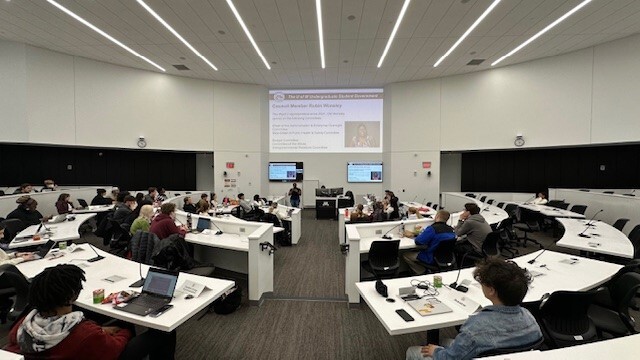
I spoke to the Undergraduate Student Government Forum, the highest leadership body of the 40,000 undergraduate students at the University of Minnesota Twin Cities. It was so great to connect with student leaders about the issues that matter most to them, including food access, mental health, and public safety.
CM Wonsley with Undergraduate Student Government leadership
Undergraduate Student Government forum
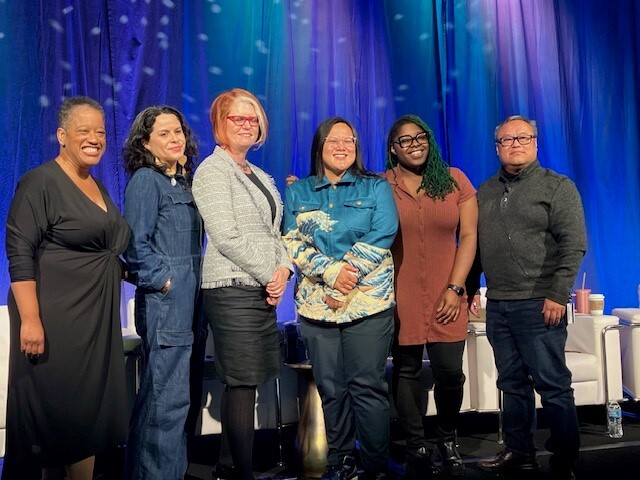
I was honored to speak at the Association for the Study of Higher Education (ASHE) Annual Conference to speak on a plenary panel called The Paradox of Minnesota Nice: Progression and Regression in the State’s Past and Present. It was a fantastic conversation led by our moderator Dr. Tania Mitchell and my co-panelists, County Commissioner Irene Fernando, Professor Lee Pao Xiong, Dr. Kate Beane, and Dr. Kristen Delegard. Thank you to everyone who attended and engaged in this meaningful conversation.
CM Wonsley with her co-panelists on the Association for the Study of Higher Education Annual Conference plenary panel The Paradox of Minnesota Nice: Progression and Regression in the State’s Past and Present. Left to Right: Dr. Tania Mitchell, Dr. Kate Beane, Dr. Kristen Delegard, County Commissioner Irene Fernando, Council Member Wonsley, and Professor Lee Pao Xiong.
Neighbors in Seward invited me to tour their new traffic calming and safety installation: a beautiful mural on the street and sidewalk. These neighbors worked with their neighborhood association and navigated a complex series of approvals from city departments to ensure that the street painting was implemented in line with traffic safety standards. I look forward to helping other neighbors replicate this process to improve safety, calm traffic, and beautify their neighborhoods.
CM Wonsley with Seward neighbors on new traffic calming mural
Contact Ward 2
Visit: minneapolismn.gov/ward2
Email: ward2@minneapolismn.gov
Phone: 612-673-2202
We've moved while work is being done in City Hall. Our office is in:
Room 100, Public Service Center
250 South 4th St.
Get directions
For reasonable accommodations or alternative format please contact 311. People who are deaf or hard of hearing can use a relay service to call 311 at 612-673-3000. TTY users call 612-263-6850. Para ayuda, llame al 311. Rau kev pab, hu 311. Hadii aad caawimaad u baahantahay, wac 311. |