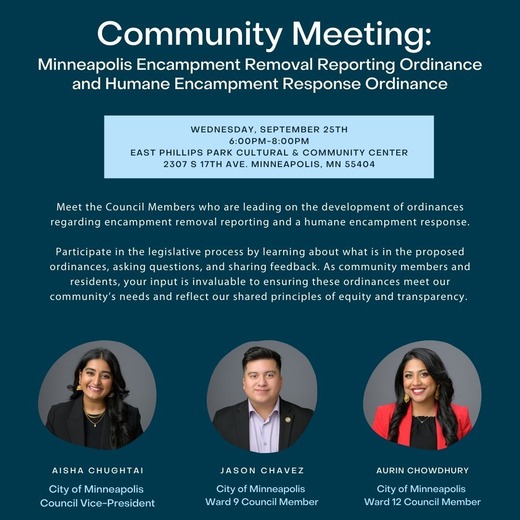
 Meet the Council Members who are leading on the development of ordinances regarding encampment removal reporting and a humane encampment response.
Participate in the legislative process by learning about what is in the proposed ordinances, asking questions, and sharing feedback. As community members and residents, your input is invaluable to ensuring these ordinances meet our community’s needs and reflect our shared principles of equity and transparency.
When? Wednesday, September 25, 2024.
Where? East Phillips Park Cultural and Community Center (2307 17th Ave South)
Time? 6:00 PM - 8:00 PM
The City will be giving an update on 3000 Minnehaha and their proposed plan to used this place as an Election and Voter Services Center, a warehouse, and some community space.
Food and refreshments will be provided.
- Wednesday, October 2nd, 2024, from 5:30-7:30 PM
- Location: Minneapolis American Indian Center, 1530 E Franklin Ave, Minneapolis, MN 55404
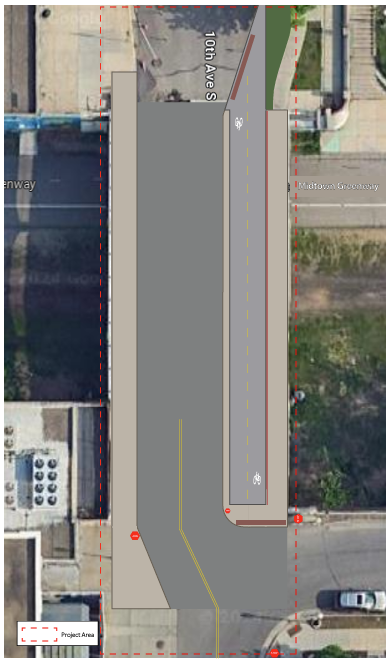 This project will rehabilitate the 10th Avenue South Bridge over the Midtown Greenway. The area adjacent to the project includes mixed use, park area owned and operated by the Minneapolis Park & Recreation Board, and the Midtown Greenway. The old bridge has been closed to motor vehicles since 2021 due to structural deficiencies. This bridge is a contributing resource to the historic Midtown Greenway corridor.
This project has the following goal statements:
- Safer conditions for walking, biking, and rolling.
- More ways to get around for everyone.
- Replace and rehabilitate aging infrastructure.
- Develop in accordance with Transportation Action Plan and Street Design Guide.
10th Avenue South is defined as an Urban Neighborhood street per the City’s Street Design Guide, with parkland and mixed use land uses abutting the project area. Key features of the concept layout include:
- Two-way vehicle traffic on the bridge
- Sidewalk on both sides of the bridge
- Dedicated sidewalk level space for a protected bikeway on the east side of the bridge
- Improved alignment of southbound vehicles on approach to East 29th Street
- Introduction of an all-way stop at the intersection of 10th Avenue South at East 29th Street
- Signage and striping
- Street lighting
The concept layout for this bridge project aligns with the Green Central Safe Routes to School project that extends to East 29th Street, by upgrading the bikeway connection to the access point to the Midtown Greenway just north of the bridge.
This is a cooperative project led by Hennepin County in coordination with the City. The project will reconstruct Cedar Avenue between East Lake Street and E. 24th St. The project length is approximately 0.75 miles.
The scope of work includes full reconstruction of Cedar Avenue, reconfiguring the current street width that originally accommodated a four-lane undivided street into a street with one lane each direction, left turn lanes at significant intersections, and medians. The project will set up the street for potential future arterial bus rapid transit (BRT), identified in the Metropolitan Council 2040 Transportation Policy Plan as a candidate corridor for arterial BRT expansion between 2030 and 2040, add pedestrian space at transit stop locations, add a separated two-way bikeway and shared use paths from E 24th Street to E 28th Street, and expand boulevards with trees.
This project has the following goals:
- Make it more comfortable for people walking, biking, rolling and using transit along the corridor;
- Build a road for today and tomorrow that reflects the community’s values;
- Design a more livable, calmer, safer street;
- Make it easier to access nearby community destinations including parks, trails, and local businesses;
- Preserve existing tree canopy and increase greening along the corridor;
- Replace and modernize aging infrastructure, such as traffic signals and stormwater facilities.
Key features of the concept layout include:
- A single travel lane in each direction for motor vehicles.
- Left turn lanes or medians at key locations along the corridor.
- Consistent and improved sidewalk space that allows for safe access for people walking and rolling.
- Off-street two-way separated bike lanes at sidewalk level between E. 24th and E. 28th streets. Between the pedestrian crossing at Little Earth and E. 26th St., the bikeway becomes a shared use path to preserve a row of mature trees.
- Maintaining trees in the corridor was identified as the highest priority by the community.
- Intersection improvements including marked crosswalks, marked bike crossings, traffic signal replacements, curb extensions, ADA-compliant pedestrian ramps, and medians.
- Regularly spaced in-lane bus stops with medians provided to prevent vehicles from passing transit buses stopped in the travel lane at transit stops.
- Median limiting left turns at E. 27th St. to encourage turns at safer adjacent intersections.
- Bus stop waiting areas with space to accommodate shelters, to be installed by Metro Transit.
- Raised crossings across side streets at unsignalized Urban Neighborhood streets, where feasible. The feasibility to construct raised crosswalks at stop-controlled side streets will be evaluated and confirmed during final design, which entails investigating grades to manage drainage needs and meet ADA curb ramp design requirements.
- Expanded green boulevards and tree planting.
- Removal of on-street parking on Cedar Ave. north of E. 28th St. and on the east side from E. 28th St. to E. Lake St. Currently, parking is allowed and had low usage rates in areas parking is being removed based upon data collected by the project team. During engagement efforts, parking was identified as a low priority for the community.
- New pavement, subbase, curb, and gutter.
- Signage and striping.
- Pedestrian scale street lighting.
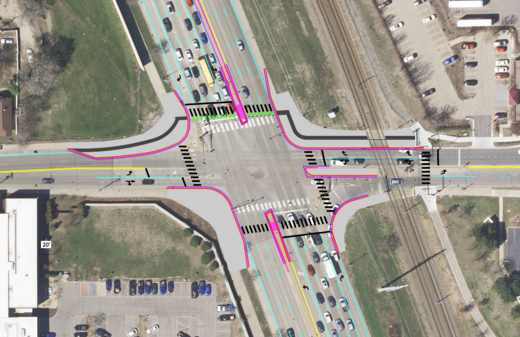 This is a cooperative project led by the City in close partnership with MnDOT and Metro Transit. With the support of MnDOT, Minneapolis applied for federal funding to make needed safety improvements at the intersection of 26th Street E. and Hiawatha Ave. This intersection is among the city’s most dangerous, including crashes ranging from property damage to death and serious injury, impacting those walking, rolling, biking, and driving. It is the intersection with the highest number of death and serious injuries and the seventh highest for total number of crashes.
The scope of work will include strategic safety retrofits to reconfigure the intersection by adding bump outs, refuge medians, and a new bikeway across Hiawatha Avenue.
The existing intersection is located just south of downtown Minneapolis. Both I-94 and I-35W have access to Hiawatha Avenue and cars exit to southbound Hiawatha with freeway speeds. This intersection represents the first signalized intersection (southbound) or last signalized intersection (northbound) and cars are transitioning to/from a multi-lane urban highway with signalized intersections. The proposed improvements will de-emphasize speed for car travel along Hiawatha Avenue and provide more physical cues to drivers that they should slow down as they approach an intersection that provides critical access and mobility for non-motorized users. Key features of the concept layout include:
- Generally reduces pedestrian and bicycle crossing distances;
- Expands refuge island medians at the north, east, and south legs
- Improved bikeway crossing along the north leg;
- Eliminates free right turns off Hiawatha Ave by removing the slip lanes;
- Removing one westbound lane on 26th Street East
Do you care about standing up for civil rights in our community? Now’s your chance to make a real difference! Apply to join the Minneapolis Civil Rights Commission and help protect the rights of everyone in our city.
The Minneapolis Civil Rights Commission is a 21-member team of dedicated city residents, including 6-8 lawyers, all volunteering their time to champion civil rights. This dynamic group leads the charge in identifying and addressing civil rights issues, engaging with elected officials and the Civil Rights Department, and educating the public about their rights under the Minneapolis Civil Rights Ordinance.
What sets the Commission apart? Its unique role in adjudicating discrimination cases. As a member, you'll review appeals of Department decisions and hold public hearings in discrimination cases, ensuring justice and fairness in our community.
Who can join? They have openings for both attorney and non-attorney seats. Serving on the Commission is a powerful way to:
-
Engage with Your Community: Be at the forefront of civil rights initiatives.
-
Work with City Officials: Collaborate with elected leaders and the Civil Rights Department.
-
Make Your Voice Heard: Play an active role in decision-making and advocacy.
Applications are open now until September 30th—don’t miss out on this amazing opportunity!
Apply now: Boards & Commissions Current Openings.
The New Nicollet project team wants to hear from you, the people who live, work, and play near the New Nicollet site. The City of Minneapolis plans to reconnect Nicollet Avenue between Lake Street and Cecil Newman Lane, through the old Kmart site, beginning in 2025. After road construction, the City will work in partnership to develop the remaining site into a high-density, mixed-use, walkable area.
We want to hear about your priorities and desires for the site, so we can reflect that in the design and outcomes of the future redevelopment.
Right now, the City wants your input on the priorities for property uses and buildings on the New Nicollet site. For this phase of engagement, there are two big opportunities for everyone to get involved:
Visit the project webpage to find updated project information, project events and ways to get involved.
Please email staff with any questions.
Community members are invited to learn strategies for effectively engaging Minneapolis communities through this free learning lab series. Meet City staff and organizations doing community engagement work, and learn more about how the City engages residents.
Afternoon and evening schedules are available. Afternoon learning labs will be in person from noon-1:30 p.m. The evening learning labs will be online from 5-6:30 p.m. or 6-7:30 p.m.
Topics
The material covered in these learning labs includes historical events that continue to affect communities. Labs also touch on effective, appropriate modes of communication relevant to each community, major gathering places, events and holidays, etc.
Take a look at the schedule and the topics offered, and save your spot.
The City and the engagement team (4RM+ULA and the Cultural Wellness Center) are holding the fifth and final visioning workshop Sept. 24 for George Floyd Square. Topics will focus on memorial locations, the Peoples Way site and right-of-way design priorities. This event will continue the discussion to create a community-centered vision for the area.
Visioning workshop on the future of George Floyd Square 5:30-8 p.m. Tuesday, Sept. 24 The Square at the Chicago Ave Shops, 3736 Chicago Ave. Read more about the event. RSVP.
Food and refreshments will be served.
Next steps
A dinner dialogue will be held in October to share our findings.
Sign up for updates
Have friends or neighbors interested in this topic? Forward this newsletter or encourage them to sign up for future updates.
To learn more about the City's efforts at George Floyd Square, visit the program webpage
Voters can cast their ballots early by mail or in person at the Early Vote Center, 980 E. Hennepin Ave., starting Sept. 20.
Voting by mail
All mail-in ballots need to be received by Election Day (Nov. 5) to count. If you choose to deliver your ballot in person to the Elections & Voter Services office, it must be returned by 8 p.m. on Election Day, Nov. 5. Mail ballots cannot be dropped off at polling places on Election Day.
Find more information on how to vote by mail on the City website.
Voting at the Early Vote Center
The Early Vote Center, 980 E. Hennepin Ave., makes early in-person voting more convenient for Minneapolis voters. It’s especially helpful if you need language support or other special accommodations, such as curbside voting. Voting early can also help you avoid lines and crowds at polling places on the day of the election.
The Early Vote Center’s hours are 8 a.m.-4:30 p.m. Monday-Friday. The center will extend its hours for the final two weeks of voting, including Saturdays and Sundays. Find all Early Vote Center hours on the City website.
For more information about registering and voting in Minneapolis, go to the City website.
Paying to repair your private sewer line that connects to the public sewer can be expensive. But if your line has cracks in it, tree roots growing into it, or gaps in the connections, it has to be fixed. This pipe carries your wastewater from your toilet, sink, shower, laundry, dishwasher, etc. to the public sanitary sewer in the street.
Help paying for a repair
The property owner is responsible for the line from the home to the public sewer. If you need help paying for a repair to your private sewer line, you might get help from a property tax assessment, an upcoming grant program or private insurance.
- Property tax assessment:
- Grant program: City staff hope to receive funding from the Metropolitan Council in 2025 to help homeowners pay for private sewer line repairs. For more information about this program, visit the City website and sign up to get an email when funding is available.
- Private insurance: Some private insurance companies offer an endorsement or rider to help pay for the cost of a private sewer line repair. This needs you to take action before you find out your line needs repair. Contact your insurance company to see if this is an option. When doing so, get a quote for the annual cost, coverage limit and deductible. Make sure to read the fine print.
Read more about home sewer maintenance on the City website.
Contact the Ward 9 Office
Email: jason.chavez@minneapolismn.gov
Phone: 612-673-2209
We've moved while work is being done in City Hall. Our office is in:
Room 100, Public Service Center
450 South 4th St.
Get directions
For reasonable accommodations or alternative format please contact 311. People who are deaf or hard of hearing can use a relay service to call 311 at 612-673-3000. TTY users call 612-263-6850. Para ayuda, llame al 311. Rau kev pab, hu 311. Hadii aad caawimaad u baahantahay, wac 311. |