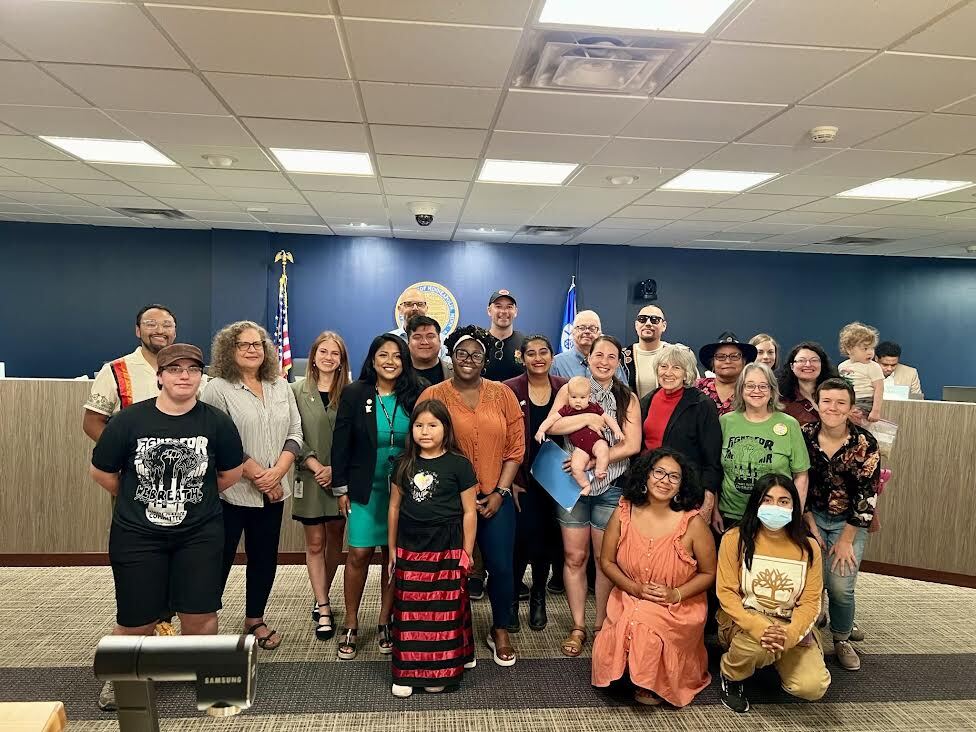
 After a century of operation in East Phillips, Smith Foundry recently shut down its operations. This came after a recent settlement with the U.S. Environmental Protection Agency after they uncovered excessive pollutants around the plant and ordered the Foundry’s owners to pay an $80,000 fine. In the end, though, it was years and decades of organizing by individuals and organizations that led to this victory for our community.
And that is why I introduced a resolution to honor the individuals and organizations who put in the work to improve Phillips and the City of Minneapolis. The reason we did this is because many of the organizers in Phillips, South Minneapolis, and the City as a whole have been advocating for clean air and water in Phillips for too long. There may have been some government action to try and close down Smith Foundry, but ultimately that wasn’t what made it happen. It was the organizing efforts of the people on the ground advocating for change. Advocating for the right to breathe clean air in Phillips.
We all owe a debt of gratitude to the organizers who took on this fight and made our community a healthier, safer place.
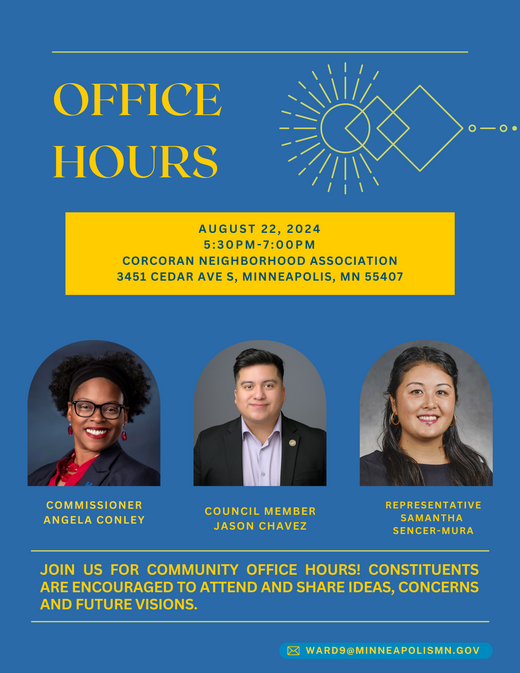 Join our next community office hours that we are hosting with Commissioner Angela Conley and Representative Sencer-Mura.
This will take place on August 22, 2024, at the Corcoran Neighborhood Association from 5:30PM-7:00PM (3451 Cedar Ave South).
Mayor Jacob Frey delivered his 2025 budget address on Aug. 14. The Mayor’s proposed 2025 budget totals $1.88 billion with an 8.1% increase in the tax levy.
Budgets are moral documents, and they must reflect the priorities of our residents. I hardly see the priorities I submitted to the Mayor for Ward 9 included in the proposed budget, so I’ll be using the budget amendment process over the coming months to ensure that critical investments are made in our communities.
Whether that means cutting ineffective budgets to lower the levy or reallocating funding to programs residents need, my office will be making changes to this budget.
Read more about the proposed 2025 budget.
The Minneapolis City Council passed an ordinance authored by Council Member Wonsley and Council Member Ellison amending the Vacancy Building Registration, which is the city’s program for buildings that are hazardous or condemned.
The VBR is a registry of properties that are condemned, boarded, or hazardous. When a property becomes hazardous or condemned, it is added to the VBR program. The owner is charged a flat fee of about $7,100 per year, and in exchange for this fee the city helps the property owner keep the property boarded up and supports the owner in either selling, rehabilitating, or demolishing the property. The VBR program has helped provide many property owners with resources and support to convert hazardous vacant properties into active assets in the community. But there are still too many condemned and boarded properties that are hurting our neighborhoods, especially Black, brown and working class neighborhoods.
There is no limit to the amount of time a property can stay in the VBR program, and some have been in the program for decades. This ordinance gives a property owner two years to get the property back up to code, with an optional third year if they apply and can prove they are making progress. After two or three years, the property will be removed from the program and the city will start to enforce citations for code violations, which cost up to $24,000 per year.
Creating a time limit for VBR eligibility will help address these chronic vacancies and support city efforts to increase more housing, more commercial space, and have fewer hazardous properties in our neighborhoods.
Cities United, Health Alliance for Violence Prevention, John Jay's National Network for Safe Communities, and the National Offices of Violence Prevention are all national organizations doing innovative work to advance successful violence prevention strategies that are rooted in a public health approach. Many of these organizations have worked with the City of Minneapolis in previous years and supported successful implementation of violence prevention strategies when the city still operated these programs through the Office of Violence Prevention (OVP).
At the August 7 Public Health and Safety Committee meeting, we heard a presentation from those organizations meant to help council members understand how best national practices can be incorporated in the City of Minneapolis' programming as well as learn more about national trends, insights, challenges, and successes of this work.
Attorneys from the Immigration Law Unit explain, in English and Spanish, the new federal program starting Aug. 19 to help immigrant spouses of U.S. citizens. The application process is outlined, as well as a caution to watch out for scams.
Legal Aid wants to be sure that our immigrant communities are informed about the legitimate effort to start a pathway to citizenship and to understand there may be look-alike programs that may use this opportunity to take advantage of them. You can watch a video of the webinar here.
The City’s 100th electric vehicle has gone into service. The City is driving an ambitious policy for a Public Works fleet with no emissions. This is just one part of the City’s Climate Equity Plan to reach aggressive climate goals over the next 10 years.
Besides the 100 electric vehicles now on city streets, 41 more have been delivered and 11 more are on order. Forty-nine fleet charging stations are installed with another 43 scheduled for this year.
The City’s new Climate Equity Plan set a goal to slash climate pollution by 2030 and become carbon neutral by 2050. The plan's initiatives also aim to weatherize all homes, reduce utility bills, train workers for green jobs, and plant more trees.
Air pollution is linked to increased rates of cancer, heart and lung disease, asthma and allergies. Carbon dioxide pollution, a greenhouse gas, causes climate change. Cars and trucks are the largest contributor of air pollution within Minneapolis and are a significant source of greenhouse gasses.
Council Member Wonsley and I worked with our BCR team to get un update in the Public Health and Safety Committee on the program and to learn how we can support the growth.
The Behavioral Crisis Response Team responds to mental and emotional health crises. They are available via 911. They can be dispatched without police if there is not an immediate danger, or with MPD or Fire if needed to ensure safety for the BCR responders. BCR has been widely celebrated since it was first implemented, winning national recognition and responding to over 10,000 calls in Minneapolis.
In their presentation they asked Council to support them in several ways which I support:
- Allocate funding to NSD to purchase & operate BCR supervisor vehicle.
- Partner with Canopy to increase awareness of the BCR via local community engagement and state/federal advocacy.
- Conduct pay equity analysis for mental health first responders compared to traditional first responders.
They identified some challenges and opportunities:
- Optimize the Neighborhood Safety Department’s (NSD) structure to
ensure BCR services are prioritized.
- Ongoing need for a dedicated vehicle for BCR supervisors for use when they need to support an active BCR team in the field.
- High inflation rates caused large cost of living increases in the last few years.
- Competitive wages are needed to continue attracting and retaining
high quality responders.
- Policies & procedures must adapt to evolving public safety response needs between the BCR and traditional first responder agencies.
They discusses their successes and progress:
- Expanded to 24/7 service operation as of June 2023 with 3 vans responding citywide.
- Launched the Canopy Roots Community Advisory Board (CAB) to ensure that community members can help guide future developments in the mental health first responder field.
- Selected as a recipient of the Harvard Alternative Response Technical Assistance program to support ongoing program improvements.
- Building community awareness of the BCR through numerous events over the past year with intentionality towards historically underrepresented and marginalized communities.
- Continuing to develop and maintain strong relationships with partner agencies and community organizations.
Here is the presentation on their services.
 August is National Immunization Awareness Month and the start of back-to-school kickoff time. As caregivers get their children ready to head back to school, ensuring their vaccinations are up to date should be at the top of the checklist.
Nearly 40 percent of children enrolled in Minneapolis Public Schools are behind on their childhood vaccines. If you’re a parent or guardian, talk with your healthcare provider to stay current with your child’s immunizations. It can help your family avoid missing school, activities, work, family events and vacation.
Resources
Listen to City health experts talking about the importance of vaccinations this month:
 The City Trees program is offering $30 trees now through Sept. 30. Minneapolis residents and property owners can purchase up to three trees per address. Choose from shade trees, fruit trees, flowering trees and evergreen trees.
Benefits of trees: Trees provide shade, lower utility bills, increase property value, clean the air, collect storm water, provide habitat for wildlife, and improve mental health and well-being. Purchase a tree today while supplies last.
City Trees program: Since the program began in 2006, the City Trees program has provided more than 20,000 low-cost trees for planting on private property, with 7,500 trees distributed in the last five years. Learn more about our City Trees program.
Low-cost trees for businesses: Businesses, nonprofits, organizations, and owners of properties with five or more units can also purchase $30 trees. Submit an application before Sept. 15.
A public comment period is now open for a report to the U.S. Department of Housing & Urban Development with a public hearing Aug. 20.
The Minneapolis Consolidated Annual Performance and Evaluation Report reviews how the City used its HUD entitlement grant funds. These funds support the City’s housing and community development strategies for residents with low and moderate incomes. The City will submit the final report to HUD at the end of August.
Programs, projects and strategies supported by these funds helped with the following goals:
- Provide decent affordable housing.
- Develop housing and services for people experiencing homelessness.
- Provide special needs housing.
- Expand economic opportunities.
- Improve neighborhood conditions.
Discover how over $18 million in funding was put to use in our community. What are your thoughts on how funds were used? Are there strategies in support of the above goals the City should consider as it develops its budget later this fall?
Public hearing
1:30 p.m. before the Business, Housing and Zoning Committee
Tuesday, Aug. 20
Public Service Center, 250 Fourth St. S., Council Chamber, Room 350
Find out how to participate in the public hearing. Written comments can also be submitted at the public hearing and to Matthew Bower through Aug. 27. Find the full report on the City website.
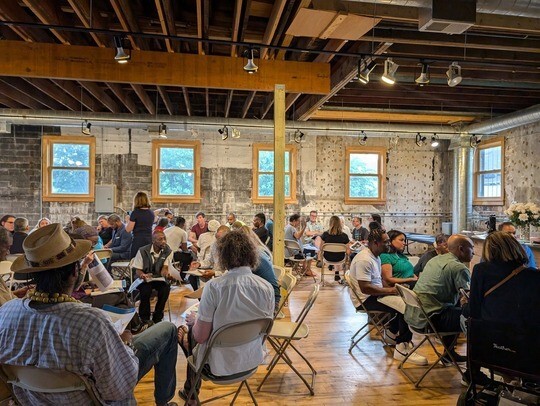 The City and the engagement team (4RM+ULA and the Cultural Wellness Center) are holding the fourth visioning workshop for George Floyd Square Aug. 27. Topics will focus on memorial locations, the Peoples’ Way site, and right-of-way design priorities. This event will continue the discussion to create a community-centered vision for the area.
August visioning workshop on the future of George Floyd Square
- 5:30-8 p.m. Tuesday, Aug. 27
- The Square at Chicago Ave. Shops, 3736 Chicago Ave. S.
- RSVP
Read more about the event. To learn more about the City's efforts at George Floyd Square, visit the program webpage.
If your child has a mental, behavioral or emotional issue that leaves you overwhelmed, Hennepin County offers help. Support is free and quick. There are no specific criteria required for Family Response support, but concerns may include children or youths who are:
- Having a hard time with a family member or change in the home.
- Showing aggression or anger.
- Feeling down or less engaged.
- Feeling worry and concern.
- Having issues at school.
Learn more about how to get support from the Family Response and Stabilization Service on the Hennepin County website.
Contact the Ward 9 Office
Email: jason.chavez@minneapolismn.gov
Phone: 612-673-2209
We've moved while work is being done in City Hall. Our office is in:
Room 100, Public Service Center
450 South 4th St.
Get directions
For reasonable accommodations or alternative format please contact 311. People who are deaf or hard of hearing can use a relay service to call 311 at 612-673-3000. TTY users call 612-263-6850. Para ayuda, llame al 311. Rau kev pab, hu 311. Hadii aad caawimaad u baahantahay, wac 311. |