|
Dear Community,
As I begin my second term, I am inspired by our residents’ commitment toward building a just Minneapolis that prioritizes people over profits. This term, my focus will be on housing, public safety and economic development. You can read more about my priorities in my recent MinnPost article.
I'm excited to immediately begin work on one of my climate equity priorities, pollution control fees, at the Public Health and Safety Committee on January 31st at 1:30pm. I authored the legislative directive on pollution control fees last year after hundreds of residents organized and asked the Council to lead on this important environmental justice issue.
Far too often, Minneapolis residents’ experiences, expertise and needs are dismissed at City Hall. I am walking into this next term excited to work alongside our communities across Minneapolis to accomplish these initiatives and so much more.
Sincerely,
Council Member Robin Wonsley
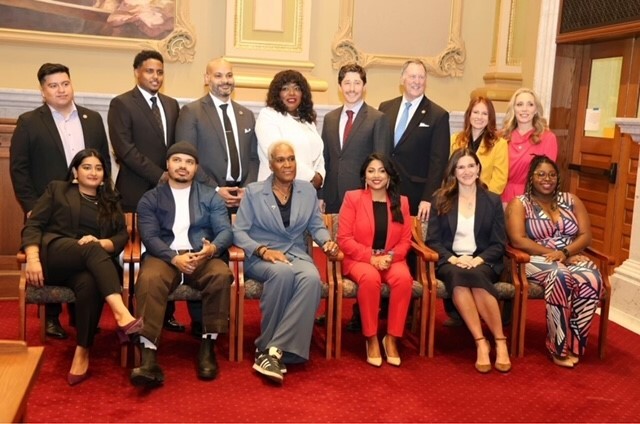
The City Council held our Organizational Meeting where we elect leadership, set committees, and arrange our schedule for the year. Council Member Elliott Payne (Ward 1) was elected Council President, and Council Member Aisha Chughtai (Ward 10) was elected Vice President. I look forward to working with Council President Payne, Council Vice President Chughtai, and all my colleagues to advance working class residents’ priorities.
This term I will be the Chair of the Administration and Enterprise Oversight (AEO) Committee, serving with Vice Chair Linea Palmisano (Ward 13). This committee replaces the Policy and Government Oversight (POGO) Committee. AEO will exercise oversight and evaluation on all matters related to general government, enterprise and administration operations not assigned to other committees. It will also receive regular reports and presentations about the City’s Strategic Racial Equity Action Plan and evaluate the Mayor’s Office and administration on efforts to recruit and retain employees, eliminate corruptions and unnecessary waste of taxpayer resources, and foster a healthy, ethical enterprise culture.
I will also be the Vice Chair of the Public Health and Safety (PHS) Committee, serving with Chair Jason Chavez (Ward 9). The PHS Committee will exercise oversight and evaluation on all matter related to public health and social service programs and initiatives, including civil rights, labor and workers’ rights, environmental justice, opioid epidemic response, and all policies and service delivery related to community safety services including but not limited to emergency management and response, fire and emergency medical services, police and safety-beyond-policing initiatives and programming, and related matters.
You can read more about the Committees, including leadership, membership, topics areas, and schedules, on the city website.
Key votes: Committee voted 10-3 to approve Council Member Payne as President. Council Members Vetaw, Jenkins, and Palmisano voted in opposition. Council voted 7-6 against approving Council Member Vetaw as Vice President, and then voted 8-5 to approve Council Member Aisha Chughtai as Vice President. Council Members Rainville, Vetaw, Jenkins, Koski, and Palmisano voted against approving Council Member Chughtai.
After my office published a statement on the violence in Israel and Gaza on October 11th, residents started reaching out to process the immense traumas that were activated in so many communities. Since October, my office has been working with Palestinian-led, Muslim-led, and Jewish-led community groups on developing a resolution calling for the end of military escalation in Gaza.
I have received questions about why Minneapolis should take an official position on foreign policy. I believe Minneapolis has the responsibility to join the national and global movement standing against the genocide taking place in Palestine, which for decades has been under occupation and apartheid conditions. Representative Ilhan Omar, whose district includes Minneapolis, has been vocal on supporting a ceasefire. Many residents have shared their frustrations that Senators Smith and Klobuchar have yet to make a public call for a ceasefire. The Minneapolis City Council passing this resolution sends a clear signal to our federal representatives and the Biden Administration that our residents do not support their tax dollars funding genocide.
For the past three months, millions of people around the world have had the moral clarity and courage to take a stance and condemn Israel’s genocide in Gaza, including the vast majority of the UN, vast numbers of human rights organizations, academics, historians, doctors, journalists, and Minneapolis residents. Sixty-one percent of voters, including 76% of Democrats, support a ceasefire. To stay silent on this genocide is to be on the wrong side of history. Silence also enables the US to remain complicit in the military-backed destruction of Gaza and the Palestinian people.
Transformative and progressive change in our society only happens when ordinary people and public officials decide to take hard but morally correct stances. The abolitionist movement in the 1800s forced people to take a stand against the inhumane system of chattel slavery. The Civil Rights Movement challenged millions of people to take public stances against the system of racial segregation.
At a Jewish-led Chanukkah for Ceasefire rally in December, I shared publicly that I would be bringing a resolution calling for an immediate ceasefire for a vote at the Council’s organizational meeting on January 8th. By passing this resolution, Minneapolis could join the broad coalition of over thirteen cities that have passed ceasefire resolutions since November. My office reiterated this intention at a press conference on January 5th.
I was prepared to vote on this resolution language on January 8th, which was supported by community organizations and the majority of my colleagues, and which was sent to the entire City Council by email on Friday, January 5th. Over the weekend, several Council Members decided to bring forward a different draft from what was shared internally on Friday. The draft includes a lot of important context, and I thank the authors for their work on it. I intend to bring forward amendments that align with the priorities that Palestinian-led and Jewish-led organizations have expressed to my office that were reflected in prior language. I am hopeful that Council can take a unanimous stance for a permanent and immediate ceasefire and an end to US military aid to Israel.
Key votes: Resolution draft was referred to Committee of the Whole for amendment and discussion in a 10-2 vote. Council Members Palmisano and Vetaw opposed referring the item to Committee. Amendments will be discussed and voted on at the Committee of the Whole on January 23rd at 1:30pm. Once amended, the resolution will face a final vote at the City Council meeting on January 25th at 9:30am.
One of my top priorities in office has been addressing chronic vacancy at both commercial and residential properties throughout the city. Last year, after working with residents in different neighborhoods in Ward 2, I brought forward a legislative directive to address chronic commercial and residential vacancy, particularly in certain parts of our city that have a major impact on working class residents. Staff came back at the end of the year with a few different proposals on how the city can best address this problem and I am incredibly excited to begin work on this issue this term.
I am also excited to share that my office is leading a Dinkytown Chronic Vacancy Solutions Collaboration effort in coordination with the University of Minnesota administration, Carlson Impact Lab, Undergraduate Student Government, the Minneapolis Downtown Council Chameleon Shoppes initiative, and Dinkytown community members.
The Dinkytown Chronic Vacancy Solutions Collaboration aims to address chronic vacancy issues in Dinkytown through a comprehensive approach involving market analysis, outreach to property owners, and policy development. A cohort of Carlson Impact Lab students will be working with my office on this initiative, which aims to pair new entrepreneurs and small businesses with properties that have been chronically vacant. This initiative has the potential to sustainably benefit property owners and small business owners, while contributing to economic vibrancy and public safety around the University community.
The Dinkytown Chronic Vacancy Solutions Collaborative is one key element of citywide solutions to chronic commercial vacancy. I look forward to pairing this program with policy changes, strengthened enforcement, and other projects to address chronic residential vacancy that is contributing to the housing crisis that disproportionately impacts working class renters.
Key votes: No votes taken.
Last year, my office authored a legislative directive on how the city can maximize Pollution Control Annual Registration (PCAR) fees to recoup the costs of the city’s existing pollution control work and work towards a system where corporate polluters pay their fair share into the city’s climate equity work. I authored this legislative directive because thousands of residents represented by dozens of groups organized around the People’s Climate and Equity Plan, which identified PCAR as a key mechanism for climate equity funding.
The findings of the PCAR legislative directive will be presented at the Public Health and Safety (PHS) Committee meeting on January 31st at 1:30pm. I look forward to using the findings to move forward with action to maximize the city’s resources for climate equity work.
Key votes: No votes taken. PCAR presentation at Public Health and Safety (PHS) Committee on January 31st at 1:30pm. This presentation had previously been scheduled for January 17th, but was delayed to the 30th.
The City Council Chamber is closed through the year for City Hall renovations. Until this construction is completed, regular council meetings will take place in the Minneapolis Public Service Center, 250 Fourth St. S. They’ll still stream on the City’s YouTube channel.
Independent bodies that also meet in the Council Chamber will move to Room 350 of the Public Service Center beginning Jan. 22.
How would you invest in regional transportation? The Metropolitan Council and the Transportation Advisory Board would like to know how you’d distribute funding for transportation projects. Your responses will help inform the Transportation Advisory Board as it considers projects this spring.
Use this tool to build your budget and learn more about the funding categories. The budget exercise will be open through Jan. 31.
Projects focus on results such as moving more people more effectively, managing congestion and improving air quality.
I had a great time connecting with neighbors at the first Southeast Como Improvement Association (SECIA) meeting of 2024! I look forward to connecting with SE Como residents this year and working together on renters’ rights, environmental justice, and community safety priorities.
Email Council Member Wonsley and her staff at ward2@minneapolismn.gov
Or contact staff directly:
Policy Aide Celeste Robinson
Policy Aide Qannani Omar
Share your opinion or address an issue, use the Ward 2 contact form
|