Two Grants Help
Foster One Minneapolis
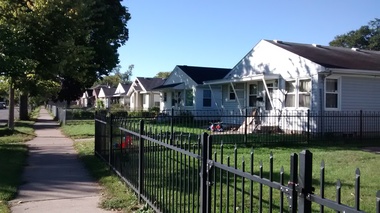 Preliminary research indicates that this modest set of mid-century Tilsenbilt homes on the 4000 block of 5th Avenue South is the first integrated single-family housing development supported by the Federal Housing Administration.
by John Smoley
Achieving One Minneapolis sometimes requires acknowledging
earlier divisions. Two National Park
Service grants totaling nearly $35,000, with matching City funds, will enable
CPED to prepare a history of Native Americans in Minneapolis; identify
properties worthy of further study when assessing Native contributions to our
community; complete the historical survey of the Homewood neighborhood, which
is emblematic of the rise of Minneapolis’ Jewish community; and prepare
designation studies for the Arthur and Edith Lee House, Tilsenbilt Historic
District, and Pilgrim Rest Baptist Church, all of which are pioneering examples
of African-Americans overcoming segregation.
This history involves tough topics, but public response has been
extremely positive thus far, and why wouldn’t it be? Part of achieving One Minneapolis involves
acknowledging the full range of citizens who have persevered in their efforts
to make our city great, and we are a community that’s well up to the task.
Civic Technology to Advance Minneapolis' Goals
 by Kjersti
Monson and Paul Mogush
CPED Long Range Planning (LRP) is implementing Civic
Technology to advance Minneapolis' goal of being innovative, data-driven, and
results oriented. The division has made investments in technology,
relationships, and skills development. Planning’s relationship with IT has
expanded, especially in data science, visualization, and interactivity. Civic
Technology will be key to the comprehensive planning process, and in division
efforts moving forward. The latest:
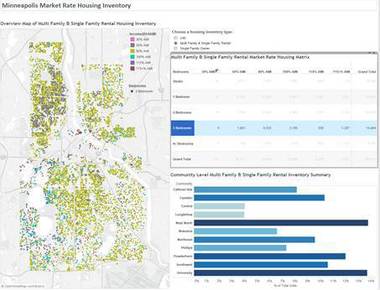
Data Visualization
– LRP is an early adopter of Tableau for data visualization, which IT has just
made available to departments. Tableau can turn complex datasets into
easily-understood interactive visualizations. Our work with IT on a housing
inventory requested by City Council will utilize Tableau to display results
like modelled market rents (see screenshot).
Both policymaking and community engagement benefit from data
visualization.
Virtual and Augmented
Reality –LRP’s partnership with the University of Minnesota to bring
virtual reality into planning and design will be shared in a session at South by Southwest Conference (SXSW) Interactive this coming March in Austin, Texas. Phase 2 of the partnership aims
to bring augmented reality to mobile devices, allowing people to see 3D models
of development alternatives superimposed on the site in their device’s live
camera view.
Business Made Simple
by Joan Hammell
Leonardo Di Vinci believed that simplicity was the ultimate
sophistication. Staff from many City
departments are striving to meet this challenge called Business Made Simple
which Mayor Hodges introduced in her 2014 State of the City address. City Attorney Susan Segal’s work researching
regulations identified several opportunities to eliminate obsolete requirements
for new and growing businesses.
On December 1, 2015, a public hearing is scheduled to
consider amending eight ordinances which, if approved, will result in 13 fewer
license types. The analysis included
identifying license categories which 1) presented little or no consumer
protection issues such as certain vending machines, 2) held licenses from other
jurisdictions or city departments such as hospitals which are licensed by the
State of Minnesota, or 3) could be merged into a broader license type such as drive
in restaurants which will be licensed as a restaurant in the future.
Other departments represented include Regulatory Services,
Health, and Finance. Although future
focus includes realigning the fee schedule using a cost recovery formula and
integrating recommendations into the new Electronic Land Management System,
Business Licenses’ involvement in Business Made Simple is an exercise in
balancing regulation, consumer protection, and business friendly
practices.
Over 300 Register for City's Minority- and Women- Owned Business Opportunities Fair
 by Daniel Bonilla
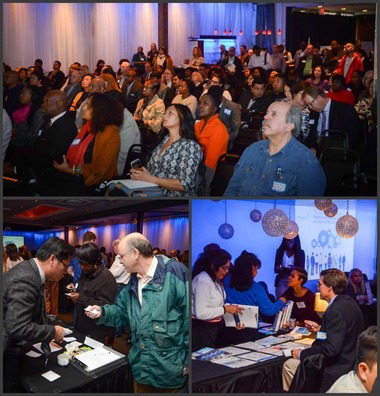
On October 29, the City of Minneapolis, through its Business
Technical Assistance Program (B-TAP) hosted a first-of-its-kind Business
Opportunities Fair designed to increase contractual opportunities between
women- and minority-owned vendors and the City. The fair was just one of the
efforts toward achieving the City’s 25 percent inclusion goal set by the City
Council in 2010.
The Opportunities Fair took place at the Profile Event
Center on University Ave and had over 338 registered participants from
different industries and ethnic backgrounds. The program included a
presentation for purchasing opportunities from seven department leaders
including CPED, Human Resources, IT, Convention Center, Public Works, and Parks
and Recreation. Additionally the program included a 3-module training about how
to do business with the City provided by Procurement, Civil Rights, and CPED.
The event included networking time where businesses were able to talk with City
staff and community partners including B-TAP providers who are able to help
small and medium sized women- and minority- owned businesses become certified
at no cost. The Business Opportunities
Fair presentations are available online and a series of B-TAP+ videos that
explain City processes like Procurement, Business Development, Development
Review, Business Licensing and more will be available online to help business
owners better navigate City processes.
City of Minneapolis and Partners Support Residents' Career Development Through "Inside Industry"
 Inside Industry career development workshop
by Marie Larson
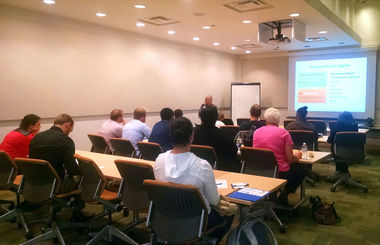
Inside Industry, a
career development and job fair event, took place on October 22nd at the
Minneapolis Central Library. The event featured job fairs for health
care and STEM (Science, Engineering, Technology and Math) careers, industry
speakers and panels, and workshops.
MnSCU students, jobseekers from area Workforce Centers and
the general public networked with thirty exhibiting companies and ten MnSCU
colleges. All exhibitors provided information on entering, transitioning and
advancing in health care and STEM professions.
Two interactive workshops, “Hire Me Again” and “Create Your
Personal Brand,” supplied jobseekers with actionable steps they can take to
build networks and relevant experience in these rapidly-growing industries.
Attendance of the event was diverse; an overwhelming
majority of attendees were women and people of color. Feedback was positive,
with many jobseekers reporting they secured job leads, job offers, and some scheduled
interviews with hiring managers.
Inside Industry
was a collaborative effort among metropolitan area MnSCU college career
advisors and Minneapolis Employment and Training. Funding for the event was provided
by Hennepin County and City of Minneapolis.
The Rose Provides More Affordable Homes for Families
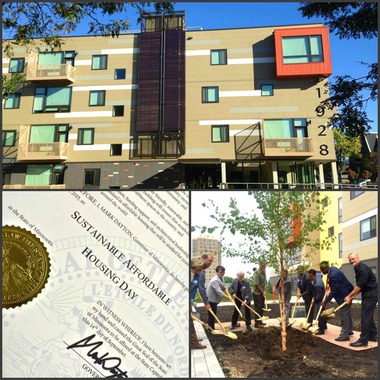 Photo Source: Nneka Njoku.
by Dollie Crowther
Franklin Portland IV- “The Rose” is located at the northwest
corner of Franklin & Portland Avenues. This project is a collaborative
effort between Aeon Homes and Hope Community Inc. The development consists of 90
new units and the integration of the 30 unit Pinecliff Apartments. This project
serves 12 homeless families and is also affordable to families at 50% AMI.
There are 41 market rate units. In total, there are 120 units and an
underground parking lot for residents. This project reaches out to the lowest
income families as well as middle income and families who want to be a part of
the Ventura Village and live near downtown Minneapolis.
The uniqueness of this project is its green design, solar panels,
storm water management, underground water retention basins, and native
vegetation. The total development cost for the project is $35,749,469. The City
of Minneapolis contributed $1,950,000 in federal funds and an allocation of
Housing Tax Credits with a value of $14,499,399. There was also an LCDA Grant.
Other lenders included Minnesota Housing Finance Agency, The Family Housing
Fund, and the Metropolitan Council.
Downtown East Commons Hosts Fourth Public Meeting
 by Brian Schaffer
A
fourth public meeting was held on October 14th for the Downtown East
Commons. The intent of the meeting was to update the community on
refinement of the design from the last presentation in May.
Since
May, a number of other announcements and actions have occurred to advance the
development of the Commons. In August, leaders from the City and business
community announced that they had secured $7 million of the $22 million needed
for the Commons. The 15-member fundraising committee for the Commons is led by
Mayor Hodges and Pat Ryan, President and CEO of Ryan Companies. For more
details, see the press release here.
In
August and September, the Minneapolis City Council authorized a series of
action to advance the fundraising and build-out of the Commons. The City
authorized Green Minneapolis, a nonprofit conservancy, to undertake a
fundraising campaign to support the construction and initial operation of the
Commons. Additionally, the City authorized agreements with Ryan Companies to
construct, at no fee, the initial phase of the enhancements to the Commons.
More details on these and additional City Council actions can be found here.
Technology, Information & Innovation
Many Minds are Better Than One
 by Ed Daley
And so it can be said for technology and information as
well. Many technical tools, combined with data, can produce some meaningful and
useful results. At the recent Technology Advisory Group (TAG) meeting, the team
was presented with some innovative work from CPED Single Family Housing.
Housing staff have been working to leverage multiple technologies to collect
and analyze data in meaningful ways. They are using the business application,
MINS, to collect property information, using COGNOS enterprise data repository
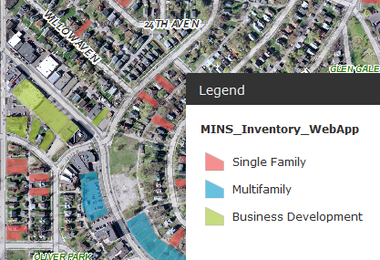
to access the data, and GIS Online (MapIT) to present the information. The
results can be seen in a couple new maps (maps provided by Robert Russell, CPED
Single Family Housing.) The first map shows all of the vacant lots owned by
CPED. The second map graphically depicts the CPED land inventory and will
require login credentials to access: (User= cped_staff, Password = pa$$w0rd).
Outcomes from these maps are driving conversations and new
opportunities to assess and adjust our business processes, to clean our
existing data and to engage and collaborate across multiple CPED business
lines. After all, many minds are better than one!
|