|
 10-17-2025
|
|
Stakeholder Survey
The Children's Division (CD) Standardized Stakeholder Feedback Surveys (HB1414, Family-Centered Services (FCS), and Child Abuse and Neglect (CA/N) Survey) are now LIVE for the third quarter of 2025!
Please complete the survey using the button below!

|
|
Walmart Clothing Vouchers
As of November 1, Walmart has announced the discontinuation of the Walmart Community Care program that is used by CD for Walmart clothing vouchers. In anticipation of this change, CD has partnered with Walmart to establish new Walmart business accounts for the counties that are currently using Walmart as a clothing voucher vendor. While resource providers in those counties should not experience any delays or inconveniences during this transition to the new Walmart accounts, CD will continue to monitor and share information as it becomes available.
As a reminder, resource providers should connect with their local Family Resource Centers to learn more about their clothing programs.
|
|
Missouri Education and Training Voucher
Foster Success is the new chosen vendor to oversee the Missouri Education and Training Voucher (ETV) and the MO Reach Tuition Waier/MO Reach Credential Completion and Employment (CCE) Programs. These programs provide financial assistance for eligible young people towards a postsecondary credential. In addition to disbursing funding, academic and student support for young people with lived experience in foster care who are enrolled in the program is provided.
|
|
October is Safe Sleep Awareness Month
October is Safe Sleep Awareness Month! To prevent sleep related infant deaths, practice your ABC’s!
|
|
|
Infants sleep safest:
-
Alone, without anyone or anything in their sleep space
- On their back for every sleep
- In a crib, bassinet, or portable play area with a firm sleep surface and fitted sheet
For more information please visit: Safe Sleep Missouri
|
|
Statewide Training Calendar
A statewide training calendar that includes all the available trainings in the state for prospective and current resource providers has been created. Please feel free to utilize this calendar to search for your training needs.
|
|
 |
|
|

For children with ongoing health needs, quick access to accurate medical information can be lifesaving. Show Me Healthy Kids (SMHK) offers Medical Alert Tags to eligible members as an important tool to keep children safe.
These tags display critical health details for first responders and medical professionals, helping avoid allergen exposure, misdiagnosis, and delays in treatment.
Customizable for Each Child
Medical Alert Tags are fully customizable. They can list multiple health conditions or allergies on one tag, so all essential information is in one place.
Who Qualifies?
Members with one or more of the following diagnoses may be eligible:
- Allergy/Anaphylaxis
- Asthma
- Autistic Disorder
- Developmental Delay
- Diabetes
- Epilepsy
To receive a Medical Alert Tag, the child must:
- Have seen their Primary Care Provider (PCP) or a Specialty Provider within the last 12 months, and
- Be enrolled and actively engaged in care management, where they receive individualized support, help navigating their condition, and assistance meeting care plan goals.
How to Get a Tag
If you believe a child in your care may qualify, please contact SMHK at 1-877-236-1020, ext. 6075125 (TTY 711) or email HSH_Anchors@homestatehealth.com.
This small tool provides big protection—giving you peace of mind and ensuring children receive timely, appropriate care when it matters most.
|
|
|
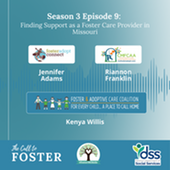
In this episode, Ashton and Shasta welcome a few guests who are making a difference in the lives of foster parents and children across Missouri. Their guests are:
|
|
Together, they explore many of the resources available to the Missouri foster care community, including support and independence programs tailored for older youth, innovative respite field trips, and family finding initiatives. Discover the physical resources available, such as clothing and food, and learn about the comprehensive foster parent training and support groups.
If you or someone you know is interested in becoming a foster parent, learn how to get started on our website. |
|
|
In recognition of Safe Sleep Awareness Month, CD would like to remind you of Missouri Secretary of State's Code of Regulations, 13 CSR 35-60.040
Foster parents must provide a safe and comfortable sleeping space including sleeping supplies, such as a mattress and linens, for each individual child, as appropriate for the child’s needs and age and similar to other household members.
A foster child, including infants, shall never co-sleep or bed-share with foster parents.
Each bed or crib shall be of a size as to ensure comfort of the foster child, shall have a firm mattress or an orthopedic supportive surface, in good, clean condition with waterproof covering, if needed, and suitable covers adequate to the season. All sleeping environments and practices for infants shall be consistent with safe sleep practices as determined by the division.
Please also refer to the Child Welfare Manual, Section 6, Chapter 3. It is required for a CD Worker to provide you with a list of the Safe Sleep Practices recommended by the American Academy of Pediatrics (AAP).
|
|
2025 Annual In-Service Psychotropic Medication Training
This training must be completed by December 31, 2025.
The new Annual In-Service Psychotropic Medication Training has been released on our website. Don't forget to complete this required training! This year's topic is, "Autism Spectrum Disorder and Psychotropic Medications".
|
|
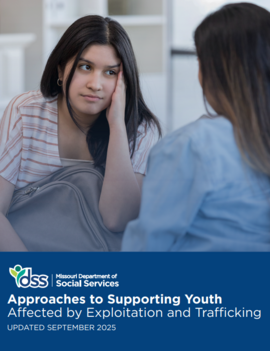
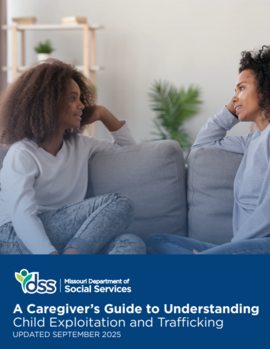
Toolkit for Caregivers Providing Care for Exploited and Trafficked Youth
The Trafficking Prevention Unit has developed a Caregiver Toolkit for resource homes caring for youth who are at risk of being exploited or who have been exploited.
|
|
- Bollinger
- Boone
- Buchanan
- Butler
- Callaway
- Cape Girardeau
- Clay
|
- Cole
- Franklin
- Greene
- Howell
- Jackson
- Jefferson
|
- Livingston
- Marion
- Saline
- Scott
- St. Charles
- St. Louis City/County
|
|
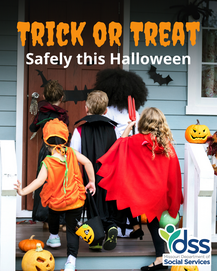
The following safety tips were provided by the American Academy of Pediatrics.
- Always accompany young children on their neighborhood trick or treating.
- If your older child/ren are trick or treating without an adult, plan and review the route that is acceptable and safe. Agree on a specific time when they should return home. Encourage a “buddy system” if the older child/ren are wanting to travel without an adult.
- Always discuss not getting in cars with strangers.
- All trick or treaters should have a flashlight.
- Look both ways when crossing the street – motorists have trouble seeing trick or treaters.
- Stay on well-lit streets and always use the sidewalks. If sidewalks are not available, walk on the far edge of the roadway facing traffic.
- Only go to homes with a porch light on.
- Plan costumes that are bright and reflective and brightly colored treat bags or glow-in-the-dark elements for greater visibility.
- Remove tripping hazards from your entry way to keep your home safe for visiting trick or treaters.
- Restrain pets so they do not jump on or bite trick or treaters.
- Wait until children are home to sort and check treats before eating them.
- Consider using battery-operated flameless candles. If you do use a candle,
a votive candle is safest.
|
|
|
Check out this podcast from the AAP regarding Halloween Safety! Click the image above to listen.
|
|
CD Wants to Hear from You!
If there is information you would like covered in future Foster Parent Connections Newsletters, please email Abigail.J.Smith@dss.mo.gov.
|
|
|
|
|