|
When litter is on the ground, it
eventually winds up in our waters. In
the Lower Grand River Watershed in northeast Missouri, streams flow into the
Grand River, which empties into the Missouri River at Brunswick, Missouri. In
2012 and 2014, Missouri River Relief (Stream Team 1875) held river trash
clean-up events in Brunswick, Missouri, where volunteers from
near the mouth of the watershed helped to pick up trash on the Grand and
Missouri Rivers. On April 11, 2015,
agency and local community partners came together for the first Locust Creek
“No MOre” Trash Blitz in the upstream portions of the Lower Grand watershed in
Linn and Sullivan Counties. The event
was coordinated with the timing of the annual “No MOre” Trash campaign that is
sponsored by the Missouri Departments of Transportation and Conservation each
April.
Over 70 volunteers, including local
youth organizations and several Adopt-A-Highway groups gathered to pick up
trash from local roadways. Volunteers in Linn County picked up trash near
Linneus, Browning, and at the Rocky Ford Access on Locust Creek. Volunteers in
Sullivan County met in Boynton and picked up trash in the drainage area of the
proposed East Locust water supply reservoir.
Youth volunteer groups that participated in the event included the
Brookfield High School Leo Club, Milan C-2 FBLA, and Cub
Scout Pack and Boy Scout Troop #93. Adopt- A- Highway teams that participated
included Brinkley Angus, Milan First Baptist Church, Milan United Methodist
Men, Jerry and Phyllis Staples, Olive Tree Outreach, and Smithfield/Farmland
volunteers.
Planning
for the event was a partnership of the Missouri Departments of Transporation,
Conservation, Natural Resources, the Missouri Stream Team Program, the local
Highway 5 Corridor Coalition, and the North Central Missouri Regional Water
Commission in Milan. Local partners, including the Linneus United Methodist
Church, Smithfield Foods, North Central Missouri Electric Coop, Pepsi, and local Wal-mart stores, helped to provide lunch for
volunteers. By bringing together state agencies, local businesses and local
volunteers, over 5 tons of trash were removed from roadways and kept from
entering Our Missouri Waters.
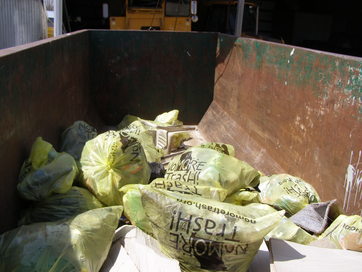 A dumpster is filled with trash picked up at the Locust Creek "No-MOre" trash blitz
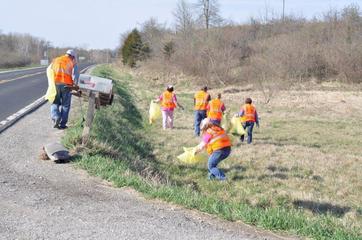 Volunteers from Smithfield Foods pick up litter along Hwy 6 at Milan
The University of Missouri has been awarded a 319 mini-grant for
the time period of February 2015 to January 2017 to install stream corridor
demonstration areas at the university’s Forage Systems Research Center in Linn
County.
The project involves eradication of fescue and establishment of
warm season grasses in areas near four ephemeral drainages on the farm that
drain toward Muddy Creek. On each side
of each ephemeral stream, 45 feet of shrubs and trees are going to be
established. The corridor of shrubs,
trees, and warm season grasses will provide erosion control,
improve the water quality of runoff, provide shade for cattle, and establish
wildlife cover and nesting and brood areas for wildlife species. A
fence will be constructed to exclude cattle from the shrubs and trees, and
cattle will be allowed to flash graze the warm season grass areas.
The project is off to a great start. The warm season
grass establishment areas were grazed by cattle this past winter in preparation
for spraying, and the areas were sprayed this past spring two times to kill the
fescue sod. All of the fence needed to exclude cattle from the demonstration
areas has been constructed. Fence types
include a combination of hot wire and barbed wire fencing. Fences were designed and constructed in such
a manner as to allow cattle into the warm season grass areas for flash
grazing. Trees and shrubs were ordered
from the state nursery and they were transplanted into the stream corridor
areas. Warm season grasses and forbes were ordered and arrived at the research farm.
The warm season grass and forbes mixtures will be sown in June. This project
will be featured in the next three newsletters for the Lower Grand River
Watershed. If you are in the Linn County area, stop by the research farm to see
the progress on this project. The annual field day at the research farm is
September 29, 2015.
319 grants are
federal dollars that are administered as part of the Clean Water Act for
projects that reduce non-point source pollution. 319 grants require a minimum
of a 40/60 match of non-federal dollars. Non-federal match for this project is
being provided by the University of
Missouri Forage Systems Research Center and the Missouri Department of
Conservation.
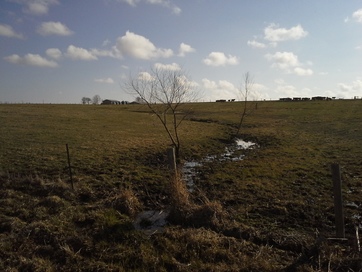 Photo of the project area before native corridor establishment and livestock exclusion
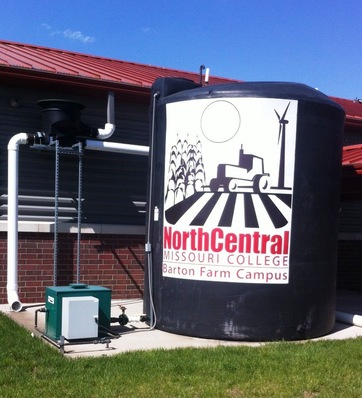 A 5000-gallon rainwater retention tank barrel harvests water discharged from the roof which is utilized in the greenhouse and for maintaining landscape plants.
David Nowland, Agriculture Instructor, North Central Missouri
College
The North Central Missouri College Agriculture and Natural
Resources department offers Associate of Applied Science and Associate of Arts
transfer degrees for students pursuing careers related to agribusiness or the
management of agricultural and natural resources. Instruction is provided at the main NCMC
campus in downtown Trenton, the Elizabeth and Arthur Barton Farm Campus south
of town, and various internship experience sites.
Agriculture producers in the Midwest are working to meet growing
domestic and international demands for agriculture products, but at the same
time they are implementing conservation practices that reduce soil erosion,
control nutrient runoff and provide wildlife habitat. Many of these conservation practices are
demonstrated at the Barton Farm Campus.
The Grundy County Soil and Water Conservation District, Natural
Resources Conservation Service and Missouri Department of Conservation assisted
in the design and construction of these projects, and following are some of the
conservation practices we are utilizing at the Barton Farm Campus.
Terraces are earthen structures installed on moderate to steep
slopes to reduce soil erosion and retain water runoff. NCMC has installed three types of terraces.
Broad-based terraces are tilled and have row crops planted over them. Narrow-based
and steep-backed terraces are covered with warm season grasses, which serve as
habitat for upland birds. Grassed
waterways and sediment retention control structures are also utilized to reduce
soil erosion.
A two-acre water containment structure is utilized for educational
and recreational purposes, and it is managed in coordination with the Missouri
Department of Conservation Community Assistance Program. The lake area features a handicap-accessible
floating dock and restroom facilities with a shelter house in the planning
stages. The lake is used for fishing and
other educational activities by approved groups consistent with the Wildlife
Code of Missouri.
Livestock at the Barton Farm Campus are housed in the Kuttler
Animal Science Complex. Manure from the
animals is composted in a roofed stacking structure and is then applied to crop
demonstration plots. It serves as fertilizer and improves soil health. Cover crops such as turnips, crimson clover
and tillage radishes are also utilized in the crop plots to reduce erosion,
reduce nutrient runoff and improve soil health.
Several types of conservation buffers have been installed. Native shrubs on one side of the lake serve
as a riparian buffer, providing wildlife habitat and protecting water quality
by filtering nutrients from water discharged from nearby crop fields. A habitat buffer was planted last fall at the
edge of our crop demonstration plots with a mixture of warm season grasses and
native forbs to provide habitat for bobwhite quail and other upland birds. Also, bioswales have been installed on the
perimeter of the parking lot. They are
seeded to native grasses and retain the runoff from the parking lot to filter
pollutants from the discharge. They
drain into a constructed wetland prior to discharge into a small pond.
Additional conservation projects were included in the Lager Energy
and Plant Science Laboratory. A
5000-gallon rainwater retention tank barrel harvests water discharged from the
roof which is utilized in the greenhouse and for maintaining landscape
plants. In addition, solar panels and a
wind turbine produce supplemental electricity.
The Elizabeth and Arthur Barton Farm Campus was established in 2011
to serve as an applied learning environment for agriculture production practices
and the conservation of agricultural and natural resources. NCMC recognizes the
importance of protecting Missouri’s natural habitat for future generations and
incorporates these concerns across its curriculum.
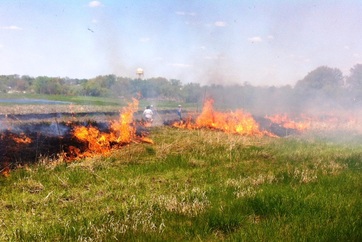 A narrow base terrace is burned to manage warm season grasses
David Heimann, U.S. Geological Survey Lee’s Summit,
Missouri; Tom Woodward, Missouri
Department of Natural Resources, Pershing State Park; Greg Pitchford, Missouri
Department of Conservation, Chillicothe, Missouri
The Missouri Department of Natural
Resources (MDNR) and Missouri Department of Conservation (MDC) are tasked with
protecting and managing the natural resources of Missouri and wish to
effectively manage large woody debris (LWD) in channelized streams in a manner
that will maintain the ecological integrity of the streamside forests and
aquatic systems without affecting the flood risks on private lands. A study is being
conducted by the U.S. Geological Survey in cooperation with MDNR and MDC to
characterize LWD and assess the effectiveness of LWD management in lower Locust
Creek.
Locust Creek, located in the Lower Grand
River Watershed, has been channelized for over half its length and lacks a
suitable riparian corridor in many sections. The combination of channel
alterations and inadequate forested corridors result in deeply incised and
rapidly eroding stream banks. These channel alterations also have resulted in
the transport of large amounts of LWD and suspended sediment resulting in
reduced water quality, and changes in the channel geometry and hydrology of the
system. Problems arise in the Locust Creek system, and
other channelized basins in northern Missouri, as a result of an increased rate
of input of LWD and sediment relative to historical (pre-channelization) rates
during channel adjustment and, at the same time, there is a substantial
decrease in the conveyance of the downstream, un-channelized stream channel as
a result of substantial channel aggradation. Numerous and extensive LWD jams
have formed in the remnant channel and sediment deposits in excess of 10 feet
have accumulated in the downstream sections of the channelized reach and
upstream sections of the un-channelized reach within Pershing State Park. The lower section of Locust
Creek (approximately 19 miles) within, or adjacent to, Pershing State Park and Fountain
Grove Conservation Area is one of the last and most extensive remaining active
meandering rivers in Northern Missouri. For the past 15 years, management of LWD
accumulations in Lower Locust Creek has involved redistributing the LWD to the
inside point bar to mimic the natural stream process of channel cutting around
the blockage. There is concern from the U.S. Army Corps of Engineers (USACE) as
to the effectiveness of the redistribution technique. Additional information is
requested by the USACE in order to test the effectiveness of the methodology
and to continue the current practice of LWD redistribution.
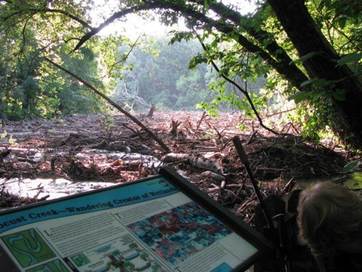 A large woody debris accumulation on Locust Creek at Pershing State Park
By
Donald H. Wilkison and Heather M. Krempa, U.S. Geological Survey, Lee’s Summit,
MO
The effectiveness of conservation
programs to adequately reduce agricultural nutrient contributions to Gulf of
Mexico hypoxia remains a concern. Quantifying conservation program success can
be difficult given that short-term changes in nutrient concentration in streams
may be masked by long-term shifts. The U.S. Geological Survey (USGS), in
cooperation with the Missouri Department of Natural Resources evaluated
nutrient export from the Lower Grand River in the 44 months that followed a
period of increased, integrated conservation implementation. These short-term
responses were then compared to export that occurred in the main stem and
adjacent rivers in northern Missouri over a 22-year period. Results recently published in River
Research and Applications indicate that
short-term (October 2010 through May 2014) total nitrogen (TN) concentrations
in the Grand River were 20 percent less than the long-term average and total
phosphorus (TP) concentrations were 23 percent less. Nutrient reductions in the
short term were primarily the result of the less-than-average precipitation
and, consequently, streamflow that was 36 percent below normal. Therefore,
nutrient concentrations measured in tributary streams were likely less than
normal during the initial conservation implementation period. Northern Missouri stream TN concentrations
(adjusted for flow) remained relatively flat or declined over the period 1991
through 2013 because available sources
of nitrogen, determined as the sum of commercial fertilizers, available animal
manures, and atmospheric inputs, were typically less than crop requirements for
much of that time frame. Conversely, TP concentrations increased over the past
22 years in northern Missouri streams, likely in response to many years of
phosphorus inputs in excess of crop requirements. Stream nutrient changes were
most pronounced during periods that coincided with the major tillage, planting,
and growth phases of row crops and increased streamflow. Nutrient reduction
strategies targeted at the period February through June would likely have the
greatest impact on reducing nutrient export from the basin.
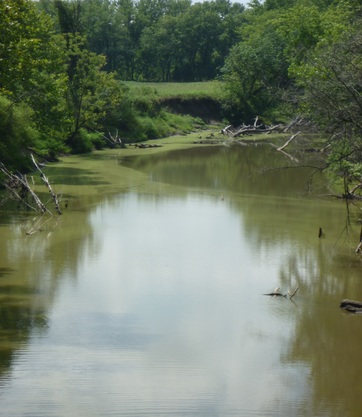 Locust Creek near Reger, MO in Sullivan County. The photo was taken in August of 2011.
Missouri is now a member of the Midwest Cover Crops
Council. Their website, http://www.mccc.msu.edu/ has a wealth of information, including information about cover crop
species, a cover crop decision tool, innovator profiles of farmers that have
used cover crops on their farms, extension materials and publications, links to
videos, and a calendar of events.
The Cover Crop
Decision Tools on the website are an initiative of the Midwest Cover Crop
Council to consolidate cover crop information by state to help farmers make
cover crop selections at the county level.
Information for each state/province is developed by a team of cover crop
experts including university researchers, Extension educators, NRCS personnel,
agriculture department personnel, crop advisors, seed suppliers and farmers, to
help you select cover crops for your situation. For your location, information
is given for considerations for using that cover crop, including planting,
termination, performance and roles, cultural traits, potential advantages and
disadvantages, and information resources about the cover crop. Check out their
website, you will find a wealth of cover crop information.
Kelly Nelson, Research Agronomist and
Professor, University of Missouri Greenley Research Center at Novelty, and Dana
Harder, Superintendent, University of Missouri Greenley Research Center at
Novelty
There are a lot of benefits of cover crops,
but successful establishment is important to realize their full potential. Intercropping systems usually involve
overlapping the growth period of two crops.
Intercropping radish with soybean could allow earlier radish cover crop
establishment while having minimal effects on soybean yield. Radish cover crops have been promoted
throughout the Midwest, but have been unsuccessful following soybean in northern
Missouri. This is due to a short growing
period following harvest, and freezing conditions usually occur around the
first week of December in northern Missouri and terminate the radish cover
crop. From 2012 to 2014 we evaluated the
effect of radish overseeding planting date in the presence and absence of N
fertilizer on soybean yield, radish biomass, and corn yield the following
year. Overseeding radish in the presence
or absence of 30 lbs N/acre had no effect on soybean yield. Precipitation following overseeding of
radishes in early September along with an open soybean canopy in 2012 provided
good conditions for successful radish establishment (Figure 1).
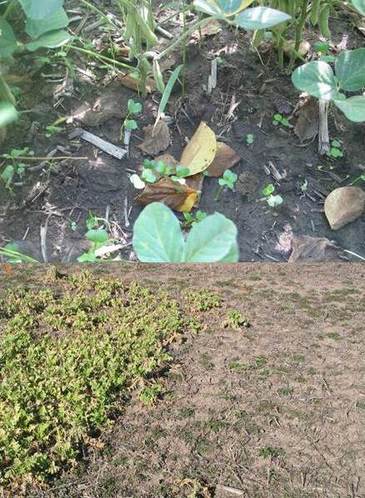 Figure 1. Radish seedlings on September 5, 2012 six days after overseeding (top) and the same plots on December 4, 2012 (bottom left) compared to a later seeding date (bottom right).
Dry conditions following overseeding of radish
in 2013 and 2014 along with a dense soybean canopy in 2014 resulted in poor
establishment of an overseeded radish cover crop (Figure 2).
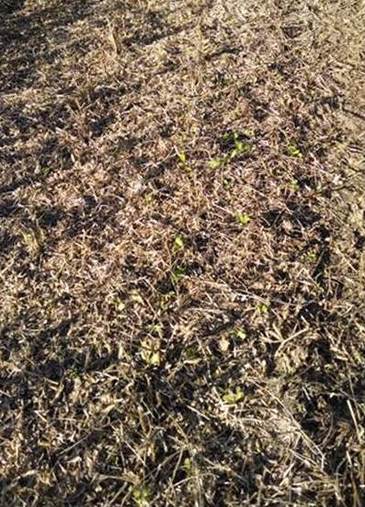 Figure 2. Radish seedlings in soybean residue following harvest on October 22, 2014.
Based on this and other research at the
Greenley Research Center, radish should be seeded before September 1 in
northern Missouri. We have observed that
an early establishment of radish suppressed winter annual weeds 40 to 90% the
following spring (Figure 3).
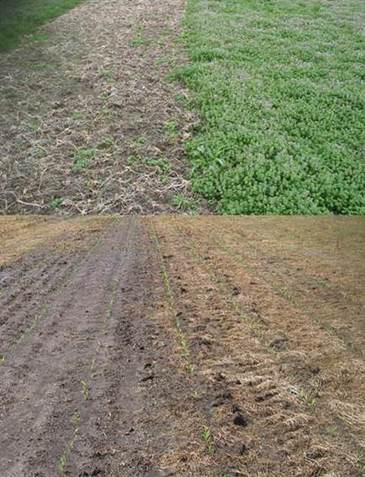 Figure 3. Henbit suppression on March 12, 2012 with radish drill seeded on September 1, 2011 (top left) and September 26, 2011 (top right). No-till corn was planted in the same areas on May 1, 2012.
Farmers should take note of their residual
herbicide program and any effects it may have on the establishment of a cover
crop. Radish is sensitive to several
residual herbicides used for weed control in soybean. Corn yield following radish overseeded into
soybean was not affected in 2013 or 2014.
Radish growth was maximized when overseeded prior to September 1 when
there was an open soybean canopy and rainfall followed the overseeding
event. If you are planning a cover crop
blend, radish could be included if it was seeded prior to September 1 in
northern Missouri. More details on this and other cover crop research at the
Greenley Research Center is available at:
http://greenley.cafnr.org/cover-crops-abstracts/.
Fifth grade students in Grundy and Mercer County
participated in the annual Water Festivals held in their county this past
spring. University of Missouri Extension and teaching partners Department of
Natural Resources, Department of Conservation, and the Soil and Water
Conservation Districts hold the festival each year to teach soil and water
stewardship along with identified grade level expectations (GLEs) set by the
state for fifth grade. Mercer County festival was hosted by the Baptist Church
in Princeton, and the Grundy County festival was hosted by North Central
Missouri College on the Barton campus.
Students are split into groups and then rotate
through eight or nine sessions which focus on various concepts of water
quality, soil conservation, animal ecosystems, pollution, and using scientific
methods. Teachers are enthusiastic about the day. It provides hands on
interactive learning to engage student learning. And it comes just before the
Missouri Assessment Program exams giving the students a great review before the
test. MU Extension also sponsors festivals for Caldwell, Clinton, DeKalb,
Gentry, Harrison, and Worth Counties.
Amy Meier, Stream Team Coordination Biologist,
Missouri Department of Conservation
On Saturday, April 18th, fifteen
volunteers from around the region attended the Stream Team Volunteer Water
Quality Monitoring (VWQM) Introductory workshop in Kirksville, held at Truman
State University. Volunteers ranged from Truman State Biology students to
teachers and landowners interested in learning about water quality. During the
classroom portion, workshop participants learned how to choose a monitoring
site based on the habitat types present, how to map a watershed, and how to
access streams safely and with landowner permission. During the field portion
at Big Creek Conservation area, volunteers collected and identified benthic
macroinvertebrates as part of their biological assessment. They also used a
tape measure, a plastic whiffle ball, and a stopwatch to measure the stream’s
cross-sectional area and velocity to calculate discharge in cubic feet per
second. Not only was it a beautiful day in between light, warm rain showers,
but volunteers were excited to find an extremely large male crayfish and nearby a
female carrying eggs.
Anyone interested in learning how to monitor a
stream is invited to join the Missouri Stream Team Program. Stream Team volunteers can participate in
numerous types of activities including litter pickups, tree-planting, storm
drain stenciling, habitat improvement, and advocacy, to name a few. Volunteer
Water Quality Monitoring is the only activity that requires training, and
offers tiered levels of training with each level building upon the previous.
Introductory classes are held in the spring, and volunteers can advance to
Level 1 in the fall. The Level 1 workshop focuses more on water chemistry and
physical attributes of the adopted stream site. Volunteers can continue to
advance to higher Quality Control/Quality Assurance designations, which assigns
a high level of confidence to the data for its users. More information about
the Stream Team Program and VWQM can be found at www.mostreamteam.org.
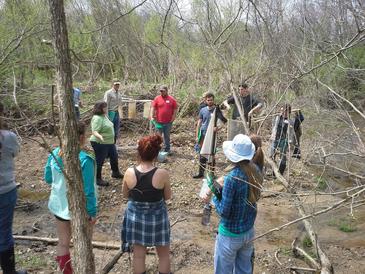 Volunteers learn about stream macroinvertebrate sampling at a Stream Team workshop in Kirksville
A new resource booklet is now available for
educators in Northeast Missouri. The booklet, entitled Land and Water Education Resources for Northeast Missouri, provides
a list of the curriculum, activity guides, field science and discovery
programs, items available for loan, soil health resources, and displays
available for guest presentations (pending staff scheduling and availability)
in Northeast Missouri. The booklet is available on-line at http://dnr.mo.gov/education/resources.htm.
The
booklet is a living document, so if you know of additional resources that
should be added to the booklet, please contact Mary Culler at Mary.Culler@dnr.mo.gov. Please share this resource with educators in
your area.
Promoting,
Protecting and Enjoying our Natural Resources. Learn more at dnr.mo.gov.
|